

Call Center Monitoring: A Complete Guide for 2026
Call center monitoring has evolved from simple call recording to a sophisticated discipline that combines technology, analytics, and human expertise to drive exceptional customer experiences. Organizations that implement comprehensive monitoring programs consistently outperform competitors in customer satisfaction, agent retention, and operational efficiency. As customer expectations continue rising in 2026, businesses must understand the full spectrum of monitoring capabilities available and how to leverage them strategically.
What Call Center Monitoring Encompasses
Call center monitoring involves systematically evaluating interactions between agents and customers to ensure quality standards, identify improvement opportunities, and maintain regulatory compliance. This practice extends far beyond listening to recorded calls.
Modern monitoring programs incorporate multiple channels and data sources. Live call monitoring allows supervisors to observe interactions in real-time, providing immediate intervention when necessary. Call recording creates a permanent archive for training, dispute resolution, and compliance verification. Screen recording captures the full agent desktop experience, revealing workflow inefficiencies and system usability issues.
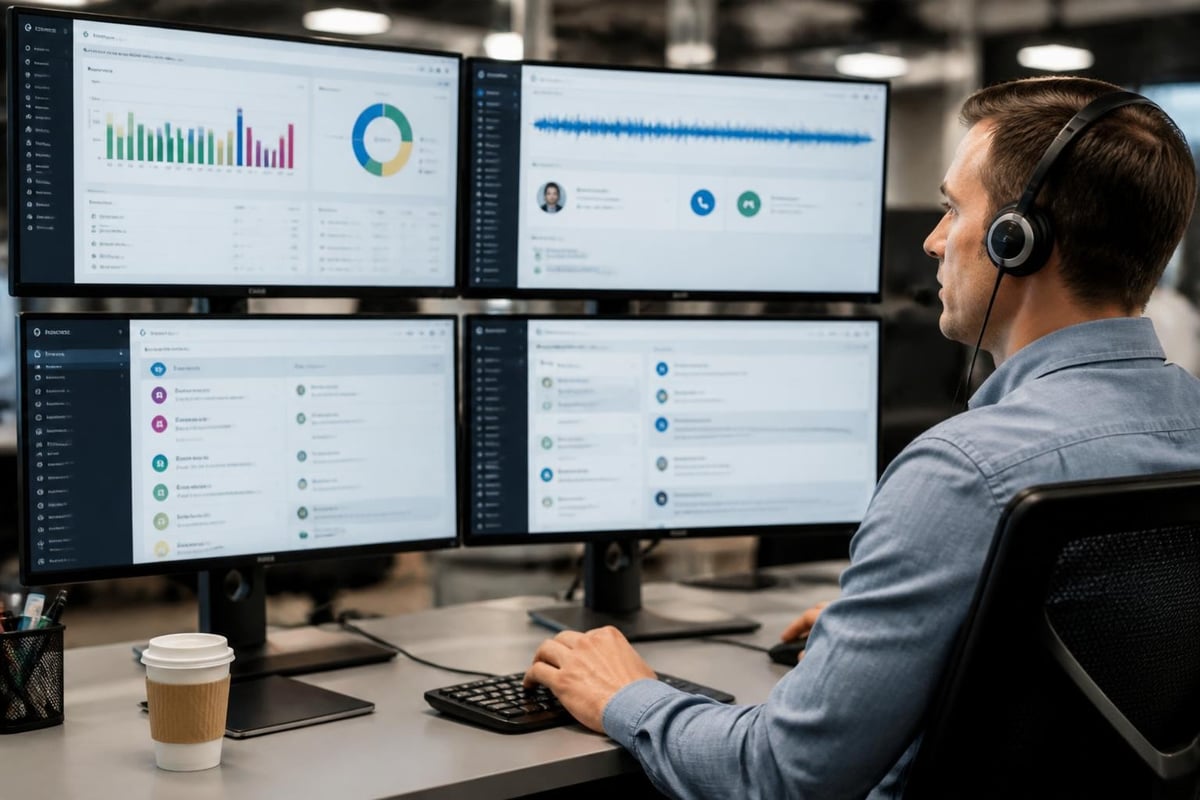
Quality assurance teams evaluate interactions across these channels using standardized scorecards. These evaluations measure adherence to scripts, problem resolution effectiveness, empathy demonstration, and compliance with regulatory requirements. The insights gathered inform coaching sessions, training curriculum development, and process improvements.
Core Components of Effective Monitoring
A comprehensive monitoring framework includes several interconnected elements:
- Scorecard design that aligns with business objectives and customer expectations
- Calibration sessions ensuring evaluators apply consistent standards
- Representative sampling that captures performance across different scenarios
- Feedback mechanisms delivering actionable insights to agents
- Analytics platforms identifying trends and systemic issues
Organizations leveraging AI-enabled workforce optimization can automate significant portions of the evaluation process, enabling quality teams to focus on complex interactions requiring human judgment.
Technologies Transforming Call Center Monitoring
The monitoring landscape has experienced dramatic technological advancement over the past five years. Solutions now available to contact centers of all sizes were previously accessible only to enterprise organizations with substantial technology budgets.
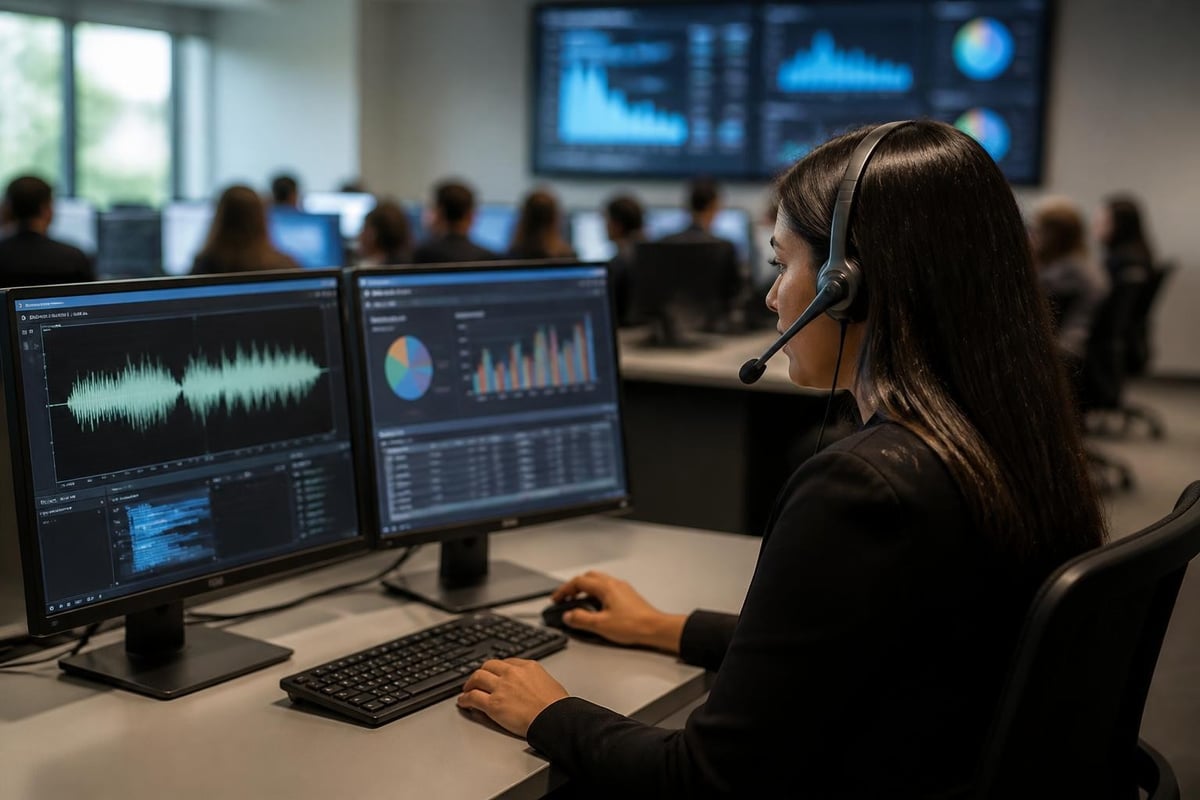
Speech analytics platforms automatically transcribe and analyze 100% of customer interactions, identifying compliance risks, sentiment patterns, and emerging issues. These systems flag specific phrases, detect emotion in voice tone, and measure talk-time ratios. Conversation intelligence solutions have become essential tools for organizations seeking to scale quality assurance without proportionally increasing staffing.
Automated quality management systems evaluate interactions against predefined criteria, generating preliminary scores that human evaluators can review and adjust. This hybrid approach combines the consistency of automated evaluation with the nuanced judgment humans provide.
| Technology | Primary Function | Key Benefit |
|---|---|---|
| Speech Analytics | Transcribe and analyze all calls | 100% coverage vs. sampling |
| Desktop Analytics | Track agent workflows and system usage | Identify efficiency barriers |
| Sentiment Analysis | Detect customer emotion and satisfaction | Early warning for escalations |
| Predictive Analytics | Forecast outcomes based on interaction patterns | Proactive intervention opportunities |
Real-time guidance tools monitor conversations as they occur, providing agents with suggestions, relevant knowledge base articles, and compliance reminders. These systems reduce errors, accelerate training curves, and improve first-call resolution rates.
Establishing Meaningful Monitoring Metrics
The metrics organizations choose to monitor fundamentally shape agent behavior and business outcomes. Poorly designed measurement systems drive counterproductive actions, while thoughtfully constructed frameworks align individual performance with organizational objectives.
Traditional metrics like average handle time and call volume remain relevant but tell an incomplete story. Choosing the right customer service metrics requires understanding the relationship between operational efficiency and customer satisfaction.
Balanced Scorecard Approach
Leading organizations implement balanced scorecards incorporating multiple performance dimensions:
- Quality scores reflecting adherence to standards and customer satisfaction
- Efficiency metrics measuring productivity without sacrificing quality
- Customer effort scores evaluating how easy the company makes problem resolution
- First-contact resolution tracking issues solved without transfers or callbacks
- Compliance adherence ensuring regulatory requirements are consistently met
This multidimensional approach prevents the gaming behaviors that emerge when organizations overemphasize single metrics. An agent who rushes customers off the phone to improve average handle time may generate callbacks that create more work for colleagues and frustrate customers.
Quality calibration sessions ensure evaluators interpret scorecard criteria consistently. During these sessions, teams independently evaluate the same interactions, compare scores, discuss discrepancies, and align on standards. Regular calibration prevents score drift and maintains measurement integrity across evaluators and locations.
Implementing Effective Monitoring Programs
Successful call center monitoring requires more than purchasing technology and creating evaluation forms. Programs that generate meaningful improvement follow systematic implementation approaches.
Start with clear objectives tied to business outcomes. Organizations might aim to reduce customer complaints by 25%, improve first-call resolution to 85%, or decrease compliance incidents to zero. These objectives guide scorecard design, sampling strategies, and coaching priorities.
Engage agents in scorecard development to build buy-in and ensure criteria reflect frontline realities. Agents often identify quality dimensions supervisors overlook and can suggest practical evaluation criteria that genuinely improve customer experiences.
Sampling Strategies That Deliver Insight
Random sampling ensures unbiased performance assessment but may miss critical interactions. Targeted sampling focuses on specific scenarios, new agents, or high-risk transactions. Most organizations employ hybrid approaches:
- Random selection providing baseline performance assessment (2-5 calls per agent monthly)
- Triggered monitoring flagging interactions with specific keywords or sentiment indicators
- New hire intensive evaluating additional calls during the initial 90 days
- Top performer analysis identifying best practices for replication
- Customer complaint review examining all interactions generating formal complaints
Organizations partnering with BPO service providers should ensure monitoring programs extend across all delivery locations, maintaining consistent standards whether agents work domestically or internationally.
Converting Monitoring Insights Into Performance Improvement
Data collection without action wastes resources and demoralizes teams. The monitoring program's value emerges from how organizations apply insights to drive improvement.
Timely, specific feedback proves most effective for behavior change. Agents should receive evaluation results within 72 hours of the interaction, while details remain fresh. Generic feedback like "improve empathy" lacks actionable direction, while specific observations like "acknowledge customer frustration before offering solutions" give agents concrete behaviors to practice.
Coaching conversations should follow a structured format:
- Review the interaction together, allowing agents to self-assess first
- Highlight specific strengths demonstrated during the call
- Identify one or two improvement opportunities with clear examples
- Collaborate on action plans with measurable objectives
- Schedule follow-up to review progress
Recognition programs celebrating quality achievements motivate continued excellence. Public acknowledgment of top performers, quality-based incentives, and career advancement opportunities tied to monitoring scores reinforce desired behaviors.
Addressing Systemic Issues
Individual coaching addresses agent-specific performance gaps, but monitoring data often reveals systemic problems requiring organizational responses. Repeated failures in specific areas might indicate:
- Inadequate training on particular products or procedures
- Confusing or outdated scripts requiring revision
- System limitations forcing inefficient workarounds
- Policy gaps leaving agents without clear guidance
- Staffing shortages creating excessive pressure
Quality teams should aggregate monitoring findings quarterly, identifying patterns that individual call reviews might obscure. These insights inform training curriculum updates, process redesigns, and technology investments.
Specialized Monitoring Considerations
Different contact center environments require tailored monitoring approaches. Inbound and outbound operations face distinct challenges that monitoring programs must address.
Inbound customer service monitoring emphasizes empathy, problem-solving ability, and first-contact resolution. Evaluators assess whether agents thoroughly understand issues, provide accurate information, and leave customers feeling valued regardless of outcome.
Outbound sales monitoring focuses on disclosure compliance, objection handling, and relationship building. Quality teams verify agents clearly explain product terms, respect do-not-call preferences, and maintain professionalism when prospects decline offers.
| Monitoring Focus | Inbound Service | Outbound Sales |
|---|---|---|
| Primary Objective | Customer satisfaction and resolution | Conversion while maintaining compliance |
| Critical Skills | Empathy, troubleshooting, de-escalation | Persuasion, resilience, disclosure accuracy |
| Compliance Emphasis | Data privacy, accurate information | TCPA, truth in advertising, opt-out respect |
| Success Indicators | CSAT scores, FCR rates, handle time | Conversion rates, compliance scores, objection handling |
Industry-specific monitoring addresses unique regulatory and customer expectations. Travel call center operations must verify agents provide accurate booking information and handle cancellation requests according to carrier policies. Healthcare contact centers require HIPAA compliance verification in every evaluation.
Building a Culture of Quality
Call center monitoring programs succeed or fail based on organizational culture. Monitoring perceived as punitive surveillance generates resistance, while programs viewed as developmental support drive engagement and improvement.
Transparency about monitoring practices builds trust. Agents should understand how many calls will be evaluated, who conducts evaluations, how scores impact performance reviews, and what appeals processes exist for disputed evaluations.
Two-way feedback mechanisms allow agents to share concerns about monitoring fairness, scorecard relevance, and evaluation quality. Anonymous surveys, agent advisory committees, and open-door policies with quality leadership create channels for continuous program improvement.

Professional development pathways connecting monitoring performance to career advancement demonstrate organizational commitment to agent growth. Top performers identified through monitoring might advance to team lead roles, specialized departments, or quality evaluator positions.
Organizations operating multiple BPO centers across different countries must navigate cultural differences in feedback reception and recognition preferences. Coaching approaches effective in North American locations may require adaptation for teams in the Philippines or South Africa.
Remote Work Monitoring Adaptations
The shift toward distributed workforces has transformed call center monitoring in fundamental ways. Organizations must balance quality oversight with respect for agent privacy when monitoring home-based workers.
Technology-enabled monitoring becomes even more critical without physical supervisor presence. Screen recording, speech analytics, and automated quality management provide visibility into remote agent performance while reducing the need for intrusive surveillance.
Scheduled monitoring windows during which agents know evaluations occur can address privacy concerns while maintaining quality standards. Clear policies about what systems monitor, how data is used, and storage duration demonstrate respect for remote workers.
Virtual coaching sessions require different facilitation approaches than in-person meetings. Supervisors should use video calls when possible, share screens to review interactions together, and provide written summaries agents can reference later.
Compliance and Legal Considerations
Call center monitoring intersects with numerous regulatory frameworks that vary by jurisdiction and industry. Organizations must navigate these requirements carefully to avoid penalties and maintain customer trust.
Recording disclosure requirements mandate informing customers when conversations are monitored or recorded. Most jurisdictions require all-party consent or single-party consent with notification. Scripts should include clear disclosure statements at interaction outset.
Data retention policies must balance business needs with privacy regulations and storage costs. Organizations should define retention periods for different interaction types, implement secure deletion processes, and document retention rationale for regulatory inquiries.
Access controls limit who can review recorded interactions and monitoring data. Role-based permissions ensure only authorized personnel access sensitive information, while audit trails track all data access for security and compliance verification.
Agent rights vary by location and should be clearly communicated. Some jurisdictions grant employees the right to access their monitoring data, dispute evaluations, or limit certain types of surveillance. Organizations with global operations must accommodate varying legal frameworks across their footprint.
Future Directions in Call Center Monitoring
Monitoring technologies and methodologies continue evolving rapidly. Organizations should monitor emerging trends to maintain competitive advantages and prepare for future requirements.
Predictive analytics will increasingly forecast customer satisfaction, agent attrition risk, and compliance violations before they occur. Machine learning models trained on historical monitoring data can identify patterns invisible to human evaluators, enabling proactive intervention.
Omnichannel integration will unify monitoring across voice, chat, email, social media, and emerging channels. Customers expect consistent experiences regardless of contact method, requiring quality standards that span all interaction types.
Automated coaching systems will deliver personalized learning recommendations based on individual performance patterns. These platforms might automatically assign microlearning modules addressing specific skill gaps identified through monitoring evaluations.
Emotion AI will provide deeper insight into customer and agent emotional states throughout interactions. These capabilities enable more nuanced quality assessment and earlier identification of escalation risks.
Call center monitoring represents a strategic investment in service quality, operational efficiency, and customer satisfaction. Organizations that implement comprehensive programs with the right technology, meaningful metrics, and supportive cultures consistently outperform competitors. Whether you operate an in-house contact center or partner with external providers, monitoring excellence requires ongoing commitment and continuous refinement. Focus Services combines advanced monitoring technologies with quality-focused culture across global operations, helping businesses deliver exceptional customer experiences while optimizing costs and maintaining rigorous quality standards.