

Customer Service Outsourcing Pricing Guide 2026
Understanding customer service outsourcing pricing requires navigating multiple pricing models, geographic considerations, and service level requirements. As businesses evaluate external partners for customer support operations, pricing structures have become increasingly sophisticated, incorporating AI capabilities, performance guarantees, and flexible scaling options. In 2026, decision-makers face a complex landscape where traditional per-hour models coexist with outcome-based arrangements and hybrid frameworks that align vendor compensation with business results.
Core Pricing Models in Customer Service Outsourcing
Customer service outsourcing pricing typically follows one of several established frameworks, each designed to match different business needs and risk tolerance levels. The most common model remains the per-agent-hour structure, where clients pay for dedicated agent time regardless of call volume fluctuations. This predictable approach works well for businesses with steady support demand and clear staffing requirements.
Transaction-based pricing has gained momentum as companies seek to align costs with actual usage. Under this model, businesses pay per interaction-whether that's per phone call, email response, chat session, or ticket resolution. The Everest Group’s market research provides benchmarks showing transaction-based rates ranging from $2.50 to $8.00 per contact depending on complexity and channel.
Blended Rate Structures
Many providers now offer blended models that combine base fees with volume-based components. These hybrid arrangements typically include:
- Monthly platform or infrastructure fees
- Per-agent minimum commitments
- Variable transaction costs above baseline volumes
- Performance bonus or penalty adjustments
Full-time equivalent (FTE) pricing remains popular for dedicated team deployments. Clients secure specific agent headcount at fixed monthly rates, gaining predictability while maintaining control over team composition and scheduling. Customer service outsourcing pricing under FTE models typically ranges from $1,800 to $4,500 per agent monthly, depending on location and service complexity.

Geographic Cost Differentials and Market Rates
Location significantly impacts customer service outsourcing pricing, with offshore, nearshore, and onshore options presenting distinct cost profiles. Understanding these geographic tiers helps businesses balance budget constraints against service quality expectations and cultural alignment needs.
Regional Rate Benchmarks
| Location Category | Hourly Rate Range | Monthly FTE Cost | Primary Advantages |
|---|---|---|---|
| United States | $22-$38 | $3,500-$6,000 | Native speakers, time zone alignment |
| Philippines | $8-$14 | $1,800-$2,800 | English proficiency, scalability |
| El Salvador | $10-$16 | $2,100-$3,200 | Nearshore, cultural fit, time zones |
| South Africa | $9-$15 | $1,900-$3,000 | Accent neutrality, multilingual |
The BPO contact center services landscape shows providers operating across multiple geographies to offer pricing flexibility. Businesses increasingly adopt multi-shore strategies, deploying basic inquiries to lower-cost locations while routing complex issues to premium sites with specialized expertise.
Time zone coverage also influences pricing. Round-the-clock support requires shift premiums, weekend staffing, and holiday coverage that can increase baseline rates by 15-30%. Customer service outsourcing pricing for 24/7 operations must account for these scheduling complexities beyond simple hourly calculations.
Language requirements add another dimension. Monolingual English support represents the baseline rate, while bilingual capabilities (Spanish, French, Mandarin) typically command 10-20% premiums. Specialized technical or industry-specific language expertise can drive rates even higher.
Service Complexity and Skill-Based Pricing Tiers
Not all customer interactions carry equal value or complexity. Modern customer service outsourcing pricing increasingly reflects the skill levels and expertise required for different support functions.
Tiered Service Levels
Basic tier support handles straightforward inquiries: password resets, order status checks, simple product questions. These interactions require minimal training and typically price at the lower end of market ranges. Providers can staff these functions with newer agents, maintaining efficiency while controlling costs.
Technical support occupies the mid-tier, requiring product knowledge, troubleshooting skills, and problem-solving capabilities. These specialized agents command 25-40% premiums over basic support rates. The investment reflects longer training periods, certification requirements, and lower agent-to-supervisor ratios.
Premium support tiers address complex customer issues, escalations, and high-value client management. These interactions may involve:
- Account management and relationship building
- Technical escalations requiring advanced expertise
- Sales support and upselling responsibilities
- Executive customer engagement
According to Deloitte’s global outsourcing research, companies increasingly segment service delivery across skill tiers to optimize spending. Rather than applying premium rates uniformly, they route interactions appropriately, ensuring cost-effective resource allocation while maintaining quality standards.

Technology and Infrastructure Cost Components
Customer service outsourcing pricing extends beyond labor to encompass technology platforms, infrastructure, and capability enablement. Understanding these components helps buyers evaluate total cost of ownership versus headline agent rates.
Modern contact center operations require substantial technology investments. Cloud-based platforms, CRM integrations, workforce management systems, and quality monitoring tools represent significant overhead. Some providers bundle these costs into per-agent rates, while others itemize technology fees separately.
Technology-Related Pricing Elements
Platform licensing fees cover the core contact center software enabling multi-channel support. These charges typically range from $75 to $200 per agent monthly, depending on feature sophistication and integration requirements. Enterprise clients with custom workflows or advanced analytics needs often encounter higher technology assessments.
Integration costs deserve careful attention during customer service outsourcing pricing negotiations. Connecting outsourced operations to existing CRM systems, order management platforms, or proprietary databases requires development effort. Initial setup fees may range from $5,000 to $50,000 depending on complexity, with ongoing maintenance adding 15-20% annually.
AI and automation capabilities increasingly influence pricing structures. The Forrester analysis of AI’s impact on BPO highlights how intelligent automation shifts commercial models toward outcome-based arrangements. Providers investing in AI-powered chatbots, intelligent routing, and agent assist tools may charge premium rates but deliver superior efficiency metrics.
| Technology Component | Typical Cost Structure | Impact on Total Pricing |
|---|---|---|
| Cloud platform licensing | $75-$200/agent/month | 10-15% of total cost |
| CRM integration | $10,000-$50,000 setup | One-time or amortized |
| AI/chatbot capabilities | $0.20-$0.80 per interaction | Variable based on adoption |
| Quality monitoring | Included or $25-$50/agent/month | 3-5% of total cost |
| Reporting/analytics | Included or $500-$2,000/month | Fixed overhead |
Performance Metrics and Service Level Agreements
Service level agreements (SLAs) directly impact customer service outsourcing pricing by defining performance expectations and financial consequences. More aggressive targets typically command premium rates, while flexible SLAs enable cost optimization.
Standard SLA metrics include average speed of answer, first-call resolution, customer satisfaction scores, and abandonment rates. The operational benchmarking data shows industry medians around 80% answer within 20 seconds and 70-75% first-call resolution. Meeting or exceeding these benchmarks requires appropriate staffing levels, training investments, and quality assurance programs that influence pricing.
Performance-Based Pricing Adjustments
Progressive providers offer performance-based pricing where compensation adjusts based on achievement. Common approaches include:
- Bonus structures rewarding SLA overachievement
- Penalty provisions reducing fees for missed targets
- Gainsharing arrangements splitting cost savings from efficiency improvements
- Customer satisfaction bonuses tied to NPS or CSAT scores
These mechanisms align vendor and client interests but require robust measurement systems. Customer service outsourcing pricing under outcome-based models demands investment in analytics infrastructure and transparent reporting to track performance accurately.
Quality requirements also shape costs. Programs requiring 100% call monitoring versus statistical sampling need additional quality assurance resources. Similarly, businesses demanding detailed coaching, calibration sessions, and continuous improvement initiatives should expect 10-20% premiums over baseline pricing.
The customer satisfaction research demonstrates clear correlations between service quality investments and customer outcome improvements, justifying premium pricing for high-performance programs.
Volume Commitments and Scaling Considerations
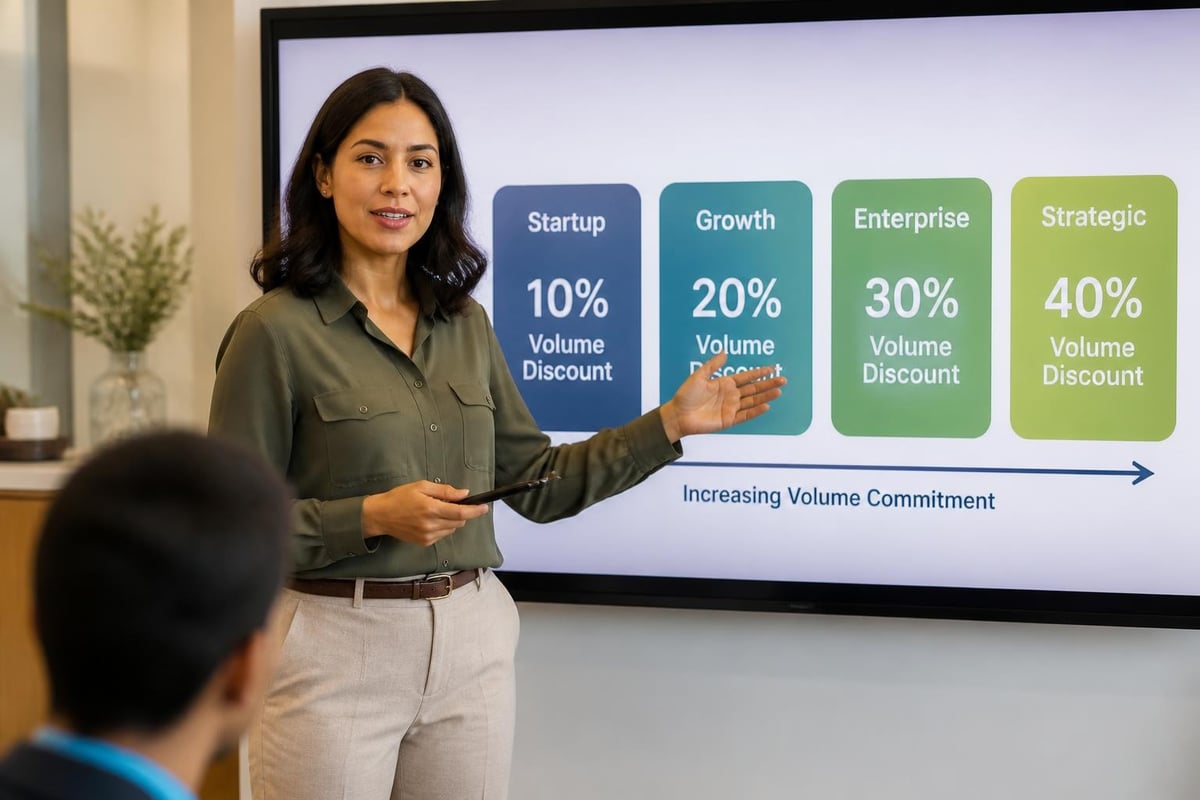
Customer service outsourcing pricing typically rewards volume through tiered rate structures. Providers offer discounts as clients commit to larger agent counts or higher interaction volumes, recognizing economies of scale in recruiting, training, and infrastructure deployment.
Minimum volume commitments represent standard practice. Providers establish baseline thresholds-often 10-20 FTEs or 5,000-10,000 monthly transactions-below which setup costs and overhead make engagements uneconomical. Understanding these minimums helps businesses assess outsourcing viability against current volumes.
Scaling flexibility carries premium pricing. Businesses requiring rapid capacity expansion during seasonal peaks or product launches need providers maintaining bench strength and surge capability. This elasticity typically costs 15-25% more than static deployments but delivers significant value during demand spikes.
Volume-Based Pricing Tiers
Progressive volume discounts incentivize consolidation and growth:
- Startup tier (1-25 agents): Premium rates reflecting setup cost amortization
- Growth tier (26-100 agents): 10-15% discount versus startup pricing
- Enterprise tier (101-500 agents): 20-30% discount with strategic partnership benefits
- Strategic tier (500+ agents): Custom pricing with dedicated account infrastructure
Long-term contracts further reduce customer service outsourcing pricing. Three-year commitments typically secure 8-12% discounts versus annual agreements, while five-year terms may achieve 15-18% savings. These extended partnerships enable providers to make technology investments and workforce development commitments that benefit both parties.
Hidden Costs and Budget Considerations
Comprehensive customer service outsourcing pricing analysis must account for costs beyond headline agent rates. These additional expenses can add 20-35% to initial budget estimates if overlooked during evaluation.
Transition and setup costs represent the most significant hidden expense category. Launching outsourced operations requires knowledge transfer, documentation development, agent training, and system integration. Providers typically charge $15,000 to $100,000 for transition programs depending on complexity, though some amortize these costs across contract terms rather than billing upfront.
Ongoing training expenses deserve careful consideration. While initial training costs factor into setup fees, continuous education programs, product update training, and skill development initiatives generate recurring expenses. Budget $50 to $150 per agent monthly for comprehensive training programs beyond basic onboarding.
Additional Cost Factors
Management and governance structures add overhead. Dedicated account managers, quality analysts, and reporting specialists supporting client operations typically add 8-12% to base agent costs. Businesses requiring on-site presence or frequent business reviews should expect additional premiums.
Exit and transition-out costs often surprise buyers. Contracts should address knowledge transfer requirements, documentation standards, and transition assistance if relationships terminate. These provisions prevent surprise expenses and ensure smooth migrations to alternative providers or internal operations.
Currency fluctuation risks affect international engagements. While providers typically contract in USD, underlying labor costs incur in local currencies. Some agreements include currency adjustment clauses protecting both parties from significant exchange rate movements that could destabilize economics.
According to industry benchmarking research, total cost of ownership calculations should incorporate:
- Agent labor: 65-75% of total costs
- Technology and infrastructure: 10-15%
- Management overhead: 8-12%
- Training and quality: 5-8%
- Transition and setup (amortized): 3-5%
Contract Terms and Pricing Negotiations
Customer service outsourcing pricing negotiations extend beyond rate discussions to encompass contract structures, risk allocation, and partnership terms. Sophisticated buyers approach these conversations strategically, understanding leverage points and value creation opportunities.
Initial proposals typically start 15-25% above providers' walk-away pricing, creating negotiation room. Understanding market benchmarks through competitive bids and industry research strengthens buyer positioning. The Focus Services approach emphasizes transparency and value alignment rather than pure price competition.
Key Negotiation Levers
Volume commitments represent the strongest negotiation tool. Buyers willing to commit larger agent counts or longer terms gain significant pricing concessions. Similarly, flexibility on geography-accepting offshore delivery versus insisting on domestic operations-unlocks substantial savings.
Payment terms influence final economics. Standard arrangements call for monthly invoicing with 30-day payment terms. Buyers offering quarterly prepayment or shorter payment cycles may secure 2-4% discounts, improving vendor cash flow in exchange for rate reductions.
Performance guarantees shift risk and should impact pricing. Contracts placing substantial financial penalties on providers for SLA misses justify premium rates compared to best-effort arrangements. Balanced approaches share risk through gainsharing models where both parties benefit from exceptional performance.
Renewal pricing protection deserves attention during initial negotiations. Contracts should specify maximum annual rate increases (typically capped at 3-5%) or tie adjustments to documented cost indices. This protection prevents significant price shocks during renewals when switching costs make buyers vulnerable.
Multi-year agreements with annual volume increases create win-win scenarios. Providers gain revenue visibility supporting workforce planning, while buyers secure favorable long-term economics and avoid annual renegotiation cycles.
Building an Accurate Pricing Model
Developing comprehensive customer service outsourcing pricing estimates requires systematic analysis of volume projections, service requirements, and quality expectations. Accurate modeling prevents budget surprises and enables informed provider selection.
Start with detailed volume forecasting across channels. Historical data on call volumes, email tickets, chat sessions, and social media inquiries provides the foundation. Factor growth projections, seasonal variations, and new product launches that may spike demand. Conservative estimates add 15-20% buffers to accommodate unexpected volume increases.
Pricing Model Components
Service complexity assessment determines appropriate rate tiers. Categorize interactions by type-basic, technical, premium-and estimate percentage distributions. Apply corresponding rate structures to each category, recognizing that blended rates depend on interaction mix rather than simple averages.
Calculate technology requirements separately from labor costs. List required integrations, reporting needs, and automation capabilities. Request itemized technology pricing rather than bundled rates to understand true infrastructure costs and identify optimization opportunities.
| Cost Category | Calculation Method | Typical Percentage |
|---|---|---|
| Base agent labor | FTEs × hourly rate × hours | 60-70% |
| Skill premiums | Complex interactions × premium rate differential | 5-10% |
| Technology platform | Agents × platform fee/agent/month | 10-15% |
| Management overhead | Base labor × overhead percentage | 8-12% |
| Training and quality | Agents × training budget/agent/month | 5-8% |
Factor contractual minimums and scaling provisions. If business volumes fluctuate significantly, evaluate whether transaction-based pricing delivers better economics than FTE models during low-demand periods. Calculate break-even points where model alternatives become more cost-effective.
Don't forget ancillary expenses: transition costs amortized across contract terms, travel for governance meetings, and contingency budgets for scope expansions. Comprehensive models typically exceed initial agent rate estimates by 25-35% when fully loaded.
Evaluating Total Value Beyond Price
While customer service outsourcing pricing significantly influences provider selection, focusing exclusively on lowest cost often proves counterproductive. Total value assessment balances financial considerations against capability, scalability, and strategic alignment.
Quality metrics deserve equal weighting with price. Providers delivering superior first-call resolution, customer satisfaction scores, and net promoter results create measurable business value. The revenue impact of retaining customers and reducing churn often exceeds outsourcing cost differentials between providers.
Technology sophistication and innovation capability separate strategic partners from commodity suppliers. Providers investing in AI, predictive analytics, and omnichannel capabilities position clients for future success. These advanced capabilities may command premium customer service outsourcing pricing but deliver competitive advantages justifying the investment.
Value Assessment Framework
Consider total cost of ownership across the relationship lifecycle:
- Transition efficiency: Faster deployments reduce opportunity costs and enable quicker ROI realization
- Operational excellence: Superior metrics reduce customer friction and support revenue goals
- Scalability: Flexible capacity prevents revenue loss during demand spikes
- Innovation partnership: Continuous improvement programs drive ongoing efficiency gains
- Risk mitigation: Geographic diversity and business continuity planning protect operations
Cultural alignment and shared values create intangible benefits difficult to quantify but critical for partnership success. Providers demonstrating genuine commitment to client success, transparent communication, and collaborative problem-solving often deliver superior outcomes despite not offering lowest pricing.
Geographic footprint diversity provides strategic value. Multi-shore capabilities enable businesses to balance cost optimization with service quality requirements, deploying tiered support models that maximize efficiency while maintaining customer experience standards. Organizations like Focus Services operating globally across the United States, El Salvador, the Philippines, and South Africa offer this flexibility.
Understanding customer service outsourcing pricing requires analyzing multiple models, geographic options, and value factors beyond simple hourly rates. Successful partnerships align pricing structures with business objectives while ensuring sustainable economics for both parties. Focus Services delivers transparent, flexible pricing across our global operations, combining competitive rates with advanced technology and proven operational excellence. Contact Focus Services to discuss customized pricing designed around your specific requirements, volumes, and quality expectations.