

Technical Support and Customer Support: Key Differences
Modern businesses face increasing pressure to deliver exceptional service across multiple touchpoints, yet many organizations struggle to distinguish between two critical support functions. Understanding the nuanced differences between technical support and customer support is essential for building effective service operations, allocating resources appropriately, and meeting evolving customer expectations. While these functions often overlap and collaborate, they serve distinct purposes that require different skill sets, methodologies, and success metrics.
Defining Technical Support and Customer Support
The distinction between these two support disciplines begins with their fundamental objectives. Customer support encompasses the broad spectrum of assistance provided to customers throughout their entire journey with a company, from pre-sales inquiries to post-purchase questions, account management, and general guidance. This function prioritizes relationship building, satisfaction, and overall customer experience.
Technical support, conversely, focuses specifically on resolving technical issues, troubleshooting product malfunctions, and providing expert guidance on complex technical matters. This specialized function requires deep product knowledge and often involves diagnostic processes, systematic troubleshooting, and collaboration with engineering or development teams.
Core Competency Requirements
The skill profiles for these roles differ significantly:
- Customer support agents excel in communication, empathy, active listening, and conflict resolution
- Technical support specialists require advanced product knowledge, analytical thinking, and problem-solving capabilities
- Both roles benefit from patience and adaptability
- Technical support demands continuous learning as products evolve
- Customer support emphasizes emotional intelligence and relationship management
Organizations implementing tech support outsourcing must carefully evaluate these competency differences when building their teams. The NIST workforce framework provides comprehensive guidance on role definitions and competency planning that supports effective hiring and training strategies for both technical and customer-facing positions.

Operational Frameworks and Methodologies
Technical support and customer support organizations typically operate under different structural frameworks that reflect their distinct objectives and processes.
Technical Support Methodologies
Technical support teams frequently adopt structured incident management frameworks to ensure consistent, efficient resolution of technical issues. The ITIL incident management framework provides industry-standard practices for:
- Incident identification and logging with detailed technical information
- Categorization and prioritization based on business impact
- Investigation and diagnosis using systematic troubleshooting
- Resolution and recovery with root cause analysis
- Incident closure and knowledge base documentation
These methodologies emphasize technical accuracy, reproducible solutions, and continuous improvement through post-incident reviews.
Customer Support Approaches
Customer support operations typically follow customer-centric frameworks that prioritize experience and satisfaction metrics. Recent research on building customer-centric organizations highlights the importance of aligning support structures with overall business strategy rather than purely technical efficiency.
Customer support workflows generally include:
- Initial contact and needs assessment
- Issue clarification through active listening
- Solution provision or appropriate escalation
- Satisfaction verification
- Relationship nurturing and follow-up
Technology Stack Differences
The tools and platforms supporting technical support and customer support reflect their operational differences significantly.
| Tool Category | Technical Support | Customer Support |
|---|---|---|
| Primary Platform | Ticketing systems with detailed diagnostic fields | Omnichannel CRM with conversation history |
| Knowledge Management | Technical documentation, troubleshooting guides, solution databases | FAQ libraries, policy documentation, procedural guides |
| Analytics Focus | Resolution time, first-contact resolution, escalation rates | CSAT, NPS, customer effort score, sentiment analysis |
| Collaboration Tools | Screen sharing, remote access, diagnostic utilities | Chat, email, social media management platforms |
| Automation | Diagnostic scripts, automated testing tools | Chatbots, automated routing, self-service portals |
Modern organizations increasingly leverage AI-enabled solutions to enhance both functions. Generative AI research from Deloitte demonstrates how intelligent automation can augment agent capabilities while maintaining quality standards across technical and customer support operations.
Companies exploring AI agent solutions can implement knowledge management systems that serve both technical and customer support needs. Microsoft’s knowledge management capabilities illustrate how unified platforms can deliver specialized content to different support tiers while maintaining consistency.
Channel Strategy and Customer Preferences
Technical support and customer support often serve customers through different communication channels based on issue complexity and customer preferences.
Channel Distribution Patterns
Understanding how customers prefer to engage for different issue types enables more effective channel strategy. Recent research on consumer channel preferences reveals distinct patterns:
For technical issues:
- Phone support remains preferred for complex troubleshooting requiring real-time collaboration
- Remote desktop sharing and screen sharing facilitate efficient technical diagnosis
- Email and ticketing systems work well for non-urgent technical documentation requests
- Community forums provide peer-to-peer technical assistance for common issues
For customer service inquiries:
- Live chat excels for quick questions and order status checks
- Social media channels handle public-facing concerns and brand engagement
- Email serves formal complaints and detailed account inquiries
- Self-service portals address routine tasks like password resets and order tracking
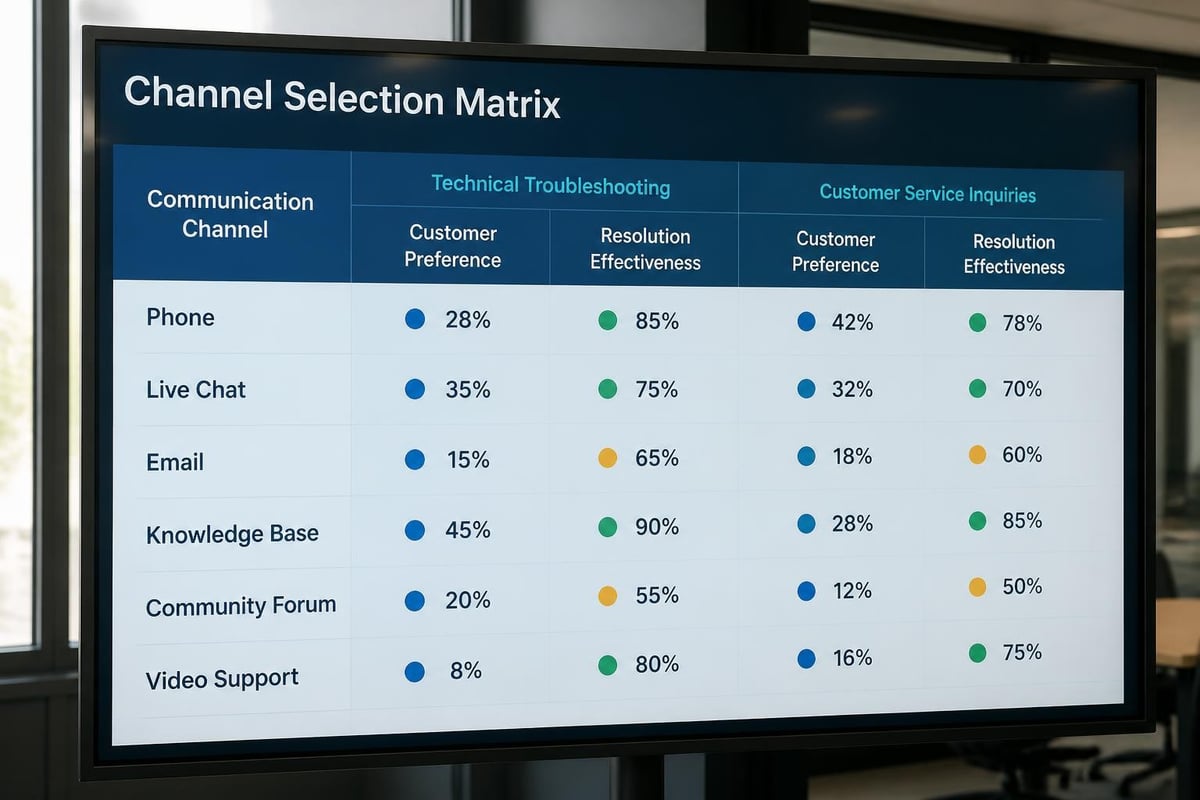
Organizations implementing outsourcing agents across multiple geographies must ensure consistent channel coverage while accounting for regional preferences and technical infrastructure capabilities in markets like the Philippines, El Salvador, and South Africa.
Performance Metrics and Success Indicators
Technical support and customer support require different measurement frameworks that reflect their distinct value propositions.
Technical Support Metrics
Technical support performance centers on resolution effectiveness and efficiency:
- First Contact Resolution (FCR) measures the percentage of issues resolved without escalation
- Mean Time to Resolution (MTTR) tracks average time from issue identification to resolution
- Escalation Rate indicates the percentage of tickets requiring higher-tier technical expertise
- Resolution Quality assesses whether solutions address root causes rather than symptoms
- Knowledge Base Contribution tracks documentation of new solutions for future reference
Customer Support Metrics
Customer support measurement emphasizes satisfaction and relationship quality:
- Customer Satisfaction Score (CSAT) captures immediate post-interaction satisfaction
- Net Promoter Score (NPS) measures likelihood to recommend based on support experience
- Customer Effort Score (CES) evaluates how easy customers find issue resolution
- Response Time tracks initial contact acknowledgment speed
- Resolution Rate measures percentage of inquiries fully addressed
| Metric Type | Technical Support Priority | Customer Support Priority |
|---|---|---|
| Speed | Important, but secondary to accuracy | Critical for satisfaction |
| Accuracy | Essential for long-term resolution | Important for trust |
| Empathy | Helpful but not primary | Fundamental requirement |
| Technical Depth | Core competency requirement | Unnecessary for most inquiries |
Training and Development Considerations
Building expertise in technical support and customer support requires fundamentally different training approaches and ongoing development programs.
Technical Support Training Programs
Technical support specialists require extensive product training that includes:
- Product architecture and functionality to understand system behavior
- Troubleshooting methodologies for systematic problem diagnosis
- Tool proficiency in diagnostic utilities and testing environments
- Version control awareness to address configuration-specific issues
- Escalation protocols for engaging engineering resources appropriately
Recent developments in large language models offer new possibilities for automating aspects of technical customer support, though careful evaluation and human oversight remain essential for quality assurance and complex technical issues.
Customer Support Training Focus
Customer support training emphasizes interpersonal skills and company knowledge:
- Communication techniques for diverse customer personalities
- De-escalation strategies for managing frustrated customers
- Product knowledge at a functional rather than technical level
- Company policies, procedures, and service standards
- Empathy development and emotional intelligence
Organizations must invest in continuous learning programs that keep both technical and customer support teams current with product updates, new methodologies, and evolving customer expectations.
Integration and Collaboration Between Functions
While technical support and customer support operate with different methodologies, their integration is crucial for delivering seamless customer experiences.
Effective Handoff Processes
Smooth transitions between customer support and technical support prevent customer frustration and duplicate effort:
- Clear escalation criteria define when customer support should transfer to technical specialists
- Information continuity ensures technical teams receive complete context from initial customer interactions
- Bidirectional communication keeps customer support informed of technical resolution progress
- Collaborative problem-solving brings both perspectives together for complex issues
Unified Knowledge Management
Shared knowledge repositories serve both functions while addressing their different needs:
| Knowledge Type | Technical Support Use | Customer Support Use |
|---|---|---|
| Product Documentation | Deep technical reference | High-level feature explanation |
| Troubleshooting Guides | Detailed diagnostic procedures | Basic troubleshooting for common issues |
| Known Issues Database | Workarounds and patch status | Customer communication templates |
| Solution Articles | Root cause analysis | Customer-friendly explanations |

Scaling Considerations for Growing Organizations
As businesses expand, the scaling requirements for technical support and customer support diverge based on product complexity and customer volume.
Technical Support Scaling Strategies
Technical support scaling presents unique challenges due to expertise requirements:
- Tiered support structures separate routine technical issues from complex engineering problems
- Specialty teams develop deep expertise in specific product areas or technical domains
- Knowledge base investment reduces repetitive inquiries through comprehensive documentation
- Automated diagnostic tools handle initial troubleshooting before human intervention
- Geographic distribution provides follow-the-sun coverage for global customer bases
Customer Support Scaling Approaches
Customer support typically scales more readily through volume management:
- Agent workforce expansion handles increased inquiry volume
- Self-service portal development deflects routine questions
- Chatbot implementation manages simple, repetitive inquiries
- Channel optimization directs customers to most efficient resolution paths
- Outsourcing partnerships provide flexible capacity during peak periods
Organizations can leverage Focus Services’ global delivery capabilities across the United States, El Salvador, the Philippines, and South Africa to scale both technical and customer support functions efficiently while maintaining quality standards.
Cost Structures and Resource Allocation
Understanding the economic differences between technical support and customer support informs better budgeting and resource allocation decisions.
Technical Support Cost Factors
Technical support typically carries higher per-agent costs due to:
- Higher compensation reflecting specialized technical expertise requirements
- Extended training periods before new hires achieve productivity
- Continuous education as products evolve and new versions release
- Specialized tools including diagnostic utilities and testing environments
- Lower agent-to-incident ratios because complex issues require more time
Customer Support Economics
Customer support often achieves better economies of scale:
- Broader talent pool with lower compensation requirements
- Faster onboarding for new agents handling routine inquiries
- Higher throughput potential for experienced agents
- Automation opportunities for repetitive, straightforward interactions
- Outsourcing flexibility providing cost-effective capacity expansion
Businesses evaluating call center outsourcing options must consider these economic differences when structuring support operations and selecting appropriate delivery models for each function.
Future Trends Reshaping Both Disciplines
The evolution of technology and customer expectations continues to reshape both technical support and customer support in 2026 and beyond.
Emerging Developments
Several trends are transforming how organizations deliver support:
- AI-augmented agents leverage machine learning to provide real-time guidance and knowledge recommendations
- Predictive support identifies potential issues before customers experience problems
- Proactive outreach addresses known issues through targeted customer communication
- Video support enables visual troubleshooting for complex technical and product issues
- Integrated analytics connect support interactions to product development and customer success initiatives
Organizations must balance technological advancement with human expertise, recognizing that while automation enhances efficiency, complex technical troubleshooting and empathetic customer interaction still require skilled human agents for optimal outcomes.
Understanding the distinct roles of technical support and customer support enables organizations to build more effective service operations that match the right expertise to specific customer needs. By recognizing these differences in competencies, methodologies, metrics, and economics, businesses can optimize resource allocation while delivering superior customer experiences across all support touchpoints. Focus Services helps organizations worldwide scale both technical and customer support functions through strategic outsourcing partnerships that combine specialized expertise, advanced technology, and flexible capacity across global delivery centers. Whether you need to expand technical troubleshooting capabilities or enhance customer service operations, our comprehensive BPO solutions deliver the specialized support infrastructure your growing business requires.