

Tools of Customer Service: Technology Stack for 2026
Customer service excellence depends on having the right technology infrastructure in place. As businesses scale their support operations and customer expectations continue to evolve, the tools of customer service have become more sophisticated, interconnected, and essential to delivering exceptional experiences. For call center outsourcing providers and BPO operations, selecting and implementing the right technology stack directly impacts agent productivity, customer satisfaction, and operational efficiency. This comprehensive guide explores the critical platforms and systems that form the foundation of modern customer service operations in 2026.
Customer Relationship Management Platforms
The CRM system serves as the central hub for all customer interactions and data. Modern tools of customer service begin with a robust CRM that consolidates customer information, interaction history, purchase records, and service tickets into a single accessible platform.
Choosing the Right CRM Architecture
Enterprise CRMs like Salesforce Service Cloud, Microsoft Dynamics 365, and Zendesk provide comprehensive functionality for managing customer relationships at scale. These platforms enable agents to view complete customer journeys, track case resolution progress, and maintain consistency across touchpoints.
Key CRM capabilities for call centers include:
- Unified customer profiles with 360-degree visibility
- Case management and ticket routing workflows
- Integration with telephony and communication systems
- Customizable dashboards for agent performance tracking
- Automated workflows and escalation rules
The selection process should prioritize platforms that integrate seamlessly with existing systems. For BPO contact center operations, multi-tenant architectures allow service providers to manage multiple client programs within a single instance while maintaining data segregation and security.

Omnichannel Communication Platforms
Customers expect to reach support teams through their preferred channels without repeating information. The tools of customer service must enable seamless conversations across voice, email, chat, SMS, social media, and messaging apps.
| Channel Type | Primary Use Case | Integration Complexity |
|---|---|---|
| Voice (Phone) | Complex inquiries, urgent issues | Medium (requires CTI) |
| Non-urgent requests, documentation | Low | |
| Live Chat | Quick questions, website support | Medium |
| Social Media | Public feedback, brand engagement | High |
| SMS/Messaging | Notifications, brief exchanges | Medium |
Cloud contact center platforms provide unified agent desktops where representatives handle interactions from multiple channels without switching applications. Microsoft’s Dynamics 365 Contact Center features demonstrate how intelligent routing and unified interfaces improve efficiency.
Building Channel Flexibility
Implementing omnichannel capabilities requires careful planning around routing logic, skill-based assignment, and context preservation. When customers switch from chat to phone, agents need immediate access to conversation history and customer data.
Modern tools of customer service incorporate AI-powered routing that considers agent expertise, current workload, customer sentiment, and interaction complexity. This intelligent distribution ensures customers reach the most qualified agent while balancing team capacity.
AI and Automation Platforms
Artificial intelligence has transformed from experimental technology to essential infrastructure. The tools of customer service now leverage AI for chatbots, virtual assistants, predictive analytics, sentiment analysis, and automated workflows.
Conversational AI Implementation
Chatbots and virtual agents handle routine inquiries, freeing human agents for complex problem-solving. Forrester’s analysis of conversational AI highlights the importance of balancing automation with human oversight.
Effective conversational AI deployments include:
- Natural language understanding trained on customer service conversations
- Integration with knowledge bases and backend systems
- Seamless handoff protocols to human agents
- Continuous learning from interaction outcomes
- Multi-language support for global operations
Google Cloud’s generative AI applications demonstrate how large language models can assist agents with real-time suggestions, summarize conversations, and generate personalized responses based on customer context.
Agent Assistance Technologies
AI tools don't just replace agents-they augment human capabilities. Real-time transcription and sentiment analysis alert supervisors to difficult interactions requiring intervention. Knowledge article recommendations surface relevant solutions as agents navigate conversations. Predictive analytics identify customers likely to churn, enabling proactive retention efforts.
For contact center monitoring programs, AI-powered quality assurance analyzes 100% of interactions rather than small sample sizes, identifying coaching opportunities and compliance issues with greater accuracy.
Knowledge Management Systems
Consistent, accurate information forms the backbone of effective customer service. The tools of customer service must include robust knowledge management platforms where agents access articles, procedures, troubleshooting guides, and product documentation.

Modern knowledge bases use AI to recommend articles based on customer inquiries and agent search patterns. Harvard Business Review’s research on knowledge management emphasizes that generative AI success depends fundamentally on organized, current knowledge content.
Maintaining Knowledge Accuracy
Knowledge management requires dedicated governance processes. Outdated or conflicting information damages customer trust and agent confidence. Effective systems include version control, regular content audits, contributor workflows, and usage analytics.
The best tools of customer service integrate knowledge directly into agent workflows. Rather than switching applications, agents see contextually relevant articles within their CRM or agent desktop based on customer attributes and inquiry type.
Workforce Management Solutions
Optimizing staffing levels, schedules, and agent utilization requires sophisticated forecasting and planning tools. Workforce management (WFM) platforms analyze historical volume patterns, predict future demand, and generate schedules that balance service levels with labor costs.
Core WFM functionality includes:
- Multi-channel volume forecasting using historical data
- Automated schedule generation based on skills and availability
- Real-time adherence monitoring and alerts
- Intraday management for handling unexpected volume spikes
- Integration with time and attendance systems
For global operations spanning multiple time zones and geographies, WFM tools coordinate schedules across locations while accounting for local regulations, holidays, and contract terms. This capability proves essential for providers like Focus Services operating across the United States, El Salvador, the Philippines, and South Africa.
Quality Assurance and Performance Analytics
Measuring service quality and agent performance requires tools that capture interaction data, apply evaluation criteria, and identify improvement opportunities. The tools of customer service extend beyond frontline systems to include quality monitoring, speech analytics, and performance dashboards.
| Quality Tool Category | Primary Function | Key Benefits |
|---|---|---|
| Call Recording | Capture interactions for review | Compliance, dispute resolution, training |
| Speech Analytics | Analyze conversation patterns | Identify trends, compliance risks, coaching needs |
| Screen Recording | Monitor agent workflows | Process adherence, security, training |
| Quality Scorecards | Standardize evaluations | Consistent feedback, performance tracking |
| Customer Surveys | Gather direct feedback | Measure satisfaction, identify pain points |
Modern analytics platforms apply AI to identify patterns that manual review misses. Detecting keywords, measuring talk-time ratios, analyzing emotional tone, and tracking hold times provide objective performance insights.
Building Performance Cultures
Technology enables transparency but doesn't guarantee improvement. The most effective tools of customer service combine measurement with coaching workflows, gamification elements, and development resources. Agents need clear performance expectations, regular feedback, and pathways to advancement.
Accenture’s research on customer service modernization emphasizes that technology investments must align with workforce development strategies to achieve meaningful operational improvements.
Telephony and Communication Infrastructure
Voice remains a critical channel despite digital growth. Cloud-based telephony systems provide the flexibility and scalability that modern call centers require, eliminating hardware dependencies and enabling rapid capacity adjustments.
Cloud Contact Center Advantages
Cloud communication platforms offer significant benefits over legacy on-premise systems. Deployment speed improves dramatically-new programs launch in weeks rather than months. Geographic expansion becomes simpler as agents connect from any location with internet access. Disaster recovery capabilities ensure business continuity during outages or emergencies.
Key telephony features include:
- Automatic call distribution with intelligent routing
- Interactive voice response (IVR) for self-service
- Computer telephony integration (CTI) with CRM systems
- Call recording and quality monitoring
- Real-time and historical reporting
- Outbound dialing capabilities for sales and surveys
For sales outsourcing operations, predictive dialers maximize agent talk time by automatically dialing numbers and connecting only answered calls. Compliance features ensure adherence to regulations governing automated calling.
Integration and Middleware Platforms
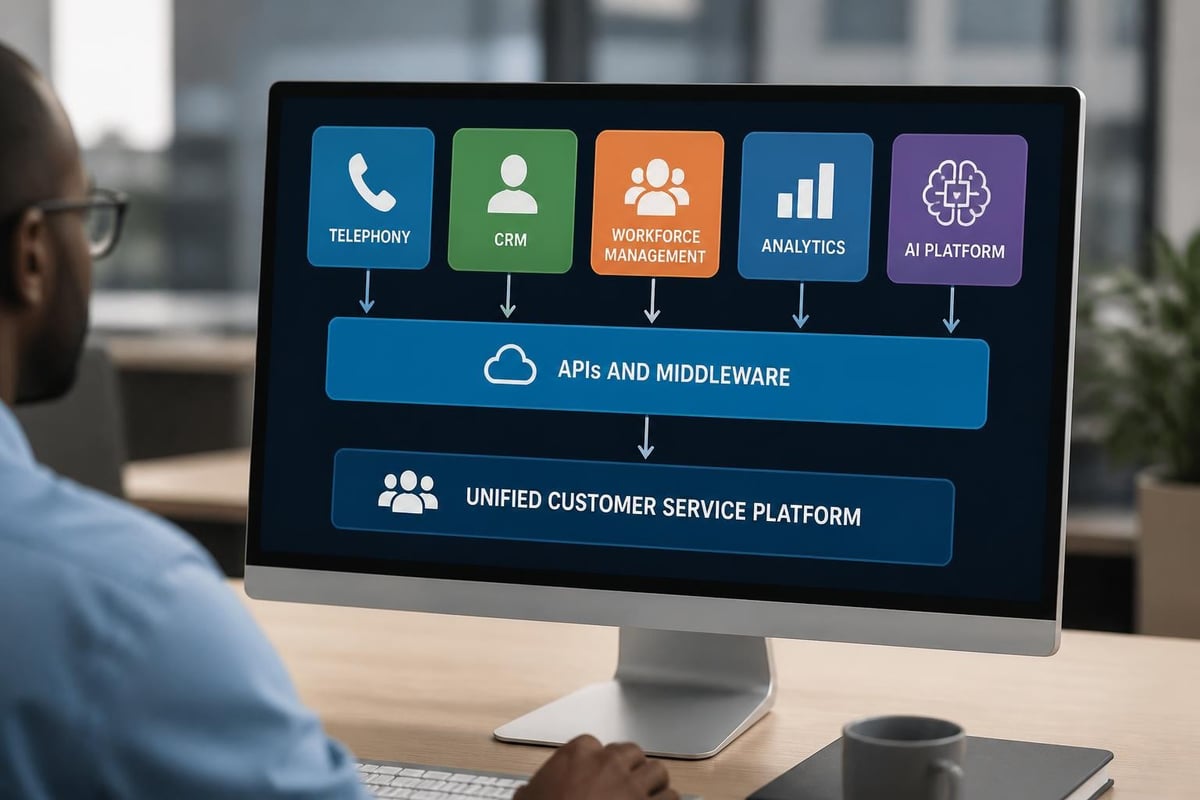
Individual tools of customer service deliver limited value in isolation. Integration platforms connect disparate systems, enabling data flow and process automation across the technology ecosystem.
APIs and middleware solutions facilitate communication between CRM platforms, telephony systems, workforce management tools, and analytics applications. Pre-built connectors accelerate implementation, while custom integrations address unique business requirements.
API Management Strategies
Successful integration requires careful planning around data security, API rate limits, error handling, and version management. Documentation and governance prevent integration debt as systems evolve.
Modern integration platforms use event-driven architectures where system changes trigger automated workflows. When a high-value customer calls, integrations might automatically route to senior agents, display account information, and log the interaction without manual steps.
Self-Service Platforms
Customers increasingly prefer resolving simple issues independently. The tools of customer service should include self-service portals, mobile applications, community forums, and automated assistants that empower customers to find answers without agent assistance.
Well-designed self-service reduces contact volume while improving satisfaction for customers who value speed and convenience. Knowledge bases optimized for customer search, video tutorials demonstrating common tasks, and troubleshooting wizards that guide problem resolution all contribute to effective self-service ecosystems.
Measuring Self-Service Effectiveness
Success metrics extend beyond deflection rates to include completion rates, search effectiveness, and customer satisfaction with self-service experiences. High abandonment suggests poor content or confusing navigation requiring optimization.
Integration between self-service and assisted channels ensures smooth escalation. Customers who can't resolve issues independently should easily transition to chat or phone support with context preserved.
Collaboration and Internal Communication Tools
Agent productivity depends on efficient internal collaboration. The tools of customer service include platforms where team members ask questions, share knowledge, escalate complex issues, and coordinate across departments.
Modern collaboration tools integrate with core service platforms, allowing agents to consult subject matter experts without leaving their workspace. Chat channels organized by topic, skill, or client program facilitate quick answers. Video conferencing enables remote training and team meetings.
For IT outsourcing services supporting technical products, collaboration platforms connecting frontline agents with engineering teams accelerate issue resolution and improve first-call resolution rates.
Data Security and Compliance Tools
Protecting customer information and maintaining regulatory compliance requires specialized security infrastructure. The tools of customer service must include encryption, access controls, audit logging, and monitoring capabilities that safeguard sensitive data.
Essential security measures include:
- Multi-factor authentication for system access
- Role-based permissions limiting data visibility
- Encryption for data at rest and in transit
- Network security and intrusion detection
- Regular security assessments and penetration testing
- Compliance with GDPR, CCPA, PCI DSS, and industry regulations
Payment card tokenization prevents agents from viewing full card numbers during transactions. Call recording redaction automatically removes sensitive information from recordings. Activity monitoring detects suspicious behavior indicating potential data breaches.
Reporting and Business Intelligence
Understanding operational performance requires comprehensive reporting and analytics capabilities. The tools of customer service include business intelligence platforms that consolidate data from multiple systems into unified dashboards and reports.
Real-time wallboards display current queue status, service levels, and agent availability, enabling supervisors to make immediate staffing adjustments. Historical reports track trends over time, identifying seasonal patterns and long-term improvements or deterioration.
Advanced analytics platforms apply machine learning to predict future performance, identify root causes of recurring issues, and recommend optimization opportunities. Customizable dashboards ensure stakeholders access relevant metrics without overwhelming detail.
Technology Selection Framework
Choosing the right tools of customer service requires systematic evaluation against business requirements, technical capabilities, and budget constraints. Successful implementations begin with clearly defined objectives and success criteria.
The evaluation process should consider total cost of ownership including licensing, implementation, training, ongoing support, and integration expenses. Vendor stability, roadmap alignment, and customer references provide insight into long-term viability.
Pilot programs test functionality in production environments before full deployment, validating assumptions and identifying gaps. Phased rollouts minimize disruption and allow teams to build competency gradually.
Selecting and implementing the right tools of customer service determines whether operations achieve their efficiency, quality, and satisfaction objectives in an increasingly competitive landscape. As customer expectations continue rising and technology capabilities expand, maintaining current infrastructure and evaluating emerging platforms becomes an ongoing priority. Organizations looking to optimize their customer service technology stack or expand support capacity through outsourcing can explore how Focus Services delivers scalable, AI-enabled solutions across global delivery centers designed to enhance service operations while reducing costs.