

Contact Center Outsourcing: Strategic Guide for 2026
Businesses today face mounting pressure to deliver exceptional customer service while managing operational costs. Contact center outsourcing has emerged as a strategic solution that enables companies to scale their customer support capabilities without the overhead of maintaining in-house teams. This approach allows organizations to tap into specialized expertise, advanced technologies, and global talent pools while focusing resources on core business functions. Whether you're considering outsourcing for the first time or optimizing an existing partnership, understanding the strategic implications and best practices is essential for success.
Understanding the Strategic Value of Contact Center Outsourcing
Contact center outsourcing involves partnering with a third-party provider to handle customer interactions through various channels including phone, email, chat, and social media. This business model has evolved significantly beyond simple cost reduction to become a strategic enabler of growth and customer experience enhancement.
The primary value proposition centers on operational flexibility. Companies can rapidly scale their support capacity up or down based on seasonal demands, product launches, or market expansion without the lengthy process of recruiting, training, and managing additional staff. This agility proves particularly valuable in industries with fluctuating customer service needs.
Financial and Operational Benefits
Cost efficiency remains a compelling driver for outsourcing decisions. By leveraging providers with operations in regions offering favorable labor economics, businesses typically reduce their customer service costs by 30-50% compared to maintaining equivalent in-house teams.
Key financial advantages include:
- Elimination of infrastructure investments in technology and facilities
- Reduced recruitment and training expenses
- Predictable monthly operational costs
- Lower employee turnover management costs
- Minimized investment in workforce management software
Beyond direct cost savings, outsourcing partners bring specialized expertise that would be expensive to develop internally. These providers invest continuously in agent training, quality assurance methodologies, and performance optimization tools that individual companies might struggle to justify financially.

Selecting the Right Outsourcing Partner
Choosing an appropriate contact center outsourcing provider requires careful evaluation beyond simply comparing hourly rates. The partnership quality directly impacts customer satisfaction, brand reputation, and ultimately business outcomes.
Critical Evaluation Criteria
Geographic considerations play a significant role in provider selection. Multi-location providers offer distinct advantages:
- Time zone coverage enabling 24/7 customer support
- Language capabilities matching your customer demographics
- Business continuity through geographic redundancy
- Cultural alignment with your target markets
Technology infrastructure deserves thorough scrutiny. Modern contact centers require sophisticated platforms integrating customer relationship management systems, workforce optimization tools, and analytics capabilities. Providers should demonstrate proficiency with AI-enabled solutions that enhance agent productivity and customer experience.
| Evaluation Factor | Questions to Ask | Red Flags |
|---|---|---|
| Technology Stack | What CRM and telephony platforms do you use? | Outdated systems, no integration capabilities |
| Quality Assurance | How do you measure and maintain service quality? | No formal QA program, limited monitoring |
| Scalability | How quickly can you add agents? | Long ramp-up times, capacity constraints |
| Security Compliance | What certifications do you maintain? | Lack of industry-specific compliance |
| Reporting | What metrics do you provide and how often? | Limited visibility, delayed reporting |
The provider's quality assurance program represents a critical differentiator. Effective contact center quality assurance practices include regular call monitoring, agent coaching, customer satisfaction measurement, and continuous process improvement.
Implementing Contact Center Outsourcing Successfully
Successful implementation requires structured planning and clear communication between all stakeholders. Rushed transitions frequently result in service disruptions, customer dissatisfaction, and strained partnerships.
Transition Planning and Knowledge Transfer
The transition phase typically spans 60-90 days and involves several critical activities. Knowledge transfer forms the foundation of successful outsourcing. Outsourcing partners need comprehensive understanding of your products, services, customer base, and brand voice.
Develop detailed documentation covering:
- Product specifications and common use cases
- Frequently asked questions and approved responses
- Escalation procedures and decision-making authority
- Brand guidelines and communication standards
- Customer segmentation and handling protocols
Pilot programs prove invaluable during implementation. Starting with a limited scope such as a specific product line or customer segment allows both parties to identify issues, refine processes, and build confidence before full-scale deployment.
Performance Metrics and Service Level Agreements
Establishing clear performance expectations prevents misalignment and ensures accountability. Service level agreements should define specific, measurable targets across multiple dimensions of contact center performance.
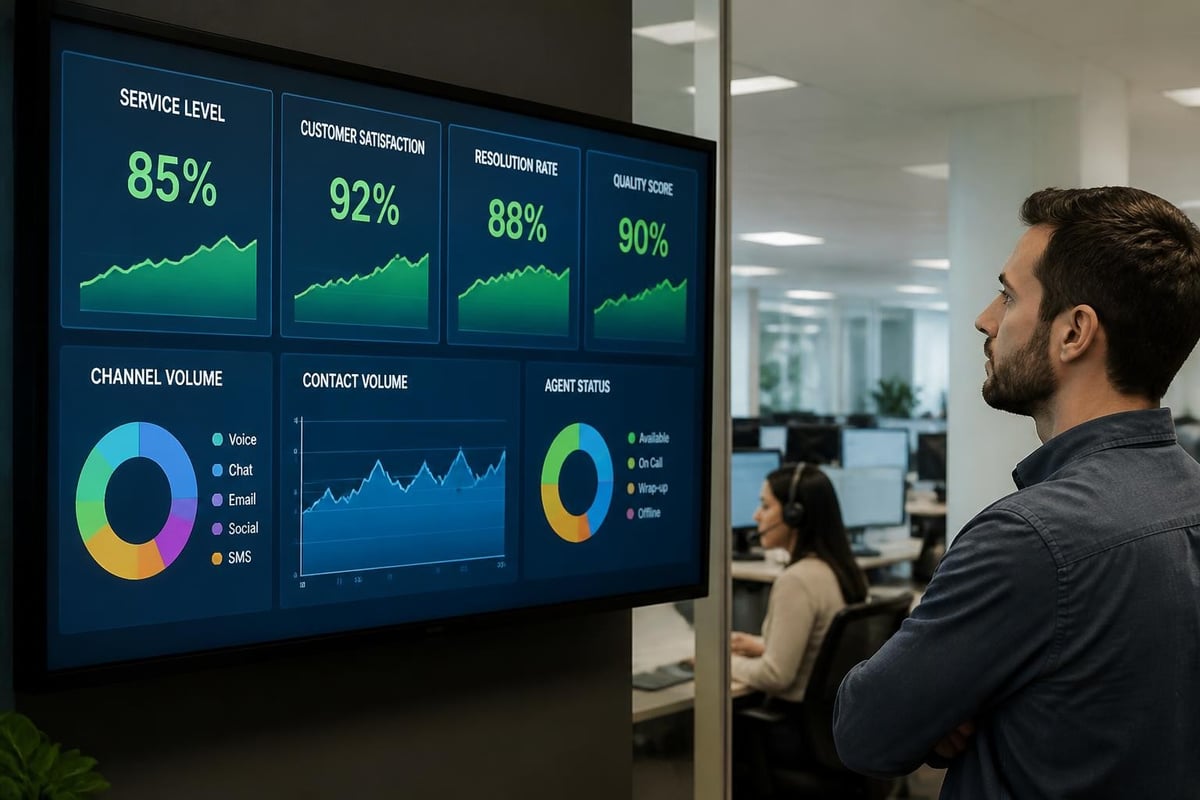
Essential performance metrics include:
- First contact resolution rate measuring issue resolution efficiency
- Average handle time balancing speed with quality
- Customer satisfaction scores capturing experience quality
- Service level achievement tracking answer speed targets
- Agent adherence monitoring schedule compliance
Beyond standard metrics, consider implementing best practices for managing contact center operations that emphasize workforce planning and continuous optimization.
While contact center outsourcing offers substantial benefits, organizations must address potential challenges proactively to maximize success. Understanding common pitfalls enables better planning and risk management.
Quality Control and Brand Consistency
Maintaining service quality at outsourced facilities requires ongoing vigilance and partnership. The physical distance between your organization and the contact center creates inherent challenges in preserving brand standards and service excellence.
Implement robust quality monitoring systems that include regular call reviews, mystery shopping programs, and customer feedback analysis. Schedule quarterly business reviews with your outsourcing partner to review performance trends, discuss improvement opportunities, and align on strategic priorities.
Cultural and communication differences can impact customer interactions, particularly when outsourcing to international locations. Select providers with strong cultural training programs and consider nearshore options when cultural alignment proves critical for your customer base.
Data Security and Compliance Management
Contact centers handle sensitive customer information requiring stringent security measures and regulatory compliance. Your outsourcing partner becomes an extension of your organization from a compliance perspective, making their security posture critically important.
Verify that providers maintain relevant certifications such as:
- PCI DSS for payment card information handling
- HIPAA for healthcare-related customer service
- SOC 2 for general information security controls
- GDPR compliance for European customer data
Regular security audits and penetration testing should be contractual requirements. Establish clear data handling protocols including information access restrictions, retention policies, and breach notification procedures.
Technology Integration and AI Enablement
Modern contact center outsourcing extends beyond traditional agent-based services to incorporate advanced technologies that enhance efficiency and customer experience. Understanding the technological landscape helps organizations maximize their outsourcing investment.
AI and Automation Capabilities
Artificial intelligence transforms contact center operations through multiple applications. Intelligent routing systems analyze customer inquiries and match them with the most qualified agents based on skills, language, previous interactions, and current availability. This optimization reduces transfer rates and improves first contact resolution.
Conversational AI and chatbots handle routine inquiries autonomously, freeing human agents for complex issues requiring empathy and problem-solving skills. When evaluating providers, assess their AI implementation maturity and integration with human agent workflows.
Workforce optimization tools leverage predictive analytics to forecast call volumes, optimize staffing schedules, and identify training needs. These capabilities enable providers to maintain service levels efficiently while controlling labor costs. Companies like Focus Services integrate AI-enabled workforce optimization into their service delivery models.
| Technology Type | Application | Business Impact |
|---|---|---|
| Speech Analytics | Analyze customer conversations for trends and compliance | Identify training needs, ensure quality |
| Predictive Dialing | Optimize outbound call efficiency | Increase sales productivity |
| Sentiment Analysis | Detect customer emotions in real-time | Enable proactive issue resolution |
| Knowledge Management | Provide agents instant access to information | Reduce handle time, improve accuracy |
Omnichannel Integration
Customer expectations have evolved beyond phone support to demand seamless experiences across email, chat, social media, SMS, and self-service portals. Your outsourcing partner should demonstrate expertise in omnichannel contact center management.
Effective omnichannel strategies maintain conversation context as customers move between channels. When a customer starts an inquiry via chat and follows up by phone, agents should access the complete interaction history without requiring customers to repeat information.

Industry-Specific Outsourcing Considerations
Different industries face unique contact center requirements that influence outsourcing strategy and provider selection. Tailoring your approach to industry-specific needs improves outcomes and customer satisfaction.
Healthcare and Financial Services
Highly regulated industries require specialized expertise and compliance capabilities. Healthcare organizations must ensure their contact center outsourcing partners understand HIPAA requirements, medical terminology, and patient privacy protocols. Similarly, financial services firms need providers experienced with PCI DSS compliance, fraud prevention, and regulatory reporting.
These industries benefit from providers offering dedicated teams trained specifically for their sector rather than shared agent pools serving multiple industries. Specialized knowledge reduces training time and improves interaction quality.
E-commerce and Retail
E-commerce businesses experience dramatic seasonal fluctuations requiring rapid scalability. Providers should demonstrate proven capacity to handle volume spikes during peak shopping periods while maintaining service quality. Order tracking, return processing, and product troubleshooting represent common interaction types requiring specific system integrations.
Technical support outsourcing demands agents with troubleshooting skills and product knowledge depth. The best practices for contact center quality assurance emphasize continuous training and knowledge validation to maintain technical competency.
Building Long-Term Partnership Success
Contact center outsourcing delivers optimal results when approached as a strategic partnership rather than a transactional vendor relationship. Cultivating collaborative dynamics creates mutual investment in success and continuous improvement.
Governance and Communication Structures
Establish regular communication cadences at multiple organizational levels. Weekly operational calls address tactical issues, performance reviews, and short-term adjustments. Monthly strategic meetings involve senior stakeholders discussing trends, improvement initiatives, and alignment with evolving business objectives.
Joint governance committees provide formal structures for decision-making and issue resolution. These committees should include representation from operations, quality assurance, technology, and business leadership from both organizations.
Transparency strengthens partnerships. Share business context including market conditions, strategic initiatives, and customer feedback with your outsourcing partner. This information enables providers to anticipate needs and proactively suggest improvements.
Continuous Improvement Initiatives
High-performing outsourcing relationships prioritize ongoing optimization. Regular analysis of performance data identifies improvement opportunities in processes, training, technology, or staffing. Understanding the pros and cons of contact center outsourcing helps organizations set realistic expectations and focus improvement efforts appropriately.
Implement formal innovation programs encouraging both parties to propose and test new approaches. Pilot projects exploring new technologies, service delivery models, or quality enhancement techniques keep the partnership dynamic and responsive to changing customer expectations.
Agent engagement directly impacts service quality and customer satisfaction. Collaborate with your provider on retention initiatives, career development programs, and recognition systems that reduce turnover and maintain experienced teams handling your customers.
Cost Optimization Strategies
While contact center outsourcing inherently reduces costs compared to in-house operations, strategic approaches maximize financial efficiency without compromising service quality.
Pricing Models and Contract Structures
Contact center outsourcing providers typically offer several pricing structures, each with distinct advantages depending on your volume patterns and predictability:
- Per-minute pricing charges based on actual talk time, ideal for variable volumes
- Per-contact pricing creates predictable costs regardless of interaction length
- Full-time equivalent (FTE) pricing provides dedicated agent capacity
- Hybrid models combine elements addressing different service components
Negotiate performance-based pricing components tying a portion of fees to achievement of quality and efficiency metrics. This alignment creates shared incentives for continuous improvement and customer satisfaction.
Contract flexibility proves valuable as business needs evolve. While longer-term commitments often secure better pricing, ensure contracts include provisions for volume adjustments, scope changes, and performance-based modifications.
Hidden Costs and Budget Considerations
Comprehensive budgeting accounts for costs beyond provider fees. Implementation expenses include knowledge transfer time, system integration development, and process documentation. Plan for ongoing costs related to quality monitoring, business reviews, and relationship management.
Technology integration may require investments in API development, data connectivity, or platform upgrades ensuring seamless information flow between your systems and the contact center infrastructure. These one-time costs deliver long-term efficiency gains justifying the initial investment.
Measuring ROI and Business Impact
Quantifying the return on investment from contact center outsourcing extends beyond simple cost comparison to encompass broader business impacts and strategic value creation.
Financial Metrics
Calculate comprehensive cost savings by comparing total in-house operational expenses against outsourcing fees plus associated costs. Include facility expenses, technology investments, management overhead, and employee benefits in the comparison for accuracy.
Cost per contact provides a standardized efficiency measure tracking changes over time. Monitor this metric across channels recognizing that different interaction types carry varying cost structures. Phone contacts typically cost more than email or chat interactions due to synchronous agent time requirements.
Customer Experience Indicators
Financial metrics tell only part of the story. Customer satisfaction scores, Net Promoter Score, and customer effort score measure the quality of outsourced interactions and their impact on customer relationships. Declining satisfaction despite cost savings signals problems requiring attention.
Retention and lifetime value metrics reveal whether outsourced customer service maintains or improves customer loyalty. Track customer churn rates and purchase behavior for customers who interact with outsourced support compared to those who don't.
According to research on contact center outsourcing best practices, successful implementations balance cost efficiency with experience quality through careful partner selection and ongoing management.
Contact center outsourcing represents a strategic opportunity to enhance customer service capabilities while optimizing operational costs, but success requires careful planning, partner selection, and ongoing management. Organizations that approach outsourcing as a true partnership, establish clear performance expectations, and invest in continuous improvement realize substantial benefits in cost efficiency, scalability, and customer satisfaction. Focus Services delivers comprehensive contact center outsourcing solutions across the United States, El Salvador, the Philippines, and South Africa, combining global reach with AI-enabled optimization to help businesses expand support capacity and enhance customer experiences. Contact our team to explore how our scalable customer care programs can support your growth objectives.