

Inbound and Outbound Call Center Services Explained
Understanding the distinction between inbound and outbound call operations forms the foundation of successful call center management. Every customer interaction falls into one of these two categories, and each requires distinct strategies, technologies, agent skill sets, and performance metrics. For businesses considering call center outsourcing, knowing how these models work independently and together enables better decision-making about resource allocation, technology investments, and staffing requirements. Whether handling customer support inquiries or conducting proactive sales campaigns, the choice between inbound and outbound call structures directly impacts customer satisfaction, operational costs, and revenue generation.
Understanding Inbound Call Centers
An inbound call center receives incoming communications from customers seeking assistance, information, or support. This reactive model positions agents as problem-solvers and service providers responding to customer-initiated contact. Inbound call centers handle diverse inquiries including technical support, order status checks, billing questions, product information requests, and complaint resolution.
Primary Functions and Use Cases
Inbound operations excel at customer retention through responsive service delivery. Common applications include:
- Customer service and support hotlines
- Technical troubleshooting and help desk services
- Order processing and fulfillment inquiries
- Warranty and product registration assistance
- Billing and account management support
The inbound and outbound call distinction becomes most apparent when examining customer expectations. Inbound callers typically require immediate assistance and expect knowledgeable agents who can resolve issues efficiently during the first contact. This places premium value on agent training, knowledge base accessibility, and call routing intelligence.
Technology Infrastructure Requirements
Modern inbound centers depend on sophisticated technology stacks that manage call volume fluctuations while maintaining service quality. Interactive Voice Response (IVR) systems filter and route calls based on customer inputs, reducing wait times and connecting callers with appropriately skilled agents. Automatic Call Distribution (ACD) balances workload across available agents, preventing bottlenecks during peak periods.

Customer Relationship Management (CRM) integration provides agents with complete customer histories, enabling personalized service without requiring callers to repeat information. Screen pop technology displays relevant customer data the moment a call connects, empowering agents to address issues proactively. For businesses offering outsourced customer support services, these technologies become non-negotiable investments in service quality.
Key Performance Metrics
Inbound call centers measure success through metrics that emphasize speed, availability, and resolution quality:
| Metric | Target Range | Purpose |
|---|---|---|
| Average Handle Time (AHT) | 4-6 minutes | Measures efficiency without sacrificing quality |
| First Call Resolution (FCR) | 70-80% | Tracks issue resolution without escalation |
| Service Level | 80% in 20 seconds | Ensures prompt answer rates |
| Customer Satisfaction (CSAT) | 85%+ | Gauges overall service quality |
| Average Speed to Answer (ASA) | Under 30 seconds | Minimizes customer wait time |
These metrics reflect the inbound focus on accessibility and problem-solving capabilities. Unlike outbound operations, success hinges on being available when customers need assistance rather than initiating contact at optimal times.
Understanding Outbound Call Centers
Outbound call centers initiate contact with prospects or existing customers for sales, marketing, research, or follow-up purposes. This proactive model positions agents as communicators and persuaders who drive business objectives through strategic outreach. The outbound approach demands different agent characteristics, including resilience to rejection, persuasive communication skills, and self-motivation.
Primary Functions and Use Cases
Outbound operations generate revenue and gather market intelligence through deliberate customer engagement. Typical applications include:
- Sales prospecting and lead qualification
- Appointment setting for field sales teams
- Market research and customer surveys
- Customer retention and win-back campaigns
- Payment reminders and collections
Sales outsourcing frequently leverages outbound strategies to expand market reach without building internal sales departments. The inbound and outbound call difference becomes evident in how success is measured-outbound centers prioritize conversion rates and contact volume over response speed.
Technology and Compliance Requirements
Predictive dialers form the backbone of efficient outbound operations, automatically dialing multiple numbers and connecting answered calls to available agents. This technology dramatically increases agent talk time by eliminating manual dialing and reducing idle periods between calls.
Power dialers provide more conservative dialing ratios for campaigns requiring personalized approaches, while preview dialers allow agents to review customer information before initiating calls. Call recording and quality monitoring systems ensure compliance with regulations like the Telephone Consumer Protection Act (TCPA) and maintain service standards.
Compliance management extends beyond technology to include Do Not Call (DNC) list scrubbing, consent verification, and calling time restrictions. For companies managing outbound call center operations, regulatory adherence prevents costly violations while maintaining brand reputation.
Agent Skills and Training
Outbound agents require resilience, persuasion capabilities, and exceptional communication skills. Training programs emphasize:
- Script adherence while maintaining conversational tone
- Objection handling and rebuttal techniques
- Active listening and needs identification
- Time zone awareness and cultural sensitivity
- Compliance protocols and call disposition accuracy
Unlike inbound agents who react to customer needs, outbound representatives must create interest, overcome skepticism, and guide conversations toward predetermined outcomes. This demanding role experiences higher turnover rates, making continuous recruitment and training essential for sustained performance.

Comparing Inbound and Outbound Call Centers
The contrast between these models extends beyond who initiates contact to encompass operational philosophy, cost structures, and success indicators. Understanding the differences helps businesses allocate resources effectively and set realistic performance expectations.
Cost Structure Differences
Inbound centers typically incur higher per-interaction costs due to unpredictable volume patterns requiring buffer capacity. Staffing must accommodate peak periods, leaving agents underutilized during slower times. Technology investments in IVR, ACD, and knowledge management systems add to operational expenses.
Outbound operations offer more predictable capacity planning since call volume depends on campaign parameters rather than customer behavior. However, dialer technology, compliance software, and list acquisition create distinct cost categories. Contact rates-the percentage of dials reaching live prospects-directly impact efficiency and cost-effectiveness.
Agent Skill Set Requirements
| Attribute | Inbound Agents | Outbound Agents |
|---|---|---|
| Primary strength | Problem-solving expertise | Persuasion and resilience |
| Communication style | Empathetic and patient | Confident and goal-oriented |
| Knowledge depth | Broad product understanding | Focused on value propositions |
| Pacing requirements | Customer-driven | Self-directed and fast-paced |
| Stress sources | Difficult customers | Frequent rejection |
These differences influence recruitment strategies, compensation structures, and career development paths. Some organizations find that agents excel in one environment but struggle when transitioning to the other model.
Technology Platform Distinctions
While both models share foundational technologies like CRM systems and quality monitoring tools, their specialized requirements differ significantly. Inbound platforms prioritize intelligent routing, queue management, and knowledge base integration. Outbound systems emphasize dialing efficiency, lead management, and campaign analytics.
The rise of omnichannel communication has blurred these distinctions somewhat, with modern platforms supporting email, chat, SMS, and social media alongside voice interactions. However, the fundamental inbound and outbound call operational differences persist regardless of channel expansion.
Hybrid Call Center Models
Many businesses recognize that strictly separating inbound and outbound functions limits operational flexibility and resource utilization. Hybrid models integrate both capabilities, allowing agents to handle incoming support calls during peak hours while conducting outbound campaigns during slower periods.
Benefits of Combined Operations
Cross-training agents in both disciplines creates workforce versatility that improves scheduling efficiency and reduces idle time. During seasonal fluctuations, hybrid centers can shift capacity between inbound support and outbound campaigns without hiring or layoffs. This flexibility particularly benefits businesses with cyclical demand patterns.
Skill development accelerates when agents experience both customer perspectives. Inbound experience builds product knowledge and problem-solving capabilities that enhance outbound effectiveness. Conversely, outbound training develops assertiveness and conversation control skills valuable for handling challenging inbound interactions.
Implementation Challenges
Successfully blending inbound and outbound call operations requires careful change management and technology integration. Performance metrics must accommodate both models without creating conflicting priorities. Agent compensation structures need balancing to prevent neglecting less lucrative but equally important activities.
Technology platforms must support seamless transitions between modes, allowing supervisors to reallocate resources dynamically based on real-time demand. Workforce management systems require sophisticated forecasting that accounts for both inbound volume patterns and outbound campaign schedules.
Choosing the Right Model for Your Business
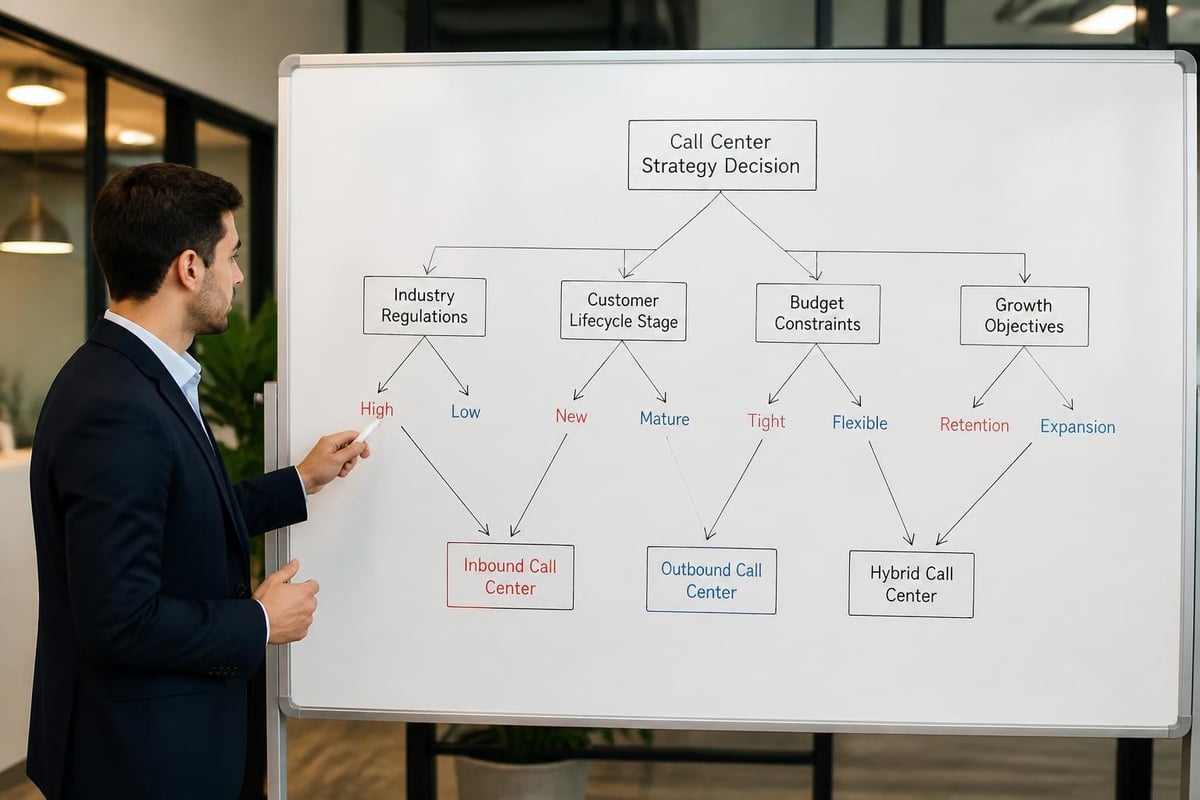
Selecting between inbound, outbound, or hybrid approaches depends on business objectives, customer lifecycle stage, and available resources. Companies focused on customer retention and support naturally gravitate toward inbound centers, while growth-oriented organizations prioritizing new customer acquisition emphasize outbound capabilities.
Assessment Framework
Begin by analyzing your customer interaction patterns and business goals:
- Determine primary objective: Customer service, sales generation, or balanced approach
- Evaluate customer base: Existing customers requiring support versus prospect targeting
- Assess regulatory environment: Industry-specific restrictions on outbound contact
- Review budget constraints: Initial investment capacity and ongoing operational costs
- Consider scalability needs: Growth projections and seasonal fluctuation patterns
For businesses in regulated industries like healthcare or financial services, compliance requirements may heavily influence model selection. Healthcare call centers must navigate HIPAA regulations, while financial services face strict telemarketing rules affecting outbound activities.
Industry-Specific Considerations
E-commerce businesses benefit from strong inbound support handling order inquiries, shipping questions, and returns processing. However, e-commerce call center outsourcing increasingly incorporates outbound elements for abandoned cart recovery and customer feedback collection.
Emergency services require specialized communication capabilities, such as those provided by Convey911, which offers real-time translation across 185 languages for critical situations. While not traditional inbound or outbound operations, emergency communication centers demonstrate how call technology adapts to unique requirements.
Technology companies often maintain robust inbound technical support while using outbound teams for product launches and upgrade campaigns. This balanced approach addresses both reactive troubleshooting needs and proactive customer engagement.
Technology Trends Shaping Both Models
Artificial intelligence and automation are transforming how both inbound and outbound call centers operate. Chatbots handle routine inbound inquiries, freeing agents for complex issues requiring human judgment. Predictive analytics identify optimal outbound contact times and personalize messaging based on prospect behavior patterns.
AI-Enabled Workforce Optimization
Modern workforce management platforms use machine learning to forecast call volumes with unprecedented accuracy, accounting for seasonal patterns, marketing campaign impacts, and external events. These systems optimize scheduling by matching agent skills to predicted demand types, reducing both understaffing and overstaffing scenarios.
Natural Language Processing (NLP) analyzes conversation content in real time, providing agents with response suggestions and identifying customer sentiment shifts. This technology proves valuable across both inbound problem resolution and outbound persuasion scenarios.
Voice biometrics enhance security in inbound authentication processes while helping outbound centers verify contact accuracy. Speech analytics extract insights from recorded calls, identifying training opportunities and compliance gaps across both operational models.
Cloud-Based Infrastructure
Cloud platforms enable rapid scaling for both inbound and outbound operations without significant capital expenditure. Geographic distribution becomes seamless, allowing businesses to leverage talent in different markets while maintaining centralized management and quality standards.
For organizations considering global expansion, cloud infrastructure supports operations across multiple time zones and languages. Companies can establish call centers in El Salvador, the Philippines, or South Africa while maintaining unified reporting and consistent service standards.
Security-conscious industries benefit from cloud providers' investments in data protection, compliance certifications, and disaster recovery capabilities. This proves particularly important when handling sensitive customer information across distributed teams.
Emerging Communication Channels
While voice remains central to call center operations, omnichannel strategies integrate email, chat, SMS, social media, and video communication. This expansion affects both inbound and outbound call strategies as customers expect consistent experiences across channels.
Inbound centers must route and prioritize communications regardless of channel while maintaining context as conversations shift between mediums. Outbound operations increasingly incorporate multi-channel campaigns where initial outreach via email or SMS precedes phone contact, improving connection rates and regulatory compliance.
For specialized use cases requiring secure connections or data scraping from call center analytics platforms, services like PinguProxy provide high-speed proxies with enhanced privacy features supporting both IPv4 and IPv6 protocols across global locations.
Outsourcing Considerations
Many businesses find that partnering with specialized providers delivers better results than building internal capabilities. Call center outsourcing offers access to established infrastructure, trained personnel, and proven processes without the capital investment and management burden of internal operations.
Evaluating Outsourcing Partners
When selecting a provider for either inbound or outbound call services, assess these critical factors:
- Industry expertise: Experience in your specific sector and understanding of regulatory requirements
- Technology capabilities: Platform sophistication and integration options with your existing systems
- Scalability: Ability to expand or contract capacity based on demand fluctuations
- Geographic presence: Location advantages for labor costs, language capabilities, and time zone coverage
- Security standards: Certifications and protocols protecting customer data and maintaining compliance
Established providers bring economies of scale impossible for individual companies to achieve. Shared infrastructure, bulk technology licensing, and specialized expertise reduce per-interaction costs while improving quality.
Global Delivery Models
Offshore, nearshore, and onshore delivery options each offer distinct advantages. Offshore centers in the Philippines or South Africa provide significant labor cost savings with strong English proficiency and technical capabilities. Nearshore locations like El Salvador offer cultural alignment and time zone compatibility with North American markets at moderate cost points.
Onshore centers deliver accent neutrality and deep cultural understanding at premium pricing. Many businesses adopt blended strategies, using offshore capacity for high-volume, straightforward interactions while retaining onshore resources for complex or sensitive communications.
Performance Management and Quality Control
Successful outsourcing relationships depend on clear service level agreements (SLAs), transparent reporting, and continuous improvement processes. Key performance indicators must align with business objectives whether focusing on inbound customer satisfaction or outbound conversion rates.
Regular quality monitoring through call reviews, customer surveys, and mystery shopping ensures standards maintenance. Technology integration allows real-time visibility into outsourced operations, enabling proactive issue identification and resolution.
Workforce Development and Agent Success
Regardless of operational model, agent performance determines call center success. Recruitment, training, and retention strategies directly impact service quality, operational costs, and business outcomes. The inbound and outbound call distinction influences every aspect of workforce management from job descriptions to compensation structures.
Recruitment and Selection
Inbound agents require patience, empathy, and strong listening skills combined with technical aptitude. Assessment processes should evaluate problem-solving capabilities, communication clarity, and stress management abilities. Customer service experience proves valuable but can be developed through comprehensive training.
Outbound representatives need resilience, self-motivation, and persuasive communication skills. Selection processes emphasize goal orientation, competitive drive, and ability to handle rejection without losing enthusiasm. Sales experience provides advantages but personality fit often predicts success more accurately than prior experience.
Training Program Design
Comprehensive onboarding introduces company culture, product knowledge, systems proficiency, and communication techniques. Inbound training emphasizes active listening, empathy demonstration, troubleshooting methodologies, and knowledge base navigation. Role-playing exercises simulate challenging customer scenarios building confidence before live interaction.
Outbound training focuses on script mastery while maintaining conversational authenticity, objection handling, closing techniques, and compliance requirements. Practice sessions with feedback loops accelerate skill development and identify coaching needs.
Ongoing development through refresher training, advanced skill workshops, and cross-functional exposure maintains engagement and performance. Technology-enabled learning platforms provide flexibility for continuous improvement without disrupting operations.
Retention Strategies
Call center roles experience notoriously high turnover rates, creating recruitment and training costs that undermine profitability. Retention initiatives should address compensation competitiveness, career advancement opportunities, work-life balance, and recognition programs.
Performance-based incentives align agent activities with business objectives while rewarding excellence. Career pathing from frontline agent to specialist, team lead, supervisor, and management roles provides advancement opportunities retaining top performers.
Work environment quality including ergonomic workstations, break facilities, and positive culture significantly impacts retention. Remote work options, particularly viable with cloud-based systems, expand talent pools and improve satisfaction for agents valuing flexibility.
Understanding the fundamental differences between inbound and outbound call operations enables businesses to design customer engagement strategies that align with organizational objectives and customer expectations. Whether you need responsive customer support, proactive sales campaigns, or integrated hybrid solutions, selecting the right approach and implementation partner determines program success. Focus Services delivers scalable call center outsourcing across global locations with expertise in both inbound customer care and outbound sales programs, supported by AI-enabled workforce optimization that drives measurable results for businesses seeking to expand support capacity while controlling costs.