

IT Outsourcing Support: A Complete Strategy Guide
Modern businesses face mounting pressure to maintain robust technology infrastructure while controlling operational expenses. The complexity of IT systems combined with the shortage of skilled technical professionals has driven organizations to seek external expertise. IT outsourcing support has evolved from a cost-cutting measure into a strategic approach that delivers specialized knowledge, 24/7 coverage, and scalable resources. Companies across industries now leverage outsourced IT services to maintain competitive advantages while focusing internal teams on core business objectives.
Understanding IT Outsourcing Support Models
Organizations can choose from several it outsourcing support frameworks depending on their specific requirements and operational structure. The traditional model involves complete transfer of IT operations to an external provider who assumes responsibility for infrastructure management, help desk services, and system maintenance. This comprehensive approach works well for companies seeking to eliminate internal IT departments entirely.
Alternatively, co-managed IT support allows businesses to retain key personnel while supplementing capabilities with external specialists. This hybrid model provides flexibility and knowledge transfer opportunities while maintaining some internal control.
Key Service Components
IT outsourcing support typically encompasses multiple service layers:
- First-line technical support for end-user issues and password resets
- Network monitoring and infrastructure management
- Security operations including patch management and threat detection
- Cloud services administration and migration support
- Disaster recovery planning and backup management
- Software licensing and vendor relationship management
The scope of services varies significantly based on provider capabilities and client needs. Some organizations outsource specific functions like security operations while maintaining other IT activities in-house.

Strategic Benefits for Business Operations
Cost reduction remains a primary driver for it outsourcing support adoption, but the financial advantages extend beyond simple labor arbitrage. Organizations eliminate expenses associated with recruitment, training, benefits, and turnover while converting fixed IT costs into variable expenses that scale with business needs.
Access to specialized expertise represents another compelling benefit. Technology evolves rapidly, and maintaining staff with current certifications across multiple domains becomes prohibitively expensive for most companies. Outsourced IT support providers invest continuously in training and certification programs, ensuring clients benefit from current best practices and emerging technologies.
Operational Improvements
| Benefit Category | Internal IT Team | Outsourced IT Support |
|---|---|---|
| Coverage Hours | Limited to business hours | 24/7/365 availability |
| Response Time | Depends on workload | Contractually guaranteed SLAs |
| Expertise Depth | Generalist knowledge | Specialized skill sets |
| Scalability | Requires hiring/training | Immediate resource adjustment |
| Technology Access | Capital investment required | Included in service agreements |
The data clearly demonstrates how outsourcing provides capabilities that would require substantial investment to replicate internally. Companies gain enterprise-grade infrastructure and support without corresponding capital expenditures.
Evaluating Provider Capabilities
Selecting an appropriate it outsourcing support partner requires thorough assessment of technical competencies, cultural alignment, and service delivery models. Research on IT outsourcing decisions highlights the importance of evaluating both internal organizational factors and external market conditions when making provider selections.
Organizations should begin by documenting current IT environments, identifying pain points, and establishing clear performance expectations. This foundation enables meaningful conversations with potential vendors and creates benchmarks for service level agreements.
Critical evaluation criteria include:
- Technical certifications and partnerships with major technology vendors
- Industry-specific experience relevant to your business sector
- Security protocols and compliance certifications matching regulatory requirements
- Financial stability ensuring long-term viability
- Reference accounts with similar organizational profiles
- Escalation procedures and account management structure
The due diligence process should involve speaking with current clients to understand day-to-day working relationships beyond polished sales presentations. Request specific examples of how providers handled complex technical challenges or service disruptions.
Service Level Agreement Structures
Effective SLAs define measurable performance standards covering response times, resolution targets, system uptime, and customer satisfaction metrics. Well-structured agreements include penalties for non-performance and bonus provisions rewarding exceptional service delivery.
Many organizations make the mistake of focusing exclusively on cost during vendor selection. While pricing matters, the cheapest option often delivers substandard service quality. Comprehensive guides on IT support outsourcing emphasize balancing cost considerations with quality metrics and strategic alignment.
Implementation Best Practices
Successful it outsourcing support transitions require careful planning and structured execution. Organizations should establish project teams combining internal stakeholders with provider representatives to manage knowledge transfer and minimize service disruptions.
The transition typically follows a phased approach beginning with non-critical systems before migrating essential business applications. This methodology reduces risk while allowing both parties to establish working relationships and refine communication protocols.

Communication Framework Development
Clear communication channels prevent misunderstandings and ensure rapid issue resolution. Establish regular touchpoints including:
- Daily operational briefings for active issues
- Weekly status meetings reviewing ticket metrics and trends
- Monthly business reviews examining strategic objectives
- Quarterly roadmap sessions planning technology initiatives
Documentation standards must be defined upfront, specifying how the provider records activities, maintains configuration databases, and reports on service delivery. Comprehensive documentation facilitates troubleshooting and supports knowledge continuity during staff transitions.
Security and Compliance Considerations
Data protection and regulatory compliance represent critical concerns when implementing it outsourcing support arrangements. Organizations remain ultimately responsible for safeguarding customer information and maintaining compliance regardless of outsourcing relationships.
Academic research on IT security outsourcing examines the complex factors influencing organizational decisions to outsource security functions, highlighting the importance of thorough risk assessment and contractual protections.
Essential security requirements include:
- Comprehensive background checks for personnel accessing systems
- Multi-factor authentication and privileged access management
- Encrypted communications for remote support sessions
- Regular security audits and penetration testing
- Incident response procedures with defined notification requirements
- Data sovereignty considerations for international providers
Industry-specific regulations like HIPAA, PCI-DSS, or GDPR impose additional requirements that must be reflected in service agreements. Verify that potential providers maintain relevant compliance certifications and understand your regulatory obligations.
Risk Mitigation Strategies
Organizations should maintain certain capabilities internally even when outsourcing most IT functions. Retaining knowledge of critical systems, business applications, and vendor relationships prevents complete dependence on external providers.
Business continuity planning must address scenarios where the outsourcing relationship terminates unexpectedly. Contractual provisions should require knowledge transfer, documentation delivery, and transition assistance periods.
Technology Integration and Automation
Modern it outsourcing support leverages advanced technologies to improve efficiency and service quality. Artificial intelligence and machine learning enable predictive maintenance, automated ticket routing, and intelligent problem resolution.
Leading providers implement self-service portals allowing users to resolve common issues without creating support tickets. These systems reduce workload on technical staff while improving user satisfaction through immediate problem resolution.
| Technology | Application | Business Impact |
|---|---|---|
| AI Chatbots | First-line support automation | 40-60% reduction in ticket volume |
| Remote Monitoring | Proactive issue detection | 70% fewer critical incidents |
| Workflow Automation | Ticket routing and escalation | 50% faster average resolution time |
| Knowledge Management | Self-service problem solving | 30% improvement in user satisfaction |
The automation capabilities available through professional outsourcing providers far exceed what most organizations could develop internally. These technologies represent significant competitive advantages for businesses leveraging external IT support.
Just as companies seek specialized freelance developers for specific technical projects, organizations benefit from accessing niche IT expertise through outsourcing relationships without maintaining those skills on permanent staff.
Performance Measurement and Optimization
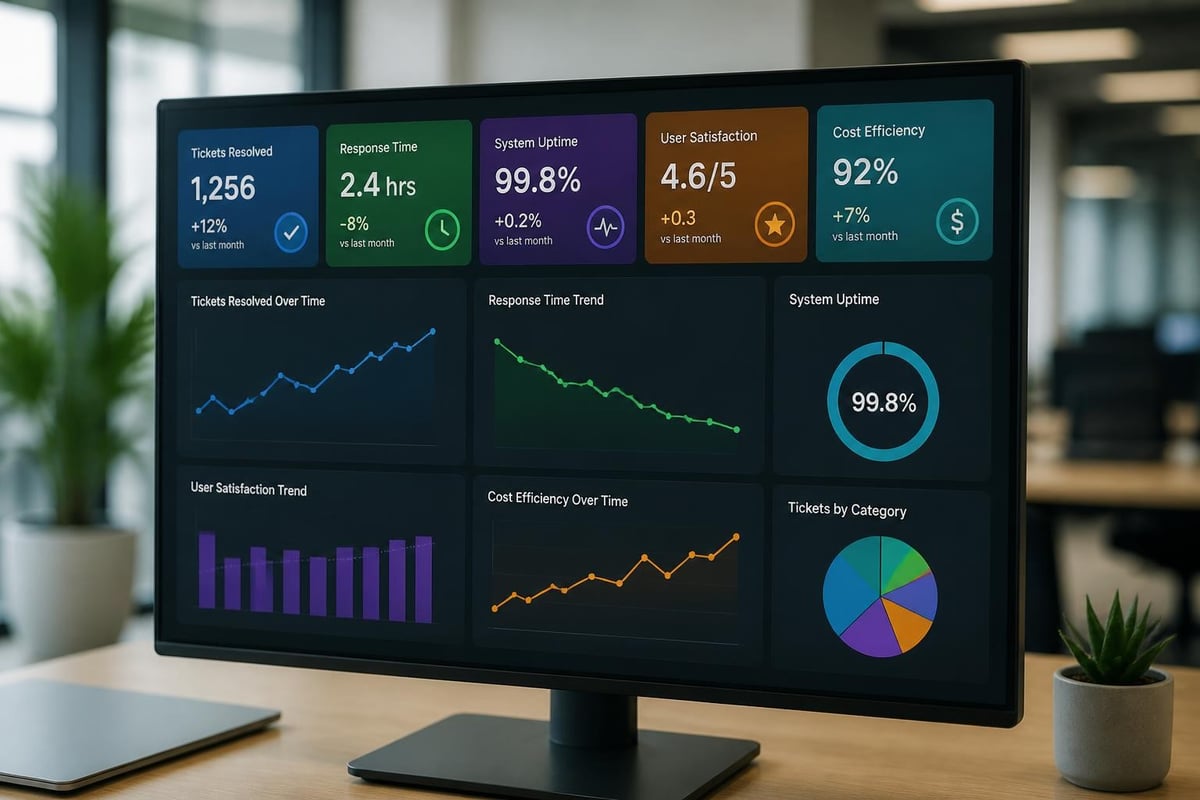
Effective it outsourcing support relationships require continuous monitoring and improvement. Organizations should establish comprehensive metrics covering technical performance, user satisfaction, and business impact.
Key performance indicators typically include:
- First contact resolution rate
- Average response and resolution times by priority level
- System uptime and availability percentages
- Customer satisfaction scores from end users
- Ticket backlog and aging reports
- Mean time to resolution for critical incidents
Regular performance reviews identify trends, highlight improvement opportunities, and ensure alignment with evolving business requirements. Research on transformational IT outsourcing demonstrates how strategic outsourcing relationships drive competitive advantage when properly managed and continuously optimized.
Continuous Improvement Processes
The most successful outsourcing relationships embrace collaborative improvement methodologies. Providers should present regular recommendations for process enhancements, technology upgrades, and cost optimization opportunities.
Organizations benefit from providers who invest in understanding business objectives beyond immediate technical requirements. This strategic perspective enables IT support to drive business value rather than simply maintaining existing systems.
Call Center and IT Support Synergies
Companies operating customer-facing call centers recognize natural synergies between customer support operations and technical infrastructure management. Both functions require similar capabilities including ticketing systems, knowledge management platforms, and quality assurance processes.
Organizations like Focus Services that provide comprehensive BPO solutions understand how integrated support models improve overall service delivery. When customer support teams work closely with IT infrastructure specialists, technical issues affecting customer interactions receive immediate attention and rapid resolution.
This integration proves particularly valuable for companies supporting technology products or services where customer inquiries frequently involve technical troubleshooting. Seamless coordination between customer service representatives and IT support staff eliminates handoff delays and improves first-contact resolution rates.
Workforce Optimization Through Technology
AI-enabled workforce management tools optimize both call center operations and IT support delivery. These platforms analyze historical patterns to predict demand, optimize staffing levels, and route work to appropriately skilled resources.
Best practices for IT help desk outsourcing emphasize the importance of selecting providers with proven track records in workforce optimization and performance management.
Geographic Distribution and Follow-the-Sun Support
Global it outsourcing support arrangements enable true 24/7 coverage through strategically distributed service delivery locations. Organizations leverage time zone differences to provide continuous support without requiring night shift premiums or overtime costs.
The follow-the-sun model routes work to teams beginning their business day, ensuring fresh, alert personnel handle all support requests. This approach improves quality while reducing costs compared to single-location operations running multiple shifts.
Geographic considerations include:
- Language capabilities and cultural alignment with user populations
- Political and economic stability in service delivery locations
- Data sovereignty and privacy regulations affecting different jurisdictions
- Telecommunications infrastructure quality and redundancy
- Disaster recovery and business continuity implications
Many organizations combine nearshore and offshore resources to balance cost efficiency with proximity benefits. Case studies on IT outsourcing transformations demonstrate how thoughtful geographic distribution improves service quality while optimizing costs.
Financial Modeling and ROI Analysis
Comprehensive financial analysis must account for both direct and indirect costs when evaluating it outsourcing support investments. While outsourcing agreements involve clear monthly or annual fees, internal IT operations include numerous hidden expenses.
Organizations should calculate total cost of ownership including salaries, benefits, training, recruitment, facilities, hardware, software licensing, and management overhead. This complete picture enables accurate comparison with outsourcing proposals.
| Cost Category | Internal IT Team | Outsourced Model |
|---|---|---|
| Direct Labor | $850K-$1.2M annually | Included in service fee |
| Benefits/Taxes | 30-40% of salaries | No additional cost |
| Training/Certification | $15K-$25K annually | Provider responsibility |
| Infrastructure | $200K-$400K capital | Operational expense |
| Software Licensing | $100K-$200K annually | Often included |
| Management Overhead | 15-20% of IT budget | Reduced significantly |
Documented case studies show organizations achieving 20-40% total cost reductions through strategic IT outsourcing while simultaneously improving service levels and expanding capabilities.
Return on Investment Timeline
Most organizations realize positive ROI from it outsourcing support within 12-18 months of implementation. Initial transition costs and learning curves delay immediate savings, but sustained operational efficiencies generate substantial long-term value.
Beyond direct cost savings, organizations should quantify benefits from improved uptime, faster issue resolution, and enhanced security postures. Preventing a single major data breach or system outage often justifies years of outsourcing investments.
Building Effective Partnerships
The most successful it outsourcing support relationships transcend traditional vendor-client dynamics to become true strategic partnerships. Both parties invest in understanding each other's businesses, challenges, and objectives.
Organizations should consider multiple factors when establishing provider relationships, including cultural compatibility, communication styles, and alignment of values and business practices.
Regular executive sponsorship from both organizations signals commitment to the partnership's success. These relationships require nurturing through consistent communication, fair treatment during disputes, and willingness to collaborate on continuous improvement initiatives.
Transparency regarding challenges, changing requirements, and performance concerns prevents small issues from escalating into relationship-threatening problems. The best partnerships feature open dialogue and mutual problem-solving rather than adversarial blame assignment.
Strategic IT outsourcing support enables organizations to access enterprise-grade technical capabilities while optimizing costs and focusing internal resources on core business activities. The key to success lies in thorough provider evaluation, clear performance expectations, and ongoing partnership management that drives continuous improvement.
Focus Services brings decades of outsourcing expertise and global delivery capabilities to help organizations transform their support operations. With proven methodologies for seamless transitions, advanced technology platforms, and teams distributed across four continents, we deliver the scalable, high-quality IT and customer support services that modern businesses require. Contact us today to discuss how our comprehensive BPO solutions can enhance your operational efficiency and service excellence.