

Outbound Call Strategies for Call Center Success
An outbound call represents one of the most direct methods for businesses to connect with prospects, nurture leads, and generate revenue. Unlike inbound operations where customers initiate contact, outbound calling requires strategic planning, skilled execution, and continuous optimization. For organizations leveraging call center outsourcing, understanding the fundamentals of outbound operations becomes essential for achieving measurable business outcomes and maintaining competitive advantage in today's market.
Understanding Outbound Call Operations
An outbound call occurs when contact center agents initiate communication with prospects or existing customers for specific business purposes. These calls serve multiple functions including lead generation, sales conversions, appointment setting, market research, customer surveys, and payment collection. The strategic value of outbound operations lies in their proactive nature, enabling businesses to control the conversation flow and timing.
Key Differences Between Outbound and Inbound
The fundamental distinction between outbound and inbound operations shapes how teams prepare, execute, and measure success. Inbound centers focus on response times and resolution rates, while outbound call center solutions emphasize contact rates, conversion percentages, and revenue generation.
Operational Characteristics:
- Agent Preparation: Outbound agents require extensive product knowledge and objection-handling skills
- Technology Requirements: Predictive dialers, CRM integration, and call recording systems
- Performance Metrics: Connection rates, talk time, conversion rates, and revenue per hour
- Compliance Considerations: TCPA regulations, do-not-call lists, and consent management
Organizations typically maintain separate teams for outbound operations, as the skill sets differ significantly from customer service roles. Training programs focus on persuasion techniques, script adaptation, and resilience building to handle rejection effectively.

Strategic Planning for Outbound Campaigns
Successful outbound operations begin with comprehensive campaign planning that aligns business objectives with tactical execution. According to best practices for outbound calls, organizations that invest time in upfront planning achieve significantly higher conversion rates than those taking ad-hoc approaches.
Defining Campaign Objectives
Every outbound campaign requires clearly defined goals that guide strategy development and resource allocation. Common objectives include generating qualified leads, scheduling product demonstrations, conducting customer satisfaction surveys, reactivating dormant accounts, or collecting overdue payments.
Campaign Success Factors:
- Target Audience Segmentation: Divide contact lists by demographics, purchase history, engagement level, and behavioral patterns
- Value Proposition Development: Craft compelling messaging that addresses specific pain points for each segment
- Timing Optimization: Identify optimal contact windows based on industry research and historical performance data
- Resource Allocation: Assign appropriate agent numbers, technology infrastructure, and budget commitments
- Quality Assurance Protocols: Establish monitoring procedures and coaching frameworks
| Campaign Type | Primary Objective | Key Metric | Typical Timeline |
|---|---|---|---|
| Lead Generation | New prospect identification | Qualified leads per hour | 30-90 days |
| Sales Conversion | Revenue generation | Conversion rate percentage | 60-120 days |
| Appointment Setting | Meeting confirmations | Appointments scheduled | 15-45 days |
| Customer Retention | Reduce churn rates | Retention percentage | Ongoing |
The planning phase should incorporate lessons learned from previous campaigns, competitor analysis, and market research to refine approaches continuously.
Technology Infrastructure and Tools
Modern outbound call operations rely on sophisticated technology platforms that enhance productivity, ensure compliance, and provide actionable insights. AI-enabled workforce optimization has transformed how organizations manage outbound campaigns, introducing automation and intelligence throughout the calling process.
Essential Technology Components
Dialing Systems:
Predictive dialers automatically call multiple numbers simultaneously, connecting answered calls to available agents while filtering out busy signals, voicemails, and disconnected numbers. This technology dramatically increases agent talk time by minimizing idle periods between conversations.
Progressive dialers offer a more controlled approach, placing one call per agent to ensure adequate preparation time before each interaction. Power dialers sit between these options, calling a predetermined ratio of numbers per available agent.
Integration Capabilities:
- CRM platforms for real-time data access and update synchronization
- Call recording systems for quality monitoring and compliance documentation
- Speech analytics tools for sentiment analysis and keyword tracking
- Workforce management software for scheduling and performance tracking
Organizations should evaluate technology providers based on scalability, integration capabilities, compliance features, and reporting functionality. The right infrastructure enables agents to focus on conversation quality rather than administrative tasks.

Agent Training and Development
The human element remains critical to outbound success despite technological advancements. Comprehensive training programs prepare agents to handle diverse scenarios while maintaining compliance and delivering positive customer experiences. BPO services providers invest heavily in ongoing development to maintain competitive performance levels.
Core Competency Development
Effective outbound agents master several fundamental skills that separate top performers from average contributors. Active listening enables agents to identify prospect needs and adapt messaging accordingly. Objection handling transforms common rejections into opportunities for further engagement.
Training Program Elements:
- Product Expertise: Comprehensive knowledge of features, benefits, pricing, and competitive advantages
- Communication Skills: Voice modulation, pacing control, and professional language usage
- Resilience Building: Psychological preparation for rejection and motivation maintenance
- Compliance Understanding: Regulatory requirements, consent protocols, and legal boundaries
- Technology Proficiency: System navigation, data entry accuracy, and troubleshooting capabilities
Role-playing exercises provide safe environments for practicing difficult conversations before engaging real prospects. Side-by-side coaching allows experienced agents to mentor newer team members through live call examples.
Performance Optimization Strategies
Continuous improvement requires regular feedback loops and performance analysis. Quality monitoring reviews random call samples against established criteria, identifying strengths and development opportunities. Coaching sessions translate observations into actionable improvement plans with specific behavioral targets.
The most effective programs combine individual performance metrics with team-based incentives, fostering both personal accountability and collaborative support. Recognition programs celebrate achievements and reinforce desired behaviors across the organization.
Best Practices for Execution Excellence
Implementing proven methodologies significantly improves outbound call outcomes. Research from industry experts demonstrates that organizations following structured best practices achieve conversion rates 30-50% higher than those using inconsistent approaches.
Contact Strategy Development
Optimal Timing Considerations:
Studies consistently show that certain timeframes produce better connection rates than others. Mid-morning periods between 10:00 AM and 11:30 AM typically yield strong results, as do early afternoon windows from 2:00 PM to 4:00 PM. Wednesday and Thursday generally outperform other weekdays for business-to-business calling.
However, timing optimization requires continuous testing specific to your target audience. Consumer-focused campaigns may find evening hours more productive, while healthcare providers might respond better during lunch breaks.
Script Framework and Flexibility
Scripts provide structure and ensure consistent messaging, but rigid adherence often sounds robotic and disengages prospects. The optimal approach establishes frameworks with key talking points while allowing agents to adapt delivery based on conversation flow.
Effective Script Components:
- Compelling Opening: Clear identification and immediate value statement within first 10 seconds
- Discovery Questions: Open-ended inquiries that uncover needs and pain points
- Benefit Presentation: Solutions framed in terms of prospect outcomes rather than features
- Objection Responses: Pre-developed answers to common concerns and hesitations
- Call-to-Action: Specific next steps with clear expectations and commitments
Agents should master core messages while developing natural conversational styles. Implementing multi-channel approaches that combine phone outreach with email, text, and social media touches increases overall campaign effectiveness.
Performance Metrics and Analytics
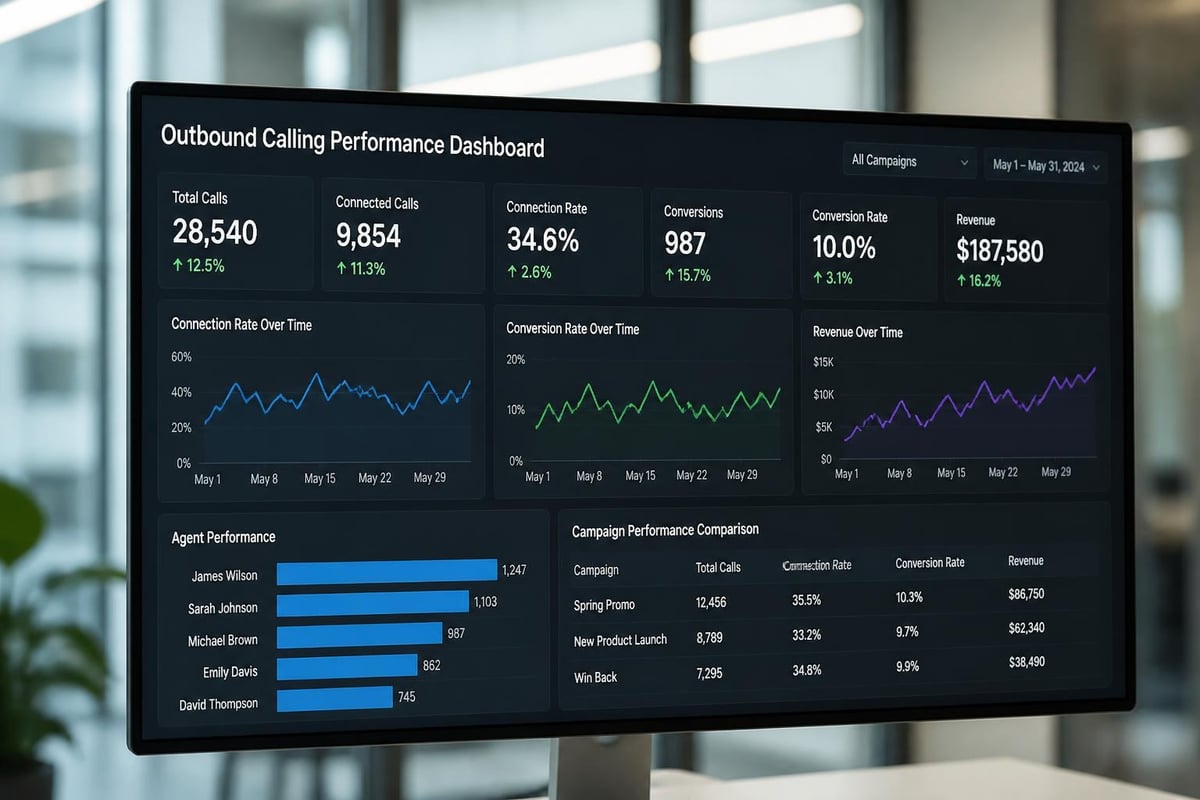
Measurement drives improvement in outbound operations. Comprehensive metric tracking reveals performance trends, identifies optimization opportunities, and quantifies return on investment. Understanding outbound call statistics enables data-driven decision making throughout campaign lifecycles.
Key Performance Indicators
| Metric Category | Specific KPI | Calculation Method | Target Range |
|---|---|---|---|
| Efficiency | Contact Rate | Connections / Total Attempts | 25-40% |
| Productivity | Talk Time Percentage | Conversation Minutes / Total Hours | 60-75% |
| Effectiveness | Conversion Rate | Sales / Qualified Conversations | 15-30% |
| Quality | First Call Close | Same-Call Conversions / Total Sales | 40-60% |
Contact Metrics:
Dial-to-connect ratios measure how many attempts produce actual conversations. Low connection rates may indicate list quality issues, incorrect timing, or technical problems requiring investigation.
Conversion Tracking:
Beyond basic conversion percentages, sophisticated analytics examine conversion by time of day, agent, script variant, and prospect segment. This granular analysis identifies specific improvement opportunities that aggregate metrics might obscure.
Analytics-Driven Optimization
Modern analytics platforms apply machine learning algorithms to predict optimal calling times for individual prospects based on historical engagement patterns. Sentiment analysis evaluates conversation tone and emotional indicators, alerting supervisors to potentially problematic interactions requiring immediate intervention.
Performance dashboards provide real-time visibility into campaign progress, enabling rapid adjustments when results deviate from expectations. Automated reporting eliminates manual data compilation, freeing managers to focus on strategic analysis rather than administrative tasks.
Compliance and Regulatory Considerations
Legal compliance represents a non-negotiable requirement for outbound operations. Violations carry severe financial penalties and reputational damage that far exceed any short-term gains from non-compliant practices. Organizations must implement robust compliance frameworks protecting both the business and consumers.
Regulatory Framework Understanding
The Telephone Consumer Protection Act (TCPA) restricts calling practices including automated dialing systems, pre-recorded messages, and contact timing. National Do Not Call Registry compliance requires regular list scrubbing to remove registered numbers before campaign launches.
Compliance Requirements:
- Written consent documentation for marketing communications
- Call time restrictions limiting contact to 8:00 AM – 9:00 PM recipient local time
- Immediate honoring of opt-out requests with confirmation documentation
- Accurate caller identification information transmission
- Recording disclosure notifications in applicable jurisdictions
State-level regulations may impose additional requirements beyond federal standards. Multi-state campaigns require careful analysis of varying regulations to ensure comprehensive compliance across all operating jurisdictions.
Internal Control Mechanisms
Quality assurance programs should include dedicated compliance monitoring components. Regular call reviews verify proper disclosure language, consent verification, and opt-out handling procedures. Documentation systems maintain detailed records of consent, opt-outs, and communication history for each contact.
Agent training emphasizes compliance as a core competency rather than secondary concern. Clear policies outline prohibited practices and escalation procedures when questions arise during live interactions.
Scaling Operations Effectively
Growth presents unique challenges for outbound operations. Maintaining quality while expanding volume requires careful planning and phased implementation. Successful scaling balances capacity increases with infrastructure development and quality preservation.
Capacity Planning Strategies
Forecasting call volume needs based on campaign objectives determines required agent headcount. Organizations should account for training time, ramp-up periods, and attrition when calculating staffing requirements. Building 10-15% capacity buffer accommodates unexpected fluctuations without compromising service levels.
Infrastructure Scaling Considerations:
Technology platforms must support increased concurrent users without performance degradation. Load testing validates system capacity before major expansions launch. Cloud-based solutions offer greater scalability than on-premise installations, enabling rapid adjustment to changing demands.
Partnering with experienced providers offering global call center outsourcing enables businesses to access proven infrastructure and trained personnel without significant capital investment. Multi-location strategies distribute risk and provide business continuity protection against regional disruptions.
Campaign Optimization Techniques
Continuous improvement methodologies transform good campaigns into exceptional performers. Systematic testing identifies winning approaches while eliminating ineffective tactics. According to outbound campaign best practices, organizations implementing structured optimization processes achieve 40% better results than those maintaining static approaches.
A/B Testing Frameworks
Controlled experiments compare different approaches across similar audience segments. Script variations test alternative value propositions, opening statements, or call-to-action language. Timing tests determine optimal contact windows for specific industries or demographic groups.
Testing Variables:
- Opening statements and value proposition framing
- Question sequences and discovery approach variations
- Objection handling techniques and response frameworks
- Closing methods and commitment request language
- Follow-up timing and communication channel selection
Valid testing requires adequate sample sizes and controlled variables to produce statistically significant results. Running too many simultaneous tests creates confusion and dilutes insights, while testing too few variables limits optimization potential.
Feedback Integration Cycles
Agent feedback provides frontline insights into prospect responses, competitive objections, and market trends. Regular debriefing sessions capture these observations for campaign refinement. Customer feedback from surveys and follow-up communications reveals perception gaps between intended and received messaging.
Analytics review sessions examine performance data against campaign objectives, identifying trends and anomalies requiring investigation. Successful organizations establish monthly optimization cycles incorporating testing results, feedback analysis, and strategic adjustments.
Technology Integration and Automation
Advanced automation streamlines repetitive tasks while freeing agents to focus on high-value activities requiring human judgment and emotional intelligence. AI voice agents handle initial qualification, appointment confirmation, and data collection, escalating complex situations to human agents.
Intelligent Call Routing
Smart routing algorithms match prospects with agents based on skills, experience, product expertise, and historical performance. Language matching ensures cultural alignment and communication effectiveness for diverse prospect populations.
Automation Opportunities:
- Voicemail detection and automated message delivery
- Initial qualification questions and data capture
- Appointment scheduling and calendar integration
- Follow-up reminder systems and task creation
- Post-call documentation and CRM updates
Robotic process automation handles administrative workflows including data entry, list preparation, and compliance verification. This technology integration reduces human error while accelerating campaign execution timelines.
Predictive Analytics Applications
Machine learning models analyze historical campaign data to identify patterns predicting successful outcomes. Lead scoring algorithms prioritize contact attempts based on conversion probability, maximizing agent productivity by focusing efforts on highest-potential prospects.
Churn prediction models identify at-risk customers requiring proactive retention outreach before defection occurs. These predictive capabilities transform reactive operations into proactive strategic initiatives that preserve revenue and strengthen customer relationships.
Mastering outbound call operations requires balancing strategic planning, technology optimization, agent development, and continuous improvement methodologies. Organizations that implement these proven practices while maintaining compliance and quality standards position themselves for sustainable growth and competitive advantage. Focus Services delivers comprehensive outbound call solutions backed by global infrastructure, advanced technology platforms, and experienced teams across the United States, El Salvador, the Philippines, and South Africa, enabling businesses to scale operations efficiently while maintaining exceptional performance standards that drive measurable results.