
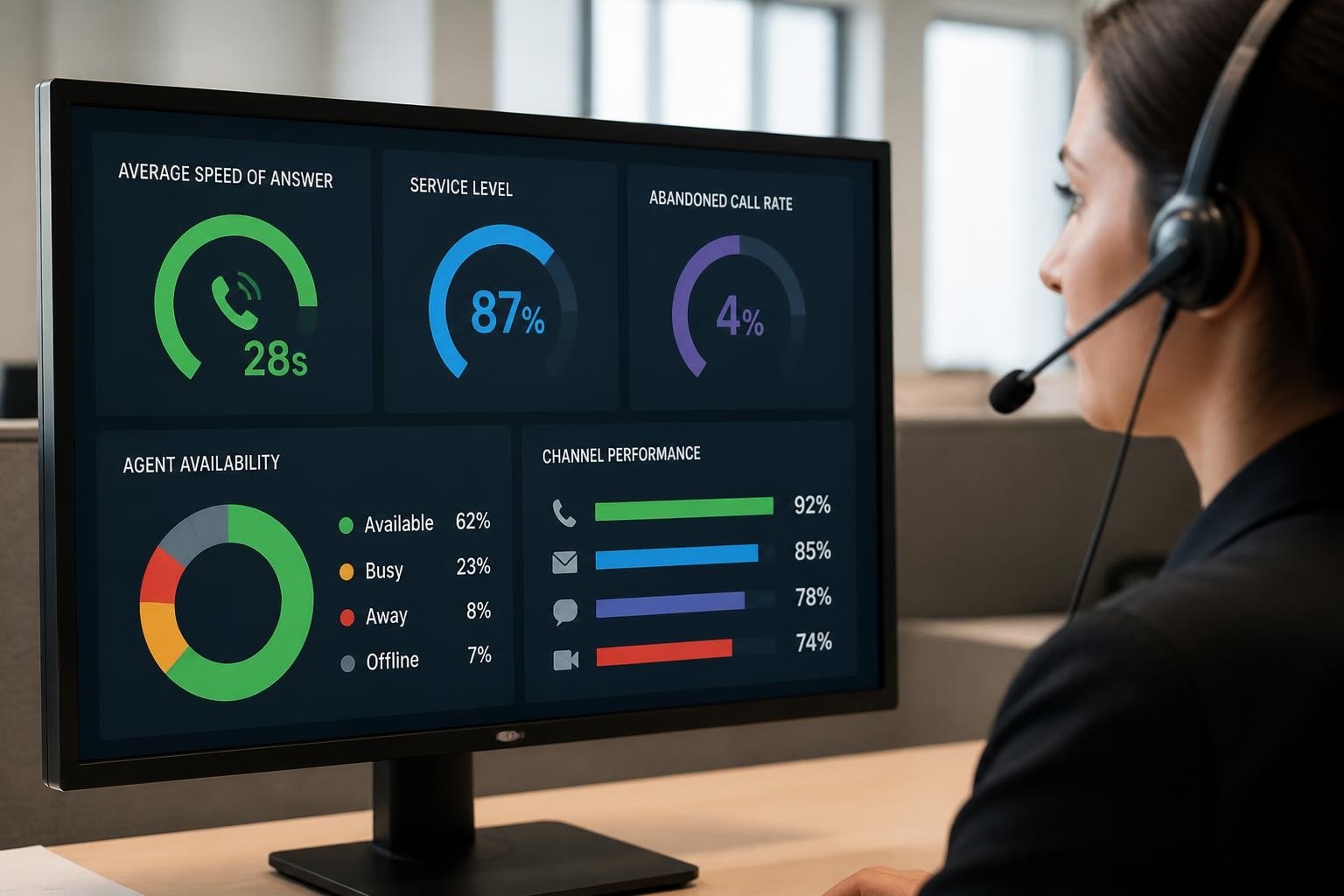
Contact Center Service Level: Metrics That Drive Success
Contact center service level stands as one of the most critical performance indicators in modern customer service operations. This metric directly measures how effectively your operation answers incoming contacts within a specified timeframe, typically expressed as a percentage of calls answered within a target threshold. For businesses evaluating outsourcing partners or optimizing internal operations, understanding and maintaining optimal service levels can mean the difference between customer loyalty and churn, operational efficiency and chaos, competitive advantage and market disadvantage.
Understanding Contact Center Service Level Fundamentals
Contact center service level represents the percentage of contacts handled within a predetermined time threshold. The industry standard formula typically follows an 80/20 model: 80% of calls answered within 20 seconds. However, this benchmark isn't universal across all industries or contact types.
The service level metric encompasses both speed and consistency. A contact center might answer 95% of calls in under 10 seconds one hour, then drop to 60% the next hour. That volatility signals staffing problems, forecasting errors, or process inefficiencies that undermine customer experience.
Why Service Level Matters Beyond Speed
Speed alone doesn't guarantee satisfaction. Contact center service level serves multiple strategic functions:
- Customer experience barometer: Shorter wait times correlate strongly with higher satisfaction scores and reduced frustration
- Operational health indicator: Consistent service levels reflect accurate forecasting, appropriate staffing, and effective scheduling
- Cost management tool: Balancing service level targets against staffing costs drives profitability without sacrificing quality
- Competitive differentiator: Superior service levels become a market advantage in industries where customers have multiple options
Service level also functions as an early warning system. When performance degrades, it signals underlying problems before they cascade into larger operational failures or customer defections.
Setting Appropriate Service Level Targets
Not every contact center should chase the same service level goal. Target-setting requires careful analysis of customer expectations, business economics, and operational constraints.
Industry-Specific Benchmarks
Different sectors demand different service level standards based on customer urgency and value:
| Industry | Typical Target | Rationale |
|---|---|---|
| Emergency Services | 90/10 | Life-threatening situations demand immediate response |
| Financial Services | 80/20 | Time-sensitive transactions and regulatory expectations |
| E-commerce Support | 75/30 | Balance between responsiveness and cost efficiency |
| Technical Support | 70/60 | Complex issues benefit from prepared agents over speed |
These benchmarks provide starting points, not absolute rules. A customer service call center serving premium brands might justify tighter targets based on customer lifetime value, while high-volume, low-margin operations might optimize for slightly relaxed thresholds.
Contact Segmentation Strategies
Advanced operations segment contacts by type, channel, or customer tier before applying service level targets. Priority routing ensures high-value customers or urgent issues receive preferential treatment.
Industry expert Brad Cleveland recommends aligning service level commitments with specific customer priorities rather than applying blanket targets across all contact types. This segmentation approach recognizes that not all contacts carry equal business impact.
For example, a travel call center outsourcing operation might enforce stricter service levels for flight cancellation inquiries than for general information requests, reflecting the urgency and revenue implications of each contact type.
The Mathematics Behind Service Level Performance
Contact center service level depends on complex queueing theory that balances arrival patterns, service times, and agent availability. Understanding these mathematical relationships helps leaders make informed staffing decisions.
Erlang C and Workforce Planning
The Erlang C formula predicts service level outcomes based on call volume, average handle time, and agent count. This mathematical model assumes random call arrivals and exponential service times.
Key variables include:
- Arrival rate: Number of contacts entering the queue per time period
- Service rate: Average contacts handled per agent per time period
- Number of agents: Total staff available to handle contacts
- Target answer time: Threshold for service level calculation
While Erlang C provides valuable predictions for traditional voice queues, its assumptions break down in complex, omnichannel environments. Academic research on telephone call centers explores both the power and limitations of analytical queueing models for service level forecasting.
When Simple Models Fall Short
Modern contact centers face complications that challenge basic Erlang calculations:
- Multiple contact channels: Email, chat, social media, and voice require different handling approaches
- Agent multiskilling: Representatives handling multiple contact types introduce complexity
- Non-stationary arrivals: Call volume fluctuations throughout the day violate steady-state assumptions
- Abandonment behavior: Customers who hang up during wait times alter queue dynamics
Simulation-based approaches offer more accurate predictions when these complex conditions exist, allowing workforce planners to model contact center service level under realistic scenarios that analytical formulas cannot capture.
Measuring and Monitoring Service Level Performance
Accurate measurement forms the foundation of service level management. Without reliable data, optimization becomes guesswork rather than science.
Essential Metrics and Relationships
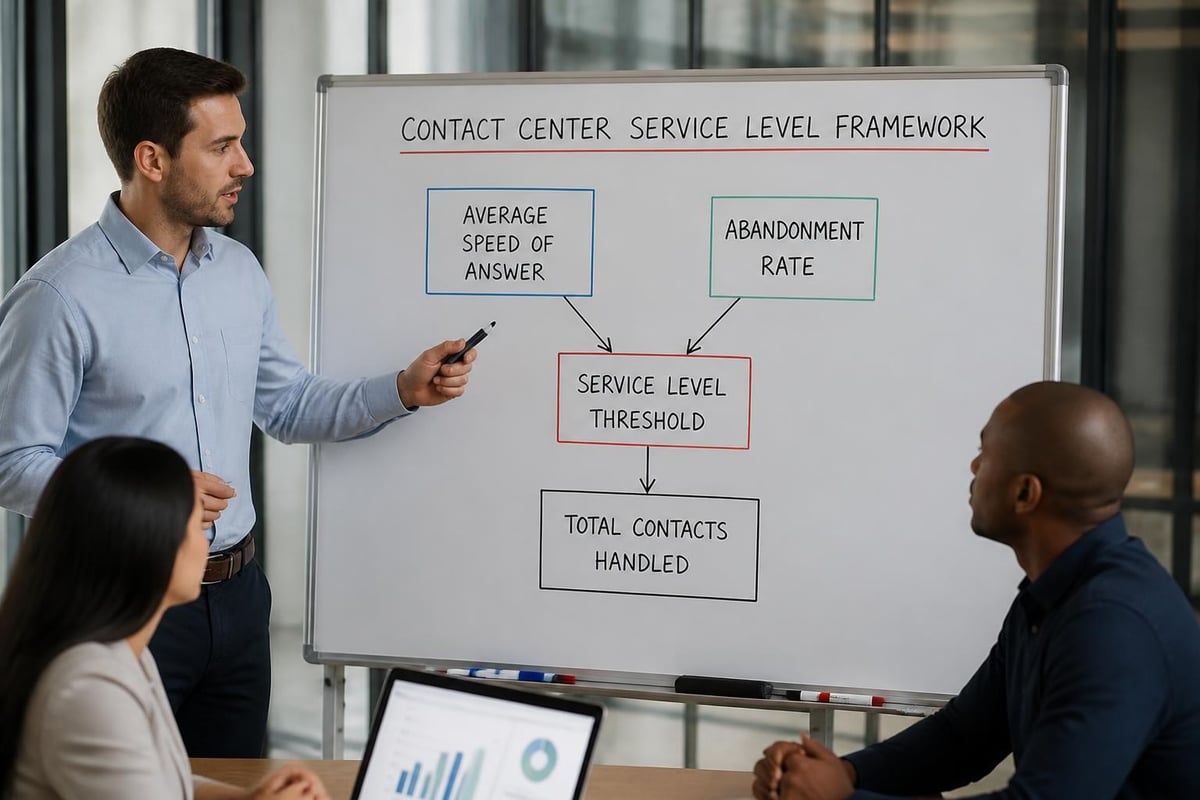
Contact center service level exists within a constellation of interdependent metrics:
| Metric | Definition | Relationship to Service Level |
|---|---|---|
| Average Speed of Answer (ASA) | Mean time customers wait before agent connection | Lower ASA improves service level percentage |
| Abandonment Rate | Percentage of callers who hang up before reaching an agent | High abandonment indicates poor service level |
| Occupancy | Percentage of time agents spend handling contacts | Higher occupancy may degrade service level |
| Schedule Adherence | How closely agents follow assigned schedules | Poor adherence directly damages service level |
The WFM Labs framework for schedule quality metrics demonstrates how workforce management disciplines directly influence contact center service level outcomes through proper scheduling, adherence monitoring, and capacity planning.
Real-Time vs. Interval-Based Tracking
Service level can be measured across different timeframes, each providing distinct insights:
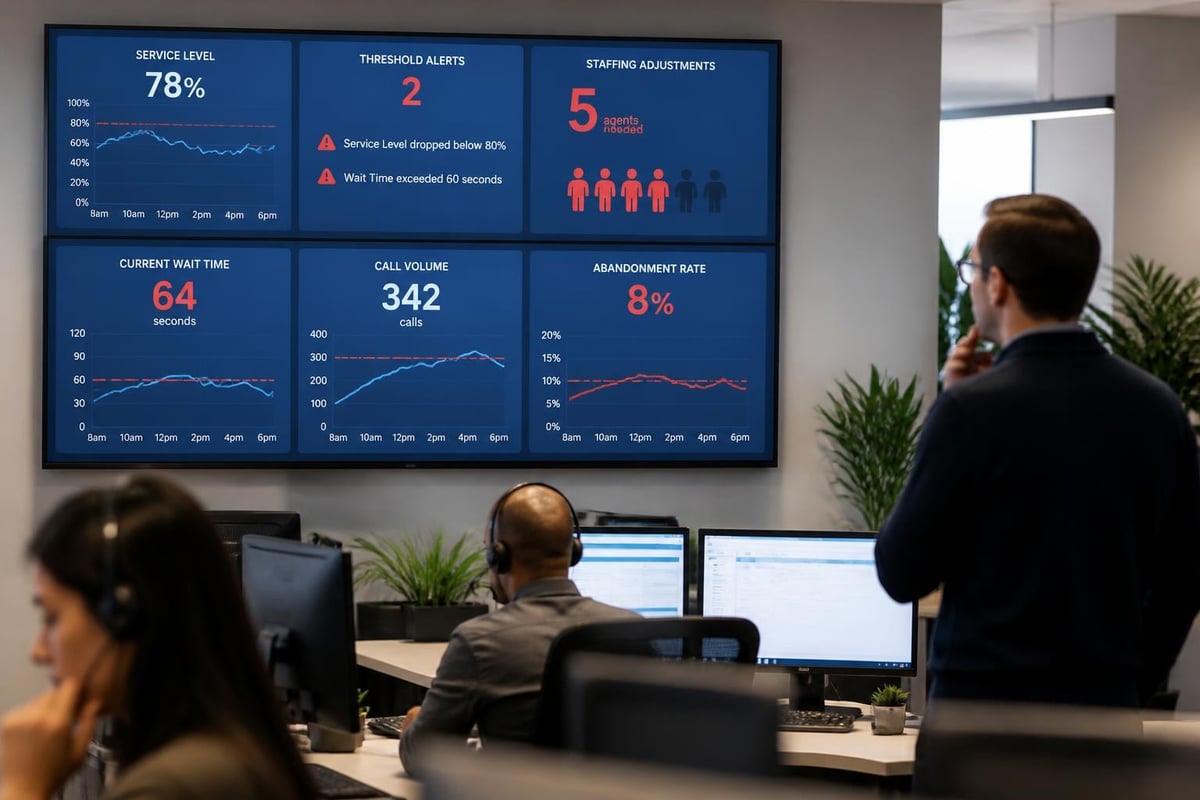
Real-time monitoring shows current performance, enabling immediate interventions when service level deteriorates. Supervisors can reassign agents, adjust breaks, or activate overflow protocols to address emerging problems.
Interval-based reporting evaluates performance across 15-minute, 30-minute, or hourly blocks. This granularity reveals patterns in staffing efficiency and forecast accuracy that daily or weekly aggregates might obscure.
Daily and weekly summaries provide trend analysis and executive reporting, though they can mask significant intraday volatility that impacts customer experience.
Balancing Service Level Against Other Priorities
Maximizing contact center service level at any cost creates its own problems. Smart operations balance speed against quality, cost, and agent wellbeing.
The Quality-Speed Tradeoff
Aggressive service level targets can pressure agents to rush through contacts, sacrificing resolution quality for speed. This approach produces several negative consequences:
- Increased repeat contacts as issues remain unresolved
- Lower first-call resolution rates
- Agent stress and burnout
- Reduced customer satisfaction despite shorter wait times
The balanced scorecard approach recommended by COPC embeds contact center service level within a broader performance management framework that includes quality, efficiency, customer satisfaction, and employee engagement metrics.
Cost Optimization Strategies
Staffing to achieve 95/15 service level costs significantly more than 80/20, yet the customer experience improvement may not justify the expense. Economic modeling helps identify the optimal service level target where marginal cost equals marginal benefit.
Consider these cost factors:
- Labor expenses: Additional agents required to meet tighter service levels
- Technology investments: Tools enabling better forecasting and scheduling efficiency
- Opportunity costs: Resources diverted from other improvement initiatives
- Revenue protection: Value of reduced abandonment and improved customer retention
Organizations using outsourcing services can leverage provider expertise and economies of scale to achieve superior service levels at lower total cost than internal operations.
Advanced Service Level Agreement Management
When outsourcing contact center operations, service level commitments transition from internal metrics to contractual obligations with financial implications.
SLA Structure and Penalties
Service Level Agreements formalize contact center service level expectations between clients and providers. Well-constructed SLAs include:
- Performance thresholds: Specific targets for service level percentage and measurement intervals
- Reporting requirements: Frequency, format, and detail of performance reports
- Penalty provisions: Financial consequences for sustained performance failures
- Remedy periods: Timeframes for correcting performance issues before penalties apply
- Force majeure clauses: Exceptions for extraordinary circumstances beyond provider control
Academic research on Service Level Agreements examines monitoring approaches and management frameworks that ensure both parties fulfill contractual commitments while maintaining operational flexibility.
Managing Seasonal and Campaign Fluctuations
Contact center service level performance faces predictable and unpredictable volume variations:
Predictable patterns include:
- Holiday shopping surges for retail support
- Tax season spikes for financial services
- Monday morning volume increases across most industries
- Year-end benefits inquiries for healthcare
Unpredictable events include:
- Product recalls or service outages
- Viral social media incidents
- Weather emergencies
- Competitive market disruptions
Effective SLAs acknowledge these realities through tiered targets, flexible staffing provisions, or temporary threshold adjustments during documented anomalies.

Technology's Role in Service Level Optimization
Modern technology platforms dramatically enhance contact center service level performance through automation, intelligent routing, and predictive analytics.
Omnichannel Routing and Prioritization
Sophisticated automatic call distributors route contacts based on multiple factors:
- Agent skill sets and proficiency levels
- Contact type and estimated handling complexity
- Customer value and relationship history
- Current queue conditions across all channels
- Service level status relative to target
This intelligent routing ensures high-priority contacts reach available agents first while distributing workload efficiently across the team.
AI-Powered Capacity Management
Artificial intelligence applications improve contact center service level through several mechanisms:
- Predictive forecasting: Machine learning models identify volume patterns human analysts might miss
- Dynamic scheduling: Algorithms optimize shift patterns and break times based on predicted demand
- Real-time recommendations: Systems suggest staffing adjustments as conditions change throughout the day
- Chatbot deflection: Automated assistants handle routine inquiries, reducing queue pressure on human agents
These technologies enable leaner operations that maintain superior service levels with fewer resources than traditional approaches required.
Performance Analytics and Continuous Improvement
Advanced analytics platforms track contact center service level performance against dozens of variables simultaneously, revealing optimization opportunities:
| Analysis Type | Insights Provided | Optimization Actions |
|---|---|---|
| Agent performance comparison | Identifying efficiency gaps between top and average performers | Targeted coaching and training interventions |
| Contact type analysis | Revealing which inquiry categories cause service level degradation | Process redesign or knowledge base enhancement |
| Channel effectiveness | Comparing service level across voice, chat, email, and social | Resource reallocation toward most efficient channels |
| Time-of-day patterns | Pinpointing recurring staffing shortfalls | Schedule adjustments and shift optimization |
Implementing Service Level Improvement Initiatives
Diagnosing service level problems represents only half the challenge. Successful improvement requires systematic implementation of proven interventions.
Forecasting Accuracy Enhancement
Inaccurate volume forecasts create inevitable service level failures. Improvement strategies include:
- Historical data cleansing to remove anomalies that skew predictions
- Collaboration with marketing and product teams on campaigns that drive contact volume
- Weather and event monitoring for external factors affecting customer behavior
- Regular forecast accuracy measurement and forecaster accountability
Even modest improvements in forecast accuracy translate to significant service level gains. Reducing forecasting error from 15% to 10% can eliminate most staffing shortfalls without adding headcount.
Schedule Adherence Programs
Agents who don't follow assigned schedules undermine even perfect forecasts. Building a culture of adherence requires:
- Clear communication of how individual adherence impacts team service level performance
- Real-time adherence monitoring with coaching for chronic offenders
- Flexible scheduling options that improve work-life balance and reduce unplanned absences
- Incentive programs rewarding consistent schedule compliance
Organizations achieving 95% schedule adherence typically maintain service level targets with 5-10% fewer agents than those struggling with 85% adherence.
Agent Efficiency Optimization
Reducing average handle time without sacrificing quality directly improves contact center service level by increasing agent capacity:
- Knowledge management systems providing instant access to answers
- Screen-pop technologies presenting customer information automatically
- Simplified workflows reducing after-call work requirements
- Ongoing training addressing common efficiency bottlenecks
A 30-second reduction in average handle time for a team handling 1,000 daily contacts creates capacity equivalent to adding one full-time agent.
The Human Element in Service Level Success
Technology and mathematics matter, but people ultimately determine contact center service level outcomes. Agent engagement, supervisor effectiveness, and leadership commitment create the cultural foundation for sustained performance.
Agent Empowerment and Motivation
Frontline representatives who understand service level importance and feel invested in team success perform differently than those viewing it as management's problem:
- Transparency: Sharing real-time performance dashboards creates collective accountability
- Celebration: Recognizing interval and daily service level achievements reinforces desired behaviors
- Input: Soliciting agent feedback on process obstacles demonstrates respect and uncovers improvement opportunities
- Development: Investing in skills training signals long-term commitment to employee growth
Contact centers achieving consistently superior service levels share common cultural attributes: open communication, collaborative problem-solving, and genuine respect for frontline contributions.
Leadership Commitment and Resource Allocation
Service level excellence requires executive sponsorship and adequate investment:
- Workforce management staffing sufficient for sophisticated forecasting and scheduling
- Technology platforms capable of omnichannel optimization
- Quality assurance programs balancing speed against resolution effectiveness
- Competitive compensation attracting and retaining talented agents
Organizations treating contact center service level as a strategic priority allocate resources accordingly. Those viewing it as a cost center to minimize inevitably struggle with performance inconsistency and customer dissatisfaction.
Mastering contact center service level requires balancing mathematical precision with human insight, leveraging technology while investing in people, and maintaining unwavering focus on customer experience. Whether you're optimizing internal operations or evaluating outsourcing partners, these principles drive sustainable performance excellence. Focus Services combines global scale, advanced workforce optimization technology, and proven operational expertise to help businesses achieve and maintain superior service levels across voice, digital, and omnichannel programs. Connect with our team to explore how our scalable solutions can elevate your customer service performance while controlling costs.