

Call Center Focus: Strategies for Operational Excellence
Call center focus represents the strategic concentration of resources, processes, and attention on activities that drive measurable improvements in customer satisfaction, operational efficiency, and business outcomes. In today's competitive landscape, maintaining sharp focus across your contact center operations separates high-performing teams from those struggling with inconsistent results. Organizations that master call center focus create environments where agents excel, customers receive exceptional service, and business objectives align seamlessly with daily operations.
Understanding the Core Elements of Call Center Focus
Call center focus encompasses multiple dimensions that work together to create operational excellence. The foundation begins with clarity around strategic priorities, ensuring every team member understands how their role contributes to organizational success.
Defining Strategic Priorities
Successful call center operations require clearly defined objectives that cascade from executive leadership through frontline agents. These priorities should address customer experience goals, efficiency targets, quality standards, and revenue objectives. When priorities lack clarity, teams waste energy on activities that don't move performance needles.
Organizations must establish measurable targets that align with broader business objectives. For example, if customer retention drives company strategy, your call center focus should emphasize first-call resolution, customer satisfaction scores, and relationship-building behaviors. Essential call center performance metrics provide the framework for tracking progress against these objectives.

Aligning Resources with Objectives
Resource allocation directly impacts your ability to maintain call center focus. This includes staffing levels, technology investments, training programs, and quality assurance efforts. Misalignment between resources and priorities creates performance gaps that frustrate both customers and employees.
Consider these resource allocation factors:
- Workforce planning that matches staffing to call volume patterns and complexity
- Technology infrastructure supporting agent productivity and customer convenience
- Training budgets enabling continuous skill development
- Quality monitoring tools providing actionable performance insights
- Incentive structures rewarding behaviors aligned with strategic goals
Organizations delivering consistent results invest proportionally across these areas, avoiding the trap of over-indexing on one element while neglecting others.
Building Agent-Centered Focus Strategies
Agents represent your most valuable asset in achieving call center focus. Their engagement, skills, and daily decisions determine whether strategic intentions translate into customer-facing reality.
Developing Comprehensive Training Programs
Initial onboarding sets the foundation for agent success, but maintaining call center focus requires continuous learning opportunities. Effective training programs address product knowledge, soft skills, system proficiency, and problem-solving capabilities.
Modern training approaches incorporate multiple delivery methods to accommodate different learning styles:
- Structured classroom sessions for foundational concepts and product knowledge
- Side-by-side coaching pairing new agents with experienced mentors
- Interactive simulations providing safe practice environments
- Microlearning modules delivering bite-sized content for ongoing development
- Performance-based coaching targeting individual improvement areas
Organizations should refresh training content quarterly to reflect evolving products, policies, and customer expectations. This continuous investment signals that agent development remains a core component of your call center focus.
Creating Supportive Work Environments
Agent performance directly correlates with workplace conditions. Call center focus extends beyond metrics and processes to encompass the physical and psychological environment where agents spend their workdays.
Supportive environments include ergonomic workstations, appropriate technology tools, accessible supervision, and cultures that value agent contributions. When call center agents feel respected and supported, they engage more fully with customers and demonstrate greater resilience during challenging interactions.
| Environmental Factor | Impact on Performance | Implementation Strategy |
|---|---|---|
| Physical workspace | Reduces fatigue, increases comfort | Adjustable seating, proper lighting, noise management |
| Technology reliability | Minimizes frustration, improves efficiency | Regular system updates, responsive IT support |
| Supervisor accessibility | Enables quick problem resolution | Strategic floor coverage, open-door policies |
| Recognition programs | Boosts morale, reinforces desired behaviors | Regular acknowledgment, performance-based rewards |
Implementing Technology to Enhance Focus
Technology serves as a force multiplier for call center focus when implemented strategically. The right tools enable agents to work more efficiently while providing leaders with visibility into performance trends.
Selecting Performance-Enabling Platforms
Modern call center software extends far beyond basic telephony. Today's platforms integrate workforce management, quality monitoring, analytics, and customer relationship management into unified systems. AI agent solutions complement human teams by handling routine inquiries, freeing agents to address complex customer needs.
When evaluating technology investments, prioritize solutions that:
- Streamline agent workflows through integrated interfaces
- Provide real-time performance visibility for supervisors
- Generate actionable insights from customer interaction data
- Scale flexibly to accommodate business growth
- Integrate seamlessly with existing business systems
The best call center software combines powerful functionality with intuitive user experiences that minimize training requirements and adoption friction.

Leveraging Analytics for Continuous Improvement
Data-driven decision-making strengthens call center focus by replacing assumptions with evidence. Analytics platforms transform raw interaction data into insights that guide strategic and tactical improvements.
Effective analytics programs monitor both operational and experiential metrics. Operational measures track efficiency dimensions like average handle time, service level, and schedule adherence. Experiential metrics capture quality elements including customer satisfaction, first-call resolution, and sentiment analysis.
Advanced analytics identify patterns invisible through manual review. For example, speech analytics detect recurring customer pain points, enabling proactive process improvements. Quality management systems flag coaching opportunities based on call content rather than random sampling.
Establishing Performance Management Systems
Maintaining call center focus requires structured approaches to measuring, analyzing, and improving performance. Well-designed performance management systems create transparency around expectations while providing frameworks for continuous development.
Defining Meaningful Metrics
The metrics you track signal organizational priorities to your team. Selecting the right call center KPIs ensures focus remains on activities that drive business results rather than vanity measures.
Essential metrics typically include:
- First Call Resolution (FCR) measuring how often customer issues are resolved during initial contact
- Customer Satisfaction Score (CSAT) capturing customer perception of service quality
- Net Promoter Score (NPS) indicating likelihood customers would recommend your service
- Average Handle Time (AHT) tracking efficiency without sacrificing quality
- Service Level monitoring ability to answer calls within target timeframes
- Quality Assurance Scores evaluating adherence to standards and protocols
Balance efficiency metrics with quality indicators to prevent optimization of one dimension at the expense of another. Understanding contact center performance metrics helps leaders identify which measures matter most for their specific business context.
Implementing Effective Quality Assurance
Quality assurance programs maintain call center focus on delivering consistent, high-quality customer experiences. These programs evaluate agent performance against established standards while identifying training needs and process improvement opportunities.
Modern quality assurance extends beyond traditional call monitoring to include multiple evaluation methods:
- Call recording review assessing adherence to scripts, policies, and best practices
- Screen recording analysis evaluating system navigation and data entry accuracy
- Customer surveys gathering direct feedback on service experiences
- Peer coaching leveraging top performers to develop teammates
- Self-assessment encouraging agent ownership of quality outcomes
Effective quality programs focus on development rather than punishment. Calibration sessions ensure evaluators apply consistent standards, while feedback sessions emphasize specific behaviors agents can improve.
Optimizing Workforce Management
Strategic workforce management represents a critical component of call center focus, ensuring the right number of appropriately skilled agents are available when customers need assistance.
Forecasting Demand Accurately
Accurate forecasting forms the foundation of effective scheduling. Organizations must analyze historical patterns, seasonal trends, and business initiatives to predict contact volume and handle time requirements.
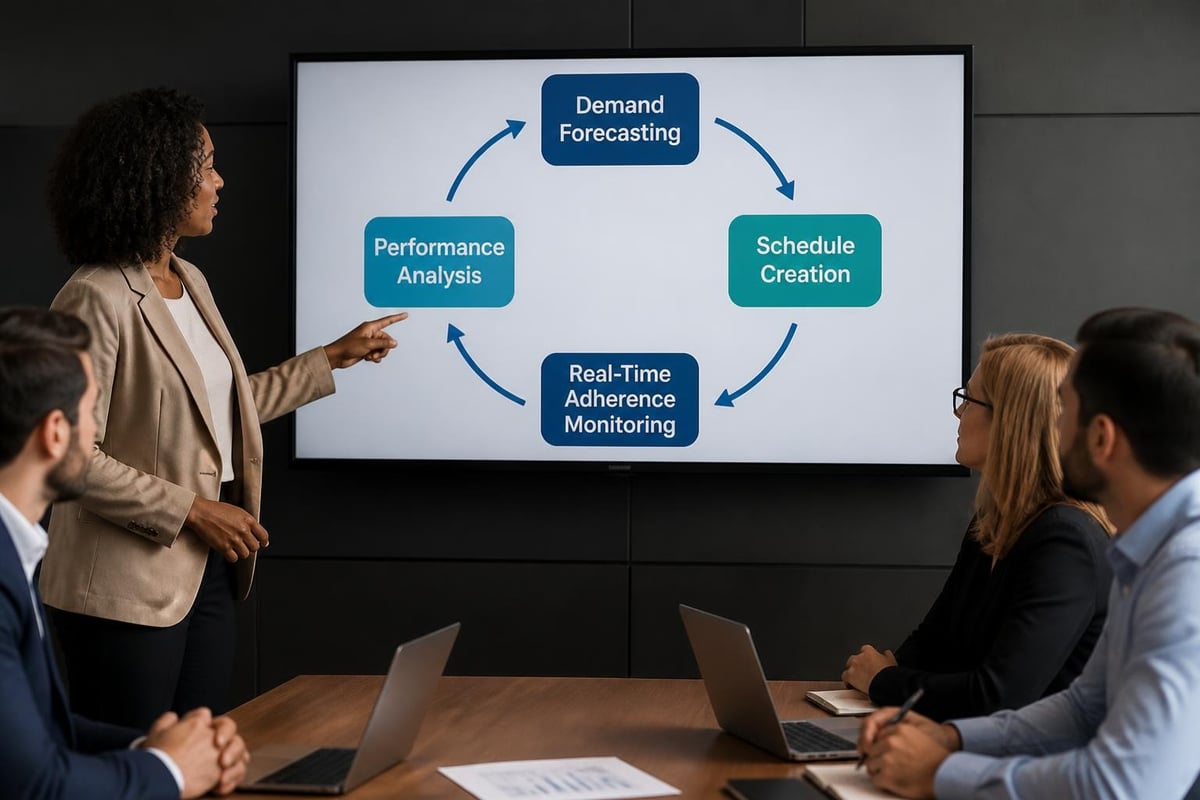
Sophisticated forecasting considers multiple variables:
- Historical volume trends across days, weeks, and seasons
- Marketing campaign impacts on inbound and outbound activity
- Product launches or changes affecting customer inquiry patterns
- External factors like weather, holidays, or economic conditions
- Channel shifts between phone, email, chat, and self-service
Productivity benchmarking in contact centers provides context for evaluating whether your forecasts align with industry standards and identifying improvement opportunities.
Balancing Flexibility and Efficiency
Rigid scheduling creates inefficiencies when actual demand deviates from predictions. Building flexibility into workforce plans enables real-time adjustments that maintain service levels without excessive overstaffing.
Flexibility strategies include offering premium pay for voluntary overtime, cross-training agents to support multiple contact types, and implementing split shifts or partial-day schedules. Remote work arrangements expand talent pools while providing scheduling options that accommodate diverse employee needs.
Cultivating Customer-Centric Cultures
Call center focus ultimately aims to deliver exceptional customer experiences that build loyalty and drive business growth. Creating customer-centric cultures requires intentional effort to align attitudes, behaviors, and processes around customer needs.
Empowering Agents to Solve Problems
Empowerment enables agents to resolve customer issues without escalating every non-routine situation to supervisors. When agents possess authority to make decisions within defined parameters, customers experience faster resolution and agents develop greater job satisfaction.
Empowerment boundaries should be clear and reasonable. For example, agents might have authority to issue credits up to certain amounts, expedite shipping without approval, or waive specific fees based on circumstances. These guidelines prevent decision paralysis while protecting company interests.
Organizations implementing call center best practices consistently empower frontline teams with both authority and resources needed to deliver outstanding service.
Gathering and Acting on Customer Feedback
Customer feedback provides direct insight into how well your call center focus translates into satisfying experiences. Multiple feedback channels capture different perspectives and interaction types.
| Feedback Method | Timing | Insights Provided | Implementation Considerations |
|---|---|---|---|
| Post-call surveys | Immediately after interaction | Transaction-specific satisfaction | Keep surveys brief to maximize response rates |
| Relationship surveys | Quarterly or semi-annually | Overall perception of service | Segment by customer value or tenure |
| Social media monitoring | Continuous | Unsolicited opinions and trends | Establish response protocols for complaints |
| Focus groups | As needed | Deep qualitative insights | Include diverse customer segments |
Collecting feedback without taking action wastes customer time and creates cynicism. Establish processes for analyzing feedback themes, prioritizing improvement initiatives, and communicating changes back to customers who contributed ideas.
Scaling Operations While Maintaining Quality
Business growth challenges organizations to expand capacity without diluting the call center focus that drove initial success. Strategic scaling requires thoughtful planning around recruitment, training, technology, and process standardization.
Building Scalable Processes
Documented, repeatable processes enable consistent execution as teams grow. Process documentation should capture not just what agents do, but why specific approaches matter and how to handle exceptions.
Scalable processes share common characteristics:
- Clarity in expectations and procedures
- Flexibility to accommodate reasonable variations
- Measurability through defined success criteria
- Adaptability enabling updates as business needs evolve
- Accessibility through centralized knowledge bases
Organizations operating across multiple locations benefit from standardized processes that maintain consistency regardless of where agents work. Companies like Focus Services with operations spanning multiple countries leverage process standardization to deliver uniform service quality globally.
Partnering with BPO Providers
Outsourcing enables rapid capacity expansion without the capital investment and timeline required to build internal operations. Business process outsourcing partnerships provide access to established infrastructure, trained personnel, and proven methodologies.
Successful BPO relationships require clear communication around expectations, regular performance reviews, and collaborative problem-solving when issues arise. The most effective partnerships function as extensions of internal teams rather than transactional vendor relationships.
When evaluating potential partners, assess their expertise in your industry, technology capabilities, quality assurance processes, and cultural alignment with your organization. BPO back office services can complement customer-facing operations by handling administrative tasks that don't require direct customer interaction.
Adapting to Evolving Customer Expectations
Customer expectations continuously evolve, driven by experiences with best-in-class service providers across industries. Maintaining call center focus requires staying attuned to shifting preferences and adapting operations accordingly.
Offering Omnichannel Support
Modern customers expect seamless experiences across communication channels. A conversation might begin via chat, continue through email, and conclude with a phone call. Without proper integration, customers face frustrating repetition of information.
Omnichannel strategies require:
- Unified customer data accessible regardless of contact channel
- Consistent service standards across phone, email, chat, and social media
- Channel-appropriate staffing matching skills to communication types
- Integrated routing directing customers to available resources
- Conversation continuity preserving context across channel transitions
Implementing comprehensive call center best practices across channels ensures customers receive consistent, high-quality service regardless of how they choose to connect.
Balancing Automation and Human Touch
Automation handles routine transactions efficiently while preserving human capacity for complex, emotionally charged interactions. The key lies in thoughtful implementation that enhances rather than frustrates customer experiences.
Effective automation identifies repetitive, rules-based processes suitable for self-service or intelligent virtual agents. Password resets, balance inquiries, appointment scheduling, and order status checks often work well in automated formats. Complex problem-solving, complaint resolution, and situations requiring empathy typically demand human interaction.
Automation should always provide easy escalation paths to human agents when customers prefer or require personal assistance. Nothing damages call center focus on customer satisfaction faster than trapping frustrated customers in automated loops.
Maintaining sharp call center focus requires ongoing attention to strategic priorities, agent development, technology enablement, and customer-centricity. Organizations that consistently execute across these dimensions create competitive advantages through superior customer experiences and operational efficiency. Focus Services helps businesses strengthen their call center focus through scalable outsourcing solutions, AI-enabled optimization, and global delivery capabilities across the United States, El Salvador, the Philippines, and South Africa. Whether you need to expand capacity, reduce costs, or enhance service quality, our team brings the expertise and infrastructure to support your growth objectives.