

Customer Care Automation: A 2026 Strategy Guide
Customer expectations have reached unprecedented heights in 2026, with consumers demanding instant responses, personalized interactions, and seamless support across every channel. Traditional customer service models struggle to meet these demands while controlling costs and maintaining quality. Customer care automation has emerged as the strategic answer, enabling businesses to scale support operations, reduce operational expenses, and deliver consistently excellent experiences. This technology combines artificial intelligence, machine learning, and intelligent workflow orchestration to handle routine inquiries, route complex issues to specialists, and provide 24/7 availability without proportional increases in staffing.
The Business Case for Automated Customer Support
Organizations implementing customer care automation typically see measurable returns within the first year of deployment. Cost reduction stands as the most immediate benefit, with automated systems handling high-volume, repetitive inquiries that would otherwise require significant agent time. Research from Accenture on reinventing customer service demonstrates how generative AI is reshaping service models and creating new growth opportunities.
Beyond cost savings, automation delivers consistency that human-only operations struggle to maintain. Every customer receives the same accurate information regardless of when they contact support or which channel they choose. This consistency builds trust and reduces the frustration that comes from receiving conflicting answers.
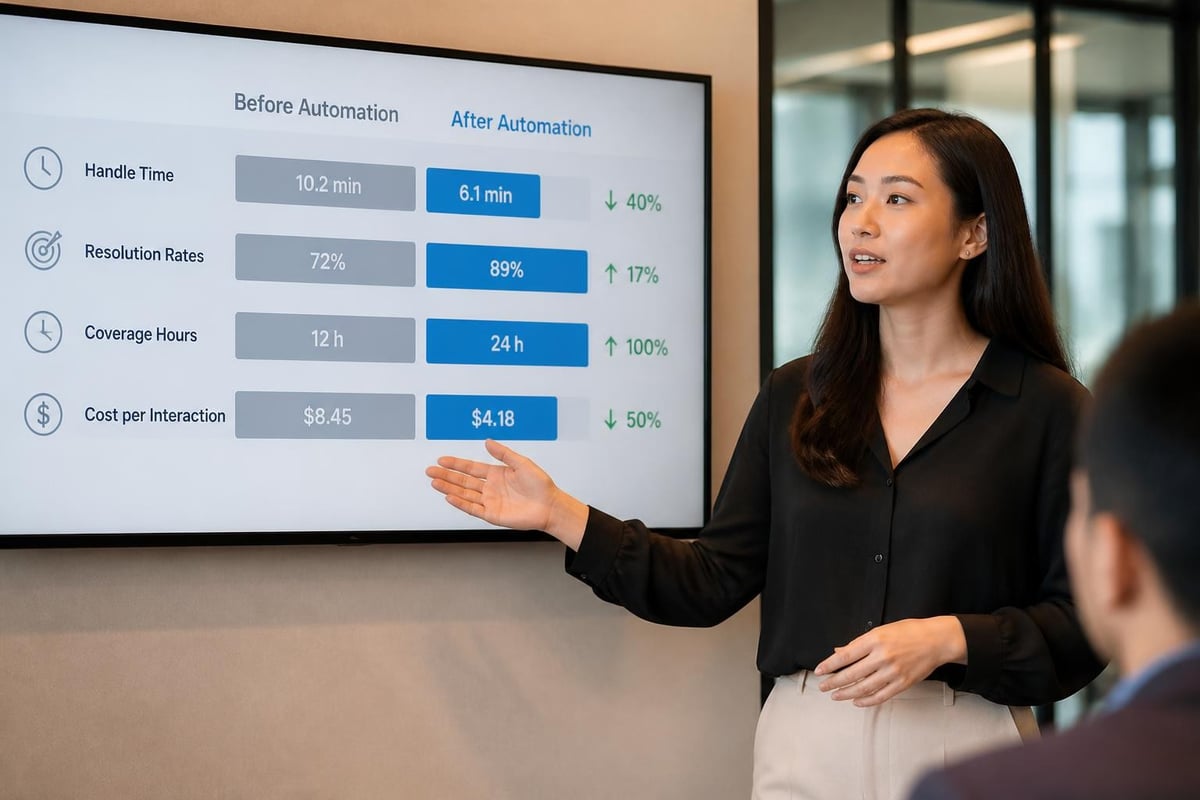
Key financial and operational benefits include:
- Average handling time reductions of 30-40% for common inquiry types
- First-contact resolution improvements of 15-25% through intelligent routing
- Support capacity increases without proportional headcount growth
- Extended service hours including true 24/7/365 availability
- Lower training costs as systems handle tier-one inquiries
| Metric | Before Automation | After Automation | Improvement |
|---|---|---|---|
| Average Handle Time | 8.5 minutes | 5.2 minutes | 39% faster |
| First Contact Resolution | 68% | 84% | 16 points higher |
| After-Hours Coverage | Limited | 24/7/365 | Complete availability |
| Cost Per Contact | $8.20 | $4.75 | 42% reduction |
Core Technologies Powering Modern Automation
Customer care automation in 2026 relies on several interconnected technologies that work together to create seamless experiences. Conversational AI platforms serve as the foundation, enabling natural language understanding and human-like dialogue. The Forrester landscape report on conversational AI platforms provides comprehensive evaluation criteria for selecting the right vendor and understanding platform capabilities.
Natural Language Processing and Understanding
Modern systems don't just match keywords. They comprehend intent, context, and sentiment. A customer asking "Where's my order?" receives different responses depending on whether they sound frustrated or merely curious. NLP engines parse complex queries, identify the underlying need, and determine the appropriate response or escalation path.
Machine learning models continuously improve by analyzing successful interactions and learning from failures. This self-improvement cycle means systems become more accurate and effective over time without constant manual tuning.
Intelligent Routing and Workflow Orchestration
Automation doesn't mean eliminating human agents. It means ensuring that human expertise focuses where it creates the most value. Intelligent routing analyzes each interaction to determine:
- Can this be fully resolved through self-service?
- Does this require simple automation with optional human escalation?
- Should this route directly to a specialized agent?
- What context and history should accompany the routing?
This tiered approach maximizes efficiency while maintaining service quality. For businesses offering specialized outbound call center services, automation can pre-qualify leads and schedule callbacks, allowing agents to focus on high-value conversations.
Knowledge Management and Information Retrieval
Automated systems are only as good as the knowledge bases supporting them. Modern platforms include sophisticated content management systems that organize policies, procedures, product information, and troubleshooting guides. When a customer asks a question, the system retrieves the most relevant, current information rather than depending on what individual agents remember.
Implementation Strategies That Deliver Results
Successful customer care automation requires thoughtful planning and phased deployment. Organizations that rush implementation or attempt to automate everything simultaneously often experience disappointing results and resistance from both customers and employees.
Phase 1: Foundation and Assessment
Begin by analyzing current contact drivers. What questions do customers ask most frequently? Which inquiries consume the most agent time? Which interactions follow predictable patterns? This data-driven assessment identifies the highest-value automation opportunities.
Document existing workflows, decision trees, and knowledge sources. Many organizations discover that their processes aren’t well understood when they attempt to automate them, a critical insight from Harvard Business Review's analysis of workplace automation.
Phase 2: Pilot Deployment
Start with a contained use case that offers clear value but limited risk. Common starting points include:
- Password reset and account recovery
- Order status inquiries and tracking
- Basic product information and FAQs
- Appointment scheduling and modifications
- Service hour and location information
Monitor performance closely during the pilot. Measure not just technical metrics but also customer satisfaction and agent feedback. This initial deployment provides invaluable learning before scaling.
Phase 3: Expansion and Integration
Successful pilots create momentum for broader deployment. Expand to additional use cases while maintaining quality standards. Integration with CRM systems, order management platforms, and other business tools becomes critical at this stage.
For companies operating across multiple regions, like those with BPO call center operations in different countries, ensure automation supports multiple languages and regional variations in customer expectations.

Balancing Automation with Human Touch
The most common mistake in customer care automation is viewing it as a replacement for human agents rather than an enhancement. Customers still want human interaction for complex problems, emotional situations, or high-stakes decisions. The goal is creating a hybrid model that leverages both automation efficiency and human empathy.
When to Route to Human Agents
Establish clear escalation criteria based on:
- Complexity indicators (multiple failed self-service attempts, unusual requests)
- Emotional signals (frustration, anger, confusion detected in language)
- Value triggers (high-lifetime-value customers, large transaction amounts)
- Compliance requirements (regulated discussions, legal matters)
Research published in IEEE conference proceedings on contact center models provides technical frameworks for optimizing these routing decisions and measuring their performance impact.
Empowering Agents with Automation
When interactions do reach human agents, automation should support rather than constrain them. Provide agents with:
- Complete interaction history including all automated touchpoints
- Suggested responses and relevant knowledge articles
- Real-time sentiment analysis and customer context
- Streamlined workflows that eliminate repetitive data entry
This agent-assist approach, detailed in Microsoft’s Dynamics 365 Customer Service documentation, shows how automation augments human capabilities rather than replacing them.
| Interaction Type | Automation Level | Human Involvement | Customer Satisfaction |
|---|---|---|---|
| Account inquiries | 85% automated | Escalation only | 4.2/5.0 |
| Technical support | 40% automated | Agent-assisted | 4.6/5.0 |
| Billing disputes | 25% automated | Primary handler | 4.1/5.0 |
| Product questions | 70% automated | Optional backup | 4.4/5.0 |
Governance, Ethics, and Trust Considerations
As automation handles more customer interactions, governance frameworks become essential. The IBM whitepaper on applying AI in customer care addresses trust, governance, and real-world deployment considerations that enterprise organizations must address.
Data Privacy and Security
Automated systems process sensitive customer information including personal identifiers, financial data, and confidential business details. Implement robust security controls:
- End-to-end encryption for all customer communications
- Role-based access controls limiting who can view interaction data
- Automated data retention and deletion policies
- Regular security audits and penetration testing
- Compliance monitoring for regulations like GDPR, CCPA, and industry-specific requirements
Transparency and Disclosure
Customers have the right to know when they're interacting with automated systems versus human agents. Clear disclosure builds trust and sets appropriate expectations. Some jurisdictions now require explicit notification when AI systems handle customer service interactions.
Bias Detection and Mitigation
Automated systems can inadvertently perpetuate biases present in their training data. Regularly audit system performance across different customer segments to identify and correct disparities in service quality, response accuracy, or routing decisions.
Measuring Success and Continuous Improvement
Customer care automation isn't a set-and-forget technology. Continuous monitoring and optimization ensure systems remain effective as customer needs evolve and business conditions change.
Primary Performance Indicators:
- Containment rate (percentage of inquiries resolved without human intervention)
- Customer satisfaction scores for automated interactions
- Average handling time across all interaction types
- First-contact resolution rates
- Cost per contact across channels
- Agent satisfaction and productivity metrics
According to Zendesk research on customer satisfaction, organizations should track both quantitative metrics and qualitative feedback to gain comprehensive insight into automation effectiveness.
Iterative Optimization Cycles
Establish monthly or quarterly review cycles that examine:
- Which automated flows have the highest abandonment rates?
- Where do customers most frequently request human escalation?
- What new inquiry types are emerging that automation should address?
- How has accuracy changed for existing automated interactions?
Use these insights to refine conversation flows, expand knowledge bases, update routing logic, and identify training opportunities for both systems and agents.

Industry-Specific Automation Applications
Different industries face unique customer service challenges that automation addresses in specialized ways. Understanding these vertical-specific applications helps organizations design more effective implementations.
Travel and Hospitality
Travel companies benefit enormously from automation because customers frequently need quick answers to time-sensitive questions. Travel call center outsourcing operations use automation for:
- Flight status updates and change notifications
- Booking modifications and cancellations
- Loyalty program inquiries
- Destination information and recommendations
- Check-in reminders and digital boarding passes
Financial Services
Banking and insurance customers require secure, accurate information access. Automation handles account balance inquiries, transaction history, payment processing, and fraud alerts while maintaining strict security protocols.
Healthcare
Medical organizations use customer care automation for appointment scheduling, prescription refill requests, insurance verification, and basic health information. Careful design ensures compliance with HIPAA and other healthcare privacy regulations.
Retail and E-commerce
Online retailers automate order tracking, return processing, product recommendations, and inventory availability questions. The CCW market study on contact center automation highlights how retail organizations are leading generative AI adoption and achieving measurable ROI.
Building the Right Team and Capabilities
Successful customer care automation requires new skills and organizational structures. Companies must evolve beyond traditional call center staffing models to include technical specialists, conversation designers, and data analysts.
Essential Roles and Responsibilities
- Conversation designers craft dialogue flows that feel natural and guide customers effectively
- Data scientists analyze interaction patterns and optimize routing algorithms
- Knowledge managers maintain and update content repositories
- Quality analysts monitor automated interactions and identify improvement opportunities
- Training specialists help human agents work effectively alongside automated systems
For organizations exploring BPO experience partnerships, ensure providers demonstrate expertise in these specialized roles rather than just traditional agent staffing.
Change Management for Employees
Agent resistance often undermines automation initiatives. Address concerns proactively through:
- Transparent communication about automation goals and agent roles
- Training programs that build new skills rather than just explaining system features
- Recognition programs that celebrate successful human-automation collaboration
- Career development paths that move agents into specialized or supervisory roles
The strategies for 2026 success discussed in recent industry analysis emphasize employee engagement as critical to automation ROI.
Integration Across Channels and Systems
Modern customers move fluidly between channels, expecting consistent experiences whether they're using chat, email, phone, social media, or mobile apps. Customer care automation must work seamlessly across all these touchpoints.
Omnichannel Orchestration
True omnichannel automation remembers context as customers switch channels. A conversation that begins in chat can continue by phone without customers repeating information. Integration requirements include:
- Unified customer profiles accessible across all channels
- Consistent knowledge bases regardless of interaction medium
- Channel-specific optimization while maintaining core capabilities
- Cross-channel analytics that track complete customer journeys
Business System Integration
Automation delivers maximum value when connected to core business systems. Essential integrations include:
- CRM platforms for customer history and preferences
- Order management systems for real-time status information
- Inventory systems for product availability
- Payment processors for transaction handling
- Field service tools for appointment scheduling
Organizations operating service contact centers across multiple locations particularly benefit from centralized automation that maintains consistency while supporting regional variations.
Future Directions and Emerging Capabilities
Customer care automation continues evolving rapidly. Forward-looking organizations prepare for capabilities that will become mainstream in the coming years.
Predictive engagement will shift from reactive support to proactive assistance. Systems will identify potential problems before customers notice them and reach out with solutions. A customer whose flight might be delayed receives rebooking options before arriving at the airport.
Emotional intelligence improvements will enable automation to detect subtle mood indicators and adjust responses accordingly. Frustrated customers receive more empathetic, solution-focused interactions while satisfied customers get efficient, streamlined service.
Multimodal interactions will combine voice, text, images, and video within single conversations. Customers can show problems through their smartphone camera while receiving visual guidance for solutions.
Hyper-personalization will leverage comprehensive customer data to tailor every interaction. Systems will remember preferences, anticipate needs based on patterns, and adapt communication styles to individual preferences.
Customer care automation represents a fundamental shift in how organizations deliver support, combining efficiency gains with improved customer experiences when implemented thoughtfully. Success requires careful planning, phased deployment, continuous optimization, and maintaining the right balance between automated efficiency and human empathy. Whether you're operating a single contact center or managing global support operations, automation enables you to scale capacity, reduce costs, and meet rising customer expectations. Focus Services combines decades of call center expertise with cutting-edge AI-enabled workforce optimization, helping businesses across the United States, El Salvador, the Philippines, and South Africa implement customer care automation that drives measurable results while maintaining the service quality your customers expect.