
Contact Center Outsourcing Solutions for 2026
Businesses face mounting pressure to deliver exceptional customer experiences while managing operational costs and staffing complexities. A contact center outsourcing solution addresses these challenges by enabling companies to access specialized expertise, advanced technology, and flexible workforce capacity without the overhead of maintaining an in-house operation. As customer expectations continue to evolve in 2026, organizations are increasingly turning to outsourcing partners to enhance service quality, expand channel coverage, and drive measurable performance improvements across their support operations.
Listen more in our podcast: https://www.focusservices.com/podcasts/contact-center-outsourcing-2026/
Strategic Benefits of Contact Center Outsourcing
Contents
- 1 Strategic Benefits of Contact Center Outsourcing
- 2
- 3 Technology Infrastructure and Digital Transformation
- 4 Scalability and Workforce Flexibility
- 5 Performance Management and Quality Assurance
- 6 Channel Expansion and Omnichannel Support
- 7 Data Security and Compliance Standards
- 8 Performance Analytics and Business Intelligence
- 9 Implementation and Transition Planning
- 10 Cost Models and Financial Planning
- 11 Partner Selection and Evaluation Criteria
- 12 Emerging Trends Shaping the Industry
The decision to implement a contact center outsourcing solution extends beyond simple cost reduction. Organizations that partner with the right provider gain access to a comprehensive ecosystem of technology, talent, and proven processes that would require years and significant capital investment to build internally.
Cost efficiency represents one of the most immediate advantages. Companies eliminate expenses associated with facility maintenance, equipment procurement, software licensing, and full-time employee benefits. The operational model shifts from fixed costs to variable expenses that scale with business demand, providing greater financial flexibility during seasonal fluctuations or market uncertainties.
Access to Specialized Expertise
Outsourcing partners bring domain-specific knowledge accumulated across hundreds of client engagements and industry verticals. This expertise translates into faster implementation timelines, reduced training cycles, and higher first-contact resolution rates.
- Industry best practices refined through continuous optimization
- Quality assurance frameworks with proven performance metrics
- Workforce management strategies that maximize productivity
- Compliance knowledge across regulatory environments
- Technology integration capabilities with existing systems
The strategic value becomes particularly evident when evaluating call center outsourcing companies that offer vertical specialization aligned with specific business needs.

Technology Infrastructure and Digital Transformation
Modern contact center outsourcing solutions deliver sophisticated technology stacks that incorporate artificial intelligence, predictive analytics, and omnichannel capabilities. These platforms enable seamless customer interactions across voice, digital messaging, social media, and self-service channels.
| Technology Component | Business Impact | Implementation Timeframe |
|---|---|---|
| Cloud-based platforms | 99.9% uptime, remote flexibility | 2-4 weeks |
| AI-powered routing | 30% reduction in wait times | 4-6 weeks |
| Speech analytics | Real-time quality monitoring | 6-8 weeks |
| Workforce optimization | 15-20% productivity gains | 8-12 weeks |
Organizations leveraging these capabilities report significant improvements in customer satisfaction scores and operational efficiency. Advanced call center software solutions now integrate seamlessly with customer relationship management systems, creating unified customer data profiles that enhance personalization and service continuity.
Artificial Intelligence Integration
The incorporation of AI technologies transforms traditional contact center operations into intelligent customer engagement platforms. Research on AI-driven coaching recommendations demonstrates how machine learning algorithms can identify optimal training opportunities and accelerate agent skill development.
Natural language processing enables automated sentiment analysis during customer interactions, allowing supervisors to intervene proactively when conversations indicate potential escalation. This real-time intelligence provides operational advantages that would be prohibitively expensive to develop independently.
Scalability and Workforce Flexibility
A contact center outsourcing solution provides the agility to expand or contract capacity in response to business requirements without the constraints of traditional hiring processes. This flexibility proves essential for companies experiencing rapid growth, seasonal demand variations, or market expansion initiatives.
Rapid scaling capabilities allow businesses to add hundreds of trained agents within weeks rather than months. Outsourcing partners maintain talent pipelines, training infrastructure, and onboarding processes that can accommodate sudden volume increases without compromising service quality.
The geographic distribution of workforce resources offers additional advantages. Global providers operate facilities across multiple time zones, enabling cost-effective 24/7 coverage and language support for international markets. Companies can access Spanish-language support teams in El Salvador, English-language operations in the Philippines and South Africa, and domestic teams in the United States through a single partnership.
Business Continuity and Risk Mitigation
Multi-site operations create inherent redundancy that protects against service disruptions. When natural disasters, infrastructure failures, or local emergencies impact one location, customer support continues uninterrupted through alternative sites.
- Geographic diversity reduces concentration risk
- Redundant technology infrastructure ensures system availability
- Cross-trained agents provide operational flexibility
- Documented disaster recovery procedures minimize downtime
- Regular business continuity testing validates preparedness
This resilience framework delivers peace of mind that internal operations struggle to replicate without substantial infrastructure investment.
Performance Management and Quality Assurance
Effective contact center outsourcing solutions incorporate rigorous performance monitoring and continuous improvement methodologies. Leading providers implement multi-layered quality assurance programs that exceed industry standards and drive measurable customer satisfaction improvements.
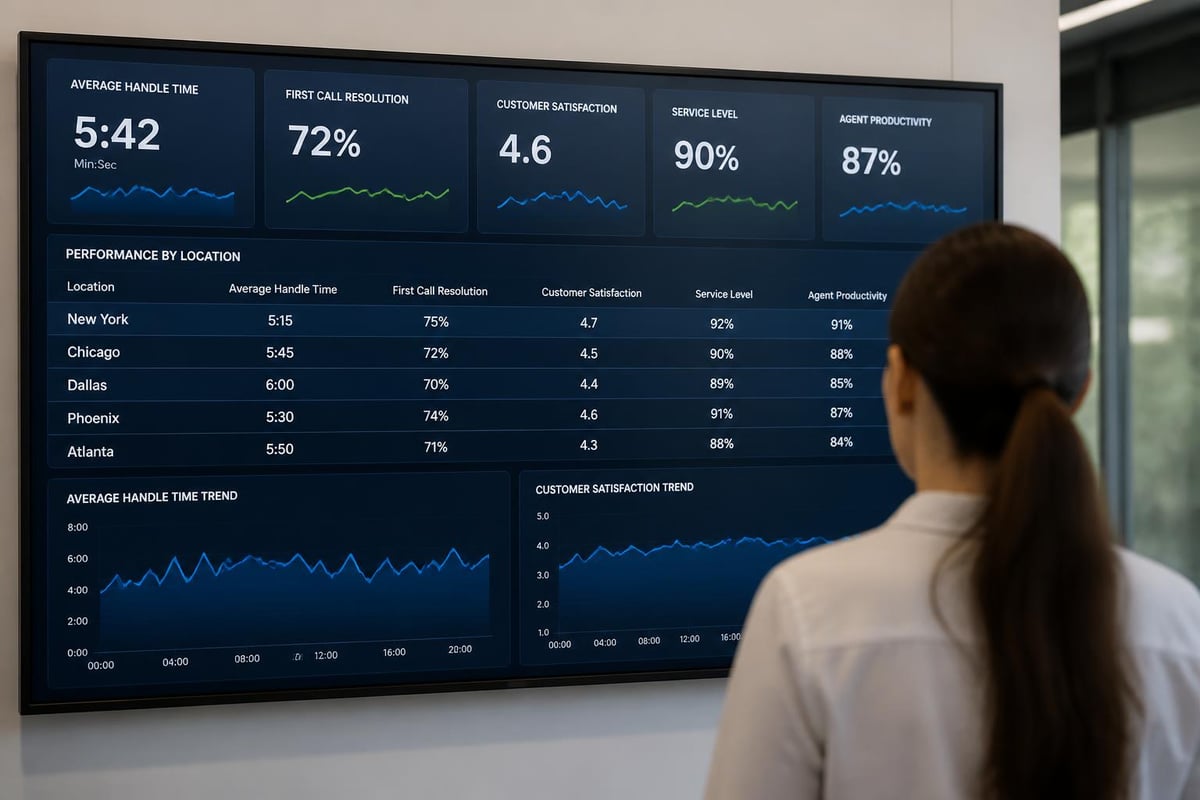
Key performance indicators tracked in real-time include average handle time, first-call resolution, customer satisfaction scores, net promoter scores, and service level achievement. Transparent reporting dashboards provide clients with complete visibility into operational performance and trending metrics.
Quality Monitoring Frameworks
Modern quality programs extend beyond traditional call monitoring to encompass comprehensive interaction analysis across all channels. Automated quality assurance tools evaluate 100% of customer interactions, identifying coaching opportunities and compliance risks that manual sampling methods would miss.
Calibration sessions ensure consistency in evaluation standards across quality analysts and locations. Regular performance reviews with agent feedback loops create accountability and drive individual skill development. Organizations benefit from continuous optimization without dedicating internal resources to quality management infrastructure.

Channel Expansion and Omnichannel Support
Customer communication preferences continue to diversify, requiring businesses to maintain consistent service quality across multiple interaction channels. A comprehensive contact center outsourcing solution delivers integrated omnichannel capabilities that meet customers on their preferred platforms.
For organizations seeking to enhance their support infrastructure, Customer Care Outsourcing provides omnichannel capabilities across voice, chat, email, SMS, and social media channels with dedicated teams that operate as seamless extensions of your brand.
| Channel | Response Time Target | Customer Preference Rate | Staffing Requirements |
|---|---|---|---|
| Voice | Immediate | 45% | High (real-time) |
| Live Chat | Under 60 seconds | 28% | Medium (concurrent) |
| Within 4 hours | 18% | Low (asynchronous) | |
| Social Media | Under 15 minutes | 9% | Medium (monitoring) |
The integration of these channels through unified agent desktops ensures conversation continuity regardless of how customers choose to engage. Context preservation across channel switches eliminates the frustration of repeating information and accelerates issue resolution.
Digital Channel Optimization
Chat and messaging platforms require specialized agent skills and workflow management approaches distinct from traditional voice support. Successful outsourcing partners train agents in concurrent conversation handling, emoji interpretation, and abbreviated communication styles appropriate for digital channels.
Social media monitoring tools track brand mentions and customer inquiries across platforms, routing messages to trained specialists who understand public forum dynamics and brand reputation management. This specialized capability protects brand image while resolving customer concerns efficiently.
Data Security and Compliance Standards
Organizations entrusting customer data to outsourcing partners must verify robust security protocols and regulatory compliance frameworks. Leading contact center outsourcing solutions maintain certifications including PCI-DSS for payment processing, HIPAA for healthcare information, and SOC 2 for data security controls.
Security measures implemented by professional providers include encrypted data transmission, role-based access controls, multi-factor authentication, network segmentation, and continuous security monitoring. Regular penetration testing and vulnerability assessments identify potential weaknesses before exploitation.
Compliance extends beyond data protection to encompass industry-specific regulations governing customer interactions. Telecommunications providers must adhere to TCPA requirements, financial services organizations face GLBA obligations, and healthcare companies navigate complex HIPAA privacy rules. Specialized outsourcing partners maintain deep regulatory knowledge and implement controls that ensure ongoing compliance.
Agent Training and Certification
Comprehensive security awareness training creates a culture of data protection among frontline agents. Regular certification programs cover phishing prevention, social engineering tactics, password hygiene, and incident reporting procedures.
Access logs and interaction recordings create audit trails that support compliance investigations and quality verification. These documentation requirements, when properly maintained, protect organizations during regulatory examinations and legal proceedings.
Performance Analytics and Business Intelligence
A sophisticated contact center outsourcing solution transforms raw operational data into actionable business intelligence. Advanced analytics platforms identify trends, predict future demand, and uncover opportunities for process optimization that drive continuous improvement.
Predictive analytics forecast call volume patterns based on historical data, seasonal trends, and business initiatives, enabling proactive workforce scheduling that minimizes wait times while optimizing labor costs. These forecasting capabilities typically achieve accuracy rates exceeding 90% for established operations.
Research on automated call driver generation using large language models demonstrates how AI technologies can analyze conversation content to identify recurring customer issues and improvement opportunities without manual categorization efforts.
Customer Journey Analytics
Interaction data reveals customer behavior patterns across touchpoints, illuminating friction points in the service experience. Journey mapping identifies where customers abandon self-service options and require live assistance, guiding investments in knowledge base content and process simplification.
- Customer effort scores quantify interaction difficulty
- Sentiment trends highlight emerging satisfaction issues
- Root cause analysis identifies systemic problems
- Agent performance patterns inform coaching priorities
- Channel preference data guides resource allocation
These insights enable data-driven decision making that aligns operational investments with customer needs and business priorities.
Implementation and Transition Planning
Successful deployment of a contact center outsourcing solution requires structured project management and careful attention to knowledge transfer. The transition process typically spans 8-12 weeks from contract signing to full operational handoff, with carefully orchestrated phases that minimize service disruption.
Discovery and assessment activities document current processes, technology integrations, performance benchmarks, and unique business requirements. This foundational work ensures the outsourcing partner understands organizational culture, brand voice, and customer expectations that agents must embody.
Phased Migration Strategies
Risk-averse organizations often implement pilot programs with limited scope before full-scale transition. A phased approach might begin with overflow call handling during peak periods, expanding to after-hours coverage, and ultimately transitioning primary support responsibilities once performance validation confirms readiness.
- Process documentation capturing standard operating procedures
- Technology integration connecting systems and data sources
- Agent recruitment selecting candidates matching skill requirements
- Training delivery covering product knowledge and soft skills
- Shadow period where new agents observe experienced staff
- Supervised production with elevated quality monitoring
- Performance validation confirming metric achievement
- Full transition completing knowledge transfer
Parallel operation periods maintain service continuity while new teams develop proficiency. Gradual volume transfer allows for course correction and ensures seamless customer experience throughout the transition.
Cost Models and Financial Planning
Understanding the financial structure of contact center outsourcing solutions enables accurate budgeting and return-on-investment analysis. Providers typically offer several pricing models tailored to different business requirements and risk profiles.
Per-minute billing aligns costs directly with customer interaction volume, making it attractive for seasonal businesses or those with unpredictable demand patterns. Organizations pay only for actual talk time plus associated after-call work, creating variable expense structures that scale with business activity.
Per-seat pricing provides cost predictability through fixed monthly fees for dedicated agent positions. This model suits companies with consistent volume and those requiring specialized training investments or proprietary system knowledge that make agent sharing impractical.
| Pricing Model | Best Fit | Cost Predictability | Scalability |
|---|---|---|---|
| Per-minute | Variable demand | Low | High |
| Per-seat | Dedicated teams | High | Medium |
| Hybrid | Blended needs | Medium | High |
| Performance-based | Outcome focus | Variable | Medium |
Performance-based pricing ties compensation to achievement of specific outcomes such as sales conversion rates, customer satisfaction scores, or first-call resolution percentages. While this model aligns provider incentives with business objectives, it requires robust measurement systems and clear accountability frameworks.
Hidden Cost Considerations
Comprehensive total cost of ownership analysis accounts for expenses beyond provider fees. Technology integration projects may require internal IT resources, quality monitoring tools might need licenses, and management oversight demands staff time allocation.
Transition costs including knowledge transfer, dual operations during migration, and potential productivity dips during agent learning curves represent one-time investments that impact near-term financials. Realistic financial models incorporate these implementation expenses to avoid budget surprises.
Partner Selection and Evaluation Criteria
Choosing the right contact center outsourcing solution provider requires systematic evaluation across multiple dimensions. Organizations should develop weighted scoring models that reflect their unique priorities and risk tolerances when comparing potential partners.
Geographic presence determines timezone coverage, language capabilities, and cost structures. Providers with facilities in the Philippines and El Salvador typically offer labor cost advantages compared to exclusively domestic operations, while maintaining quality standards through rigorous training and quality assurance programs.
Cultural alignment ensures agents can authentically represent brand values and communication styles. Site visits and agent interviews during the selection process provide insights into organizational culture and service delivery philosophy that proposal documents cannot convey.
Technical Capabilities Assessment
Infrastructure requirements vary based on integration complexity and channel diversity. Organizations with extensive CRM customization or proprietary systems need partners with strong technical teams and API development capabilities. Help desk software integration becomes critical when supporting technical products requiring ticket management and escalation workflows.
References from existing clients in similar industries provide valuable insights into operational performance, partnership responsiveness, and problem-solving effectiveness. Candid conversations with current customers often reveal strengths and weaknesses not apparent during the sales process.
- Request case studies demonstrating relevant experience
- Verify industry certifications and compliance standards
- Evaluate technology platform capabilities and limitations
- Assess financial stability and business continuity plans
- Review contractual terms including termination provisions
Due diligence investments during partner selection prevent costly mismatches and establish foundations for successful long-term relationships.
Emerging Trends Shaping the Industry
The contact center outsourcing landscape continues evolving rapidly as technology advancement and changing customer expectations drive innovation. Organizations evaluating solutions in 2026 should consider how providers are positioning themselves to address emerging requirements and capitalize on new capabilities.
Artificial intelligence automation extends beyond simple chatbots to encompass sophisticated virtual agents handling complex transactions previously requiring human intervention. However, the most effective implementations blend AI efficiency with human empathy, routing interactions based on complexity and emotional content rather than rigid channel rules.
Sentiment analysis capabilities now operate in real-time during voice conversations, providing entity-level emotion detection that alerts supervisors to customer frustration before situations escalate. This proactive intervention capability transforms quality monitoring from reactive assessment to preventive management.
Workforce Transformation
Remote work models fundamentally altered contact center staffing strategies, enabling access to talent pools previously constrained by geographic proximity to physical facilities. Distributed workforce management introduces new challenges around productivity monitoring, culture building, and technology security, but expands recruitment reach and improves employee satisfaction through flexibility.
Gig economy integration allows providers to maintain scalable capacity through on-demand agents who work variable schedules matching personal preferences with business demand patterns. This staffing flexibility reduces overhead while providing workers with autonomy that traditional shift structures cannot offer.
The evolution toward outcome-based service models shifts focus from traditional efficiency metrics to customer lifetime value and business impact measures. Forward-thinking outsourcing partnerships align compensation with revenue generation and customer retention rather than simply minimizing handle time.
Implementing a contact center outsourcing solution delivers strategic advantages that extend well beyond cost reduction, providing access to specialized expertise, advanced technology, and scalable capacity that transforms customer support into a competitive differentiator. Whether you’re managing seasonal volume fluctuations, expanding into new markets, or seeking to enhance service quality without capital investment, the right outsourcing partnership creates measurable value across your operation. Focus Services combines global reach with localized expertise across the United States, El Salvador, the Philippines, and South Africa, delivering high-performance customer care programs supported by AI-enabled workforce optimization and proven operational excellence.