

How to Hire a Call Center: Your 2026 Guide
Businesses face mounting pressure to deliver exceptional customer service while controlling operational costs. The decision to hire a call center represents a strategic inflection point that can transform customer experience, accelerate growth, and unlock operational efficiency. Whether you're managing seasonal volume spikes, expanding into new markets, or seeking specialized expertise, selecting the right call center partner requires careful evaluation of technology capabilities, geographic footprint, compliance frameworks, and cultural alignment. This comprehensive guide walks you through the essential considerations and actionable steps to make an informed outsourcing decision in 2026.
Understanding Your Call Center Requirements
Before you hire a call center, establish a clear understanding of your specific business needs. This foundation determines which provider capabilities matter most and prevents costly mismatches between your requirements and vendor offerings.
Start by categorizing your contact volume and complexity:
- Inbound support volume: Average daily contacts, seasonal peaks, and expected growth trajectory
- Outbound campaign requirements: Sales prospecting, appointment setting, customer retention, or market research
- Channel mix: Voice, email, chat, social media, SMS, or emerging channels like WhatsApp Business
- Language and timezone coverage: Domestic-only or multilingual global support
- Technical complexity: Basic FAQs versus specialized product support requiring deep technical knowledge
Document your current performance baselines and future targets. Understanding metrics like average handle time, first-call resolution, customer satisfaction scores, and service level agreements provides objective criteria for vendor evaluation.
Budget Planning and Cost Structures
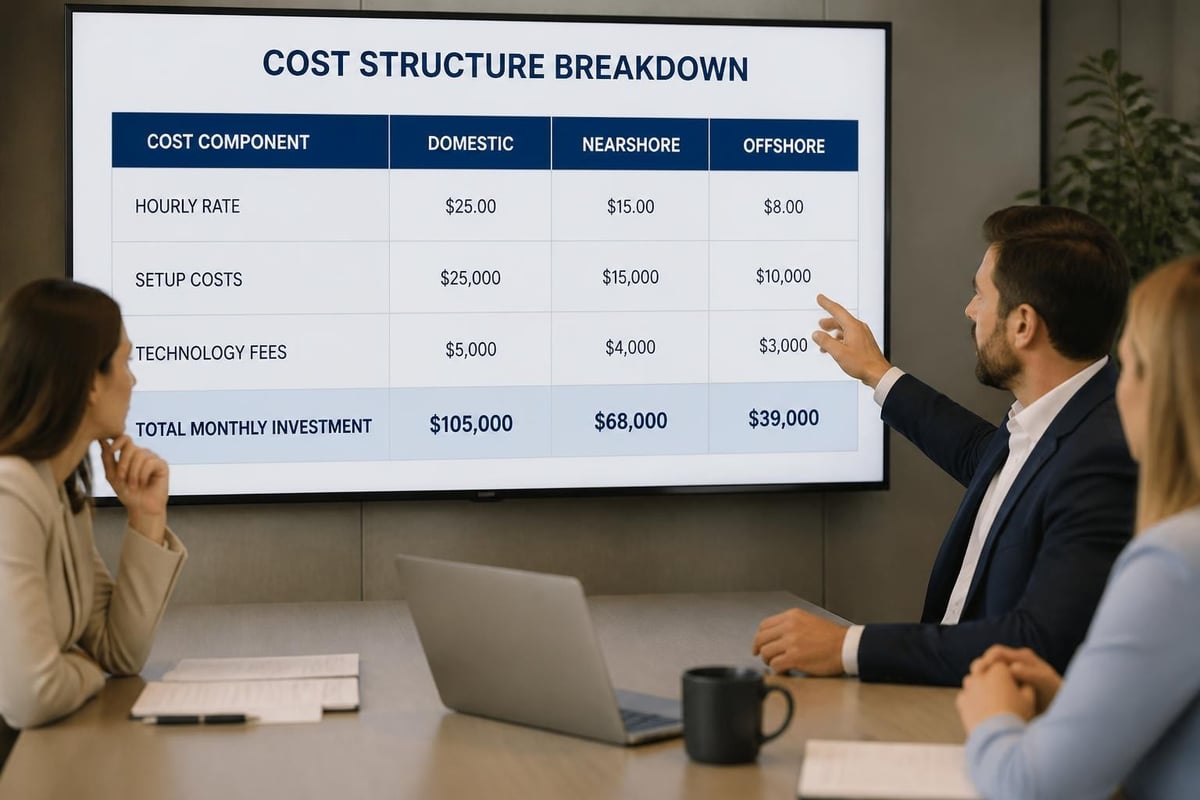
Financial planning extends beyond simple per-hour agent rates. When you hire a call center, consider the total cost of ownership across multiple dimensions.
| Cost Component | Typical Range | Key Variables |
|---|---|---|
| Agent hourly rate | $12-$45 | Location, skill level, language requirements |
| Setup and onboarding | $5,000-$50,000 | Program complexity, training duration, technology integration |
| Technology platform | $0-$15,000/month | Included vs. separate licensing, advanced features |
| Management fees | 10-25% markup | Vendor pricing model, volume discounts |
Offshore locations like the Philippines and El Salvador typically offer 40-60% cost savings compared to domestic U.S. operations, while nearshore options balance cost efficiency with timezone alignment. South African operations provide excellent English proficiency and cultural affinity for both U.S. and European markets.
Evaluating Call Center Provider Capabilities
The outsourcing landscape has evolved dramatically, with technology and AI reshaping contact center operations in unprecedented ways. Modern providers offer far more than basic phone answering services.
Technology Infrastructure and Integration
Assess each potential partner's technology stack carefully. Cloud-based platforms enable rapid scaling and remote work flexibility, while legacy on-premise systems may limit agility. Look for providers offering:
- Omnichannel routing engines that intelligently distribute contacts across voice, digital, and self-service channels
- CRM integrations with Salesforce, HubSpot, Zendesk, or your proprietary systems
- Workforce management tools for accurate forecasting, scheduling, and real-time adherence monitoring
- Quality assurance platforms with speech analytics, screen recording, and automated scoring
- AI-enabled capabilities including chatbots, predictive dialers, sentiment analysis, and agent assist tools
The ICMI guide to AI in contact centers offers practical frameworks for evaluating vendor technology claims versus actual implementation maturity.
When you hire a call center, request detailed demonstrations showing how their systems handle your specific workflows. Generic platform tours reveal less than customized walkthroughs using your actual use cases and data structures.
Compliance and Security Standards
Regulatory compliance represents a non-negotiable requirement, particularly for industries handling sensitive customer data. Verify that prospective providers maintain current certifications and understand their role as data processors under relevant privacy regulations.
Essential compliance certifications include:
- PCI DSS Level 1 for any operations processing payment card information
- SOC 2 Type II attestation demonstrating security control effectiveness
- HIPAA compliance for healthcare-related customer service
- ISO 27001 information security management certification
- GDPR and CCPA compliance frameworks with documented data processing agreements
The PCI Security Standards Council provides authoritative guidance on requirements for service providers handling cardholder data. For European operations, the European Commission’s standard contractual clauses establish the legal framework for cross-border data transfers.
Understanding controller and processor obligations under UK GDPR ensures your outsourcing arrangement meets privacy requirements when serving British customers.
The Selection and Procurement Process
Structured vendor selection minimizes risk and identifies the provider best aligned with your strategic objectives. Rushing this process often leads to expensive transitions and service disruptions.
Building Your Evaluation Framework
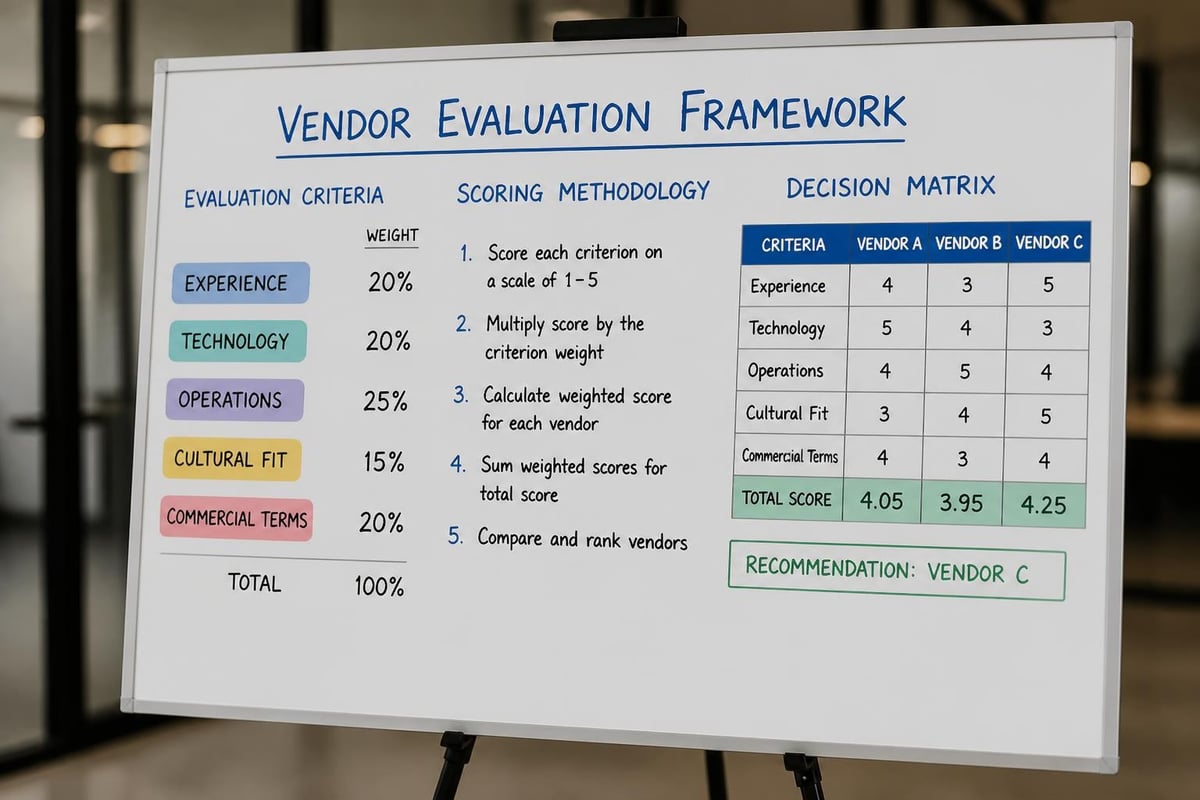
Create a weighted scorecard covering five core dimensions:
- Experience and industry expertise (25%): Years in operation, client retention rates, vertical specialization, case studies matching your use case
- Technology and innovation (20%): Platform capabilities, AI adoption, integration flexibility, reporting sophistication
- Operational excellence (25%): Quality management systems, training programs, performance metrics tracking, continuous improvement culture
- Cultural and strategic fit (15%): Communication style, partnership approach, geographic presence, scalability roadmap
- Commercial terms (15%): Pricing competitiveness, contract flexibility, volume discounts, exit provisions
Request detailed responses to a comprehensive RFP addressing each evaluation dimension. Include scenarios requiring providers to demonstrate problem-solving approaches rather than generic capability statements.
Reference Checks and Site Visits
Never hire a call center without speaking directly to current and former clients. Prepare specific questions about responsiveness during crises, flexibility with scope changes, transparency in reporting, and actual versus promised performance levels.
Schedule site visits to shortlisted facilities, even if conducted virtually. Observe:
- Physical security controls and workspace environment
- Agent engagement and supervisor presence on the production floor
- Real-time dashboards and monitoring tools in use
- Training sessions and quality calibration meetings
- Technology redundancy and disaster recovery capabilities
According to Deloitte’s Global Outsourcing Survey, successful outsourcing relationships correlate strongly with thorough due diligence and cultural alignment assessment during the selection phase.
Onboarding and Implementation Best Practices
The transition period determines long-term partnership success. A structured onboarding program ensures your call center representatives deliver brand-consistent experiences from day one.
Knowledge Transfer and Training Design
Develop comprehensive training materials covering:
- Brand voice, values, and customer service philosophy
- Product or service technical specifications and common use cases
- Systems navigation and CRM workflows
- Escalation protocols and decision-making authority
- Regulatory requirements and compliance obligations
Plan for 2-4 weeks of initial training depending on complexity, followed by ongoing coaching and knowledge base updates. Involve your internal subject matter experts in curriculum development and live training delivery to ensure accuracy and cultural nuance.
When you hire a call center, clarify responsibility for training content creation versus delivery. Many businesses underestimate the time required to document processes and build training assets, delaying launch timelines.
Setting Performance Expectations
Establish clear, measurable service level agreements covering operational, quality, and business outcome metrics. Avoid generic industry benchmarks in favor of targets aligned with your customer expectations and competitive positioning.
| Metric Category | Example KPIs | Typical Targets |
|---|---|---|
| Accessibility | Service level (% answered in X seconds) | 80/20, 90/30 |
| Efficiency | Average handle time, occupancy rate | Baseline +/- 10% |
| Quality | Quality assurance score, first-call resolution | 90%+, 75%+ |
| Customer experience | CSAT, NPS, customer effort score | Industry benchmark + 5 points |
| Business outcomes | Conversion rate, retention rate, revenue per contact | Program-specific |
The HDI guidance on service metrics emphasizes translating operational KPIs into meaningful business accountability through balanced scorecards and tiered performance incentives.
Understanding contact center service levels in the context of your industry and customer expectations ensures realistic target-setting that balances service quality with cost efficiency.
Managing the Ongoing Partnership
Successful outsourcing relationships require active governance, transparent communication, and continuous optimization. The decision to hire a call center marks the beginning of a strategic partnership, not a set-and-forget transaction.
Governance and Communication Cadence
Implement a structured operating rhythm with multiple touchpoints:
- Daily standups (15 minutes): Volume trends, system issues, escalations requiring immediate attention
- Weekly business reviews (60 minutes): Performance against SLAs, quality deep-dives, upcoming initiatives
- Monthly executive reviews (90 minutes): Strategic alignment, continuous improvement projects, relationship health
- Quarterly strategic planning (half-day): Roadmap refinement, capacity planning, technology investments
Designate clear points of contact on both sides with defined decision-making authority. Ambiguity about who approves process changes or budget adjustments creates frustration and slows responsiveness.
Quality Management and Continuous Improvement
Maintain ongoing visibility into customer interactions through systematic quality assurance programs. Rather than relying solely on the provider's internal QA team, implement dual-monitoring approaches where your team evaluates a sample of interactions using the same rubric.
Effective quality programs include:
- Random sampling across agents, time periods, and interaction types
- Targeted sampling of new agents, escalations, and low-scoring interactions
- Side-by-side calibration sessions to align scoring interpretation
- Root-cause analysis of quality gaps and systemic issues
- Closed-loop feedback with coaching documentation and re-evaluation
When you hire a call center with AI-enabled quality tools, speech and text analytics identify patterns across 100% of interactions rather than small samples. This comprehensive view reveals emerging issues before they impact significant customer volumes.

Scaling Operations and Long-Term Optimization
Your business needs evolve, and your call center partnership should flex accordingly. Build scalability and optimization into your operating model from the outset.
Flexible Capacity Models
Modern outsourcing arrangements move beyond fixed seat commitments toward variable capacity models that align costs with actual demand. Options include:
- Dedicated teams: Reserved agents working exclusively on your program, optimal for complex products requiring deep expertise
- Shared capacity: Agents handling multiple client programs, cost-effective for simpler interactions with variable volume
- Blended models: Core dedicated team supplemented by shared flex capacity during peaks
- Work-from-home pools: Remote agent networks providing elasticity without facility constraints
For businesses with pronounced seasonality, negotiate clear ramp-up and ramp-down protocols. E-commerce companies, for example, require 2-3x normal capacity during holiday peaks but minimal staffing in January. Understanding customer support for e-commerce requirements helps structure appropriate seasonal flexibility provisions.
Expanding Service Scope
As the partnership matures, consider expanding beyond initial scope to capture additional value. Starting with customer service for e-commerce operations might evolve to include:
- Sales and revenue generation: Outbound call center programs for lead qualification, upselling, and retention campaigns
- Technical support: Tier 1 and Tier 2 troubleshooting for software or hardware products
- Back-office processing: Order entry, claims processing, data verification, and administrative tasks
- Specialized programs: Collections, appointment scheduling, or industry-specific services
When you hire a call center with global footprint, explore following-the-sun models where different geographic locations provide continuous 24/7 coverage. Understanding the difference between outbound call and inbound call requirements ensures appropriate facility and agent skill matching as scope expands.
Geographic Considerations and Multi-Location Strategies
Location strategy balances cost, quality, timezone coverage, language capabilities, and risk mitigation. Single-location dependencies create vulnerability to local disruptions, while excessive geographic distribution complicates management and dilutes culture.
Evaluating Location Options
Each geographic region offers distinct advantages:
United States: Premium positioning for complex B2B support, highly regulated industries, and customers preferring domestic agents. Higher costs offset by cultural alignment and minimal accent concerns.
El Salvador: Nearshore advantage with minimal timezone difference from U.S. markets, strong English proficiency, and 30-40% cost savings versus domestic operations. Growing technology infrastructure and business-friendly environment.
Philippines: Largest global outsourcing market with mature infrastructure, exceptional English skills, high cultural affinity for Western brands, and 50-60% cost savings. Deep talent pool enables rapid scaling.
South Africa: Neutral accent appreciated by both American and British customers, strong education system producing skilled knowledge workers, and coverage for European and Middle Eastern timezones.
Multi-location strategies provide business continuity resilience and optimal timezone coverage. A three-site model (U.S., nearshore, and offshore) enables continuous follow-the-sun support while balancing cost optimization with service quality.
When you hire a call center operating across multiple countries, pay particular attention to data residency requirements, cross-border transfer mechanisms, and consistent training and quality standards across sites.
Technology Integration and Data Management
Seamless technology integration determines operational efficiency and customer experience quality. Friction in systems, data flows, or reporting creates agent frustration, slows handle times, and degrades service.
System Architecture and APIs
Modern call center platforms integrate with business systems through robust APIs and pre-built connectors. Evaluate integration approaches:
- Screen pop and CTI integration: Customer data automatically displays when calls connect, eliminating manual lookup
- Bi-directional CRM sync: Contact outcomes, notes, and disposition codes update your CRM in real-time
- Ticketing system integration: Support cases created, updated, and closed from the call center platform
- E-commerce platform connectivity: Order status, return processing, and account management without system switching
Request detailed integration architecture diagrams showing data flows, latency expectations, error handling, and security controls. Understanding which systems reside on-premise versus cloud environments informs integration complexity and options.
Data Governance and Ownership
Clarify data ownership, access rights, and portability provisions before signing contracts. Your customer data remains your asset regardless of processing location.
Address these data governance questions:
- Where is customer data stored geographically and is it encrypted at rest and in transit?
- What data retention policies apply and who controls retention periods?
- How is data returned or destroyed upon contract termination?
- What audit rights do you have to verify data handling practices?
- Are subprocessors permitted and how are they vetted and managed?
When you hire a call center handling payment data, verify PCI DSS compliance covers the entire processing chain including any third-party platforms or tools integrated into the workflow.
Risk Mitigation and Business Continuity
Outsourcing concentrates customer service risk with a third party. Comprehensive risk assessment and mitigation planning protects against service disruptions that damage customer relationships and revenue.
Disaster Recovery and Redundancy
Evaluate provider business continuity capabilities across multiple scenarios:
- Technology failures: Redundant systems, automatic failover, backup power and connectivity
- Facility disruptions: Multiple sites, work-from-home capability, geographic diversity
- Vendor failure: Financial stability, client concentration, management depth
- Security incidents: Incident response plans, cyber insurance, breach notification protocols
Request copies of business continuity plans, recent test results, and actual incident responses. Theoretical plans matter less than demonstrated capability to maintain operations during real disruptions.
Performance Guarantees and Service Credits
Well-structured contracts include financial accountability for performance failures. Service level agreements should specify:
- Measurement methodology and calculation formulas
- Reporting frequency and format
- Thresholds triggering service credits
- Credit calculation methodology (percentage of fees, fixed amounts)
- Caps on total credits and relationship to termination rights
When you hire a call center, balance aggressive SLAs with realistic operational targets. Overly punitive terms incentivize gaming metrics rather than optimizing customer outcomes.
The decision to hire a call center represents a strategic investment in customer experience, operational scalability, and cost efficiency. Success requires thorough vendor evaluation, structured implementation, active partnership management, and continuous optimization aligned with evolving business needs. Focus Services delivers global call center outsourcing solutions across the United States, El Salvador, the Philippines, and South Africa, combining scalable capacity with AI-enabled workforce optimization to help businesses enhance customer service operations while controlling costs. Contact our team to discuss how customized call center programs can support your growth objectives.