

Offshore Call Center: A Strategic Guide for 2026
Businesses today face mounting pressure to deliver exceptional customer experiences while controlling operational costs. An offshore call center represents one of the most effective solutions to this challenge, enabling companies to access skilled talent, reduce expenses, and maintain 24/7 service coverage. As we move through 2026, the offshore call center industry has matured significantly, offering advanced technology integrations, refined quality control processes, and proven methodologies that address historical concerns around language barriers and cultural alignment. This guide examines the strategic considerations, tangible benefits, and operational best practices that define successful offshore call center partnerships in today’s competitive marketplace.
Understanding the Offshore Call Center Landscape
Contents
- 1 Understanding the Offshore Call Center Landscape
- 2 Strategic Benefits Beyond Cost Reduction
- 3 Addressing Common Concerns and Challenges
- 4 Selecting the Right Offshore Location
- 5 Implementation Best Practices
- 6 Managing Hybrid and Remote Offshore Teams
- 7 Data Security and Compliance Considerations
- 8 Evaluating Provider Capabilities and Partnerships
- 9 The Future of Offshore Call Center Services
- 10 Building Long-Term Strategic Partnerships
The offshore call center model involves partnering with service providers located in countries with lower labor costs than your domestic market. This arrangement enables businesses to maintain customer service, technical support, and sales operations at a fraction of what similar services would cost locally.
Popular offshore destinations include:
- The Philippines (English proficiency, cultural affinity with Western markets)
- El Salvador (geographic proximity, timezone alignment for North American clients)
- South Africa (multilingual capabilities, British and American English fluency)
- India (technical expertise, established infrastructure)
According to industry research, the offshore call centers market continues to expand as businesses recognize the operational flexibility and cost advantages these partnerships provide. The sector has evolved beyond simple cost arbitrage to deliver sophisticated customer experience programs that rival domestic operations.
Cost Structure and Savings Analysis
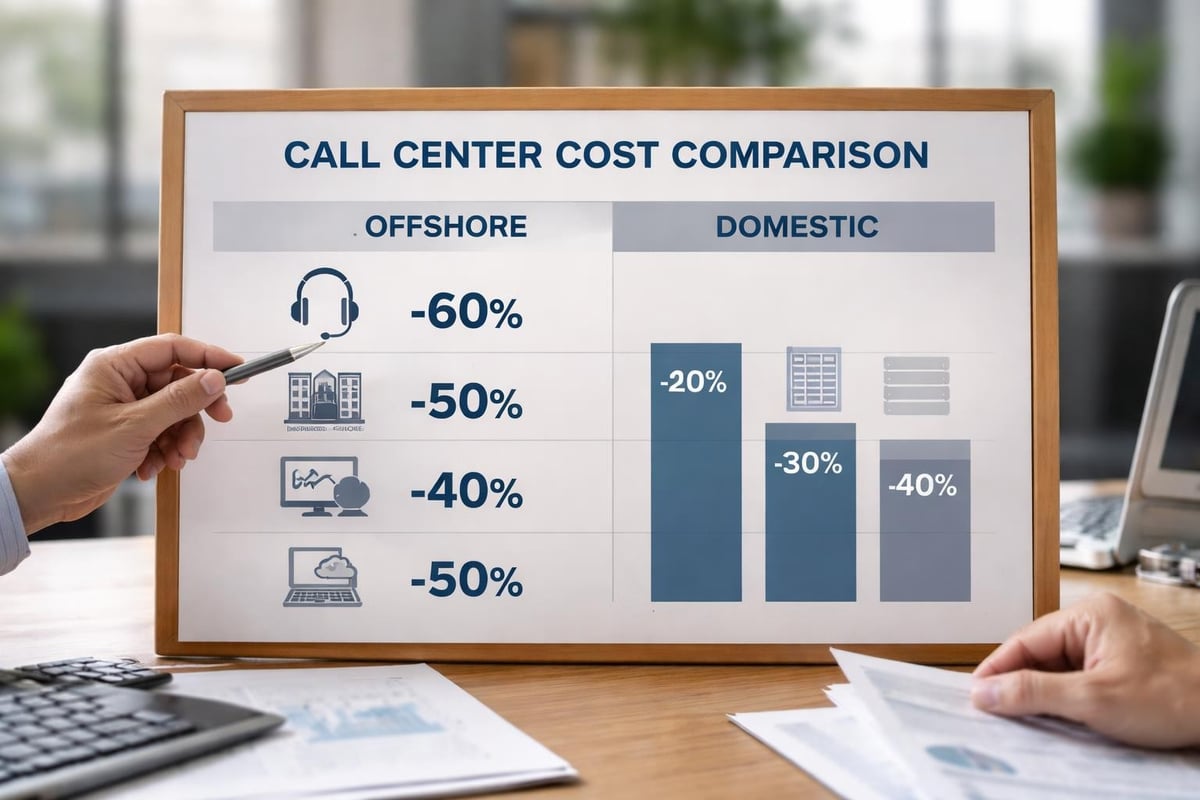
The financial case for offshore call center services remains compelling. Organizations typically realize 40-60% cost reduction compared to domestic staffing when all factors are considered.
| Cost Component | Domestic (US) | Offshore (Philippines) | Offshore (El Salvador) |
|---|---|---|---|
| Hourly Agent Rate | $18-28 | $6-10 | $7-12 |
| Facilities/Infrastructure | High | Included | Included |
| Benefits/HR Overhead | 30-40% | Included | Included |
| Technology Stack | Separate investment | Often included | Often included |
These savings compound significantly at scale. A 50-seat operation that costs approximately $2.1 million annually in the United States might run at $750,000-$900,000 through an offshore partner, creating substantial budget flexibility for growth initiatives or technology investments.
Strategic Benefits Beyond Cost Reduction
While financial savings drive initial interest, successful offshore call center partnerships deliver value across multiple dimensions that transform business operations.
Scalability and Flexibility
Offshore providers maintain larger talent pools and established infrastructure that enable rapid scaling. Whether you need to add 10 seats for a product launch or 100 agents for seasonal demand, offshore partners can recruit, train, and deploy teams in weeks rather than months.
Flexibility advantages include:
- Quick ramp-up for new programs or product lines
- Seasonal scaling without long-term commitments
- Easy adjustment of service hours and capacity
- Access to specialized skill sets on demand
This operational agility proves particularly valuable for startups and growth-stage companies that face unpredictable demand patterns. Many businesses rely on offshore call centers specifically for this capacity to adapt quickly without significant capital investment.
Access to Multilingual Talent
Global markets demand global language capabilities. Offshore locations like the Philippines and South Africa offer access to agents fluent in multiple languages, enabling companies to serve diverse customer bases without maintaining separate regional operations.
A single offshore facility might staff agents proficient in English, Spanish, French, German, and Asian languages, creating comprehensive coverage that would prove prohibitively expensive to replicate domestically.
Extended Service Hours
Geographic distribution enables true 24/7/365 coverage through natural timezone advantages. A business headquartered in New York can leverage Philippine teams to cover nighttime hours, creating seamless round-the-clock service without requiring domestic graveyard shifts.
Addressing Common Concerns and Challenges
Despite proven benefits, businesses considering offshore partnerships must acknowledge and address legitimate operational concerns that can impact service quality if not managed properly.
Language and Communication Standards
Language barriers represent a primary concern for many companies evaluating offshore options. Modern offshore call center providers have developed comprehensive solutions to this challenge through rigorous screening, accent neutralization training, and ongoing language development programs.
Effective language management includes:
- Multiple screening rounds testing comprehension and articulation
- Accent training specific to your target market
- Industry vocabulary and terminology education
- Regular quality assessments with native speakers
- Continuous coaching based on call monitoring
Top-tier providers maintain language proficiency standards equivalent to or exceeding many domestic operations, particularly in countries like the Philippines where English serves as an official language and medium of instruction throughout education.
Cultural Alignment and Customer Experience
Cultural differences can create friction in customer interactions if agents lack context for references, expectations, or communication norms common in your market. Progressive offshore providers invest heavily in cultural training that extends beyond surface-level awareness.
Training programs should cover customer psychology, regional business practices, common reference points in popular culture, and communication style preferences. Agents serving American customers need different preparation than those supporting European or Asian markets.
Quality Control and Performance Management
Maintaining consistent quality across distributed teams requires robust monitoring systems and clear performance frameworks. Successful offshore partnerships establish the same quality standards that would apply to domestic operations.
| Quality Metric | Target Range | Monitoring Frequency |
|---|---|---|
| First Call Resolution | 75-85% | Daily |
| Average Handle Time | Program-specific | Real-time |
| Customer Satisfaction | 85%+ | Per interaction |
| Quality Assurance Score | 90%+ | Weekly |
| Schedule Adherence | 95%+ | Real-time |
Implementing comprehensive analytics enables offshore teams to track performance metrics, identify improvement opportunities, and maintain accountability that drives continuous improvement.

Selecting the Right Offshore Location
Geographic selection significantly impacts operational success. Each major offshore market offers distinct advantages that align with different business needs and priorities.
The Philippines: Cultural Affinity and English Proficiency
The Philippines dominates offshore call center services for North American companies due to strong English proficiency, cultural alignment with Western business practices, and a large pool of educated talent. Philippine agents typically understand American idioms, cultural references, and communication styles more naturally than counterparts in other regions.
The country’s infrastructure for contact center operations is mature and sophisticated, with established business districts housing modern facilities equipped with redundant power, high-speed internet, and advanced technology platforms. Learn more about nearshore and offshore call center operations to understand location-specific advantages.
El Salvador: Nearshore Advantages
For businesses prioritizing timezone alignment and geographic proximity, El Salvador offers compelling nearshore benefits. Agents work during standard North American business hours without overnight shifts, facilitating easier collaboration with domestic teams.
Travel between the United States and El Salvador takes hours rather than the 15-20 hours required for Asian destinations, simplifying management oversight, training delivery, and relationship building. Cultural similarities and increasing English proficiency make El Salvador an attractive option for companies wanting offshore economics with nearshore convenience.
South Africa: Multilingual Capabilities
South Africa excels in serving European markets and businesses requiring multilingual support. The country offers fluency in English, Afrikaans, and various European languages, along with cultural understanding of both British and American business practices.
Time zone positioning enables coverage of European business hours while also supporting Middle Eastern and African markets. Companies expanding into multiple international markets find South African operations particularly valuable for their linguistic versatility.
Implementation Best Practices
Success with offshore call center partnerships depends on thoughtful implementation that addresses operational, cultural, and technical considerations from the outset.
Comprehensive Onboarding and Training
Effective training programs extend well beyond product knowledge and call scripts. Key considerations before offshoring include establishing training frameworks that create genuine expertise and customer advocacy.
Training components should include:
- Deep product and service knowledge across your full portfolio
- Customer journey mapping and pain point understanding
- Communication techniques and soft skills development
- Technology platform proficiency and troubleshooting
- Escalation procedures and decision-making authority
- Brand voice and values integration
Allocate 3-4 weeks for comprehensive initial training, followed by ongoing development that keeps agents current with product updates, policy changes, and evolving customer needs.
Technology Integration and Infrastructure
Modern offshore call center operations require seamless technology integration between your systems and provider infrastructure. Cloud-based contact center platforms have eliminated many historical challenges around connectivity and data sharing.
Critical technology requirements include:
- CRM integration for complete customer history access
- Quality monitoring and call recording systems
- Real-time reporting and analytics dashboards
- Workforce management and scheduling tools
- Knowledge base and resource libraries
- Secure data transmission and storage protocols
Ensure your offshore partner maintains redundant internet connections, backup power systems, and business continuity plans that guarantee service availability even during local infrastructure disruptions.
Performance Management and Continuous Improvement
Establish clear KPIs aligned with your business objectives and customer experience goals. Regular performance reviews should identify trends, celebrate successes, and address gaps promptly.
Optimizing offshore customer service teams requires consistent feedback loops, coaching opportunities, and recognition programs that maintain engagement and motivation across distance and cultural boundaries.

Managing Hybrid and Remote Offshore Teams
The evolution toward remote work has transformed offshore call center operations, creating new opportunities and challenges for distributed team management.
Remote Work Infrastructure
Many offshore providers now operate hybrid models where agents work from home part or full-time. This approach expands talent pools beyond major urban centers and reduces facility overhead, but requires robust technology and management systems.
Remote working best practices emphasize secure home office setups, reliable connectivity verification, and monitoring systems that maintain productivity without invasive surveillance. Successful remote offshore programs provide equipment, internet subsidies, and technical support that ensure consistent service delivery.
Communication and Collaboration
Geographic and cultural distance requires intentional communication strategies that build connection and alignment. Regular video meetings, collaborative platforms, and informal interaction opportunities help create team cohesion despite physical separation.
Schedule overlapping hours where domestic and offshore teams can interact in real-time, facilitating knowledge sharing, relationship building, and rapid problem resolution. These synchronous touchpoints prove invaluable for maintaining cultural integration and operational alignment.
Data Security and Compliance Considerations
Offshore call center partnerships involve sharing sensitive customer data across international boundaries, making security and compliance critical considerations that require diligent attention.
Regulatory Compliance
Understand regulatory requirements governing customer data in your industry and markets. GDPR, HIPAA, PCI-DSS, and other frameworks impose specific obligations around data handling, storage, and transmission that your offshore partner must meet.
Compliance requirements typically include:
- Data encryption in transit and at rest
- Access controls and authentication protocols
- Regular security audits and penetration testing
- Incident response and breach notification procedures
- Data residency and sovereignty considerations
- Employee background checks and security training
Verify your offshore provider maintains relevant certifications (ISO 27001, SOC 2, PCI-DSS) appropriate to your industry and data sensitivity levels.
Intellectual Property Protection
Call center agents access proprietary information about products, processes, pricing, and customer relationships. Robust contractual protections, including non-disclosure agreements, intellectual property clauses, and restrictive covenants, safeguard your competitive advantages.
Review local legal frameworks in your offshore location to understand enforcement mechanisms and remedies available if disputes arise. Some jurisdictions offer stronger IP protection than others.
Evaluating Provider Capabilities and Partnerships
Selecting the right offshore call center partner fundamentally determines program success. Comprehensive evaluation of operational issues helps identify providers with genuine capabilities rather than just attractive pricing.
Assessment Criteria
Evaluate potential partners across multiple dimensions:
| Evaluation Area | Key Questions |
|---|---|
| Experience | How long in business? What industries served? |
| Scale | Current agent count? Growth capacity? |
| Technology | Platform capabilities? Integration options? |
| Quality Systems | QA processes? Performance metrics? |
| Financial Stability | Company backing? Client retention rates? |
| Cultural Fit | Management philosophy? Values alignment? |
Request facility tours (virtual or in-person), speak with current clients, and review detailed proposals that demonstrate understanding of your specific requirements rather than generic capabilities.
Pilot Programs and Controlled Expansion
Begin with pilot programs that test provider capabilities on limited scope before committing to large-scale partnerships. A 10-20 seat pilot over 60-90 days reveals operational strengths, identifies gaps, and validates cultural fit with manageable risk.
Structure pilots with clear success metrics, regular checkpoints, and defined expansion criteria. This measured approach protects your customer relationships while gathering evidence that informs confident scaling decisions. If you’re managing cost pressures and rising customer expectations simultaneously, a 30-minute strategy call with a Focus Services specialist provides clarity on what outsourcing can realistically deliver for your operation.
The Future of Offshore Call Center Services
The offshore call center industry continues evolving rapidly, incorporating advanced technologies and shifting business models that expand value propositions beyond traditional labor arbitrage.
AI and Automation Integration
Artificial intelligence tools are transforming offshore operations through chatbots handling routine inquiries, speech analytics identifying improvement opportunities, and predictive routing connecting customers with ideal agents. These technologies amplify human capabilities rather than replacing agents, enabling offshore teams to focus on complex, high-value interactions.
Progressive providers invest in AI-enabled workforce optimization that enhances both efficiency and experience quality. The combination of offshore economics and advanced technology creates compelling cost-performance advantages that pure automation or domestic-only operations struggle to match.
Specialization and Vertical Expertise
Leading offshore providers increasingly develop deep expertise in specific industries or functions rather than positioning as generalist vendors. This specialization enables more sophisticated service delivery with agents who understand industry nuances, regulatory requirements, and customer expectations without extensive training.
Seek partners with demonstrated experience in your vertical, evidenced by relevant case studies, industry certifications, and specialized training programs that accelerate time-to-proficiency.
Outcome-Based Pricing Models
Traditional per-hour or per-agent pricing is giving way to outcome-based arrangements that align provider compensation with business results. Models based on customer satisfaction scores, revenue generated, or issues resolved create shared incentives that drive continuous improvement.
These arrangements require mature analytics capabilities and strong trust between partners, but deliver superior alignment and typically better overall results than pure transactional relationships.
Building Long-Term Strategic Partnerships
The most successful offshore call center relationships transcend vendor-client transactions to become true strategic partnerships where both organizations invest in mutual success.
Relationship Investment
Treat your offshore team as an extension of your internal operation rather than an external vendor. Include offshore leaders in strategic planning, share company updates and wins, and create career development pathways that retain top talent.
Regular site visits, leadership exchanges, and cultural integration activities build relationships that enhance collaboration, problem-solving, and innovation. These investments pay dividends through reduced turnover, improved performance, and proactive partnership.
Continuous Evolution and Innovation
Markets change, customer expectations evolve, and competitive pressures intensify. Your offshore partnership should adapt continuously rather than operating in static mode after initial implementation.
Schedule quarterly business reviews that assess performance against objectives, identify emerging opportunities, and align on strategic priorities. Challenge your partner to propose innovations, efficiency improvements, and capability expansions that drive mutual growth. For insights on maintaining operational excellence, explore resources on call center operational excellence.
Offshore call centers deliver powerful advantages when implemented strategically, combining significant cost savings with access to skilled talent pools and operational flexibility that enable business growth. Success requires careful provider selection, robust quality management, and genuine partnership investment that goes beyond transactional relationships. Focus Services operates high-performance offshore and nearshore call centers across the Philippines, El Salvador, South Africa, and the United States, delivering customer care, sales, and technical support programs that combine global talent with advanced technology and proven methodologies that drive measurable business results.

Leave a Reply
Want to join the discussion?Feel free to contribute!