

Call Center Automation Solutions for 2026
Call centers continue to face mounting pressure in 2026. Customer expectations have reached unprecedented heights while operational costs climb steadily. The challenge of maintaining quality service while controlling expenses has pushed businesses to embrace automation at an accelerating pace. Call center automation solutions represent far more than simple cost-cutting measures. They fundamentally transform how contact centers operate, enabling teams to deliver superior customer experiences while optimizing workforce productivity. Organizations implementing comprehensive automation strategies are discovering opportunities to scale operations, reduce agent burnout, and create more meaningful customer interactions.
Understanding Call Center Automation in 2026
Contents
- 1 Understanding Call Center Automation in 2026
- 2 Core Components of Modern Automation Solutions
- 3 Implementation Strategies for Automation Success
- 4 Balancing Automation with Human Touch
- 5 Advanced Automation Applications
- 6 Overcoming Implementation Challenges
- 7 Measuring Automation ROI and Performance
- 8 Future Trends in Call Center Automation
The landscape of call center automation solutions has evolved significantly over the past few years. Modern automation extends well beyond basic interactive voice response systems or simple chatbots. Today’s solutions integrate artificial intelligence, machine learning, natural language processing, and predictive analytics to create sophisticated ecosystems that handle complex customer interactions.
Automation now encompasses multiple layers of contact center operations:
- Customer-facing automation including AI-powered voice assistants and intelligent virtual agents
- Agent-assistance tools that provide real-time guidance and information retrieval
- Backend process automation for quality assurance, scheduling, and workforce management
- Predictive systems that anticipate customer needs and route interactions strategically
The shift toward AI-driven contact center platforms has redefined what’s possible in customer service delivery. These platforms don’t simply replace human agents; they augment human capabilities and create hybrid service models that combine the efficiency of automation with the empathy and problem-solving abilities of skilled representatives.
The Business Case for Automation
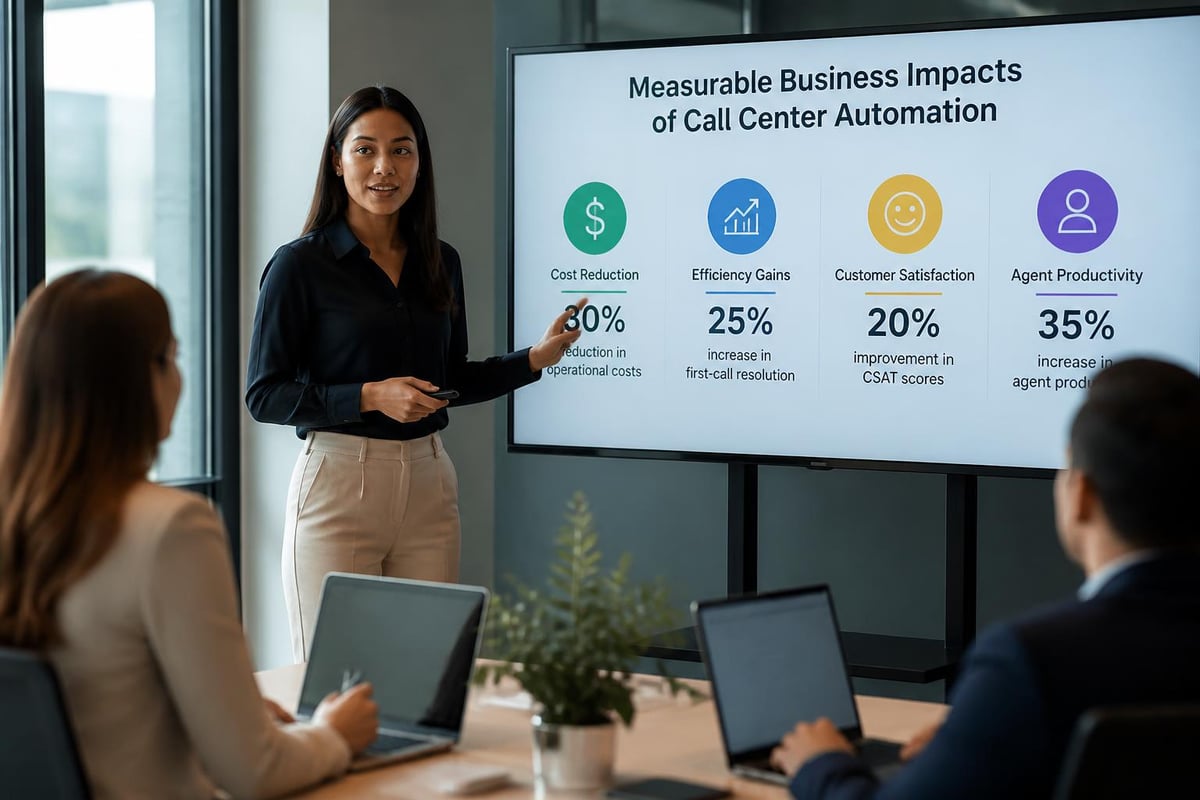
Organizations implementing call center automation solutions typically see measurable improvements across multiple performance indicators. Cost reduction remains a primary driver, but the strategic benefits extend far beyond immediate savings.
Average handle times decrease by 20-40% when automation handles routine inquiries and provides agents with instant access to customer information. First-call resolution rates improve as automated systems route customers to the most qualified agents based on issue type, customer value, and agent expertise. Customer satisfaction scores rise when wait times shrink and issue resolution becomes more consistent.
Core Components of Modern Automation Solutions
Building an effective automation strategy requires understanding the key technologies that drive contemporary call center operations. Each component serves distinct functions while working together to create seamless customer experiences.
Interactive Voice Response and Intelligent Routing
Modern IVR systems have transcended their reputation for frustrating menu trees. Today’s call center software solutions leverage natural language understanding to interpret customer intent from conversational speech. Customers can describe their issues in their own words rather than navigating rigid menu options.
Intelligent routing algorithms analyze multiple data points simultaneously. They consider customer history, current issue complexity, agent skill sets, real-time queue status, and even predictive models of resolution likelihood. This sophisticated matching ensures customers reach the right resource at the right time.
| Routing Factor | Traditional Approach | Automated AI Approach |
|---|---|---|
| Skill Matching | Broad department categories | Granular skill assessment with proficiency scoring |
| Customer Priority | Account tier or value | Predictive lifetime value and churn risk |
| Agent Selection | Round-robin or longest idle | Performance history and specialization match |
| Queue Management | First-in-first-out | Dynamic prioritization based on urgency and complexity |
Conversational AI and Virtual Agents
Conversational AI has matured dramatically. Research into real-time spoken language understanding has enabled virtual agents to handle increasingly complex interactions with natural dialogue flow. These systems maintain context throughout multi-turn conversations, recognize emotional cues, and escalate to human agents when appropriate.
The most effective implementations position virtual agents as the first line of support for common inquiries. Password resets, order status checks, appointment scheduling, and basic troubleshooting can be resolved entirely through automation. This frees human agents to focus on complex problem-solving, relationship building, and situations requiring empathy and judgment.
Key capabilities of advanced virtual agents include:
- Multi-language support with real-time translation
- Integration with CRM and backend systems for personalized responses
- Learning from interactions to continuously improve accuracy
- Seamless handoff to human agents with full context transfer
- Sentiment analysis to detect frustration and adjust responses
Workforce Optimization and Management
Automation transforms how call centers manage their human resources. Predictive scheduling algorithms analyze historical patterns, seasonal trends, and real-time conditions to forecast contact volume with remarkable accuracy. This enables precise staffing decisions that balance service levels with cost efficiency.
Quality assurance automation represents another significant advancement. Rather than manually reviewing a small sample of interactions, AI systems can analyze 100% of customer contacts. They identify compliance issues, coaching opportunities, and performance patterns that would be impossible to detect through traditional sampling methods.
Agent assistance tools provide real-time support during customer interactions. These systems listen to conversations, retrieve relevant information, suggest responses, and even automate post-call documentation. Agents become more productive and confident when they have instant access to knowledge bases and procedural guidance.
Implementation Strategies for Automation Success
Successfully deploying call center automation solutions requires careful planning and a phased approach. Organizations that rush implementation often struggle with adoption challenges and suboptimal results.
Assessing Your Automation Readiness
Before investing in automation technology, evaluate your current operations and infrastructure. Identify pain points where automation delivers the highest impact. Common starting points include high-volume repetitive inquiries, after-hours support, and routine transaction processing.
Critical assessment areas:
- Data infrastructure: Do you have clean, accessible customer data that automation systems can leverage?
- Process documentation: Are your service procedures clearly defined and standardized?
- Technology stack: Will new automation tools integrate with existing platforms?
- Team capabilities: Does your organization have the skills to implement and maintain automated systems?
- Customer expectations: Will your customer base embrace automated interactions?
For businesses exploring customer service outsourcing options, Customer Care Outsourcing providers increasingly offer integrated automation capabilities alongside traditional agent services, allowing organizations to leverage both technology and skilled human support.
Choosing the Right Automation Technologies
The marketplace for call center automation solutions has expanded significantly. Vendors offer specialized point solutions alongside comprehensive platforms that integrate multiple capabilities. Your selection should align with specific business requirements rather than pursuing the most feature-rich option.
Human-centered design principles should guide technology selection. The best automation solutions enhance rather than replace human judgment. They provide customers with choice, allowing easy access to human agents when needed. They make agent jobs easier rather than creating surveillance systems that increase stress.

Evaluate vendors based on implementation support, ongoing training resources, and system flexibility. Automation needs evolve as your business grows and customer expectations shift. Solutions that allow customization and continuous improvement deliver better long-term value than rigid out-of-box products.
Balancing Automation with Human Touch
The most successful call center operations recognize that automation serves customers best when paired strategically with human agents. Pure automation strategies that eliminate human interaction typically damage customer relationships and brand perception.
Creating Effective Hybrid Models
Design your service model around customer journey complexity. Simple, transactional inquiries flow through automated channels. Emotionally charged situations, complex problem-solving, and relationship-building interactions route to skilled human agents.
Empower customers to choose their service channel. Some customers prefer self-service options and appreciate the speed of automation. Others value human connection and want to speak with representatives. Providing choice demonstrates respect for customer preferences.
| Interaction Type | Automation Level | Human Involvement | Expected Outcome |
|---|---|---|---|
| Account balance inquiry | Full automation | None | Instant resolution |
| Product recommendation | AI-assisted | Agent-led with AI suggestions | Personalized guidance |
| Complex technical support | Hybrid | Agent-led with real-time knowledge support | Expert problem-solving |
| Service complaint | Human-primary | Agent-handled with automated documentation | Relationship preservation |
Train agents to work effectively with automation tools. Resistance often stems from fear that technology will eliminate jobs. Frame automation as a productivity enhancer that removes tedious tasks and allows agents to focus on rewarding work that showcases their skills.
Maintaining Service Quality Standards
Automation introduces new quality management requirements. Monitor both technical performance metrics and customer experience indicators. Automated systems should meet or exceed the service standards you expect from human agents.
Essential quality metrics for automated interactions:
- Intent recognition accuracy
- Containment rates for self-service interactions
- Customer effort scores
- Fallback to human agent frequency
- Resolution accuracy
- Customer satisfaction with automated service
Continuous improvement processes become critical as automation scales. Implement feedback loops that capture customer reactions to automated interactions. Analyze conversation logs to identify misunderstood intents, awkward dialogue flows, and opportunities to expand automation capabilities.
Advanced Automation Applications
Leading organizations are pushing automation boundaries beyond traditional contact center functions. These advanced applications demonstrate the expanding potential of call center automation solutions.
Proactive Customer Engagement
Rather than waiting for customers to initiate contact, automated systems can reach out proactively. Predictive analytics identify customers who may need assistance based on behavioral signals. Automated outreach can prevent issues before they escalate into complaints.
Appointment reminders, shipping notifications, and service alerts delivered through automated voice, SMS, or email reduce inbound inquiry volume. Self-improving automation systems learn from customer responses to optimize messaging timing, channel selection, and content personalization.
Sentiment Analysis and Emotion Detection
Modern automation can detect emotional states through voice tone analysis and conversation patterns. When systems identify customer frustration, they can automatically adjust responses, offer conciliatory gestures, or expedite transfer to senior agents.
This emotional intelligence creates more empathetic automated interactions. Customers feel heard even when speaking with AI systems. The technology also protects agents by flagging potentially hostile interactions and providing intervention support.
Multilingual and Global Support
Organizations operating across multiple regions benefit enormously from automation’s language capabilities. Virtual agents can converse fluently in dozens of languages without the staffing challenges of maintaining multilingual agent teams.
For companies with global contact center operations, automation provides consistency across geographic markets while allowing cultural customization. Automated systems can be programmed with region-specific knowledge, compliance requirements, and communication norms.

Overcoming Implementation Challenges
Despite clear benefits, call center automation solutions implementation presents obstacles. Anticipating these challenges and developing mitigation strategies improves success rates.
Integration Complexity
Legacy systems often resist integration with modern automation platforms. Customer data may reside in multiple disconnected databases. CRM systems, ticketing platforms, knowledge bases, and communication tools all need to share information seamlessly.
Budget adequate time and resources for integration work. Consider middleware solutions that facilitate connections between disparate systems. Prioritize integration points that deliver maximum value rather than attempting comprehensive integration immediately.
Change Management Resistance
Employees and customers alike may resist automation changes. Agents worry about job security. Customers accustomed to human service may distrust automated systems. Middle managers may fear losing control or relevance.
Address resistance through transparent communication about automation goals and benefits. Involve frontline agents in automation design and testing. They offer valuable insights into customer needs and process inefficiencies. Their participation builds buy-in and improves solution quality.
Effective change management tactics:
- Communicate the “why” behind automation initiatives clearly and repeatedly
- Provide comprehensive training on new tools and processes
- Celebrate early wins and share success stories
- Address concerns honestly and adjust implementations based on feedback
- Recognize and reward employees who embrace automation effectively
Data Privacy and Security
Automated systems process vast amounts of customer data. This creates both opportunities and risks. Robust security measures and privacy compliance become paramount as automation scales.
Implement strong access controls, encryption, and audit trails. Ensure automation vendors meet industry security standards and compliance requirements. Regular security assessments should evaluate both technical safeguards and process vulnerabilities.
Measuring Automation ROI and Performance
Quantifying the impact of call center automation solutions requires comprehensive measurement frameworks. Focus on metrics that reflect both operational efficiency and customer experience quality.
Financial Performance Indicators
Calculate total cost per interaction across automated and human-handled contacts. Track how automation shifts cost structures over time. Monitor labor costs, technology expenses, and overhead allocation to understand true return on investment.
Most organizations see payback periods of 12-24 months for automation investments. Ongoing operational savings then provide continuous value. Factor in both direct cost reductions and indirect benefits like improved customer retention and increased sales conversion.
Operational Efficiency Metrics
Average handle time, first-call resolution, and agent utilization rates all improve with effective automation. Service level achievement becomes more consistent as automation handles volume spikes that would otherwise overwhelm human agents.
Monitor automation containment rates to understand what percentage of inquiries resolve without human intervention. Track escalation patterns to identify automation gaps where additional training or functionality could improve performance.
Customer Experience Outcomes
Customer satisfaction scores, Net Promoter Score, and customer effort scores reveal how automation affects experience quality. Segment these metrics by channel and interaction type to understand where automation excels and where improvements are needed.
Analyze customer feedback specifically related to automated interactions. Survey customers about their preferences for self-service versus human assistance across different scenarios. Use these insights to refine your automation strategy and channel design.
Future Trends in Call Center Automation
The evolution of call center automation solutions continues at a rapid pace. Several emerging trends will shape the industry over the next few years.
Generative AI Integration
Large language models and generative AI are beginning to transform virtual agent capabilities. These systems can engage in more natural, contextually appropriate conversations. They generate unique responses rather than selecting from predefined scripts.
The technology also creates new applications in agent support. Generative AI can summarize lengthy customer histories, draft personalized email responses, and create training materials based on interaction patterns.
Predictive and Preventative Automation
Advanced analytics will enable contact centers to predict and prevent customer issues before they prompt calls. Machine learning models identify customers at risk of churn, product failures likely to generate complaints, and service gaps that create friction.
Automated interventions based on these predictions reduce support volume while improving customer satisfaction. The focus shifts from reactive problem-solving to proactive relationship management.
Hyperautomation and Ecosystem Integration
The concept of hyperautomation combines multiple technologies into comprehensive automation frameworks. Robotic process automation, AI, machine learning, and workflow orchestration work together across entire business processes.
For call centers, this means automation extending beyond customer interactions into backend operations. Order processing, account updates, billing adjustments, and case management all become increasingly automated with seamless handoffs between systems and human workers.
Vendors like Genesys and Talkdesk continue advancing platform capabilities that orchestrate customer experiences across multiple touchpoints and business systems.
Call center automation solutions have matured into essential tools for delivering efficient, scalable customer service in 2026. The organizations achieving the greatest success recognize that automation enhances rather than replaces human capabilities, creating hybrid models that leverage the strengths of both technology and people. Whether you’re exploring initial automation implementations or advancing existing capabilities, Focus Services combines AI-enabled workforce optimization with experienced global teams to help you transform customer service operations while maintaining the human touch that builds lasting customer relationships.

Leave a Reply
Want to join the discussion?Feel free to contribute!