

Outsourced Customer Support: A Strategic Guide
Businesses across every industry face mounting pressure to deliver exceptional customer experiences while managing operational costs and resource constraints. Outsourced customer support has emerged as a strategic solution that allows companies to scale their service operations efficiently without sacrificing quality or breaking their budgets. From startups navigating rapid growth to enterprise organizations optimizing their global footprint, partnering with specialized providers offers access to skilled talent, advanced technology, and proven processes that would be costly and time-consuming to build in-house.
Understanding the Strategic Value of Outsourcing Customer Support
Contents
- 1 Understanding the Strategic Value of Outsourcing Customer Support
- 2 Choosing the Right Outsourcing Model
- 3 Building a Successful Outsourcing Partnership
- 4 Managing Quality and Performance
- 5 Overcoming Common Challenges
- 6 Scaling Your Outsourced Operations
- 7 Measuring Return on Investment
- 8 Planning Your Transition
- 9 Industry-Specific Considerations
- 10 Selecting Your Outsourcing Partner
- 11 Advanced Considerations for Mature Partnerships
The decision to outsource customer support represents more than a cost-cutting measure. It’s a strategic choice that can fundamentally transform how your organization delivers value to customers.
Financial and Operational Benefits
Organizations that implement outsourced customer service typically realize immediate advantages across multiple dimensions. The most obvious benefit comes from labor cost arbitrage, especially when partnering with providers operating in regions like the Philippines, El Salvador, or South Africa where skilled agents command lower salaries than their U.S. counterparts.
Beyond direct labor savings, outsourcing eliminates the capital expenditures associated with building and maintaining infrastructure:
- Real estate costs for call center facilities
- Technology investments in telephony systems, CRM platforms, and workforce management tools
- HR overhead including recruitment, training, benefits administration, and compliance
- Management layers required to oversee day-to-day operations
The financial model shifts from fixed to variable costs, providing flexibility to scale support capacity up or down based on seasonal demand, product launches, or market conditions.
Access to Specialized Expertise and Technology
Modern customer support requires proficiency across multiple channels, familiarity with sophisticated software platforms, and the ability to handle increasingly complex customer inquiries. Building this capability internally demands significant time and investment.
Established outsourcing providers bring mature processes, proven methodologies, and deep domain expertise. They’ve already invested in training programs, quality assurance frameworks, and omnichannel customer service infrastructure that allows seamless support across phone, email, chat, social media, and messaging platforms.

Choosing the Right Outsourcing Model
Not all outsourcing arrangements deliver the same value. The model you select should align with your business objectives, customer expectations, and growth trajectory.
Comparing Service Delivery Options
| Model | Best For | Typical Applications | Key Considerations |
|---|---|---|---|
| Offshore | High-volume, cost-sensitive operations | E-commerce support, subscription services, technical tier-1 support | Time zone coverage, language proficiency, cultural alignment |
| Nearshore | Balance of cost and proximity | B2B support, financial services, healthcare | Minimal time zone differences, similar business culture |
| Onshore | Premium service, complex products | Enterprise software, luxury brands, regulated industries | Higher costs offset by quality and compliance advantages |
| Hybrid | Organizations with diverse needs | Mix of routine and specialized support | Coordination complexity, consistent experience delivery |
The right choice depends on factors beyond cost alone. Consider your customer demographics, the complexity of your product or service, regulatory requirements, and brand positioning when evaluating options.
Some providers offer dedicated teams that work exclusively for your organization, while others utilize shared agent pools that handle multiple clients. Dedicated teams develop deeper product knowledge and stronger alignment with your brand, but shared resources often provide better cost efficiency and staffing flexibility.
For businesses in specialized industries or those with unique service protocols, dedicated arrangements typically deliver superior results. Companies with straightforward support needs and price sensitivity may find shared models perfectly adequate.
Building a Successful Outsourcing Partnership
The transition to outsourced customer support requires careful planning and active management. Success depends on clear communication, aligned expectations, and structured governance.
Essential Elements of the Partnership Framework
Start by documenting detailed service requirements that go beyond basic metrics. Define your brand voice, escalation procedures, decision-making authority, and quality standards. Professional tips for outsourcing customer support emphasize the importance of creating comprehensive documentation before engaging with potential providers.
Your service level agreements should address:
- Response time targets across all channels
- Resolution timeframes for different issue categories
- Quality benchmarks including customer satisfaction scores, first contact resolution rates, and accuracy standards
- Availability requirements specifying coverage hours, holiday schedules, and disaster recovery procedures
- Performance reviews establishing cadence and criteria for ongoing assessment
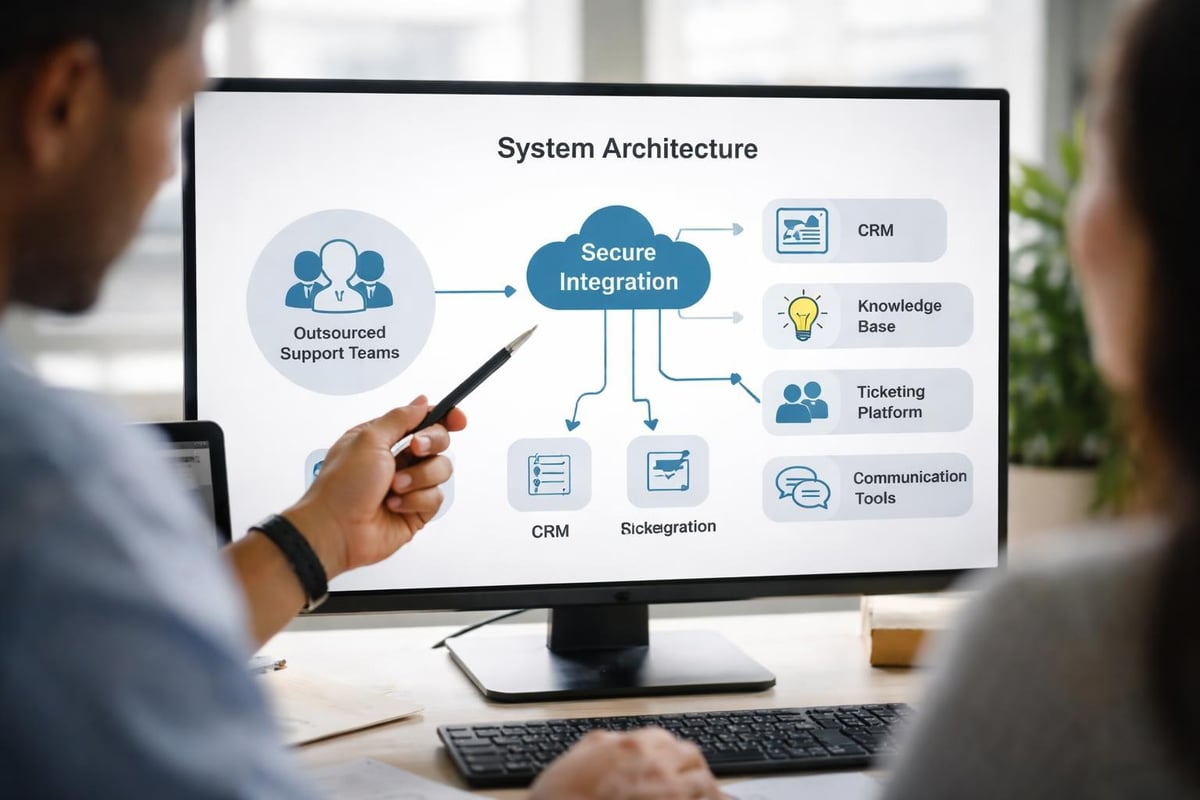
Technology integration represents another critical success factor. Your outsourcing partner needs access to the same systems your internal team uses, including your CRM platform, knowledge base, ticketing system, and any specialized applications. Seamless integration ensures agents have complete customer context and can deliver consistent experiences.
Knowledge Transfer and Training Programs
The quality of your outsourced customer support depends heavily on how well agents understand your products, policies, and customers. Invest significant time in developing comprehensive training materials and onboarding programs.
Create detailed product documentation, video tutorials, and interactive training modules. Develop scenario-based exercises that prepare agents for common and unusual customer situations. Many successful partnerships include initial shadowing periods where outsourced agents observe internal team members before handling live interactions.
Ongoing training should address product updates, seasonal promotions, process changes, and skill development. Regular calibration sessions ensure agents maintain alignment with your quality standards and evolving customer expectations.
Managing Quality and Performance
Maintaining high service standards across an outsourced operation requires structured oversight and continuous improvement mechanisms.
Establishing Effective Quality Assurance
A robust QA program evaluates both quantitative metrics and qualitative factors. Track standard metrics like average handle time, abandonment rate, and customer satisfaction scores, but don’t overlook the importance of call monitoring, interaction reviews, and customer feedback analysis.
Best practices for managing outsourced customer service recommend regular quality audits conducted by both the provider’s QA team and your internal stakeholders. This dual-layer approach catches issues early and provides multiple perspectives on performance.
Schedule weekly performance reviews to discuss trends, address challenges, and celebrate successes. Monthly business reviews should examine broader patterns, assess progress against long-term objectives, and identify improvement opportunities.
Performance Management and Agent Development
The strength of your customer support operation ultimately comes down to individual agent performance. Working with providers that prioritize employee development and retention delivers long-term benefits for your business.
Solutions like Hatchproof help outsourcing providers identify high performers, optimize team composition, and reduce attrition by providing data-driven insights into employee engagement and performance patterns. When your outsourcing partner invests in their workforce, your customers benefit from more experienced, motivated agents.
Recognition programs, career advancement opportunities, and competitive compensation structures all contribute to agent satisfaction and longevity. Lower turnover translates directly to better customer experiences as agents accumulate product knowledge and develop expertise over time.
Overcoming Common Challenges
Even well-planned outsourcing initiatives encounter obstacles. Anticipating these challenges and developing mitigation strategies increases your likelihood of success.
Communication and Cultural Alignment
When working with teams in different countries or regions, communication differences can create friction. Accents, idioms, and cultural references that seem natural to agents may confuse or frustrate customers.
Address these concerns through:
- Accent neutralization training that helps agents communicate clearly with your target customer base
- Cultural education programs covering your customers’ expectations, communication preferences, and common concerns
- Localization of scripts and responses that sound natural rather than translated
- Regular customer feedback collection specifically addressing communication quality
Time zone differences can be an advantage (providing 24/7 coverage) or a challenge (complicating real-time collaboration). Structure your operations to leverage offshore hours for customer support while maintaining overlapping time for team meetings, training, and escalation handling.
Data Security and Compliance Requirements
Outsourced customer support teams often access sensitive customer information, financial data, and proprietary business information. Protecting this data requires comprehensive security protocols and clear contractual provisions.
Verify that potential providers maintain appropriate certifications for your industry, such as PCI-DSS for payment processing, HIPAA compliance for healthcare information, or SOC 2 for general data security. Understand where data will be stored, how it will be transmitted, and who has access under what circumstances.
| Security Concern | Mitigation Strategy | Verification Method |
|---|---|---|
| Unauthorized access | Role-based permissions, multi-factor authentication | Security audits, access logs review |
| Data breaches | Encryption, secure networks, and incident response plans | Penetration testing, certification validation |
| Privacy violations | GDPR/CCPA compliance, data handling policies | Legal review, training records |
| Insider threats | Background checks, activity monitoring, NDAs | Compliance documentation, audit trails |
Scaling Your Outsourced Operations
As your business grows, your customer support needs will evolve. The right outsourcing partnership provides flexibility to expand capacity, add new capabilities, and enter new markets.
Capacity Planning and Demand Forecasting
Work closely with your provider to anticipate staffing needs based on historical patterns, upcoming initiatives, and seasonal variations. Most established providers require several weeks to recruit, hire, and train new agents, so advance planning prevents service disruptions during growth periods.
Develop escalation protocols for unexpected volume spikes. Your provider should maintain a pool of trained backup agents who can be activated quickly when call volumes exceed projections. Buffer capacity costs more than baseline staffing but prevents catastrophic service failures during crisis situations or viral marketing success.
Adding New Channels and Capabilities
Customer preferences continue shifting toward digital channels, including live chat, social media messaging, and SMS support. Your outsourcing provider should help you evaluate which channels matter most for your customers and support seamless expansion as your omnichannel strategy evolves.
Consider gradually adding specialized support tiers. Basic inquiries can be handled by less experienced agents at lower cost, while complex technical issues or high-value customers route to specialized teams with deeper expertise. This tiering optimizes both cost efficiency and customer satisfaction.
If you’re exploring more efficient operations, implementing Six Sigma methodologies within your outsourced support environment can significantly reduce errors and improve process consistency.

Measuring Return on Investment
Demonstrating the value of outsourced customer support requires tracking metrics beyond simple cost savings.
Comprehensive ROI Calculation
Calculate total cost of ownership by comparing your current or projected in-house expenses against outsourcing fees. Include all direct and indirect costs:
In-house costs: salaries, benefits, payroll taxes, facilities, technology, management, recruitment, training, turnover replacement
Outsourced costs: monthly service fees, transition expenses, additional technology licenses, ongoing management overhead
The difference represents your cost savings, but complete ROI analysis incorporates revenue impact and opportunity costs. Consider how redeploying internal resources to strategic initiatives rather than customer support operations creates additional value.
Customer Experience Metrics
Financial savings mean nothing if customer satisfaction deteriorates. Monitor these indicators closely:
- Net Promoter Score (NPS) measures customer loyalty and likelihood to recommend
- Customer Satisfaction (CSAT) scores track satisfaction with individual interactions
- Customer Effort Score (CES) evaluates how easy customers find problem resolution
- First Contact Resolution (FCR) shows efficiency and effectiveness
- Customer retention rates demonstrate long-term relationship health
Case studies on customer service outsourcing demonstrate that well-managed partnerships often improve customer experience metrics while reducing costs, creating a true win-win outcome.
Planning Your Transition
Moving from in-house to outsourced customer support or changing providers requires methodical execution to minimize disruption.
Creating a Detailed Migration Plan
Develop a project timeline spanning 60-90 days for most transitions. Earlier phases focus on provider selection, contract negotiation, and preparation. Middle phases address knowledge transfer, training, and system integration. Final phases involve parallel operation, testing, and full cutover.
Maintain your existing support capacity throughout the transition. Running both teams simultaneously for 2-4 weeks allows you to validate quality, identify gaps, and make adjustments before fully committing to the new arrangement.
Change Management and Internal Communication
Your internal stakeholders need clear communication about why outsourcing makes sense, how it will work, and what changes to expect. Address concerns proactively and involve affected team members in planning and execution.
For organizations transitioning existing staff, consider whether some team members might transition to oversight roles, quality assurance, training development, or specialized support tiers. Others may move into different departments where their customer knowledge adds value.
For technology companies needing specialized expertise, tech support outsourcing provides dedicated teams trained in complex troubleshooting and technical problem resolution.
Industry-Specific Considerations
Different industries face unique challenges when implementing outsourced customer support solutions.
Regulated Industries
Financial services, healthcare, insurance, and utilities operate under strict regulatory frameworks that govern data handling, agent licensing, and communication protocols. Your outsourcing provider must demonstrate compliance expertise and maintain appropriate certifications.
Specialized providers serving regulated industries often command premium pricing but deliver value through reduced compliance risk and proven processes. Utility companies seeking outsourced call center services benefit from providers experienced in complex billing inquiries, outage reporting, and regulatory compliance requirements.
High-Growth Technology Companies
Fast-growing software companies, mobile apps, and digital platforms need support operations that scale as quickly as their user bases. The right outsourcing partnership provides this elasticity without requiring long-term commitments to fixed capacity.
Technology companies should prioritize providers comfortable with frequent product updates, agile development cycles, and evolving customer needs. Strategies for managing outsourced support teams emphasize continuous knowledge sharing and rapid adaptation to change.
E-commerce and Retail
Seasonal businesses experience dramatic volume fluctuations that make fixed in-house teams inefficient. Outsourcing providers absorb this variability, staffing up for peak seasons and scaling back during slower periods.
E-commerce support requires order management expertise, shipping and returns knowledge, and often multilingual capabilities for international customers. Look for providers with retail experience and established processes for handling high-volume, transactional interactions efficiently.
Selecting Your Outsourcing Partner
With hundreds of providers offering customer support services, choosing the right partner requires careful evaluation.
Key Selection Criteria
Start with basic qualifications, including geographic presence, industry experience, technology capabilities, and pricing structure. Then dig deeper into factors that differentiate truly excellent providers:
- Cultural fit with your organization’s values and customer philosophy
- Technology platform compatibility and integration capabilities
- Quality management systems and continuous improvement processes
- Financial stability ensuring long-term partnership viability
- Client references from companies similar to yours in size, industry, or complexity
Request detailed proposals that outline specific approaches to your unique requirements rather than generic presentations. The best providers ask probing questions about your business, customers, and objectives before proposing solutions.
The Strategic Consultation Advantage
Before making a final decision, consider scheduling consultations with top candidates to discuss your specific situation in depth. A 30-minute strategy call with a Focus Services Call Center Outsourcing specialist gives you a clear picture of what outsourcing can realistically do for your operation, with an honest conversation about capabilities, benchmarks, and direction rather than generic sales messaging.
Evaluate provider responses to complex scenarios. Ask how they’ve handled similar challenges for other clients. Request implementation case studies demonstrating their ability to deliver results in situations comparable to yours.
Advanced Considerations for Mature Partnerships
Once your outsourced customer support operation runs smoothly, opportunities emerge for optimization and innovation.
Continuous Improvement Initiatives
Establish regular business reviews focused not just on performance against SLAs but on identifying improvement opportunities. Analyze customer feedback themes, recurring pain points, and process inefficiencies. Work collaboratively with your provider to design and test solutions.
Consider implementing formal continuous improvement methodologies like Lean or Six Sigma. These structured approaches systematically eliminate waste, reduce variation, and enhance quality. Many mature outsourcing partnerships generate ongoing cost savings and quality improvements year after year through disciplined optimization.
Expanding the Relationship
Successful customer support partnerships often expand into adjacent areas. Companies that start with basic support outsourcing may add sales development, technical support, back-office processing, or other business process outsourcing services over time.
This expansion leverages the established relationship, integrated systems, and mutual understanding developed through the initial engagement. It also simplifies vendor management by consolidating multiple functions with a trusted partner.
Outsourced customer support delivers measurable benefits when implemented strategically with the right partner and governance framework. Success requires clear objectives, structured management, and continuous optimization to maintain quality while achieving cost efficiency and scalability. Focus Services brings global expertise, proven methodologies, and flexible delivery models that help businesses from startups to enterprises transform their customer support operations while improving both experience quality and operational performance.
