

Call Center Agent Services: Complete 2026 Guide
The call center agent remains the cornerstone of customer experience delivery in 2026, even as artificial intelligence reshapes the contact center landscape. These professionals handle millions of customer interactions daily, solving problems, closing sales, and building brand loyalty through every conversation. For businesses scaling operations or managing cost pressures, understanding what separates high-performing agents from average ones determines success in competitive markets. Managed call center agent services have evolved beyond simple staffing solutions to become strategic partnerships that combine skilled personnel with advanced technology and performance optimization frameworks.
The Evolution of the Call Center Agent Role
Contents
- 1 The Evolution of the Call Center Agent Role
- 2 Building High-Performance Agent Teams
- 3 Performance Management and Quality Assurance
- 4 The Case for Managed Call Center Agent Services
- 5 Technology Enablement and Agent Productivity
- 6 Specialization and Program Types
- 7 Building Agent Career Pathways
- 8 Quality Assurance and Compliance Management
- 9 Workforce Management and Optimization
- 10 Measuring Business Impact and ROI
- 11 The Future of Call Center Agent Roles
The traditional image of agents reading from scripts in cubicles has fundamentally changed. Modern call center agents operate as brand ambassadors who navigate complex systems, interpret customer intent, and make real-time decisions that impact revenue and retention.
Today’s agents work alongside AI tools that provide instant information, suggest responses, and automate routine tasks. Research shows that AI is transforming how agents work, shifting their focus from transactional tasks to relationship-building and complex problem resolution.
Technology Integration and Agent Capabilities
The skill requirements for effective agents have expanded significantly:
- Digital fluency across multiple communication channels (voice, chat, email, social media)
- Data interpretation to understand customer history and predictive insights
- Emotional intelligence to manage difficult conversations and de-escalate conflicts
- Technical troubleshooting for product support and account management
- Sales acumen to identify opportunities and close transactions
These competencies require structured training programs and continuous development. Organizations investing in agent capabilities see measurable improvements in first-call resolution rates and customer satisfaction scores.

Building High-Performance Agent Teams
Creating a successful agent workforce requires more than hiring warm bodies to answer phones. Strategic workforce planning addresses recruitment, training, performance management, and retention as interconnected elements.
Recruitment and Selection Criteria
The foundation starts with identifying candidates who possess both aptitude and attitude. Essential call center agent skills include communication ability, problem-solving capacity, and stress tolerance.
Key selection factors include:
- Communication clarity through voice and written assessments
- Learning agility measured by scenario-based testing
- Customer service orientation evaluated through behavioral interviews
- Technical comfort with software and multi-tasking requirements
- Cultural alignment with company values and customer base
Many organizations struggle with agent turnover rates exceeding 30-40% annually. This churn creates constant recruitment pressure and training costs that erode profitability. Managed services providers address this challenge through proven hiring frameworks and career development pathways that improve retention.
Training Programs That Deliver Results
Effective training transforms new hires into productive agents within weeks rather than months. Comprehensive programs combine product knowledge, system proficiency, soft skills development, and real-world practice.
| Training Component | Duration | Focus Area | Success Metric |
|---|---|---|---|
| Product Knowledge | 2-3 weeks | Features, pricing, policies | Knowledge assessment scores |
| System Navigation | 1-2 weeks | CRM, knowledge base, tools | Speed and accuracy tests |
| Communication Skills | Ongoing | Tone, empathy, resolution | Call quality scores |
| Scenario Practice | 1-2 weeks | Common situations, objections | Call handling time |
The most effective programs incorporate customer-agent pairing strategies that use machine learning to match agent strengths with customer needs, optimizing outcomes for both parties.
Performance Management and Quality Assurance
Measuring agent performance extends beyond simple call volume metrics. Modern quality frameworks evaluate customer outcomes, efficiency indicators, and compliance adherence across multiple dimensions.
Key Performance Indicators for Agents
Smart organizations track metrics that balance productivity with quality:
- Average Handle Time (AHT): Measures efficiency without sacrificing thoroughness
- First Call Resolution (FCR): Indicates problem-solving effectiveness
- Customer Satisfaction Score (CSAT): Captures experience quality
- Net Promoter Score (NPS): Predicts customer loyalty and referrals
- Schedule Adherence: Tracks reliability and availability
- Quality Assurance Score: Evaluates compliance and best practices
These metrics work together to create comprehensive performance profiles. An agent with low handle time but poor satisfaction scores needs coaching on thoroughness. High satisfaction with low efficiency suggests process improvements or additional training opportunities.

Coaching and Continuous Improvement
Regular coaching sessions transform performance data into actionable improvements. Effective managers conduct weekly one-on-one reviews that celebrate wins, identify development areas, and set specific goals.
Coaching best practices include:
- Using call recordings to illustrate specific behaviors
- Role-playing challenging scenarios for skill development
- Setting measurable improvement targets with timelines
- Providing resources and job aids for self-directed learning
- Recognizing progress and reinforcing positive behaviors
Research indicates that customer satisfaction directly impacts downstream business metrics including repeat purchases, lifetime value, and referral rates. This connection makes agent performance improvement a direct driver of revenue growth.
The Case for Managed Call Center Agent Services
Many organizations discover that managing an in-house agent workforce diverts resources from core business activities. Managed services offer an alternative model that provides experienced agents, proven processes, and scalable infrastructure without capital investment.
Strategic Advantages of Outsourced Agent Teams
Partnering with specialized providers delivers multiple operational benefits:
Cost efficiency: Managed services eliminate recruitment expenses, training investments, infrastructure costs, and management overhead. Providers achieve economies of scale that individual companies cannot match.
Scalability: Seasonal demand fluctuations, product launches, and market expansion require workforce flexibility. Managed teams scale up or down within days rather than months.
Expertise access: Specialized providers bring deep knowledge across industries, technologies, and best practices developed through thousands of client engagements.
Technology enablement: Leading providers invest in AI agent solutions that enhance productivity without requiring client technology investments.
Risk mitigation: Compliance requirements, security standards, and disaster recovery capabilities come built into managed service agreements.
For companies evaluating options, a 30-minute strategy call with an experienced outsourcing specialist provides clarity on realistic outcomes, cost structures, and implementation timelines without commitment.
Global Delivery Models and Location Strategy
Modern managed services leverage global talent pools to optimize quality, cost, and coverage. Strategic location selection balances language capabilities, cultural alignment, labor costs, and time zone coverage.
| Location | Primary Advantages | Best Use Cases | Typical Cost Range |
|---|---|---|---|
| United States | Native speakers, cultural fit | Complex B2B, regulated industries | Premium |
| Philippines | English proficiency, tech skills | Customer service, tech support | Moderate |
| El Salvador | Nearshore proximity, neutral accent | Sales, customer care | Moderate |
| South Africa | Multiple languages, UK/US alignment | International support | Competitive |
Organizations benefit from hybrid models that match agent locations to specific program requirements. Premium products requiring consultative selling may justify US-based agents, while high-volume support operations achieve efficiency through offshore locations.
Technology Enablement and Agent Productivity
The contact center technology stack directly impacts agent effectiveness and job satisfaction. Modern platforms integrate customer data, communication channels, knowledge resources, and AI assistance into unified workspaces.
Essential Technology Components
High-performing agent environments include:
- Omnichannel platforms that route and manage voice, chat, email, and social interactions
- CRM integration providing complete customer history and context
- Knowledge management systems offering instant access to answers and procedures
- Workforce management tools optimizing scheduling and forecasting
- Quality monitoring with speech analytics and automated scoring
- AI assistants that suggest responses and automate after-call work
Voice communication remains central even in AI-powered environments, as complex issues and emotional situations require human empathy and judgment that technology cannot replicate.
AI and Agent Augmentation
Artificial intelligence enhances rather than replaces skilled agents. Large Language Models deployed in contact centers provide real-time assistance, automate documentation, and extract insights from conversations without removing the human element.
AI applications that improve agent performance:
- Real-time transcription that captures conversation details automatically
- Sentiment analysis alerting agents to customer frustration or satisfaction
- Next-best-action recommendations based on customer history and intent
- Automated summarization reducing after-call documentation time
- Predictive routing matching customers with best-fit agents
These tools reduce agent cognitive load, accelerate training curves, and improve consistency across teams. Agents spend less time searching for information and more time building customer relationships.
Specialization and Program Types
Different business objectives require distinct agent capabilities and program structures. Understanding these variations helps organizations align resources with strategic goals.
Customer Service and Support Operations
Customer care programs focus on issue resolution, account management, and relationship maintenance. Agents handle inquiries, process transactions, and solve problems while creating positive experiences that drive retention.
Success metrics emphasize resolution quality, satisfaction scores, and efficiency. Training concentrates on product knowledge, empathy development, and problem-solving frameworks.
Sales and Revenue Generation
Sales-focused operations require agents with consultative skills, objection handling abilities, and closing techniques. These teams generate new business, upsell existing customers, and qualify leads for field sales organizations.
Performance measurement tracks conversion rates, revenue per contact, and average order value. Compensation often includes incentive components tied to individual and team results.
Technical Support and Troubleshooting
Technical support agents possess specialized product knowledge and diagnostic capabilities. They guide customers through complex procedures, identify root causes, and escalate unresolved issues to engineering teams.
These programs require longer training periods, ongoing product updates, and close collaboration with development organizations. Metrics focus on resolution rates, escalation percentages, and customer effort scores.
Building Agent Career Pathways
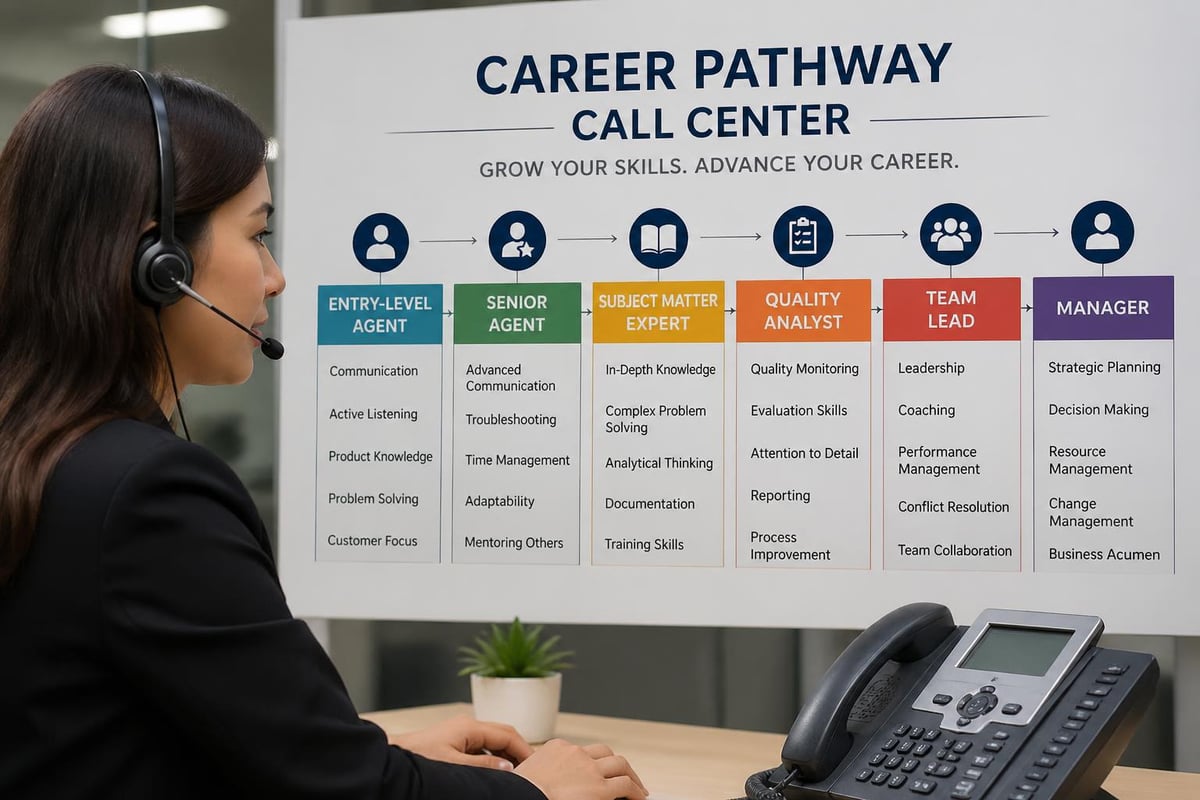
Retention improves dramatically when agents see clear advancement opportunities. Progressive organizations create defined career ladders with skill requirements, compensation increases, and role transitions.
Career Progression Framework
Typical advancement stages include:
- New Agent: Handles standard transactions with supervision and support
- Senior Agent: Manages complex situations independently with consistent quality
- Subject Matter Expert: Specializes in product areas and assists peer agents
- Quality Analyst: Evaluates performance and delivers coaching
- Team Lead: Supervises small groups and handles escalations
- Manager: Owns program results and manages multiple teams
Each level requires demonstrated competencies, performance achievements, and often completion of certification programs. This structure provides motivation and reduces turnover costs.
Organizations also develop lateral movement opportunities into training, quality assurance, workforce management, and analytics roles that leverage contact center experience in new contexts.
Quality Assurance and Compliance Management
Maintaining consistent service standards requires systematic monitoring, evaluation, and improvement processes. Quality programs protect brand reputation, ensure regulatory compliance, and identify training opportunities.
Quality Monitoring Best Practices
Effective programs combine multiple evaluation methods:
- Call recording review with structured scorecards evaluating specific behaviors
- Live monitoring providing real-time feedback and coaching opportunities
- Customer surveys capturing experience feedback directly from interactions
- Peer review encouraging knowledge sharing and collaborative improvement
- Self-assessment developing agent awareness and ownership
Leading organizations evaluate 3-5% of interactions monthly per agent, balancing coverage with resource constraints. Random sampling ensures unbiased assessment across performance levels and time periods.
Compliance and Risk Management
Regulated industries face strict requirements around data protection, disclosure language, and documentation standards. Non-compliance creates legal exposure, regulatory penalties, and reputational damage.
Critical compliance elements include:
- Payment Card Industry (PCI) standards for handling payment information
- Health Insurance Portability and Accountability Act (HIPAA) requirements for medical data
- Telephone Consumer Protection Act (TCPA) regulations governing outbound calling
- General Data Protection Regulation (GDPR) rules for European customer data
- Industry-specific regulations for financial services, healthcare, and telecommunications
Managed service providers maintain expertise across compliance frameworks and implement monitoring systems that prevent violations before they occur. This specialization reduces client risk significantly compared to in-house operations.
Workforce Management and Optimization
Matching agent availability to customer demand requires sophisticated forecasting, scheduling, and real-time management. Poor workforce planning creates customer wait times, agent burnout, and unnecessary labor costs.
Forecasting and Capacity Planning
Accurate volume predictions enable appropriate staffing levels. Historical data analysis identifies patterns by hour, day, week, and season. Special events, marketing campaigns, and product launches require demand adjustments.
Modern workforce management systems use statistical models and machine learning to generate forecasts automatically. Managers review predictions, apply business intelligence, and publish schedules that balance coverage requirements with agent preferences.
Schedule Optimization Techniques
Creating efficient schedules considers multiple variables:
- Service level targets defining acceptable wait times and abandonment rates
- Agent skills matching specialized capabilities to customer needs
- Shift preferences accommodating personal constraints within business requirements
- Break patterns maintaining compliance while minimizing coverage gaps
- Overtime policies controlling costs while meeting unexpected demand
Advanced algorithms generate optimal schedules in minutes that would take days to create manually. These tools also manage schedule adherence, track attendance, and facilitate shift trades while maintaining coverage.
Measuring Business Impact and ROI
Executives evaluating managed agent services demand clear evidence of financial returns. Comprehensive measurement connects operational metrics to business outcomes that matter to stakeholders.
Financial Performance Indicators
| Metric | Calculation | Business Impact | Target Range |
|---|---|---|---|
| Cost Per Contact | Total costs / Total contacts | Efficiency benchmark | Industry-dependent |
| Revenue Per Agent | Total revenue / FTE count | Productivity measure | $200K-$500K annually |
| Customer Lifetime Value | Future revenue from retained customers | Long-term impact | 3x-5x acquisition cost |
| Return on Investment | (Gains – Costs) / Costs | Program justification | 150%-300% |
These metrics quantify the value that effective agents deliver beyond hourly wage rates. A call center agent who retains a customer worth $10,000 in lifetime value through exceptional service creates far more value than their annual compensation.
Operational Excellence Metrics
Beyond financial measures, operational indicators demonstrate program health:
- Service level achievement measuring percentage of contacts answered within target time
- Abandonment rate tracking customers who disconnect before reaching an agent
- Occupancy rate showing productive time versus idle time for cost efficiency
- Shrinkage percentage accounting for training, breaks, meetings, and absenteeism
Organizations track these metrics daily, addressing deviations quickly to maintain performance standards. Dashboard visibility ensures accountability across all management levels.
The Future of Call Center Agent Roles
As technology continues evolving, the call center agent position adapts rather than disappears. Automation handles routine transactions, freeing agents to focus on complex situations requiring human judgment, creativity, and emotional intelligence.
Emerging Skill Requirements
Future-ready agents develop capabilities that complement rather than compete with technology:
Advanced analytical thinking to interpret AI recommendations and customer data patterns. Agents who understand why systems suggest specific actions make better decisions when situations fall outside normal parameters.
Emotional resilience to manage increasingly complex and escalated interactions. As simple issues move to self-service channels, agents handle frustrated customers with difficult problems.
Continuous learning orientation to keep pace with product changes, technology updates, and process improvements. Organizations that build learning cultures attract and retain top talent.
Hybrid Human-AI Service Models
The most effective contact centers blend technological efficiency with human connection. AI handles initial triage, information gathering, and simple transactions. Agents receive enriched context when complex issues require intervention.
This division of labor improves both customer experience and agent satisfaction. Customers get faster resolution for straightforward needs. Agents tackle challenging problems that provide variety and professional growth.
Organizations implementing hybrid models report higher employee engagement, lower turnover, and improved customer satisfaction compared to either fully human or heavily automated approaches.
Building world-class call center agent capabilities requires strategic planning, ongoing investment, and operational discipline that many organizations struggle to maintain alongside core business priorities. Whether you need to scale existing operations, improve performance metrics, or launch new customer engagement programs, having the right partner makes all the difference. Focus Services delivers managed call center solutions combining experienced agents, proven processes, and AI-enabled optimization across global delivery locations designed to improve your customer experience while reducing operational costs.
