

Saving Money with Call Center Outsourcing in 2026
The modern call center outsourcing landscape has evolved far beyond simple phone answering services. Today’s operations integrate advanced AI technologies, omnichannel communication platforms, and sophisticated workforce optimization tools to deliver exceptional customer experiences while maintaining cost efficiency. For businesses ranging from startups to enterprise-level organizations, understanding how to select the right call center outsourcing partner and leverage outsourcing to reduce operational expenses has become a critical competitive advantage. This comprehensive guide explores the essential decision-making framework and cost-saving strategies that define successful partnerships in 2026.
Listen to our podcast: https://www.focusservices.com/podcasts/call-center-saving-money-solutions/
Understanding the Modern Call Center Outsourcing Ecosystem
Contents
- 1 Understanding the Modern Call Center Outsourcing Ecosystem
- 2 How to Choose the Right Call Center Outsourcing Partner
- 3 How Call Center Outsourcing Saves You Money
- 4 Maximizing Return on Investment Through Strategic Partnership
- 5 Building Effective Transition Strategies
- 6 Emerging Trends Shaping Call Center Outsourcing Excellence
- 7 Making the Final Decision
The distinction between traditional call centers and modern contact centers has blurred significantly over the past decade. A call center outsourcing today represents a comprehensive customer interaction hub that manages voice calls, digital messaging, email, social media, and chat through unified platforms. This evolution reflects changing customer expectations and technological capabilities.
Key characteristics of contemporary call center outsourcing operations include:
- Omnichannel integration across all customer touchpoints
- AI-powered routing and predictive analytics
- Cloud-based infrastructure for flexibility and scalability
- Real-time performance monitoring and quality assurance
- Workforce management systems optimizing agent productivity
The transformation toward digital-first customer engagement has accelerated dramatically. According to recent research on contact center trends, customer expectations for seamless multichannel experiences have reached unprecedented levels, with 78% of consumers expecting consistent service quality regardless of communication channel.

Technology Infrastructure Requirements
Building or partnering with a call center outsourcing demands careful evaluation of technology foundations. Cloud-based platforms have become the industry standard, replacing legacy on-premise systems that limited scalability and innovation. The infrastructure must support both current operational needs and future growth trajectories.
Critical technology components include automatic call distribution systems, interactive voice response capabilities, customer relationship management integration, workforce management software, and quality monitoring tools. These systems work together to create seamless customer experiences while providing managers with actionable performance data.
The shift toward AI integration in contact centers has fundamentally changed operational capabilities. Intelligent routing algorithms ensure that customers reach the most qualified agents, while sentiment analysis tools help supervisors identify coaching opportunities in real time. Natural language processing powers chatbots that handle routine inquiries, freeing human agents for complex problem-solving.
How to Choose the Right Call Center Outsourcing Partner
Selecting a call center outsourcing partner represents one of the most impactful decisions businesses make regarding customer experience delivery. The evaluation process requires a systematic assessment across multiple dimensions that directly affect service quality, cost structure, and the long-term viability of the partnership.
Financial Stability and Operational Track Record
Begin your evaluation by examining the provider’s financial health and operational history. Companies with proven track records demonstrate stability that protects your customer relationships during economic fluctuations. Request case studies and client references that reflect your industry and operational scale.
Essential due diligence questions include:
- How long has the provider operated in the call center outsourcing industry?
- What is their client retention rate over the past three years?
- Can they provide references from companies with similar service requirements?
- What certifications and compliance standards do they maintain?
- How do they handle business continuity and disaster recovery?
Geographic presence matters significantly for call center outsourcing operations. Providers with strategically distributed facilities across multiple countries offer redundancy, timezone coverage, and cultural alignment advantages. Companies like Focus Services operate teams in the United States, El Salvador, the Philippines, and South Africa, providing clients with flexible deployment options that balance cost efficiency with service quality.
Technology Platform Capabilities
The technology stack your call center outsourcing partner employs directly impacts operational efficiency and customer experience quality. Evaluate platforms based on integration capabilities, scalability, reporting functionality, and innovation roadmaps. Legacy systems create operational bottlenecks that increase costs and limit competitive differentiation.
| Evaluation Criterion | Must-Have Features | Nice-to-Have Features |
|---|---|---|
| CRM Integration | Native Salesforce, HubSpot connections | Custom API development |
| Reporting | Real-time dashboards, SLA tracking | Predictive analytics, AI insights |
| Omnichannel | Voice, email, chat | SMS, social media, video |
| Security | PCI DSS, HIPAA compliance | Advanced fraud detection |
| Scalability | Cloud-based architecture | Auto-scaling capabilities |
The platform should support seamless workflow customization without requiring extensive technical resources. Modern call center outsourcing solutions offer low-code configuration tools that enable rapid adjustment to changing business requirements.
Quality Assurance and Training Programs
Service quality consistency separates exceptional call center outsourcing partners from mediocre providers. Investigate the partner’s quality assurance methodologies, training programs, and performance management frameworks. Strong providers invest heavily in agent development, recognizing that well-trained teams deliver superior customer experiences.
Comprehensive training programs should cover product knowledge, communication skills, system proficiency, and customer service excellence. Ongoing coaching and development opportunities keep agents engaged and continuously improving performance metrics.

Cultural Fit and Communication Standards
The call center outsourcing team represents your brand to customers, making cultural alignment essential. Evaluate communication styles, service philosophies, and organizational values to ensure compatibility with your company culture. Misalignment in these areas creates friction that damages customer relationships and internal collaboration.
Request live demonstrations of agent interactions and review recorded calls to assess communication quality. Pay attention to language proficiency, problem-solving approaches, and emotional intelligence. The best partners maintain consistent service delivery that authentically reflects your brand voice.
How Call Center Outsourcing Saves You Money
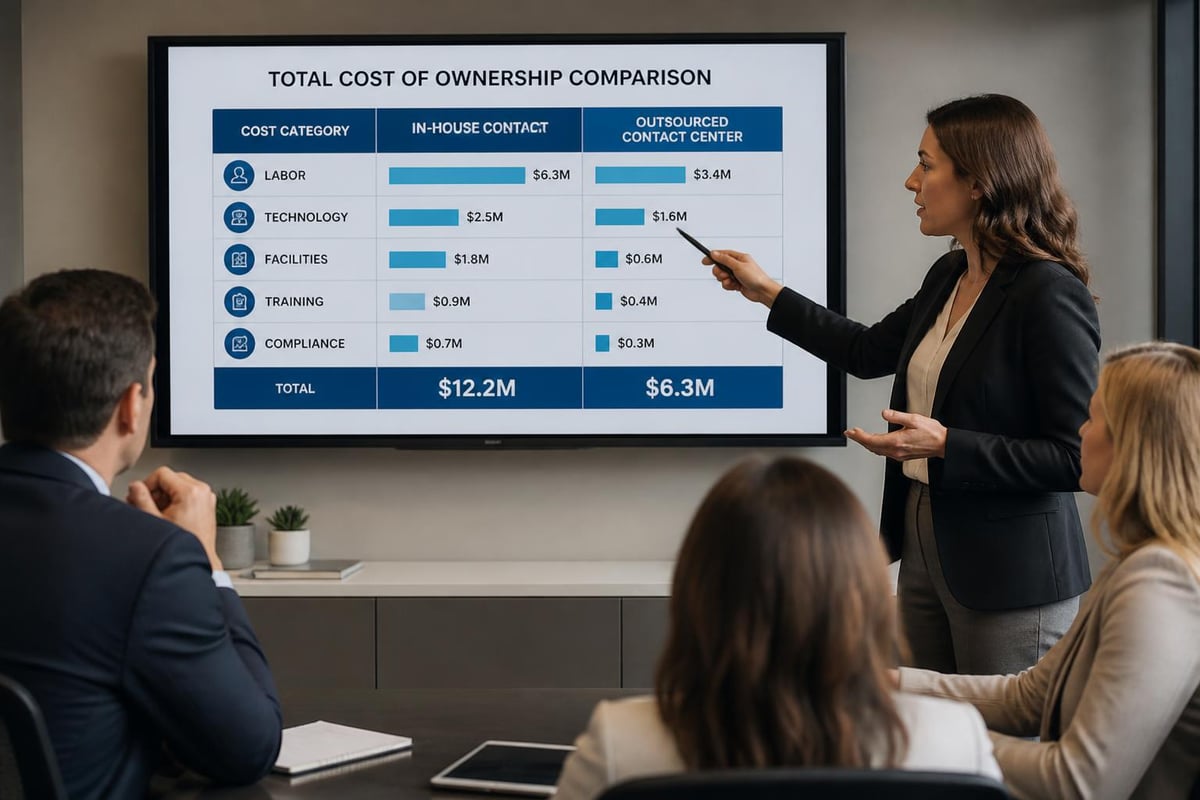
Understanding the financial impact of call center outsourcing requires looking beyond simple hourly rate comparisons. The total cost of ownership encompasses infrastructure investments, personnel expenses, technology licensing, training costs, and operational overhead. Strategic outsourcing transforms these fixed costs into variable expenses while accessing economies of scale impossible to achieve internally.
Labor Cost Optimization
Personnel expenses typically represent 60-70% of call center outsourcing operational costs. Outsourcing partners achieve significant labor cost advantages through strategic geographic placement, optimized scheduling, and efficient workforce management. These savings translate directly to your bottom line without compromising service quality.
Direct labor cost reductions include:
- Lower base compensation rates in cost-effective markets
- Reduced benefits and payroll tax burdens
- Elimination of overtime premium expenses
- Decreased turnover-related recruitment and training costs
- Optimized staffing levels matching demand fluctuations
Global providers leverage timezone differences to maintain 24/7 coverage without expensive shift premiums. A well-designed call center outsourcing operation distributes workload across multiple regions, ensuring customers receive immediate assistance regardless of when they reach out.
Infrastructure and Technology Savings
Building an internal call center outsourcing infrastructure requires substantial capital investment in technology platforms, telephony systems, facility buildouts, and security measures. These upfront costs often exceed budget constraints for growing businesses, while ongoing maintenance and upgrade expenses create perpetual financial drains.
Outsourcing partners absorb these infrastructure costs, spreading investments across multiple clients to achieve economies of scale. You access enterprise-grade technology platforms, redundant network connectivity, and state-of-the-art facilities through operational expense models that scale with business volume.
The financial comparison reveals compelling advantages. Internal operations face technology refresh cycles every 3-5 years, requiring significant capital allocation. Cloud-based technology implementations eliminate these cyclical investments while providing continuous feature updates and security enhancements.
Operational Efficiency Gains
Experienced call center outsourcing providers optimize operational efficiency through proven methodologies developed across thousands of client engagements. These process improvements reduce average handle time, increase first-call resolution rates, and minimize costly escalations. The cumulative impact significantly lowers per-interaction costs.
| Cost Category | Internal Operation | Outsourced Operation | Savings Potential |
|---|---|---|---|
| Technology | $150,000-300,000 annual | Included in per-seat pricing | 40-60% |
| Facilities | $50-100 per square foot | Included in service fees | 100% |
| Management | 1 supervisor per 10-15 agents | 1 supervisor per 20-25 agents | 35-45% |
| Training | $3,000-5,000 per agent | $800-1,500 per agent | 65-75% |
| Attrition | 30-45% annual turnover | 18-25% annual turnover | 40-55% |
Workforce management expertise represents another significant efficiency advantage. Specialized call center outsourcing providers employ sophisticated forecasting models that align staffing levels precisely with anticipated demand patterns. This optimization prevents both understaffing, which damages service levels, and overstaffing, which inflates labor costs.
Risk Mitigation and Compliance
Regulatory compliance and data security requirements create substantial ongoing expenses for internal call center outsourcing operations. Maintaining certifications like PCI DSS, HIPAA, GDPR, and industry-specific standards demands dedicated resources and continuous monitoring. Outsourcing partners distribute these compliance costs across their entire client base while maintaining specialized expertise.
The financial risk of security breaches or compliance violations can devastate organizations. AI voice fraud threats require increasingly sophisticated security measures that strain internal IT budgets. Specialized providers invest in advanced fraud detection systems and security protocols that would be cost-prohibitive for individual companies to implement independently.
Maximizing Return on Investment Through Strategic Partnership
The relationship between your organization and your call center outsourcing provider should function as a true partnership rather than a transactional vendor arrangement. Maximizing ROI requires active collaboration, clear communication, and shared commitment to continuous improvement.
Performance Metrics and SLA Management
Establish comprehensive service level agreements that align with business objectives and customer experience goals. Effective SLAs balance quantitative metrics like average speed of answer and abandonment rate with qualitative measures, including customer satisfaction scores and first-call resolution.
Critical performance indicators for call center operations:
- Average handle time and adherence to schedule
- Customer satisfaction and net promoter scores
- First-call resolution and transfer rates
- Service level achievement and abandonment rates
- Quality assurance scores and compliance adherence
Regular performance reviews create accountability and identify optimization opportunities. Monthly business reviews should examine trending data, discuss improvement initiatives, and celebrate achievements. This cadence maintains focus on continuous enhancement while building collaborative relationships between teams.
Scalability and Flexibility Advantages
Market conditions change rapidly, requiring call center outsourcing capacity to expand or contract accordingly. Seasonal businesses face particularly acute challenges balancing service levels during peak periods without carrying excess capacity during slower months. Outsourcing provides elasticity that matches resources precisely to demand.
The ability to scale operations quickly delivers competitive advantages during product launches, marketing campaigns, or unexpected demand surges. Where internal hiring processes require 6-8 weeks to onboard new agents, experienced outsourcing partners deploy trained resources within days. This responsiveness prevents revenue loss from missed customer interactions.
Focus Services delivers omnichannel customer care outsourcing designed to support growing brands across voice, chat, email, SMS, and social media channels, providing the scalability that businesses need to adapt to changing market conditions while maintaining consistent service quality.
Innovation and Continuous Improvement
Leading call center outsourcing providers invest continuously in innovation, testing emerging technologies and methodologies that enhance efficiency and customer experience. Clients benefit from these innovations without bearing research and development costs. This access to cutting-edge capabilities levels the competitive playing field for smaller organizations competing against larger enterprises.
The integration of AI-driven automation represents the most significant innovation reshaping call center outsourcing operations. Intelligent virtual assistants handle routine inquiries, predictive analytics anticipate customer needs, and machine learning algorithms optimize routing decisions. These technologies reduce operational costs while improving service consistency.
Building Effective Transition Strategies
Migrating from internal operations to an outsourced call center requires careful planning and execution. Rushed implementations create service disruptions that damage customer relationships and undermine cost savings objectives. Successful transitions follow structured methodologies that minimize risk while accelerating time-to-value.
Knowledge Transfer and Documentation
Comprehensive knowledge transfer ensures the outsourced team understands your products, processes, and customer base. Document standard operating procedures, escalation protocols, and brand guidelines in detail. The investment in thorough documentation pays dividends through reduced training time and faster agent proficiency.
Create detailed process flowcharts for common customer scenarios and edge cases. These visual aids help agents navigate complex situations while maintaining consistency with established protocols. Include decision trees for troubleshooting, authorization matrices for special requests, and templates for customer communications.
Phased Implementation Approach
Implement outsourced call center outsourcing services incrementally rather than attempting wholesale transitions. Phased approaches reduce risk by validating performance before expanding scope. Start with specific call types, customer segments, or geographic regions that offer controlled testing environments.
Recommended implementation phases:
- Phase 1: Non-critical inbound inquiries and basic support (weeks 1-4)
- Phase 2: Complex customer service and account management (weeks 5-8)
- Phase 3: Sales support and outbound campaigns (weeks 9-12)
- Phase 4: Full operational transition and optimization (weeks 13-16)
Monitor performance metrics closely during each phase, making adjustments before progressing to subsequent stages. This disciplined approach identifies and resolves issues while impact remains limited, protecting customer experience throughout the transition.
Change Management and Internal Stakeholder Communication
Successful call center outsourcing requires buy-in from internal stakeholders across multiple departments. Sales teams may resist changes to lead qualification processes, while product groups might worry about feedback loop disruptions. Address these concerns proactively through transparent communication and inclusive planning.
Engage key stakeholders early in the evaluation process, incorporating their requirements into provider selection criteria. Regular updates throughout implementation maintain alignment and prevent surprises. Consider establishing a cross-functional steering committee that meets bi-weekly during transition phases to address issues and make decisions collaboratively.
Emerging Trends Shaping Call Center Outsourcing Excellence
The call center outsourcing industry continues evolving rapidly, driven by technological innovation and changing customer expectations. Organizations planning long-term outsourcing partnerships should evaluate providers based on their capacity to adapt to emerging trends that will define competitive differentiation in the coming years.
AI and Automation Integration
Artificial intelligence has moved from experimental technology to operational necessity within modern call center outsourcing r environments. Current trends indicate that AI adoption will accelerate throughout 2026, with intelligent automation handling increasingly complex customer interactions while human agents focus on high-value relationship building.
The most sophisticated call center outsourcing operations employ AI across multiple dimensions, including predictive routing, real-time agent assistance, sentiment analysis, and post-interaction analytics. These capabilities improve both efficiency metrics and customer satisfaction simultaneously, creating operational synergies that traditional approaches cannot achieve.
Voice biometrics and conversational AI represent particularly high-impact applications. Customer authentication through voice recognition eliminates friction while enhancing security. Conversational AI platforms engage customers in natural dialogue, resolving simple inquiries instantly while seamlessly transferring complex issues to human agents with complete context.
Workforce Experience and Agent Empowerment
Progressive call center outsourcing providers recognize that exceptional customer experiences depend fundamentally on engaged, empowered agents. The industry has shifted from viewing agents as interchangeable resources toward recognizing them as skilled professionals requiring investment in development, recognition, and career progression.
Modern workforce strategies emphasize flexible scheduling, remote work options, and career development pathways that reduce attrition while improving performance. Agents equipped with comprehensive training, decision-making authority, and supportive management deliver demonstrably better customer outcomes than those operating under rigid, micromanaged environments.
Technology plays a crucial enabling role in agent empowerment. Unified agent desktops consolidate information from multiple systems into a single interface, eliminating time-consuming application switching. AI-powered assistance provides real-time guidance during interactions, suggesting responses and surfacing relevant knowledge articles. These tools help agents resolve issues faster while building confidence and job satisfaction.
Data Analytics and Predictive Insights
Advanced analytics transform call center outsourcing operations from reactive service delivery to proactive customer engagement. Historical interaction data combined with predictive modeling identifies at-risk customers, anticipates support needs, and optimizes resource allocation. These insights enable preemptive outreach that prevents problems rather than simply responding to them.
The evolution toward customer-centric metrics reflects growing recognition that traditional efficiency measures like average handle time may conflict with customer experience objectives. Leading organizations balance productivity metrics with outcome-based measurements, including customer effort scores, issue resolution rates, and lifetime value impact.
Sophisticated reporting dashboards provide stakeholders at all levels with relevant performance visibility. Executives track strategic KPIs and trend analysis, managers monitor team performance and coaching opportunities, while agents access individual metrics and improvement resources. This transparency creates accountability while enabling data-driven decision-making throughout the organization.
Making the Final Decision
Choosing and implementing a call center outsourcing partnership represents a significant strategic decision requiring thorough evaluation and executive commitment. The selection process should balance immediate cost considerations with long-term capability requirements, ensuring the chosen provider supports both current operations and future growth trajectories.
Request detailed proposals from shortlisted providers that outline service delivery models, technology platforms, pricing structures, and implementation timelines. Compare proposals using standardized evaluation criteria weighted according to organizational priorities. Involve stakeholders from customer service, finance, technology, and operations in assessment processes to ensure a comprehensive perspective.
Conduct site visits to evaluate facilities, observe operations, and meet management teams before making final selections. These in-person assessments reveal cultural factors and operational realities that proposals and presentations cannot fully convey. Pay attention to facility conditions, technology infrastructure, agent engagement levels, and management accessibility during visits.
The businesses successfully navigating call center outsourcing recognize that the provider relationship extends far beyond transactional service delivery. Strategic partners contribute expertise, innovation, and operational excellence that enhance competitive positioning while delivering measurable cost savings. Organizations exploring sales call center outsourcing or customer support solutions should prioritize providers demonstrating commitment to partnership principles and continuous improvement.
Selecting the right call center outsourcing partner and leveraging outsourcing strategically can transform customer service from a cost center into a competitive advantage while delivering substantial operational savings. The framework outlined in this guide provides the foundation for making informed decisions that balance cost efficiency with service excellence. Focus Services brings global capabilities, advanced technology platforms, and proven methodologies to organizations seeking to optimize customer engagement operations while controlling costs. Whether you’re exploring outsourcing for the first time or evaluating alternatives to current arrangements, partnering with experienced providers enables you to focus resources on core business activities while delivering exceptional customer experiences that drive loyalty and growth.

Leave a Reply
Want to join the discussion?Feel free to contribute!