

Call Center Customer Service Training: A Complete Guide
The success of any contact center hinges on one critical factor: how well agents are trained to handle customer interactions. In 2026, call center customer service training has evolved far beyond basic scripts and product knowledge. Today's training programs must balance technical proficiency with emotional intelligence, integrate AI-powered tools, and deliver measurable improvements in customer satisfaction and operational efficiency. For businesses scaling their support operations globally, a structured training framework isn't just beneficial-it's essential for maintaining service quality across distributed teams and multiple channels.
Building a Foundation: Core Components of Effective Training Programs
Modern call center customer service training starts with a comprehensive onboarding process that sets new agents up for long-term success. The first two weeks determine whether an agent will thrive or struggle, making structured onboarding a strategic priority rather than an administrative task.
Essential Onboarding Elements
Every effective training program should include these foundational components:
- Product and service knowledge: Deep understanding of offerings, common use cases, and technical specifications
- System proficiency: Hands-on practice with CRM platforms, ticketing systems, and knowledge bases
- Communication protocols: Channel-specific best practices for phone, email, chat, and social media
- Company culture and values: Understanding organizational mission and how it translates to customer interactions
- Compliance and security: Data protection, privacy regulations, and industry-specific requirements
The onboarding phase typically spans two to four weeks, depending on product complexity and channel mix. During this period, new hires should spend at least 60% of their time in active practice rather than passive listening.

Competency-Based Certification
Rather than simply completing hours of training, agents should demonstrate specific competencies before handling live customer interactions. This approach ensures consistency and protects both customer experience and agent confidence.
| Competency Area | Assessment Method | Pass Threshold |
|---|---|---|
| Product Knowledge | Written exam and scenario quiz | 85% accuracy |
| System Navigation | Timed task completion | 90% efficiency |
| Call Handling | Role-play evaluation | Manager approval |
| Compliance | Certification test | 100% accuracy |
| Soft Skills | Recorded interaction review | Rubric score 4/5 |
This certification framework provides objective benchmarks and identifies specific skill gaps before they impact customer satisfaction. Agents who don't meet thresholds receive targeted remediation rather than being pushed into production unprepared.
Developing Soft Skills That Drive Customer Satisfaction
Technical knowledge alone doesn't create exceptional customer experiences. The most successful call center customer service training programs dedicate substantial time to developing interpersonal skills that differentiate good service from great service.
The Five Pillars of Service Excellence
Empathy remains the cornerstone of effective customer service. Agents must genuinely understand customer frustration and communicate that understanding through active listening and validating statements. Training should include exercises that build perspective-taking abilities and emotional awareness.
Adaptability enables agents to adjust their communication style, pace, and approach based on customer personality and situation. Role-playing diverse customer types-from highly technical users to those needing patient explanation-helps agents develop this flexibility.
Problem-solving transforms agents from script-readers into trusted advisors. Training should emphasize root-cause analysis, creative thinking within guidelines, and knowing when to escalate versus when to persist.
Clear communication ensures customers understand solutions without confusion or jargon. Exercises in explaining complex concepts simply, confirming understanding, and summarizing action items build this critical skill.
Resilience helps agents maintain composure and positivity through difficult interactions and high-volume periods. Stress management techniques, positive self-talk, and healthy boundaries prevent burnout while sustaining service quality.
Recent research demonstrates that soft skills combined with AI assistance significantly improve contact center performance, making interpersonal development even more valuable as technology handles routine tasks.
Practical Soft Skills Training Methods
The most effective soft skills development happens through experiential learning rather than lectures. Consider these high-impact approaches:
- Shadowing top performers: New agents observe exemplary calls, noting specific phrases, tone variations, and recovery techniques
- Recorded review sessions: Agents listen to their own interactions, identifying improvement opportunities with coach guidance
- Customer perspective exercises: Agents experience your service as customers, building empathy through direct experience
- Peer coaching circles: Small groups discuss challenging interactions and brainstorm alternative approaches
- Improv workshops: Theater techniques build spontaneity, active listening, and collaborative problem-solving
These methods create muscle memory for interpersonal skills, making them automatic rather than forced during stressful customer interactions. Organizations following customer experience professional standards see measurably higher satisfaction scores and lower handle times.
Integrating Technology and AI Into Training Workflows
Call center customer service training in 2026 must prepare agents to work alongside artificial intelligence and automation. Rather than replacing human judgment, technology amplifies agent capabilities when properly integrated into training programs.
AI-Powered Training Tools
Modern learning platforms use artificial intelligence to personalize training paths, identify knowledge gaps, and deliver just-in-time learning. These systems analyze agent performance data to recommend specific modules or practice scenarios addressing individual weaknesses.
Virtual role-play with AI conversational agents allows unlimited practice without requiring supervisor time. These systems simulate diverse customer personalities, complaint scenarios, and technical issues, providing immediate feedback on response quality and tone.
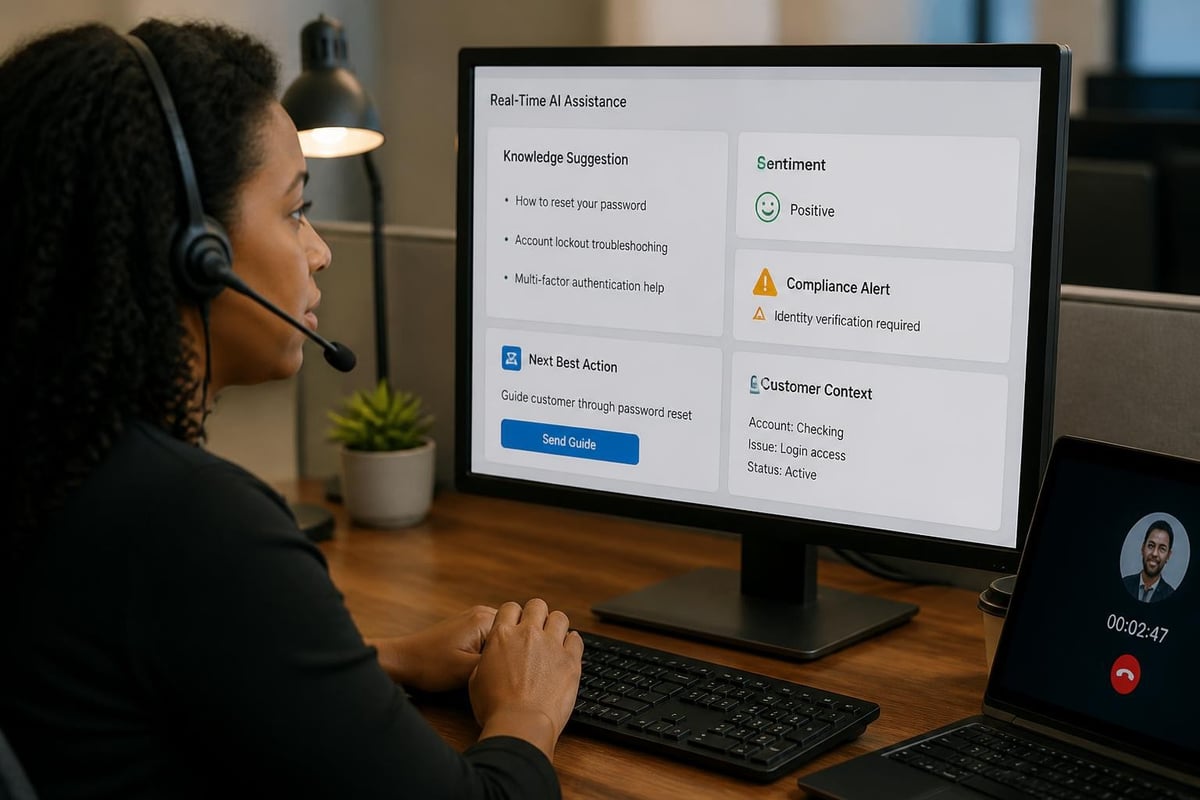
Real-time agent assist tools suggest knowledge articles, next-best actions, and compliance reminders during live interactions. Training must prepare agents to leverage these suggestions without becoming dependent or losing conversational flow.
Sentiment analysis provides objective feedback on customer emotional states throughout interactions. Agents learn to recognize escalation signals and adjust their approach accordingly.
Technology Proficiency Requirements
| Tool Category | Training Focus | Proficiency Timeline |
|---|---|---|
| CRM Systems | Navigation, data entry, history review | Week 1-2 |
| Knowledge Management | Search techniques, content contribution | Week 2-3 |
| AI Agent Assist | Suggestion interpretation, override judgment | Week 3-4 |
| Quality Analytics | Score interpretation, improvement planning | Ongoing |
| Workforce Management | Schedule adherence, break protocols | Week 1 |
Organizations that implement quality assurance dashboards create transparency around performance expectations and help agents connect daily behaviors to measurable outcomes.
Creating a Culture of Continuous Learning and Improvement
Initial training represents just the beginning of agent development. The most successful call center customer service training programs establish ongoing learning as a cultural expectation rather than a periodic event.
Microlearning for Sustained Development
Brief, focused learning sessions maintain skill sharpness without disrupting production schedules. Research on microlearning effectiveness demonstrates that 5-10 minute modules delivered weekly produce better retention than monthly hour-long sessions.
Effective microlearning topics include:
- New product feature highlights and positioning
- Updated compliance requirements or policy changes
- Customer feedback themes and service recovery techniques
- Seasonal issue preparation and FAQ updates
- Technology tip shortcuts and efficiency hacks
These bite-sized sessions fit naturally into shift schedules and keep information current without overwhelming agents during busy periods. Many call center outsourcing providers incorporate microlearning platforms to maintain consistency across global operations.
Quality Assurance as a Training Tool
Traditional quality assurance focuses on identifying failures. Progressive programs transform QA into a coaching and development resource that strengthens call center customer service training outcomes.
Calibration sessions ensure evaluators apply scoring criteria consistently, creating fairness and clarity around expectations. When agents trust the evaluation process, they engage more openly with feedback.
Strength-based coaching acknowledges what agents do well before addressing improvement areas. This approach, supported by Harvard Business Review research on coaching, maintains motivation while driving skill development.
Side-by-side coaching places supervisors next to agents during live interactions, providing immediate whisper coaching and celebrating real-time successes. This method accelerates learning by shortening the feedback loop from days to seconds.
Organizations implementing robust quality assurance programs see faster agent improvement and higher job satisfaction compared to those relying solely on periodic reviews.
Performance Improvement Plans That Actually Work
When agents struggle despite training, structured improvement plans provide clarity and support rather than serving as termination paperwork. Effective plans include:
- Specific behavioral targets: Clear, observable actions rather than vague goals like "improve attitude"
- Resource identification: Exactly which training modules, shadowing opportunities, or coaching sessions will address gaps
- Measurement criteria: Objective metrics and rubrics showing progress and completion
- Regular check-ins: Weekly conversations to adjust approach and maintain momentum
- Success celebration: Recognition when improvement targets are met, reinforcing positive change
This structured approach salvages valuable team members while maintaining performance standards across the organization.
Specialized Training for Different Service Channels
Call center customer service training must account for the distinct skills required across communication channels. What works for phone support often fails in chat or social media environments.
Phone-Specific Skills
Voice communication requires exceptional tone management, pacing, and verbal clarity. Training should develop:
- Vocal variety to maintain customer engagement and convey empathy
- Active silence that gives customers space to explain without interruption
- Hold procedures that maintain rapport and set clear expectations
- Transfer protocols that ensure warm handoffs without customer frustration
- Call control techniques that guide conversations efficiently while remaining customer-focused
Phone agents benefit from listening to exemplary calls and recording practice sessions for self-review. Many successful call center representatives credit recorded feedback as their most valuable development tool.
Digital Channel Excellence
Chat, email, and social media interactions require different competencies than traditional phone support:
- Written clarity: Concise, jargon-free explanations that customers understand immediately
- Tone without voice: Conveying warmth and empathy through word choice and formatting
- Multi-tasking ability: Managing multiple conversations simultaneously without quality degradation
- Typing efficiency: Maintaining speed without sacrificing accuracy or personalization
- Template customization: Adapting standard responses to feel personal and relevant
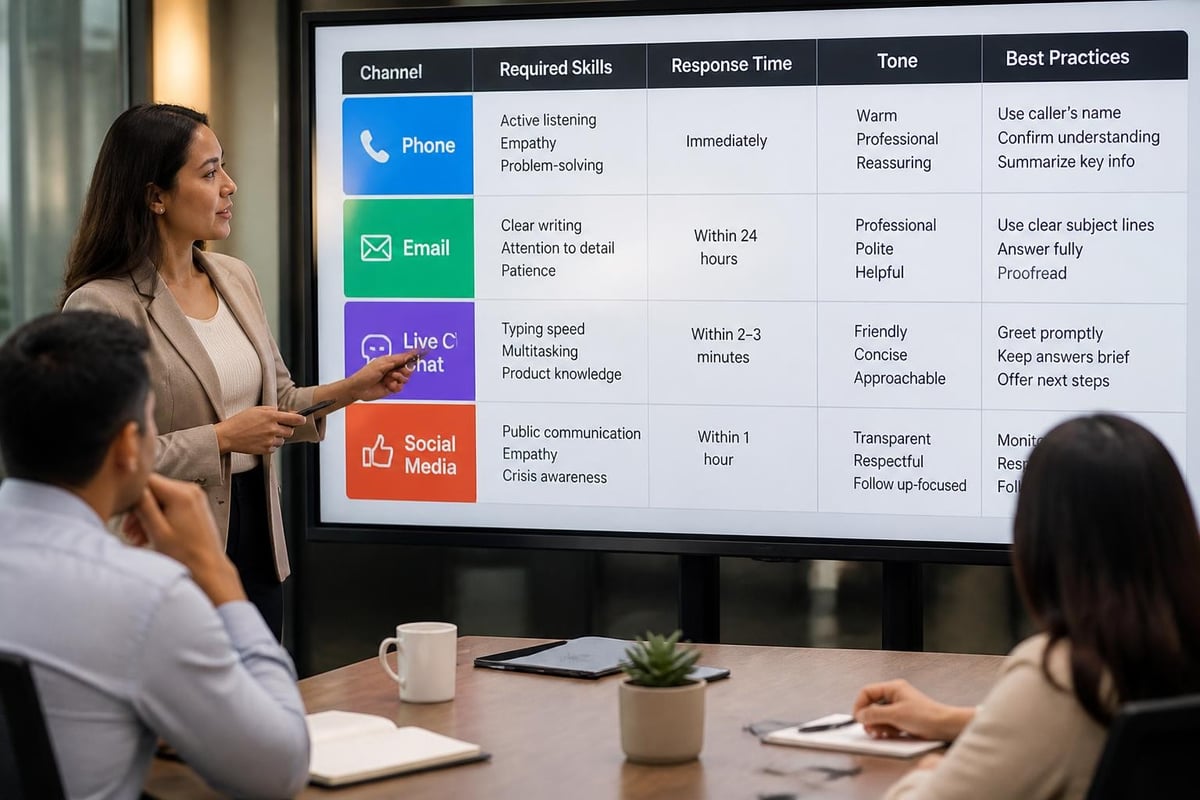
Digital channel training should include timed typing tests, template libraries, and exercises in reading tone from written text. Agents switching between channels need explicit training on adjusting their communication style appropriately.
Measuring Training Effectiveness and ROI
Sophisticated call center customer service training programs track specific metrics that demonstrate business impact rather than simply counting training hours completed.
Leading Indicators of Training Success
Monitor these early signals that predict long-term performance:
| Metric | Target | Measurement Frequency |
|---|---|---|
| New hire ramp time | 30 days to independence | Per cohort |
| First-call resolution rate | 75% or higher | Weekly |
| Quality assurance scores | Average 85%+ | Monthly |
| Customer satisfaction (CSAT) | 4.5/5.0 or 90%+ | Per interaction |
| Schedule adherence | 95% or higher | Daily |
| Peer coaching participation | 80% engagement | Monthly |
Organizations can access comprehensive training frameworks that align these metrics to broader business objectives and demonstrate training ROI to executive stakeholders.
Long-Term Performance Indicators
Beyond immediate skill acquisition, effective training produces sustained improvements:
- Retention rates: Well-trained agents stay longer, reducing recruitment and training costs
- Promotion velocity: Strong training pipelines fill supervisor and specialist roles internally
- Customer lifetime value: Better service increases retention and expansion revenue
- Net Promoter Score: Exceptional interactions create brand advocates
- Cost per contact: Efficient agents resolve issues faster with fewer escalations
Tracking these outcomes justifies training investment and identifies which program components deliver the strongest returns.
Continuous Program Refinement
Training programs should evolve based on performance data and business changes. Quarterly reviews should examine:
- Which training modules correlate with highest performance scores?
- Where do most agents struggle, indicating curriculum gaps?
- How do different delivery methods impact retention and application?
- What customer feedback themes suggest training opportunities?
- Which coaches produce the fastest agent development?
This data-driven approach transforms call center customer service training from a static curriculum into a dynamic capability that adapts to changing customer expectations and business requirements.
Building Training Infrastructure for Scale
Organizations expanding contact center operations across multiple locations or countries face unique training challenges. Scalable infrastructure ensures consistency while accommodating local requirements.
Centralized Curriculum, Localized Delivery
Successful global programs maintain core training content centrally while enabling regional customization:
- Universal service principles: Brand values, quality standards, and customer-first mindset remain consistent
- Localized examples: Scenarios, product references, and regulations reflect regional context
- Cultural adaptation: Communication norms, holiday awareness, and local expectations shape delivery
- Language considerations: Translation quality, idiomatic expressions, and bilingual support requirements
- Technology access: Platform availability, connectivity reliability, and device compatibility
This balance preserves brand consistency while respecting local market differences and agent backgrounds.
Train-the-Trainer Programs
Rather than centralizing all training delivery, organizations scaling globally should develop internal training capabilities within each location. Effective train-the-trainer programs include:
- Instructional design basics: Creating engaging content and structuring effective learning experiences
- Facilitation skills: Managing group dynamics, encouraging participation, and handling difficult questions
- Assessment development: Designing valid tests and rubrics that measure actual competency
- Coaching techniques: Providing developmental feedback that motivates rather than discourages
- Technology proficiency: Leveraging learning management systems, virtual classrooms, and collaboration tools
Internal trainers understand local context and culture while maintaining alignment to organizational standards. They also create career progression opportunities that improve retention.
Effective call center customer service training combines foundational knowledge, soft skills development, technology integration, and continuous learning into a comprehensive system that drives measurable business results. Organizations that view training as strategic investment rather than operational expense consistently outperform competitors on customer satisfaction, agent retention, and operational efficiency. Focus Services partners with businesses worldwide to implement scalable training frameworks across our global operations in the United States, El Salvador, the Philippines, and South Africa, ensuring consistent service excellence regardless of location while reducing costs and expanding support capacity.