

Center Contact Excellence: Strategies for 2026 Success
The landscape of customer service has transformed dramatically over the past decade, with center contact operations becoming increasingly sophisticated and technology-driven. Today's contact centers are no longer simple call-answering facilities-they represent strategic business assets that directly impact customer retention, brand reputation, and revenue growth. As organizations navigate this evolution, understanding the core principles and emerging trends in center contact management becomes essential for maintaining competitive advantage and delivering exceptional customer experiences across all channels.
The Foundation of Effective Center Contact Operations
Building a robust center contact infrastructure requires careful attention to both technological capabilities and human resources. Organizations must balance automation with personalization, ensuring that every customer interaction feels meaningful while maintaining operational efficiency at scale.
Key components of successful center contact operations include:
- Comprehensive workforce management systems
- Advanced call routing and distribution technologies
- Real-time performance monitoring and analytics
- Quality assurance programs with measurable outcomes
- Flexible staffing models that accommodate demand fluctuations
The integration of these elements creates a foundation that supports both customer satisfaction and agent productivity. Modern contact centers leverage data from every interaction to continuously refine their approaches, identifying patterns that inform training programs, process improvements, and technology investments.
Quality Assurance in Center Contact Environments
Quality assurance represents one of the most critical aspects of center contact management. Implementing contact center quality assurance best practices ensures consistent service delivery across all customer touchpoints.
Establishing clear quality metrics starts with defining what success looks like for your organization. These metrics might include first-call resolution rates, average handle time, customer satisfaction scores, and compliance adherence. Each metric should align with broader business objectives while remaining achievable for front-line agents.
| Quality Metric | Industry Benchmark | Impact on CX |
|---|---|---|
| First Call Resolution | 70-75% | High |
| Customer Satisfaction | 85-90% | Very High |
| Average Handle Time | 6-8 minutes | Medium |
| Abandonment Rate | Below 5% | High |
Real-time monitoring capabilities allow supervisors to identify quality issues as they occur, enabling immediate coaching and intervention. This proactive approach prevents small problems from escalating into major customer service failures.

Technology Integration and Center Contact Evolution
The technological transformation of center contact operations has accelerated dramatically in recent years. AI-powered solutions are reshaping how contact centers operate, introducing capabilities that were unimaginable just a few years ago.
Artificial intelligence now powers multiple aspects of center contact operations, from initial customer interactions to post-call analytics. Intelligent virtual assistants handle routine inquiries, freeing human agents to focus on complex issues requiring empathy and critical thinking. This division of labor maximizes efficiency while ensuring customers receive the appropriate level of support for their specific needs.
AI-Enabled Workforce Optimization
Machine learning algorithms analyze historical data to predict call volumes, enabling more accurate staffing decisions. These predictive capabilities help center contact managers maintain optimal service levels while controlling labor costs-a balance that has long challenged the industry.
Advanced AI applications in center contact settings include:
- Sentiment analysis during live calls
- Automated quality scoring and evaluation
- Predictive routing based on customer history
- Real-time agent assistance and guidance
- Post-interaction survey automation
Organizations leveraging AI agent solutions report significant improvements in both operational metrics and customer satisfaction scores. The technology augments human capabilities rather than replacing them, creating a collaborative environment where agents have the tools and information needed to excel.
Omnichannel Support and Customer Expectations
Modern consumers expect seamless experiences across multiple communication channels. A customer might initiate contact through social media, continue via email, and complete resolution through a phone call-all while expecting agents to have full context of the entire journey.
Center contact operations must integrate these diverse channels into a unified platform that maintains conversation continuity. When implemented effectively, omnichannel support reduces customer effort and frustration while providing agents with comprehensive interaction histories.
Building Omnichannel Capabilities
Transitioning from multichannel to truly omnichannel center contact operations requires both technological infrastructure and cultural shifts. Teams must move beyond channel-specific silos, embracing a holistic view of customer relationships.
The implementation process involves several critical steps:
- Audit existing communication channels and identify integration gaps
- Select technology platforms capable of unified data management
- Train agents on cross-channel customer engagement strategies
- Establish consistent service level agreements across all channels
- Monitor channel preferences and adapt resource allocation accordingly
Organizations operating across multiple geographic regions face additional complexity in delivering consistent omnichannel experiences. Time zones, language preferences, and cultural expectations all influence how customers prefer to engage with support teams.

Global Center Contact Operations and Scalability
As businesses expand into new markets, their center contact requirements grow in complexity and scale. Geographic distribution of support facilities offers multiple advantages, including extended coverage hours, language capabilities, and cost optimization through strategic labor arbitrage.
Benefits of distributed center contact operations:
- 24/7 customer support across global time zones
- Native language support for international markets
- Business continuity through geographic redundancy
- Access to diverse talent pools with specialized skills
- Flexible capacity that scales with business growth
Organizations must carefully evaluate potential locations for center contact operations, considering factors beyond simple labor costs. Infrastructure reliability, political stability, educational systems, and cultural alignment with brand values all influence long-term success. Industries with specific regulatory requirements, such as travel and hospitality, may face additional compliance considerations when selecting operating locations.
Emerging Trends Shaping Center Contact Future
The rapid pace of technological innovation continues to introduce new possibilities for center contact operations. Staying informed about emerging trends helps organizations maintain competitive positioning and meet evolving customer expectations.
Cloud-Based Infrastructure Advantages
Migration to cloud platforms has fundamentally changed how center contact facilities operate. Cloud infrastructure offers unprecedented flexibility, allowing organizations to scale capacity up or down based on demand without significant capital investments.
| Traditional Infrastructure | Cloud-Based Infrastructure |
|---|---|
| High upfront capital costs | Pay-as-you-go pricing models |
| Limited scalability | Elastic capacity scaling |
| Maintenance overhead | Managed services |
| Geographic constraints | Global accessibility |
| Slow deployment | Rapid implementation |
Cloud platforms also enable remote and hybrid work models that have become essential in today's employment landscape. Agents can deliver the same quality of service from home offices as they would from traditional call center facilities, expanding the available talent pool while reducing overhead costs.
Security and Fraud Prevention
As center contact operations become more sophisticated, so do the security threats they face. AI-generated voice fraud represents an emerging challenge that requires new authentication approaches beyond traditional security questions.
Implementing multi-layered security protocols protects both customer data and organizational assets. Biometric verification, behavioral analysis, and contextual authentication create robust defenses against increasingly sophisticated fraud attempts.
Performance Metrics and Continuous Improvement
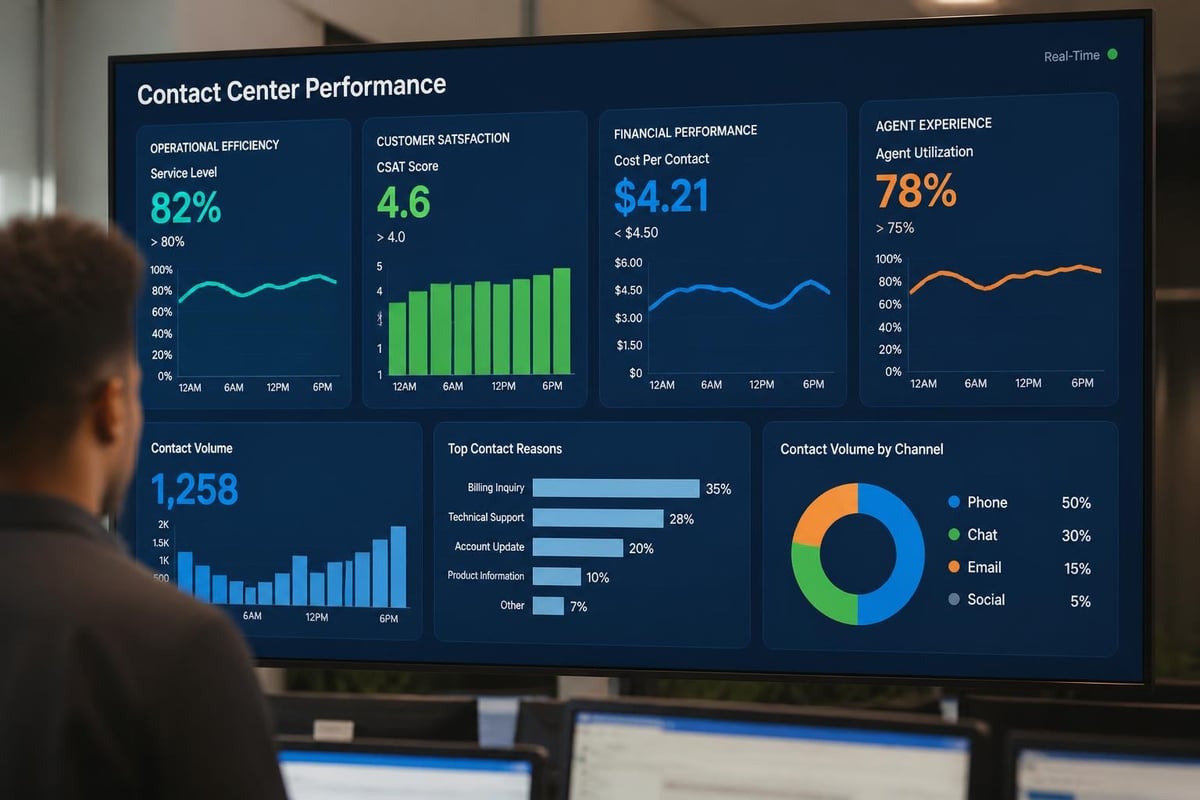
Measuring center contact performance requires a balanced approach that considers both efficiency and effectiveness. Organizations often fall into the trap of optimizing for speed at the expense of quality, creating poor customer experiences despite impressive-looking operational metrics.
Comprehensive performance measurement encompasses multiple dimensions:
- Operational efficiency: Average handle time, call resolution rates, agent utilization
- Customer satisfaction: CSAT scores, Net Promoter Score, customer effort score
- Financial performance: Cost per contact, revenue per agent, customer lifetime value impact
- Agent experience: Employee satisfaction, retention rates, training effectiveness
- Strategic alignment: Achievement of business objectives, market differentiation, brand enhancement
Regular analysis of these metrics reveals opportunities for improvement and validates the effectiveness of implemented changes. Leading center contact operations establish continuous improvement cycles that test new approaches, measure results, and scale successful innovations across the organization.
Workforce Management and Agent Development
The human element remains central to center contact success despite increasing automation. Attracting, training, and retaining skilled agents requires strategic workforce management practices that recognize the challenging nature of customer service roles.
Creating Positive Agent Experiences
Agent burnout represents a significant challenge in center contact environments. High-stress interactions, repetitive tasks, and demanding performance expectations contribute to elevated turnover rates that disrupt service quality and increase recruitment costs.
Strategies for improving agent retention include:
- Comprehensive onboarding programs that build confidence
- Career development pathways with clear advancement opportunities
- Recognition programs celebrating exceptional performance
- Flexible scheduling that accommodates personal needs
- Technology tools that reduce frustration and increase productivity
Organizations that invest in agent well-being typically see corresponding improvements in customer satisfaction. Engaged, supported agents deliver better service, demonstrate greater problem-solving creativity, and represent the brand more authentically during customer interactions.
Technology Selection and Implementation
Choosing the right technology stack for center contact operations involves evaluating numerous platforms and vendors. Selecting appropriate call center software requires understanding both current operational needs and future growth trajectories.
The evaluation process should include:
- Defining specific functional requirements based on business needs
- Assessing integration capabilities with existing systems
- Evaluating vendor stability and long-term viability
- Conducting proof-of-concept testing with real-world scenarios
- Analyzing total cost of ownership beyond initial licensing fees
Implementation success depends heavily on change management practices that prepare teams for new systems and processes. Rushing technology deployments without adequate training and support often results in poor adoption rates and failure to realize expected benefits.
Environmental Sustainability in Center Contact Operations
Growing awareness of environmental impact has prompted many organizations to examine the sustainability of their center contact operations. Cloud-based technology helps reduce carbon emissions through infrastructure virtualization and reduced physical facility requirements.
Remote work models offer additional environmental benefits by eliminating agent commutes and reducing the energy consumption associated with large office facilities. Organizations committed to sustainability can leverage these operational models to advance both business objectives and environmental responsibility.
Industry-Specific Center Contact Considerations
Different industries face unique challenges in their center contact operations. Healthcare organizations must navigate HIPAA compliance, financial services require enhanced security protocols, and retail businesses experience dramatic seasonal volume fluctuations.
Understanding industry-specific requirements helps center contact managers design appropriate solutions. Specialized knowledge, compliance frameworks, and tailored technology configurations ensure operations meet regulatory requirements while delivering excellent customer experiences.
The complexity of industry-specific center contact operations often makes outsourcing an attractive option. Specialized providers bring deep expertise in particular verticals, maintaining current knowledge of regulatory changes and industry best practices that would be difficult for individual organizations to develop internally.
The evolution of center contact operations continues to accelerate as technology advances and customer expectations rise. Organizations that embrace innovation while maintaining focus on fundamental service quality principles position themselves for sustained success in increasingly competitive markets. Focus Services delivers comprehensive call center outsourcing solutions that combine cutting-edge AI technology with experienced teams across the United States, El Salvador, the Philippines, and South Africa, helping businesses scale their customer support operations while maintaining exceptional service standards and controlling costs.