

Technical and Customer Support Best Practices for 2026
The landscape of technical and customer support continues to evolve rapidly as businesses face increasing demands for instant resolutions, personalized service, and seamless multi-channel experiences. Organizations investing in call center outsourcing and business process optimization must balance technological innovation with the irreplaceable value of human expertise. As customer expectations reach new heights in 2026, companies need comprehensive strategies that integrate advanced tools, well-trained personnel, and scalable infrastructure to maintain competitive advantage while delivering exceptional service quality.
Understanding Modern Technical and Customer Support Requirements
Technical and customer support operations have transformed dramatically over the past decade. Today's consumers expect immediate assistance across multiple platforms, from traditional phone calls to live chat, social media, and mobile apps. This shift has created complex challenges for businesses attempting to maintain consistent service quality while managing operational costs.
The integration of artificial intelligence and automation tools has revolutionized how support teams handle routine inquiries. However, maintaining the human touch in tech remains critical for preserving customer trust and satisfaction. Organizations must strike a delicate balance between efficiency-driven automation and personalized human interaction.
Key Components of Effective Support Systems
A robust technical and customer support infrastructure requires several fundamental elements working in harmony:
- Comprehensive knowledge management systems that enable agents to access accurate information quickly
- Multi-channel communication platforms that unify customer interactions across all touchpoints
- Real-time analytics and reporting to monitor performance metrics and identify improvement opportunities
- Scalable workforce solutions that adapt to fluctuating demand patterns
- Continuous training programs that keep support teams updated on product changes and best practices

Implementing Strategic Support Operations
Building an effective technical and customer support framework starts with understanding your specific business requirements and customer demographics. BPO and call center solutions offer scalable alternatives for companies seeking to enhance service capabilities without massive capital investments.
Strategic implementation involves careful planning across multiple dimensions. Organizations must evaluate their current capabilities, identify gaps, and develop roadmaps for systematic improvement. This process requires input from stakeholders across departments, including operations, technology, finance, and human resources.
Technology Infrastructure Decisions
Selecting the right technology stack forms the foundation of modern support operations. Helpdesk software functionalities have expanded significantly, now offering sophisticated ticket management, automation workflows, and integration capabilities that streamline agent workflows.
| Technology Category | Primary Function | Business Impact |
|---|---|---|
| Ticket Management | Organize and track customer requests | Improved response times and accountability |
| Knowledge Bases | Centralize information and solutions | Faster resolutions and reduced escalations |
| CRM Integration | Unify customer data and history | Personalized service and context awareness |
| Analytics Platforms | Monitor KPIs and identify trends | Data-driven decision making and optimization |
| Communication Tools | Enable multi-channel support | Enhanced accessibility and convenience |
The decision to build internal capabilities versus partnering with specialized providers depends on numerous factors. Cost considerations, scalability requirements, and core competency alignment all play crucial roles in determining the optimal approach.
Optimizing Agent Performance and Training
The quality of technical and customer support ultimately depends on the people delivering it. Investing in comprehensive training programs and ongoing development opportunities ensures agents possess the knowledge and skills necessary to handle diverse customer situations effectively.
Successful training initiatives extend beyond initial onboarding. Continuous education programs keep teams updated on product enhancements, new technologies, and evolving customer service methodologies. Regular skill assessments help identify areas where additional coaching might benefit individual agents or entire teams.
Creating Effective Training Frameworks
Modern training approaches incorporate multiple learning modalities to accommodate different learning styles and schedules:
- Structured classroom sessions for foundational knowledge and complex concepts
- Hands-on simulations that replicate real customer interactions
- Microlearning modules for quick skill refreshers and updates
- Peer mentoring programs that facilitate knowledge sharing
- Performance feedback loops that reinforce positive behaviors
Organizations should also recognize that customer service best practices emphasize hiring personnel with natural aptitude for problem-solving and empathy. Technical skills can be taught, but innate customer-focused attitudes prove more difficult to develop.
The globalization of support operations introduces additional training considerations. Cultural awareness, language proficiency, and regional market understanding become essential components when managing geographically distributed teams across different time zones and markets.

Leveraging Artificial Intelligence and Automation
Artificial intelligence has emerged as a transformative force in technical and customer support operations. AI’s viability in customer care continues to improve, offering capabilities that enhance both efficiency and service quality when implemented thoughtfully.
Intelligent chatbots handle routine inquiries, freeing human agents to focus on complex issues requiring critical thinking and emotional intelligence. Natural language processing enables systems to understand customer intent more accurately, while machine learning algorithms continuously improve response quality based on interaction outcomes.
Strategic AI Implementation
Successful AI integration requires careful planning and realistic expectations:
- Start with clearly defined use cases where automation delivers measurable value
- Maintain human oversight to ensure quality and handle edge cases
- Monitor performance metrics to validate effectiveness and identify optimization opportunities
- Communicate transparently with customers about when they're interacting with automated systems
- Preserve escalation pathways that connect customers with human agents when needed
The relationship between AI and human agents should be collaborative rather than competitive. Technology handles repetitive tasks and data analysis while people provide creativity, empathy, and judgment in ambiguous situations.
Building Multi-Channel Support Ecosystems
Customers expect seamless experiences regardless of which communication channel they choose. Technical and customer support strategies must therefore encompass integrated omnichannel approaches that maintain context and continuity across interactions.
A customer might begin a support journey through self-service resources, escalate to live chat when unable to find answers, and eventually speak with a phone agent for complex troubleshooting. Each transition should feel natural, with agents having complete visibility into previous interaction history.
Channel-Specific Considerations
Different communication channels serve distinct purposes and require tailored approaches:
| Channel | Best For | Response Expectations | Agent Skills Required |
|---|---|---|---|
| Phone | Complex issues, urgent situations | Immediate | Strong verbal communication |
| Detailed explanations, documentation | 24-48 hours | Clear written communication | |
| Live Chat | Quick questions, real-time guidance | Under 2 minutes | Multitasking, concise writing |
| Social Media | Public issues, brand engagement | 1-4 hours | Diplomacy, brand awareness |
| Self-Service | Common questions, account management | Instant | N/A (content creation team) |
Technical support best practices emphasize the importance of reducing customer wait times across all channels while maintaining service quality standards. This requires sophisticated workforce management that anticipates demand patterns and allocates resources accordingly.
Measuring and Improving Support Performance
Data-driven optimization separates high-performing technical and customer support operations from mediocre ones. Establishing comprehensive metrics frameworks enables organizations to track performance, identify trends, and make informed improvement decisions.
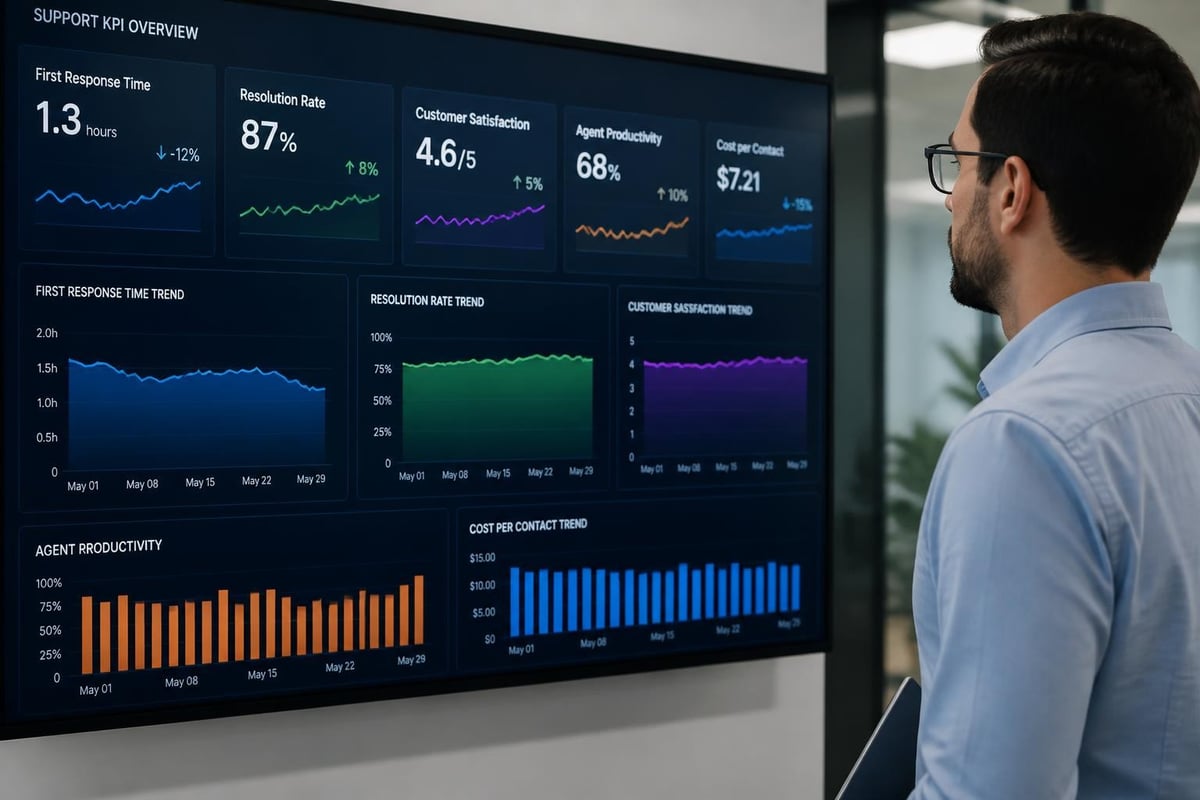
Key performance indicators should balance operational efficiency with customer satisfaction outcomes. Focusing exclusively on speed metrics can inadvertently encourage agents to rush interactions at the expense of quality. Conversely, prioritizing satisfaction without considering efficiency may lead to unsustainable cost structures.
Essential Metrics for Support Operations
Comprehensive performance measurement incorporates multiple perspectives:
- First Response Time: How quickly customers receive initial acknowledgment
- First Contact Resolution: Percentage of issues resolved without escalation
- Customer Satisfaction Score: Direct feedback on service quality
- Net Promoter Score: Likelihood of customers recommending your company
- Average Handle Time: Duration of typical customer interactions
- Agent Utilization: Percentage of time agents spend on productive activities
- Cost Per Contact: Total support costs divided by interaction volume
- Escalation Rate: Frequency of issues requiring supervisor intervention
Regular analysis of these metrics reveals patterns that inform strategic decisions. Sudden increases in average handle time might indicate product quality issues or inadequate training. Rising escalation rates could suggest knowledge gaps or overly restrictive agent empowerment policies.
Adapting to Emerging Support Trends
The technical and customer support landscape continues evolving as new technologies emerge and customer expectations shift. Organizations must remain agile, continuously evaluating industry developments and adjusting strategies accordingly.
Remote work has fundamentally changed workforce dynamics, enabling companies to access talent pools previously limited by geographic constraints. This shift creates opportunities for building diverse, globally distributed teams while introducing new challenges around collaboration, culture building, and performance management.
Future-Focused Capabilities
Forward-thinking organizations are investing in capabilities that position them for long-term success:
- Predictive analytics that anticipate customer needs before issues arise
- Proactive outreach programs that address potential problems automatically
- Advanced personalization leveraging comprehensive customer data
- Video support capabilities for visual troubleshooting and demonstrations
- Augmented reality tools enabling remote technical assistance
The state of tech support in 2025 highlights increasing complexity in training requirements and the growing impact of AI integration. Organizations that adapt quickly to these changes gain competitive advantages through enhanced efficiency and improved customer experiences.
Scaling Support Operations Effectively
Growth creates both opportunities and challenges for technical and customer support teams. As customer bases expand and product portfolios diversify, support operations must scale proportionally without compromising quality or dramatically increasing costs.
BPO customer service career opportunities have expanded as more companies recognize the strategic value of outsourced support partnerships. These arrangements provide flexibility, expertise, and cost efficiency that internal teams often struggle to match.
Effective scaling requires careful planning across multiple dimensions. Technology infrastructure must handle increased volume, knowledge management systems need expansion to cover new products and scenarios, and workforce capacity requires growth through hiring, training, or partnership arrangements.
Outsourcing Considerations
Organizations evaluating outsourcing options should consider several critical factors:
- Geographic coverage to ensure appropriate time zone alignment and language capabilities
- Industry expertise demonstrating understanding of your specific market and challenges
- Technology compatibility allowing seamless integration with existing systems
- Quality assurance processes maintaining consistent service standards
- Scalability provisions accommodating seasonal fluctuations and long-term growth
Partnership success depends heavily on clear communication, aligned expectations, and collaborative relationships between internal teams and external providers. Regular performance reviews, transparent reporting, and continuous improvement initiatives ensure outsourcing arrangements deliver intended value.
Enhancing Customer Experience Through Support Excellence
Technical and customer support operations directly impact overall customer experience and brand perception. Every interaction represents an opportunity to strengthen relationships, build loyalty, and differentiate your company from competitors.
Exceptional support goes beyond simply solving problems. It anticipates needs, demonstrates genuine care for customer success, and creates positive emotional connections that transcend transactional relationships. These experiences drive customer retention, increase lifetime value, and generate positive word-of-mouth referrals.
Experience-Driven Support Strategies
Organizations committed to support excellence implement practices that prioritize customer experience:
Empowerment initiatives give agents authority to make decisions that benefit customers without requiring supervisory approval. This accelerates resolutions and demonstrates trust in frontline personnel.
Feedback integration incorporates customer input into product development and process improvement initiatives. When customers see their suggestions implemented, they feel valued and heard.
Consistency enforcement ensures customers receive similar quality experiences regardless of which channel they use or which agent they reach. Standardized processes and comprehensive training create this uniformity.
Proactive communication keeps customers informed about known issues, scheduled maintenance, and relevant updates before they need to contact support. This transparency builds trust and reduces friction.
The investment in technical and customer support excellence pays dividends through improved retention rates, reduced churn, and increased customer advocacy. Organizations viewing support as a strategic differentiator rather than a cost center unlock significant competitive advantages in crowded marketplaces.
Excellence in technical and customer support requires thoughtful integration of technology, well-trained personnel, and customer-centric processes that adapt to evolving expectations. Organizations that invest strategically in these areas create sustainable competitive advantages through superior service delivery. Focus Services offers comprehensive call center outsourcing and BPO solutions designed to help businesses scale support operations efficiently across global markets. With AI-enabled workforce optimization and proven expertise in customer care programs, Focus Services empowers companies to enhance service quality while controlling costs.