

Contact Center Monitoring: Best Practices & Tools 2026
Contact center monitoring has evolved from simple call recording to a sophisticated ecosystem of quality assurance, compliance verification, and performance optimization. As customer expectations continue rising and regulatory requirements become more stringent, organizations must implement comprehensive monitoring strategies that balance operational efficiency with exceptional service delivery. Today's monitoring programs leverage artificial intelligence, speech analytics, and real-time dashboards to transform raw interaction data into actionable insights that drive measurable business results.
Understanding the Foundations of Contact Center Monitoring
Contact center monitoring encompasses the systematic observation, recording, and evaluation of customer interactions across multiple channels. This discipline serves three primary objectives: ensuring quality standards, maintaining regulatory compliance, and identifying opportunities for agent development and process improvement.
Modern monitoring programs typically include:
- Live call monitoring and side-by-side observation
- Recorded interaction review and scoring
- Screen capture and desktop analytics
- Speech and text analytics for pattern detection
- Customer feedback integration and correlation
- Compliance verification and audit trails
The ISO 18295-1 standard for customer contact centres provides authoritative guidance on quality requirements and operational governance. Organizations that align their monitoring frameworks with internationally recognized standards demonstrate commitment to excellence and establish clear benchmarks for performance measurement.
Core Components of Effective Monitoring Systems
A robust monitoring infrastructure requires integration across technology platforms, clear evaluation criteria, and consistent application of quality standards. The foundation begins with defining what constitutes a quality interaction within your specific business context.
Quality scorecards should reflect both universal service principles and industry-specific requirements. For example, financial services contact centers must emphasize regulatory disclosure and authentication procedures, while technical support environments prioritize problem resolution and knowledge transfer.
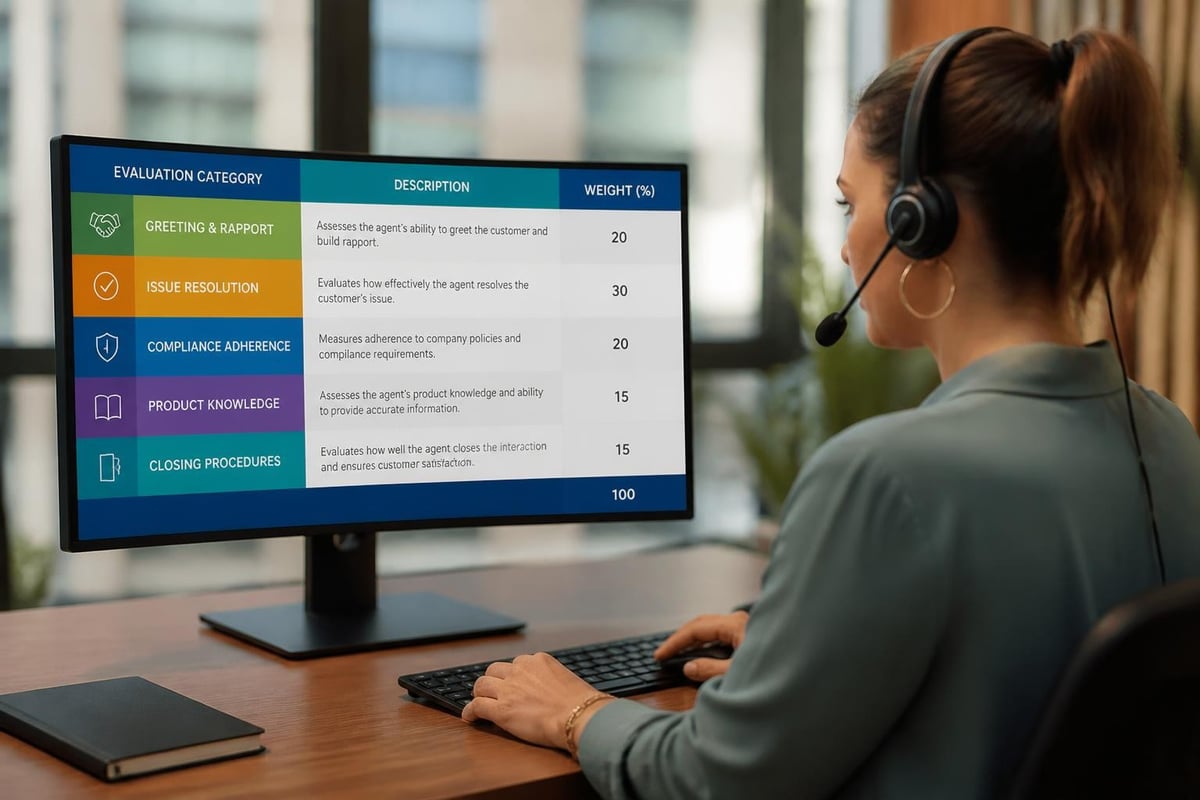
| Scorecard Element | Weight | Measurement Approach |
|---|---|---|
| Compliance & Security | 30% | Binary pass/fail plus severity ratings |
| Customer Experience | 25% | Rating scale with behavior anchors |
| Process Adherence | 20% | Checklist verification |
| Communication Skills | 15% | Qualitative assessment |
| Issue Resolution | 10% | Outcome tracking and follow-up |
This weighted approach ensures that critical elements like compliance receive appropriate emphasis while maintaining focus on holistic service quality. Organizations should calibrate weights based on strategic priorities and risk profiles.
Implementing Strategic Monitoring Programs
Successful contact center monitoring requires more than technology deployment. It demands a comprehensive program design that encompasses sampling methodology, evaluator training, calibration sessions, and feedback mechanisms that translate observations into improvement.
The ICMI research on quality monitoring programs highlights four critical success factors: clear performance standards, consistent calibration, timely feedback delivery, and analytics-driven continuous improvement. Organizations that excel in monitoring treat it as a developmental process rather than a punitive tool.
Sampling Strategies and Coverage Models
Determining how many interactions to monitor involves balancing statistical validity with operational capacity. Random sampling provides unbiased insights but may miss critical events or trends. Targeted sampling allows focus on specific agents, interaction types, or customer segments but introduces selection bias.
Effective sampling approaches include:
- Baseline random sampling covering 3-5% of all interactions
- New hire monitoring at 100% during initial weeks, tapering to 10-15%
- Triggered monitoring based on keywords, sentiment scores, or duration thresholds
- Focused sampling for specific campaigns, products, or compliance requirements
- Peer-to-peer monitoring where experienced agents evaluate colleagues
Many organizations adopt hybrid models that combine random baseline coverage with event-triggered monitoring. This approach ensures representative quality assessment while capturing high-risk or high-value interactions that warrant special attention.
The monitoring frequency should align with contact volume, agent experience levels, and business risk. High-volume operations might monitor thousands of interactions monthly, while specialized teams handling complex transactions may require more intensive review of fewer contacts.
Technology Platforms and Tool Selection
The contact center monitoring landscape includes specialized quality management platforms, workforce optimization suites, and AI-powered analytics engines. Selecting appropriate tools requires understanding your specific monitoring objectives, integration requirements, and scalability needs.
Modern platforms have evolved beyond simple recording and playback. Today's solutions offer speech analytics that automatically identify compliance risks, emotion detection that flags potentially escalating situations, and pattern recognition that surfaces training opportunities across agent populations.
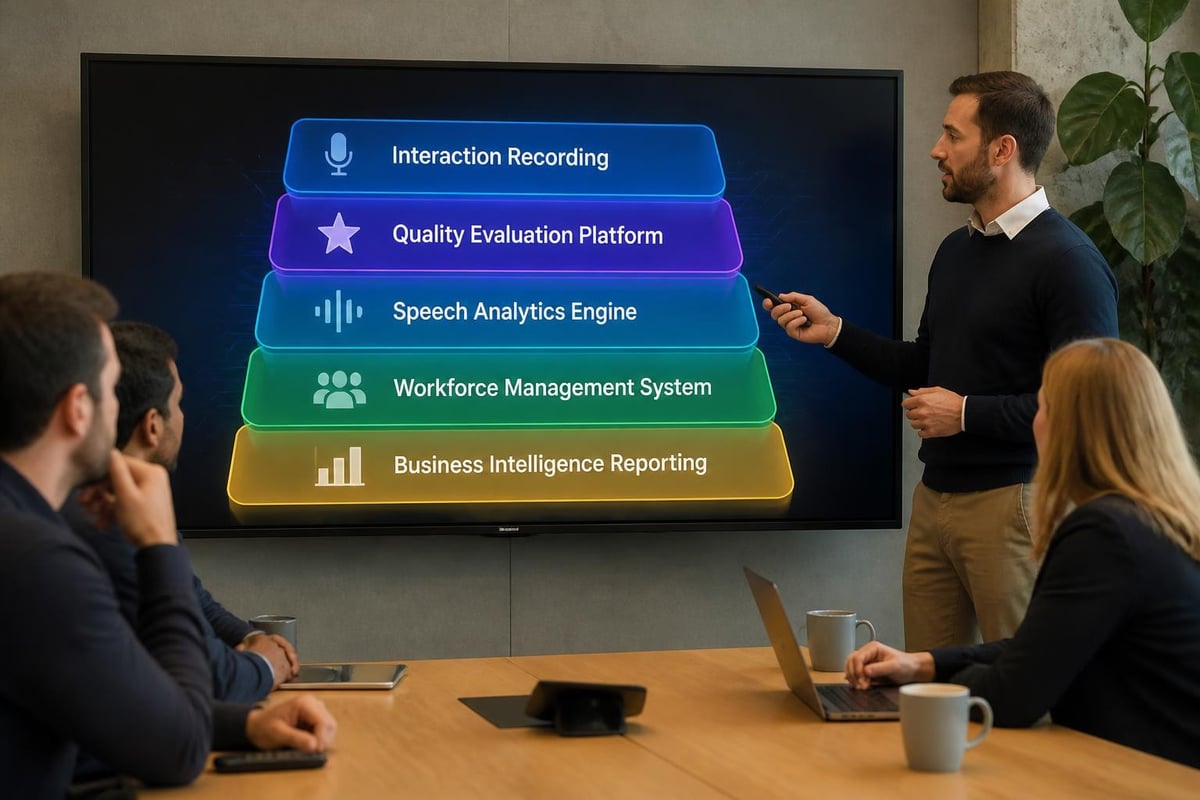
Forrester’s research on contact center technologies provides valuable context for understanding where monitoring tools fit within the broader technology ecosystem and how maturity levels affect implementation success.
Speech Analytics and Automated Quality Detection
Speech analytics represents a transformative advancement in contact center monitoring capabilities. These systems analyze 100% of voice interactions, identifying keywords, phrases, sentiment indicators, and compliance markers without human review.
Key applications include:
- Automatic compliance violation detection and flagging
- Customer sentiment tracking across interaction lifecycle
- Competitive intelligence from customer mentions
- Process adherence verification through script compliance
- Training need identification from recurring knowledge gaps
When implementing speech analytics, organizations should start with clearly defined use cases rather than attempting to analyze everything simultaneously. Focused deployment around specific compliance requirements or quality metrics typically delivers faster return on investment and clearer success indicators.
Integration between speech analytics and quality management platforms creates powerful synergies. Automated systems can pre-score interactions or flag those requiring human review, allowing quality teams to focus expertise on complex evaluations rather than routine screening.
Quality Calibration and Evaluator Consistency
Even the most sophisticated monitoring tools cannot overcome inconsistent evaluation standards. Calibration sessions where multiple evaluators score identical interactions serve as the cornerstone of reliable quality programs.
Regular calibration accomplishes several objectives: it identifies scoring drift where evaluators gradually become more lenient or harsh, surfaces ambiguity in scorecard criteria that requires clarification, and builds shared understanding of quality standards across the evaluation team.
Calibration Session Best Practices
Effective calibration follows structured methodology rather than casual discussion. Sessions should occur monthly or quarterly depending on evaluator volume and organizational size. The process typically involves pre-work where participants independently score selected interactions, followed by group discussion of scoring variances.
| Calibration Metric | Target Range | Corrective Action Threshold |
|---|---|---|
| Inter-rater reliability | 85-95% agreement | Below 80% requires retraining |
| Score variance (standard deviation) | Less than 0.5 points | Above 0.7 indicates drift |
| Category-level consistency | 90%+ agreement | Below 85% suggests unclear criteria |
| Fatal error identification | 100% agreement | Any miss requires immediate review |
The TechTarget best practices for contact center quality assurance provides practical guidance on implementing calibration programs and maintaining evaluator accuracy over time.
Organizations should document calibration outcomes and use variance patterns to refine scorecard definitions. When evaluators consistently disagree on specific criteria, the issue typically lies in ambiguous scorecard language rather than evaluator capability.
Compliance Monitoring and Security Requirements
Contact centers handling sensitive customer information face stringent regulatory requirements around monitoring, recording, and data protection. Payment card industry data security standards, healthcare privacy regulations, and financial services rules all impose specific obligations on monitoring programs.
The PCI Security Standards Council provides detailed requirements for organizations that record calls containing payment card data. Monitoring systems must implement proper redaction, access controls, and retention policies to maintain compliance while supporting quality objectives.
Balancing Quality and Privacy
Recording customer interactions creates inherent tension between quality improvement needs and privacy protection. Organizations must establish clear policies governing what gets recorded, how long recordings are retained, who can access them, and under what circumstances.
Privacy-conscious monitoring practices include:
- Clear disclosure statements at interaction beginning
- Automatic payment card data redaction or pause-resume recording
- Role-based access controls limiting playback permissions
- Defined retention schedules with automated purging
- Encryption for stored recordings and secure transmission
- Audit trails tracking who accessed which recordings
Many jurisdictions require customer consent for recording. Even where single-party consent suffices, transparency builds trust and demonstrates organizational integrity. Clear recording policies should be documented and communicated to both customers and agents.

Transforming Monitoring Data into Performance Improvement
The ultimate value of contact center monitoring lies not in scoring interactions but in driving measurable performance improvement. Organizations that treat monitoring as a coaching catalyst rather than an evaluation endpoint achieve superior results in both agent development and customer satisfaction.
Effective feedback delivery follows specific principles: it occurs promptly after the monitored interaction, focuses on specific observable behaviors rather than generalizations, balances reinforcement of strengths with development opportunities, and concludes with clear action items the agent can implement immediately.
From Evaluation to Coaching Excellence
The transition from traditional monitoring to coaching-centric programs requires cultural shift and structural support. Quality teams must develop coaching skills beyond evaluation accuracy, and operational leaders must create time and space for meaningful development conversations.
Coaching program elements include:
- Weekly one-on-one sessions reviewing monitored interactions
- Skill-building action plans with measurable milestones
- Side-by-side coaching for real-time skill application
- Peer coaching and knowledge sharing forums
- Recognition programs celebrating improvement and excellence
Organizations should track coaching effectiveness through metrics like time-to-proficiency for new hires, quality score improvement trajectories, and correlation between coaching frequency and performance outcomes. When monitoring data informs targeted development, both individual and team performance accelerates.
The recent CCW market study reveals how leading contact centers are evolving their measurement strategies to emphasize development and continuous improvement over pure evaluation.
Metrics and Performance Indicators
Contact center monitoring generates extensive data that requires thoughtful analysis to extract meaningful insights. The most successful programs establish clear key performance indicators aligned with business objectives and customer experience goals.
Quality scores represent just one metric within a comprehensive measurement framework. Organizations should correlate monitoring findings with operational metrics like first-call resolution, customer satisfaction scores, average handle time, and compliance incident rates to understand the full performance picture.
Building Comprehensive Dashboards
Effective performance dashboards present monitoring data in context with other critical metrics. Visualization should enable quick identification of trends, outliers, and improvement opportunities while supporting both individual coaching and program-level decision making.
Consider tracking these interconnected metrics:
| Metric Category | Key Indicators | Monitoring Connection |
|---|---|---|
| Quality | Average quality score, category scores, fatal errors | Direct monitoring output |
| Efficiency | Average handle time, hold time, after-call work | Context for quality evaluation |
| Effectiveness | First-call resolution, escalation rate, callback rate | Outcome validation of quality |
| Customer Experience | Satisfaction score, net promoter score, sentiment | External quality validation |
| Compliance | Violation rate, audit findings, disclosure adherence | Specific monitoring focus |
Understanding relationships between these metrics reveals whether quality improvements translate into better customer outcomes and business results. For example, rising quality scores accompanied by declining customer satisfaction suggests misaligned evaluation criteria.
Organizations leveraging contact center metrics strategically use monitoring data as one input within a holistic performance management system that drives continuous optimization.
Outsourcing Considerations and Partnership Models
Organizations partnering with contact center business process outsourcing providers must establish clear monitoring expectations and governance frameworks. Successful outsourcing relationships include defined quality standards, transparent reporting, and collaborative improvement processes.
Service level agreements should specify monitoring frequency, evaluation criteria, reporting cadence, and performance thresholds that trigger escalation or remediation. Many organizations maintain independent monitoring programs that validate vendor-reported quality metrics and ensure alignment with internal standards.
Maintaining Quality Across Global Operations
Organizations operating across multiple geographies face unique monitoring challenges around language capabilities, cultural norms, and regional compliance requirements. Standardized quality frameworks must accommodate local adaptation while maintaining consistent service standards.
Global monitoring programs benefit from centralized scorecard design with regional calibration sessions that address market-specific nuances. Technology platforms should support multilingual evaluation and reporting while maintaining consolidated visibility across locations.
The ACCA guidance on monitoring and global quality assurance offers practical considerations for organizations managing monitoring programs across borders, addressing governance and compliance from an operational perspective.
Emerging Trends and Future Directions
Contact center monitoring continues evolving as artificial intelligence, omnichannel customer journeys, and remote work models reshape the industry. Forward-looking organizations are exploring how emerging technologies can enhance monitoring effectiveness while addressing new challenges these changes introduce.
Key trends shaping the future include:
- Real-time agent assistance powered by AI analyzing interactions as they occur
- Automated quality scoring supplementing human evaluation
- Omnichannel journey monitoring tracking customer experience across touchpoints
- Predictive analytics identifying agents at risk before performance declines
- Gamification and continuous feedback replacing periodic formal evaluations
These innovations promise to expand monitoring coverage, accelerate feedback delivery, and shift quality team focus toward strategic analysis and coaching rather than routine evaluation. However, human judgment remains essential for nuanced assessment and meaningful development conversations.
Organizations should approach new monitoring technologies with clear use cases and success criteria. Pilot programs testing innovations on limited scope before full deployment reduce risk and build organizational confidence in new approaches.
Implementing effective contact center monitoring requires strategic planning, appropriate technology, consistent processes, and unwavering commitment to agent development. Organizations that invest in comprehensive monitoring programs position themselves to deliver exceptional customer experiences while maintaining compliance and operational efficiency. Focus Services combines advanced monitoring capabilities with proven quality frameworks across global operations, helping businesses achieve measurable improvements in service delivery, agent performance, and customer satisfaction through scalable, AI-enabled workforce optimization solutions.