

Customer Care Operations: The Complete 2026 Guide
Customer care operations have evolved from simple phone support to complex, multi-channel ecosystems that define brand reputation and customer lifetime value. In 2026, businesses face mounting pressure to deliver seamless experiences across voice, chat, email, social media, and emerging platforms while managing costs and maintaining quality. The organizations that excel understand that effective customer care operations require more than friendly agents-they demand strategic planning, operational excellence, and continuous optimization. Whether you’re scaling a startup or managing enterprise-level support, building robust customer care operations is no longer optional; it’s a competitive necessity.
Listen more in our podcast: https://www.focusservices.com/podcasts/customer-care-operations/
The Foundation of Modern Customer Care Operations
Contents
Building effective customer care operations starts with understanding the core components that drive performance. At its foundation, customer care operations encompass the people, processes, technology, and metrics that enable organizations to resolve customer issues, answer questions, and build lasting relationships.
The Four Pillars of Customer Care Operations:
- Workforce Management: Recruiting, training, scheduling, and retaining qualified customer care professionals
- Technology Infrastructure: CRM systems, helpdesk platforms, communication tools, and analytics software
- Process Design: Standard operating procedures, escalation paths, quality assurance frameworks, and knowledge management
- Performance Measurement: KPIs, quality metrics, customer satisfaction scores, and operational efficiency benchmarks
Each pillar must work in harmony with the others. A sophisticated technology stack means little without properly trained agents to use it. Similarly, exceptional talent cannot deliver results without clear processes and the right tools.
Designing Your Operational Framework
The operational framework serves as the blueprint for how your customer care operations function daily. This framework should align with business objectives while remaining flexible enough to adapt to changing customer needs and market conditions.
Start by mapping the customer journey from initial contact through resolution. Identify common touchpoints, pain points, and moments that matter most to your customers. This journey map becomes the foundation for designing workflows that streamline customer service operations and eliminate friction.

Consider these essential elements when building your framework:
- Channel Strategy: Determine which communication channels you’ll support and how they’ll integrate
- Routing Logic: Establish rules for directing inquiries to the right agents or departments
- Knowledge Management: Create centralized repositories of information agents can access instantly
- Quality Standards: Define what excellent service looks like across different interaction types
- Escalation Protocols: Build clear pathways for complex issues requiring specialized attention
| Framework Component | Purpose | Key Considerations |
|---|---|---|
| Channel Strategy | Define customer touchpoints | Volume expectations, customer preferences, resource availability |
| Routing Rules | Match customers with right resources | Skill-based routing, priority levels, availability |
| Knowledge Base | Enable consistent responses | Regular updates, easy search, version control |
| Quality Program | Maintain service standards | Sample size, evaluation criteria, coaching process |
| Escalation Path | Handle complex issues | Authority levels, response time targets, documentation |
Workforce Planning and Management
Your customer care operations are only as effective as the people delivering service. Workforce planning involves forecasting demand, scheduling appropriately, and ensuring you have the right number of agents with the right skills available when customers need support.
Accurate forecasting requires analyzing historical data, seasonal trends, marketing campaigns, product launches, and external factors that influence contact volume. Advanced operations use predictive analytics to anticipate spikes and valleys in demand, adjusting staffing levels accordingly.
Building High-Performance Teams
Recruitment should focus not just on experience but on traits that predict success in customer care environments: empathy, problem-solving ability, communication skills, and resilience. The best customer care operations invest heavily in structured training programs that go beyond product knowledge to include soft skills, customer service management strategies, and company culture.
Training Program Essentials:
- Product and service knowledge certification
- Communication and de-escalation techniques
- System and tool proficiency
- Company values and brand voice alignment
- Ongoing coaching and development opportunities
Agent retention directly impacts customer care operations quality and cost efficiency. High turnover disrupts team cohesion, increases training expenses, and diminishes institutional knowledge. Create career paths that allow agents to advance within customer care operations or transition to other departments. Recognize top performers, provide competitive compensation, and foster a supportive work environment.
Technology Stack Optimization
The technology powering customer care operations has expanded dramatically beyond traditional phone systems. Modern operations leverage integrated platforms that unify customer data, communication channels, and analytics in ways that were impossible just a few years ago.
Your technology stack should enable agents to work efficiently while providing customers with flexibility in how they reach you. Core systems typically include a customer relationship management (CRM) platform, helpdesk or ticketing system, knowledge management tool, workforce management software, and quality monitoring solution.
Embracing Omnichannel Support
Customers expect to move seamlessly between channels without repeating information or losing context. Omnichannel customer service means creating a unified experience where conversation history, customer data, and context follow the customer regardless of channel.
For businesses looking to establish or enhance their multi-channel capabilities, Focus Services delivers omnichannel customer care outsourcing designed to support growing brands across voice, chat, email, SMS, and social media channels with dedicated teams that operate as seamless extensions of your business.
Integration is critical. When systems don’t communicate, agents waste time switching between platforms, customer information gets fragmented, and the experience suffers. Prioritize solutions with robust APIs and native integrations that create a single source of truth for customer information.

| Technology Component | Primary Function | Integration Requirements |
|---|---|---|
| CRM Platform | Customer data management | Bi-directional sync with all touchpoints |
| Helpdesk System | Ticket tracking and resolution | Email, chat, API connections |
| Knowledge Base | Self-service and agent reference | Search integration, helpdesk linking |
| WFM Software | Scheduling and forecasting | Time tracking, ACD integration |
| Quality Monitoring | Performance evaluation | Call recording, screen capture, analytics |
Process Standardization and Quality Assurance
Consistency separates exceptional customer care operations from mediocre ones. Standardizing workflows ensures every customer receives the same high-quality experience regardless of which agent they reach or when they make contact.
Document standard operating procedures for common scenarios: account inquiries, order modifications, technical troubleshooting, billing questions, and complaint resolution. These procedures should be detailed enough to guide agents but flexible enough to allow personalization and judgment.
Implementing Quality Assurance Programs
Quality assurance in customer care operations involves systematic evaluation of interactions against defined standards. Effective QA programs include both automated monitoring and human evaluation to assess technical accuracy, adherence to procedures, communication quality, and customer satisfaction.
Quality Assurance Framework:
- Define Evaluation Criteria: Establish specific, measurable standards for different interaction types
- Sample Selection: Determine how many interactions to evaluate and selection methodology
- Calibration Sessions: Ensure evaluators apply standards consistently
- Feedback Delivery: Provide timely, actionable coaching to agents
- Trend Analysis: Identify systemic issues requiring training or process changes
- Continuous Improvement: Regularly update standards based on evolving customer expectations
Quality scores should tie to coaching and development, not just performance management. The goal is improvement, not punishment. Top-performing customer care operations use quality insights to refine training, update knowledge bases, and identify opportunities for process enhancement.
Performance Metrics and Analytics
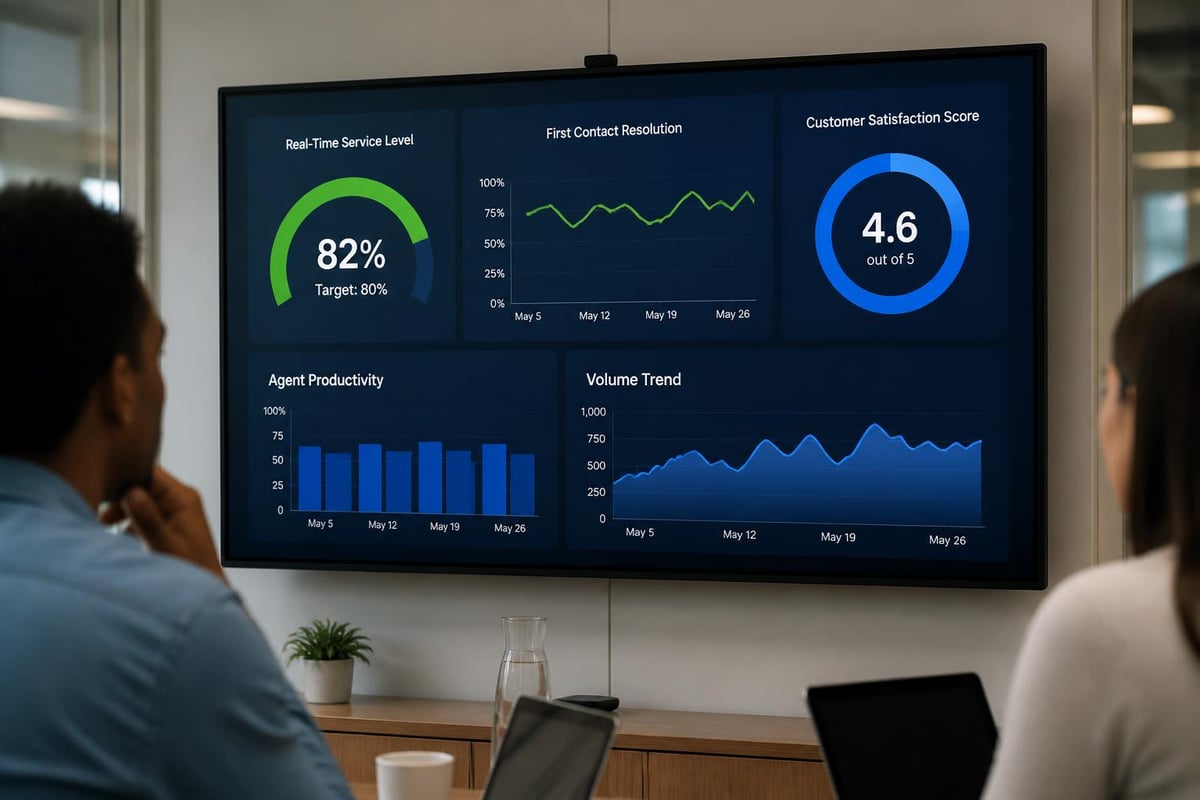
Data-driven decision-making separates growing customer care operations from stagnant ones. The right metrics provide visibility into operational health, customer satisfaction, and business impact. However, tracking too many metrics dilutes focus, while tracking the wrong ones optimizes for outcomes that don’t matter.
Essential Metrics for Customer Care Operations
Focus on metrics that balance operational efficiency with customer experience quality. Customer service management requires monitoring both leading indicators that predict future performance and lagging indicators that measure past results.
Operational Efficiency Metrics:
- Average Handle Time (AHT)
- First Contact Resolution (FCR)
- Service Level (percentage of contacts answered within target time)
- Occupancy Rate
- Schedule Adherence
Customer Experience Metrics:
- Customer Satisfaction Score (CSAT)
- Net Promoter Score (NPS)
- Customer Effort Score (CES)
- Escalation Rate
- Repeat Contact Rate
| Metric Category | What It Measures | Why It Matters |
|---|---|---|
| Efficiency | Resource utilization and speed | Controls costs and staffing needs |
| Quality | Accuracy and completeness | Drives customer satisfaction and FCR |
| Experience | Customer perception and effort | Predicts loyalty and retention |
| Business Impact | Revenue, retention, lifetime value | Connects operations to company goals |
Advanced customer care operations go beyond basic metrics to analyze correlation and causation. Does reducing average handle time improve or harm first contact resolution? How does agent tenure correlate with customer satisfaction? What impact does wait time have on Net Promoter Score?
Scaling Customer Care Operations
Growth presents both opportunities and challenges for customer care operations. Volume increases expose weaknesses in processes that worked at smaller scale. What functioned with ten agents often breaks with fifty or one hundred.
Scalable operations are built on documented processes, robust technology, and organizational structures that can expand without redesigning the entire system. As contact volume grows, you’ll need supervisory layers, specialized teams, and more sophisticated workforce management.
Building Scalability Into Operations
Planning for scale means making decisions today that won’t constrain you tomorrow. Choose technology platforms that can grow with you. Design processes that work at 10x your current volume. Building sustainable support infrastructure requires thinking beyond immediate needs to future requirements.
Consider whether to build operations in-house, partner with call center outsourcing companies, or adopt a hybrid model. Each approach offers distinct advantages depending on your growth trajectory, capital availability, and strategic priorities.
Scaling Considerations:
- Geographic distribution for follow-the-sun support or disaster recovery
- Specialization by product line, customer segment, or issue complexity
- Automation for routine inquiries and self-service deflection
- Leadership development to maintain culture and quality during rapid growth
- Technology infrastructure that handles increased load without degradation
Automation and AI Integration
Artificial intelligence and automation are transforming customer care operations by handling routine inquiries, augmenting agent capabilities, and generating insights from massive data sets. In 2026, the question isn’t whether to adopt AI but how to integrate it effectively.
Chatbots and virtual assistants can resolve simple questions instantly, reducing wait times and freeing agents for complex issues. Natural language processing analyzes sentiment in real-time, flagging escalations before they spiral. Predictive analytics forecast contact volume with increasing accuracy, improving workforce planning.
Balancing Automation with Human Touch
The most effective customer care operations use automation to enhance, not replace, human interaction. Customers appreciate quick resolution of simple issues through self-service but expect human empathy and judgment for complex or emotional situations.
Implement automation progressively, starting with high-volume, low-complexity interactions. Monitor customer satisfaction closely to ensure automated experiences meet expectations. Always provide easy escalation to human agents when automation reaches its limits.
Effective Automation Use Cases:
- Password resets and account verification
- Order status inquiries and tracking updates
- FAQ responses and knowledge base search
- Appointment scheduling and reminders
- Routine account changes and updates
Agent-assist technologies represent a powerful middle ground. These tools suggest responses, surface relevant knowledge articles, and analyze sentiment while agents maintain control of the interaction. This combination of AI efficiency and human judgment delivers superior outcomes.
Continuous Improvement Culture
Static customer care operations inevitably decline as customer expectations evolve, competitors advance, and markets shift. Building a culture of continuous improvement ensures your operations adapt and excel over time.
Encourage agents to identify inefficiencies and suggest improvements. They interact with customers and systems daily, giving them unique insights into what works and what doesn’t. Create formal channels for submitting ideas and recognize those whose suggestions drive meaningful change.
Implementing Feedback Loops
Regular retrospectives examine what went well and what needs improvement. After major incidents, product launches, or seasonal peaks, gather teams to analyze performance, identify lessons learned, and implement corrective actions.
Customer feedback provides invaluable direction for improvement efforts. Beyond standard satisfaction surveys, analyze customer comments, social media mentions, and review sites. What themes emerge? What frustrations appear repeatedly? Use this qualitative data alongside quantitative metrics to prioritize enhancements.
Benchmark against industry standards and best practices, but remember that customer service management excellence comes from understanding your unique customers and business context. What works for one company may not work for yours. Test, measure, and refine based on your results.
Exceptional customer care operations combine strategic planning, operational discipline, and relentless focus on customer experience to create competitive advantage and drive business growth. By investing in your people, leveraging the right technology, standardizing processes, and continuously improving, you build operations that scale efficiently while maintaining quality. Focus Services helps companies from startups to enterprise operations build high-performance customer care programs with global teams, AI-enabled optimization, and proven frameworks that deliver measurable results across every customer touchpoint.
