

Customer Service BPO: The 2026 Complete Guide
Businesses today face mounting pressure to deliver exceptional customer experiences while managing operational costs and scaling efficiently. A customer service BPO partnership offers a strategic solution, enabling companies to access specialized expertise, advanced technology, and global workforce capabilities without the overhead of building in-house teams. As customer expectations continue rising and omnichannel support becomes standard, understanding how to leverage outsourced customer service has become essential for competitive success.
Understanding Customer Service BPO in Modern Business
Customer service BPO (Business Process Outsourcing) refers to the practice of contracting specialized third-party providers to handle customer interactions, support operations, and related processes. Unlike traditional staffing arrangements, a comprehensive customer service BPO partnership delivers complete operational infrastructure, including technology platforms, workforce management, quality assurance, and continuous improvement programs.
The scope of modern BPO services extends far beyond simple call answering. Today's providers offer integrated solutions spanning multiple channels and specializations:
- Omnichannel support covering voice, email, chat, SMS, and social media
- Technical support for software, hardware, and digital products
- Sales and retention programs with revenue generation focus
- Back-office processing including order management and data entry
- AI-enabled services incorporating chatbots, sentiment analysis, and predictive routing
The Economic Case for Outsourcing
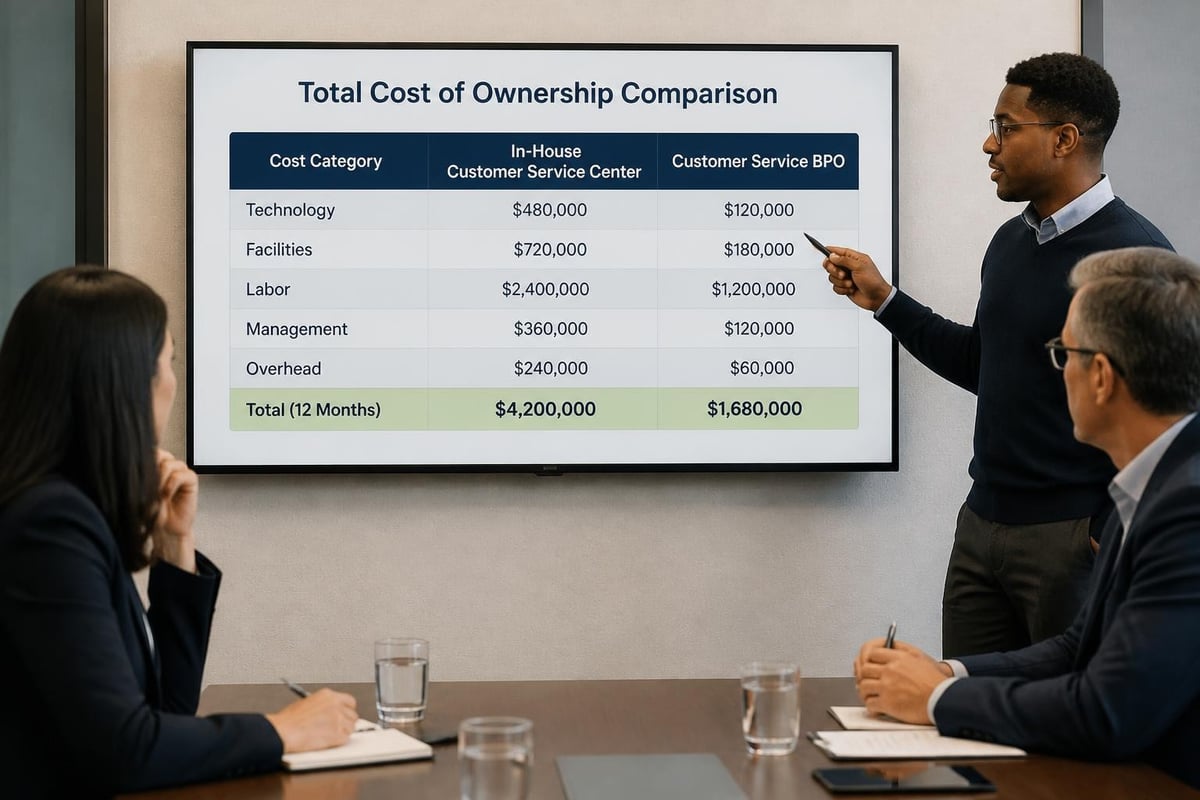
Organizations pursue customer service BPO partnerships for compelling financial and operational reasons. Labor arbitrage remains a significant driver, with offshore and nearshore locations offering 40-60% cost savings compared to domestic operations. However, the value proposition extends well beyond wages.
Capital expenditure avoidance represents a major advantage. Building a 100-seat contact center requires substantial investment in facilities, technology infrastructure, telephony systems, and workforce management tools. BPO providers amortize these costs across multiple clients, delivering enterprise-grade capabilities at a fraction of the build cost.
Variable cost structures enable businesses to align expenses with demand. Rather than maintaining fixed overhead during slow periods, outsourced models allow capacity to flex with seasonal patterns, product launches, or market fluctuations. This elasticity proves particularly valuable for businesses with unpredictable volume or rapid growth trajectories.
Geographic Distribution and Location Strategy
The global nature of customer service BPO creates strategic options for matching capabilities with business requirements. Different regions offer distinct advantages based on labor costs, language capabilities, time zone coverage, and regulatory environments.
Regional Capabilities Overview
| Region | Primary Advantages | Typical Applications | Cost Position |
|---|---|---|---|
| United States | Native language, cultural alignment, complex problem-solving | Premium support, B2B services, regulated industries | Highest |
| Latin America | Bilingual capability, time zone alignment, cultural proximity | US market support, Spanish language, after-hours coverage | Medium-High |
| Philippines | Neutral accent, high education, strong customer service culture | General support, technical help desk, back-office | Medium |
| South Africa | Multilingual, Commonwealth alignment, strong infrastructure | UK/Europe support, specialized industries | Medium-Low |
| India | Technical expertise, scalability, mature BPO ecosystem | IT support, process-intensive work, high-volume operations | Lowest |
Forward-thinking organizations increasingly adopt hybrid location strategies that distribute workloads across multiple geographies. A financial services company might handle regulatory inquiries domestically while routing general account questions to nearshore teams and back-office processing to offshore locations. This approach optimizes costs while maintaining quality and compliance where it matters most.
The World Bank’s analysis of global digital services trends highlights how emerging markets continue developing BPO capabilities, with significant growth in specialized services like AI training, content moderation, and digital customer experience management.
Technology Infrastructure and Platform Considerations
Modern customer service BPO operations run on sophisticated technology stacks that integrate communication channels, customer data, workforce management, and analytics. The shift toward cloud-based Contact-Center-as-a-Service (CCaaS) platforms has fundamentally transformed BPO capabilities.
Cloud infrastructure delivers several critical advantages for outsourced operations. Rapid deployment allows new programs to launch in weeks rather than months. Built-in redundancy ensures business continuity without expensive disaster recovery sites. Automatic updates provide continuous feature enhancements without disrupting operations.
Essential Technology Components
Effective customer service BPO programs require integrated systems working in concert:
- Omnichannel routing platforms that distribute work across voice, digital, and self-service channels based on agent skills, customer value, and channel preference
- Customer relationship management (CRM) systems providing 360-degree customer views, interaction history, and case management
- Workforce management tools optimizing schedules, forecasting demand, and managing real-time adherence
- Quality management solutions recording interactions, evaluating performance, and identifying coaching opportunities
- Analytics and reporting engines delivering operational metrics, customer insights, and business intelligence
The Forrester Wave evaluation of CCaaS platforms provides detailed analysis of leading solutions, helping organizations and their BPO partners select platforms aligned with specific requirements. Leading providers offer pre-built integrations accelerating implementation timelines.
Organizations considering automated call center solutions should evaluate how AI-powered tools integrate with human agents. Conversational AI handles routine inquiries, freeing agents for complex interactions requiring empathy and problem-solving. This hybrid approach maximizes efficiency while maintaining service quality.

Compliance, Security, and Risk Management
Customer service BPO relationships involve sharing sensitive business data and customer information with external parties, creating significant compliance and security obligations. Robust governance frameworks protect both parties while meeting regulatory requirements.
Payment Card Industry Standards
Contact centers handling payment information must maintain PCI DSS compliance. The PCI Security Standards Council provides specific guidance for telephone-based card data protection, including requirements for call recording segmentation, agent screen capture controls, and secure payment tokenization.
Best practices include implementing payment isolation solutions that remove agents from the payment process entirely. Customers enter card details via dual-tone multi-frequency (DTMF) tones or secure web forms while agents remain connected for conversation. Maintaining PCI compliance in outsourced environments requires documented processes, regular audits, and clear responsibility matrices between client and BPO provider.
Data Protection and Privacy Regulations
Organizations operating across borders must navigate complex data protection frameworks. The General Data Protection Regulation (GDPR) imposes strict requirements on EU personal data processing, with significant implications for customer service BPO arrangements.
Data processing agreements must clearly define the roles and responsibilities of data controllers (clients) and data processors (BPO providers). The European Data Protection Board’s guidelines provide authoritative interpretation of lawful processing bases, cross-border transfer mechanisms, and processor obligations relevant to outsourced customer service operations.
Additional regulations affecting customer service BPO include:
- CCPA/CPRA in California requiring consumer privacy rights and data sale disclosures
- HIPAA for healthcare information with business associate agreements
- GLBA for financial services imposing safeguards and privacy notices
- TCPA governing telephone marketing and automated dialing restrictions
Selecting and Managing BPO Partnerships
Successful customer service BPO relationships require careful provider selection, structured implementation, and ongoing performance management. Organizations should approach vendor evaluation systematically, assessing capabilities across multiple dimensions.
Critical Selection Criteria
Industry expertise significantly impacts outcomes. Providers with vertical specialization understand unique customer needs, regulatory requirements, and business processes. A healthcare-focused BPO brings built-in HIPAA knowledge, claims processing experience, and clinical terminology familiarity that generalist providers lack.
Financial stability matters for long-term partnerships. Review audited financial statements, ownership structure, and growth trajectory. Undercapitalized providers may struggle to invest in technology or weather economic downturns, putting your program at risk.
Geographic presence should align with your location strategy. Evaluate not just current sites but expansion capabilities. Can the provider scale into additional markets as your business grows? Do they own facilities or sublease, affecting flexibility?
| Evaluation Factor | Key Questions | Evidence to Request |
|---|---|---|
| Scale capability | Can they handle 2x-3x growth? | Client case studies, facility tours, hiring processes |
| Technology stack | Is their platform modern and integrated? | Demo environments, integration documentation, API specs |
| Security posture | What certifications and controls exist? | SOC 2 reports, ISO certifications, security policies |
| Quality processes | How do they ensure consistent performance? | QA scorecards, calibration methods, improvement frameworks |
| Cultural fit | Do their values align with yours? | Site visits, leadership meetings, employee interviews |
Implementation and Transition Planning
Launching a customer service BPO program demands detailed project planning across knowledge transfer, technology integration, and change management. Rushing implementation creates service disruptions and quality issues that damage customer relationships.
Knowledge transfer represents the most underestimated challenge. Document not just procedures but the reasoning behind them. Capture edge cases, exception handling, and undocumented workarounds that experienced agents apply. Shadowing sessions, recorded calls, and scenario-based training accelerate learning curves.
Pilot programs allow controlled testing before full deployment. Start with a small agent cohort handling specific interaction types or customer segments. Monitor performance closely, identify gaps, refine training and processes, then expand gradually. This staged approach minimizes risk while building confidence.
Performance Measurement and Continuous Improvement
Effective customer service BPO governance relies on clear performance metrics, regular reviews, and collaborative improvement initiatives. Service level agreements (SLAs) establish baseline expectations, but leading partnerships go beyond compliance to drive excellence.
Balanced Scorecard Approach
Relying exclusively on operational efficiency metrics creates perverse incentives. Agents minimize handle time at the expense of resolution quality. Teams focus on answering speed while ignoring customer satisfaction. A balanced measurement framework evaluates multiple dimensions:
Efficiency metrics track operational productivity:
- Average handle time and after-call work
- Service level (percentage answered within threshold)
- Occupancy and utilization rates
- Cost per contact across channels
Quality metrics assess interaction excellence:
- Quality assurance scores from evaluation forms
- First contact resolution rates
- Compliance adherence and error rates
- Customer satisfaction (CSAT) and Net Promoter Score (NPS)
Business outcome metrics connect operations to results:
- Revenue generated from sales interactions
- Customer retention and churn rates
- Issue recurrence and product feedback
- Cross-sell and upsell conversion rates

Governance Structures and Review Cadence
Mature customer service BPO relationships establish multi-tiered governance matching decision-making authority with review frequency. Daily operational calls address real-time issues, schedule adherence, and immediate escalations between program managers. Weekly business reviews examine performance trends, quality scores, and upcoming initiatives with broader stakeholder participation.
Monthly executive reviews focus on strategic topics: program expansion opportunities, technology enhancements, market feedback, and competitive positioning. Quarterly business reviews provide comprehensive assessment with deep-dive analytics, benchmarking data, and annual planning discussions.
Workforce Development and Agent Excellence
The quality of customer service BPO delivery ultimately depends on frontline agents. Progressive providers invest heavily in recruitment, training, career development, and workplace culture that attracts and retains top talent.
Recruitment and Selection
Effective hiring processes assess both technical qualifications and behavioral competencies. Cognitive assessments evaluate problem-solving ability, learning agility, and attention to detail. Situational judgment tests present realistic scenarios measuring customer orientation, emotional intelligence, and decision-making under pressure.
Language proficiency extends beyond basic fluency to accent neutrality, grammar precision, and communication clarity. Providers serving US markets often implement accent reduction training and cultural familiarization programs helping agents connect authentically with customers.
Continuous Learning Programs
Initial training provides foundation knowledge, but ongoing development maintains excellence. Microlearning modules deliver bite-sized content on new products, policy updates, and skill development between nesting and production. Gamification elements increase engagement and knowledge retention.
Career pathing opportunities reduce attrition by showing advancement possibilities. Agent progression might move from general support to specialized tiers, then to quality assurance, training, or workforce management roles. Transparent competency frameworks and promotion criteria motivate performance.
Emerging Trends Reshaping Customer Service BPO
The customer service BPO industry continues evolving rapidly as technology, customer expectations, and business models transform. Organizations planning long-term partnerships should understand directional changes shaping future capabilities.
Artificial Intelligence Integration
AI technologies increasingly augment human agents rather than replacing them. Conversational AI handles routine inquiries through natural language understanding, escalating to humans when needed. Real-time agent assist analyzes ongoing conversations, suggesting knowledge articles, recommended responses, and next-best actions during customer interactions.
Sentiment analysis detects customer frustration or dissatisfaction, triggering supervisor alerts or automatic escalation protocols. Predictive analytics anticipate contact drivers, enabling proactive outreach before problems occur. Leading providers leverage cloud contact center platforms with built-in AI capabilities accelerating deployment.
Experience Orchestration
Traditional channel-based thinking gives way to journey-centric design. Rather than optimizing phone, email, and chat independently, experience orchestration maps customer journeys across touchpoints, identifying friction points and improvement opportunities.
Customer service BPO providers increasingly offer journey mapping services analyzing how customers move between self-service, digital channels, and voice support. These insights inform redesigned processes that reduce effort and improve satisfaction. Proactive notification programs keep customers informed, reducing inbound contact volume.
Hybrid Delivery Models
The pandemic accelerated work-from-home adoption across customer service BPO operations. Many providers now offer flexible models combining facility-based, remote, and hybrid arrangements. Distributed workforce strategies expand talent pools beyond facility commute zones while maintaining productivity and security through cloud platforms and monitoring tools.
Organizations considering inbound contact center solutions should evaluate provider capabilities across delivery models, ensuring business continuity regardless of location constraints.
Building Strategic BPO Partnerships
The most successful customer service BPO relationships transcend vendor-client dynamics to become strategic partnerships. Rather than viewing outsourcing purely through a cost lens, forward-thinking organizations recognize BPO providers as extensions of their brand and sources of customer insight.
Regular voice-of-customer sharing ensures BPO teams understand customer feedback, pain points, and feature requests collected through support interactions. This intelligence feeds product development, marketing messaging, and experience improvement initiatives. Providers with mature analytics capabilities identify trends invisible to individual clients.
Innovation collaboration leverages BPO provider expertise in emerging technologies and best practices. Providers working across multiple industries and geographies bring cross-pollinated ideas, benchmark data, and proven solutions. Joint pilot programs test new approaches with shared investment and risk.
Long-term alignment requires contract structures supporting mutual success. Pure cost-per-hour arrangements create misaligned incentives where providers benefit from longer handle times and higher volumes. Outcome-based pricing tied to business results, customer satisfaction, and efficiency gains ensures both parties profit from improvement.
Strategic customer service BPO partnerships deliver measurable advantages in cost efficiency, scalability, and operational excellence while freeing internal resources to focus on core business priorities. Success requires careful provider selection, robust governance frameworks, and commitment to continuous improvement across technology, processes, and people. Focus Services combines global delivery capabilities across four countries with AI-enabled workforce optimization and deep vertical expertise, helping businesses of all sizes build customer service operations that drive satisfaction, loyalty, and growth.