

Call Center and BPO Solutions Guide for 2026
The business landscape in 2026 demands customer service excellence at scale, and organizations are turning to specialized partners to meet these expectations. Modern call center and BPO providers deliver comprehensive solutions that extend far beyond traditional answering services, offering strategic advantages including cost reduction, access to specialized expertise, advanced technology integration, and the flexibility to scale operations up or down based on demand. As customer expectations continue to evolve and new communication channels emerge, businesses must decide whether to build internal capabilities or leverage external expertise to maintain competitive advantage.
Understanding the Call Center and BPO Landscape
Business Process Outsourcing encompasses a broad spectrum of services where companies delegate specific operational functions to specialized third-party providers. Within this ecosystem, call centers represent one of the most visible and impactful applications. The relationship between these two concepts has grown increasingly sophisticated as providers expand their capabilities beyond voice-based interactions.
Core Service Categories
Call center and BPO providers typically organize their offerings into distinct service lines, each addressing specific business needs:
- Inbound customer support: Handling inquiries, technical support, order processing, and general customer service
- Outbound sales and lead generation: Proactive customer acquisition, appointment setting, and market research
- Back-office operations: Data entry, claims processing, document management, and administrative tasks
- Technical support: Specialized troubleshooting and product expertise across multiple tiers
- Multilingual support: Cross-border customer service in native languages across global markets
The evolution of these services reflects changing market demands. Traditional metrics like average handle time now share importance with customer satisfaction scores, first-call resolution rates, and net promoter scores.

Geographic Considerations and Multi-Shore Strategies
Modern call center and BPO strategies increasingly leverage multi-shore delivery models that balance cost, quality, language proficiency, and time zone coverage. Organizations typically structure their operations across three tiers:
| Location Type | Primary Benefits | Common Applications |
|---|---|---|
| Onshore (Domestic) | Cultural alignment, regulatory compliance, premium brand positioning | High-value customers, complex technical issues, regulated industries |
| Nearshore (Adjacent regions) | Time zone overlap, cultural similarity, moderate cost savings | Real-time collaboration needs, bilingual support, scalable overflow |
| Offshore (Global centers) | Significant cost reduction, 24/7 coverage, large talent pools | High-volume transactional support, back-office processing, multilingual programs |
This geographic diversification provides operational resilience while optimizing cost structures. The ContactBabel US Contact Center Decision-Makers’ Guide provides comprehensive benchmarking data that helps organizations understand industry standards across different operational models.
Technology Integration and Digital Transformation
The technology infrastructure supporting call center and BPO operations has transformed dramatically over the past five years. Cloud-based platforms now enable seamless integration between provider systems and client applications, creating unified customer experiences regardless of where agents are physically located.
AI and Automation Capabilities
Artificial intelligence has moved from experimental to essential within modern contact center environments. Generative AI specifically represents a catalyst for change across multiple operational dimensions. According to Forrester’s research on generative AI in contact centers, organizations are deploying these technologies to augment human capabilities rather than replace them entirely.
Key AI applications include:
- Intelligent routing: Analyzing customer intent and history to connect inquiries with the most appropriate agents
- Real-time agent assistance: Providing suggested responses, knowledge base articles, and next-best-actions during live interactions
- Quality monitoring: Automatically reviewing 100% of interactions for compliance, sentiment, and coaching opportunities
- Predictive analytics: Forecasting contact volumes, identifying at-risk customers, and optimizing staffing models
- Self-service automation: Enabling customers to resolve routine inquiries through conversational interfaces
The Harvard Business Review has highlighted that generative AI success in contact centers starts with knowledge management, emphasizing the importance of governance frameworks and data quality before deploying advanced technologies.
Omnichannel Integration
Today's customers expect seamless experiences across multiple touchpoints. Leading call center and BPO providers integrate voice, email, chat, SMS, social media, and messaging platforms into unified agent desktops that maintain conversation continuity regardless of channel switching.
This integration requires sophisticated middleware that synchronizes customer data, interaction history, and business rules across systems. Providers specializing in customer care automation deliver these capabilities through pre-built integrations with popular CRM and enterprise platforms.

Operational Excellence and Performance Management
Successful call center and BPO partnerships depend on clearly defined expectations, robust governance structures, and continuous improvement disciplines. Organizations must establish comprehensive performance frameworks that balance efficiency with quality and employee satisfaction.
Critical Performance Indicators
Different stakeholders prioritize different metrics, requiring balanced scorecards that address multiple perspectives:
| Metric Category | Key Indicators | Target Ranges (Industry Benchmarks) |
|---|---|---|
| Efficiency | Average Handle Time (AHT), Cost Per Contact | 4-8 minutes, $2.50-$8.00 depending on complexity |
| Quality | First Call Resolution (FCR), Customer Satisfaction (CSAT) | 70-80% FCR, 85-95% CSAT |
| Accessibility | Service Level (% answered in X seconds), Abandonment Rate | 80% in 20 seconds, <5% abandonment |
| Agent Performance | Occupancy Rate, Schedule Adherence | 75-85% occupancy, >90% adherence |
The Call Centre Helper 2024 survey offers practical benchmarking data that helps organizations calibrate expectations and identify improvement opportunities across these dimensions.
Quality Assurance Frameworks
Traditional quality monitoring evaluated small sample sizes of interactions, creating blind spots and inconsistent feedback. Modern programs leverage technology to expand coverage while maintaining meaningful coaching relationships.
Contemporary quality approaches include:
- Automated scoring of 100% of interactions using speech analytics and sentiment analysis
- Calibration sessions ensuring consistent evaluation standards across quality teams
- Agent self-assessment and peer review to build ownership and learning cultures
- Customer feedback integration linking quality scores directly to satisfaction outcomes
- Trend analysis identifying systemic issues requiring process or training interventions
Leading providers embed quality management into daily workflows rather than treating it as separate audit functions. This integration accelerates improvement cycles and reinforces desired behaviors.
Strategic Considerations for Partner Selection
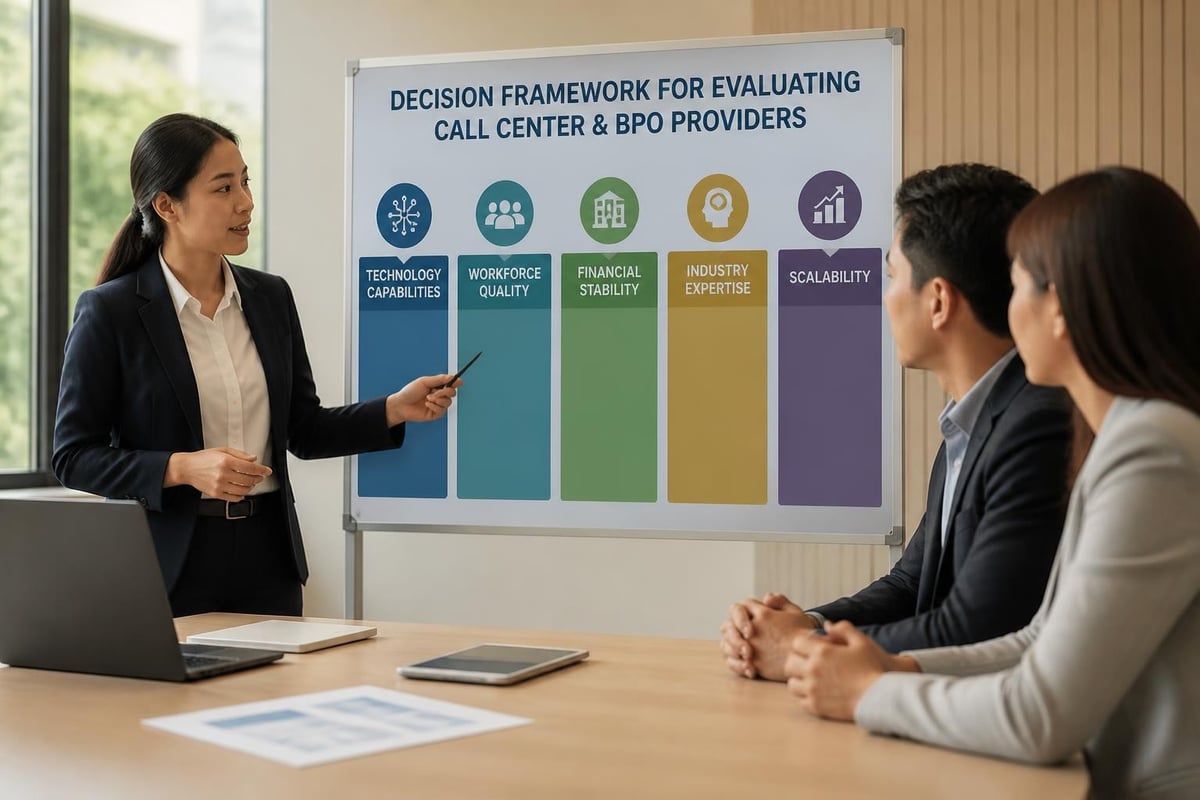
Choosing the right call center and BPO provider requires systematic evaluation across multiple dimensions. Organizations should approach this decision as a strategic partnership rather than a transactional vendor relationship, particularly when outsourcing customer-facing functions that directly impact brand perception.
Evaluation Criteria and Due Diligence
Financial stability and business continuity: Review audited financial statements, disaster recovery capabilities, and business continuity plans. Providers should demonstrate operational redundancy across multiple sites and robust backup systems.
Technology platform and integration capabilities: Assess the maturity of the provider's technology stack, API availability, security certifications, and track record with similar integrations. Request demonstrations using your actual use cases rather than generic scenarios.
Workforce management and culture: Evaluate recruitment practices, training programs, career development opportunities, and employee retention metrics. High agent turnover creates inconsistent customer experiences and increases training costs.
Domain expertise and vertical specialization: Determine whether the provider has relevant industry experience, specialized knowledge requirements, and references from similar client engagements. Generic capabilities may not address sector-specific compliance or technical needs.
Scalability and flexibility: Confirm the provider's capacity to accommodate growth, seasonal fluctuations, and program modifications. Review contract terms regarding volume commitments, ramp-up timelines, and change management processes.
The Forrester Tech Tide for Contact Centers provides valuable context on the evolving technology landscape, helping organizations understand which capabilities represent table stakes versus competitive differentiators.
Emerging Trends Reshaping the Industry
The call center and BPO sector continues evolving in response to technological advances, changing workforce expectations, and shifting customer preferences. Organizations planning long-term outsourcing strategies should account for these directional trends when structuring partnerships.
Hybrid and Distributed Workforce Models
The pandemic permanently altered assumptions about where work happens. Many providers now operate hybrid models combining traditional contact center facilities with work-from-home agents and fully distributed teams. This flexibility expands talent pools, improves agent satisfaction, and creates operational resilience.
Considerations for distributed models include:
- Technology infrastructure supporting secure remote access to customer data and business applications
- Performance management adapted for virtual supervision and coaching
- Collaboration tools enabling team connectivity despite physical separation
- Home office requirements and equipment provisioning standards
- Labor law compliance across multiple jurisdictions for remote workers
Providers with mature distributed workforce capabilities offer geographic flexibility that traditional facility-based models cannot match.
Specialization and Vertical Focus
Generic call center and BPO providers increasingly face competition from specialists offering deep expertise in specific industries or functions. Healthcare BPOs understand HIPAA compliance and medical terminology. Financial services providers navigate complex regulatory environments. Technology support specialists maintain certifications on specific platforms.
This specialization trend enables providers to command premium pricing while delivering superior outcomes through domain knowledge. Businesses should evaluate whether generalist or specialist providers better align with their specific requirements.
Transformation Services and Consulting
Leading call center and BPO providers have expanded beyond execution to include strategic consulting and transformation services. These capabilities help clients redesign customer journeys, optimize channel strategies, and implement new technologies.
Deloitte’s 2025 Global Business Services survey highlights how shared services and outsourcing relationships increasingly focus on innovation and transformation rather than purely cost arbitrage.
Implementation Best Practices and Transition Management
Launching a new call center and BPO partnership represents a significant organizational change requiring careful planning and execution. Rushed implementations create service disruptions, knowledge gaps, and stakeholder frustration that undermine potential benefits.
Phased Transition Approach
Successful transitions typically follow structured phases that build capabilities progressively:
- Discovery and design (4-6 weeks): Document current state processes, define future state requirements, establish governance structures, and develop detailed transition plans
- Build and test (6-8 weeks): Configure technology integrations, develop training materials, recruit and train initial agent cohorts, and conduct pilot testing with limited volumes
- Pilot launch (4-6 weeks): Transfer controlled volumes to the new provider, monitor performance intensively, identify and resolve issues, and refine processes based on early learnings
- Full production ramp (8-12 weeks): Gradually increase volumes to target levels, continue performance monitoring, optimize staffing models, and transition from launch to steady-state governance
Organizations should resist pressure to compress timelines, as adequate preparation directly correlates with long-term success. Inbound contact center programs particularly benefit from methodical transitions that preserve service quality throughout the change.
Knowledge Transfer and Training
The quality of knowledge transfer determines how effectively providers can represent your brand and resolve customer issues. Comprehensive training programs address multiple dimensions:
| Training Component | Content Areas | Delivery Methods |
|---|---|---|
| Product/Service Knowledge | Features, benefits, common use cases, troubleshooting | Interactive modules, hands-on practice, certification testing |
| Systems and Tools | CRM navigation, order management, knowledge bases | Screen simulations, sandbox environments, workflow exercises |
| Processes and Policies | Standard operating procedures, escalation paths, compliance requirements | Process documentation, scenario-based exercises, policy quizzes |
| Soft Skills | Communication techniques, empathy, de-escalation, cultural awareness | Role-playing, call observations, coaching sessions |
Ongoing training should refresh skills, introduce new products or policies, and address performance gaps identified through quality monitoring.
Cost Structures and Financial Considerations
Understanding the economics of call center and BPO relationships helps organizations structure agreements that align incentives and create sustainable partnerships. Pricing models have evolved beyond simple per-hour or per-call arrangements to include outcome-based and risk-sharing structures.
Common Pricing Models
Per-contact pricing: Clients pay a fixed rate for each interaction handled, regardless of duration or complexity. This model provides predictable unit economics but may incentivize providers to minimize handle time at the expense of resolution quality.
Per-hour pricing: Charges based on agent hours dedicated to the program, typically with minimum commitment levels. This approach works well for programs with variable interaction durations or significant non-phone work requirements.
Full-time equivalent (FTE) pricing: Clients purchase dedicated agent capacity at monthly rates, providing budget predictability and workforce stability. This model suits programs requiring specialized knowledge or consistent team assignments.
Performance-based pricing: Base fees combined with incentive payments tied to quality metrics, customer satisfaction, or business outcomes. These structures align provider motivation with client objectives but require sophisticated measurement systems.
Total Cost of Ownership Analysis
Organizations should evaluate outsourcing decisions using comprehensive TCO frameworks that account for both direct and indirect costs:
- Direct provider fees and technology charges
- Transition and implementation costs
- Ongoing governance and vendor management resources
- Quality monitoring and compliance oversight
- Knowledge base maintenance and training material updates
- Integration development and system maintenance
Comparing these total costs against internal operation expenses provides more accurate financial justification than simplistic per-contact comparisons.
Governance and Relationship Management
The operational success of call center and BPO partnerships depends on effective governance structures that facilitate collaboration, resolve issues quickly, and drive continuous improvement. Mature organizations invest in relationship management capabilities that extend beyond contract compliance.
Governance Framework Components
Steering committees: Executive-level forums meeting quarterly to review strategic alignment, major initiatives, and relationship health. These sessions address escalated issues and approve significant program changes.
Operational review meetings: Weekly or bi-weekly sessions with program managers reviewing performance trends, discussing operational challenges, and coordinating tactical adjustments. These meetings maintain momentum and prevent small issues from becoming major problems.
Business review sessions: Monthly or quarterly meetings analyzing detailed metrics, identifying improvement opportunities, and sharing best practices. These reviews should celebrate successes while maintaining accountability for commitments.
Communication protocols: Clear escalation paths, response time expectations, and notification requirements for various issue types. Documented protocols prevent confusion during critical situations.
Change management processes: Formal procedures for requesting, evaluating, approving, and implementing program modifications. Structured change management prevents scope creep while enabling necessary adaptations.
Successful partnerships balance accountability with collaboration, avoiding adversarial dynamics that undermine shared objectives.
Modern call center and BPO partnerships deliver strategic value far beyond cost reduction, enabling organizations to access specialized expertise, leverage advanced technologies, and maintain service excellence at scale. As customer expectations continue rising and operational complexities increase, choosing the right partner and managing the relationship effectively become critical competitive advantages. Focus Services combines global delivery capabilities across the United States, El Salvador, the Philippines, and South Africa with AI-enabled workforce optimization to help businesses enhance customer service operations while reducing costs. Contact our team to explore how scalable call center and BPO solutions can support your growth objectives.