

Outsourced Customer Care: A Complete 2026 Guide
Businesses face mounting pressure to deliver exceptional customer experiences while managing operational costs and scaling efficiently. Outsourced customer care has evolved from a simple cost-reduction tactic into a strategic imperative that enables companies to access specialized expertise, advanced technologies, and global talent pools. As customer expectations continue to rise and communication channels multiply, organizations across industries are reimagining their customer support strategies through partnerships with specialized service providers.
The Strategic Value of Modern Customer Care Outsourcing
Outsourced customer care represents far more than transferring phone calls to an external team. Today's outsourcing partnerships create comprehensive support ecosystems that integrate seamlessly with internal operations while delivering measurable improvements in customer satisfaction, operational efficiency, and business agility.
The fundamental value proposition centers on three core advantages: access to specialized expertise, operational scalability, and cost optimization. Service providers bring years of accumulated knowledge across industries, proven methodologies for handling complex customer interactions, and established training programs that ensure consistent service quality. Organizations can rapidly expand or contract their support capacity based on seasonal demands, product launches, or market conditions without the lengthy recruitment cycles and infrastructure investments required for in-house teams.
Financial and Operational Benefits
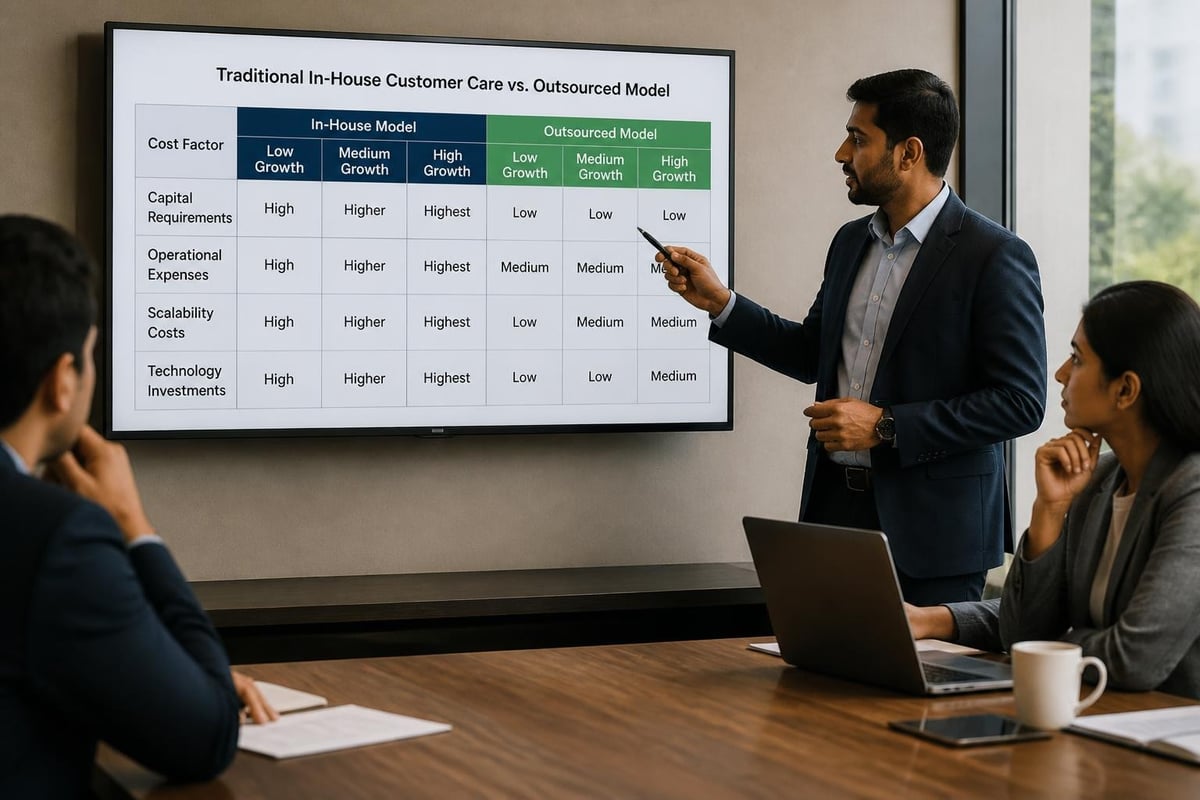
The economic case for outsourcing customer support extends beyond simple labor arbitrage. While accessing talent in cost-effective markets remains important, the complete financial picture includes avoided capital expenditures, reduced training costs, lower employee turnover expenses, and improved resource utilization.
Key financial advantages include:
- Reduced overhead costs: Elimination of facility expenses, technology infrastructure investments, and ongoing maintenance
- Variable cost structure: Transformation of fixed labor costs into flexible operational expenses aligned with actual demand
- Economies of scale: Shared resources across multiple clients reduce per-unit costs for technology, training, and management
- Faster time-to-value: Immediate access to trained agents and established processes accelerates program launches
According to Deloitte’s 2024 Global Outsourcing Survey, organizations increasingly view outsourcing through a multidimensional lens that balances cost savings with innovation capabilities and strategic flexibility. The survey reveals that successful outsourcing relationships now incorporate AI-enabled tools, advanced analytics, and continuous process improvement methodologies that drive ongoing value creation.
Selecting the Right Outsourcing Partner
Choosing an outsourced customer care provider requires careful evaluation across multiple dimensions. The decision impacts customer satisfaction, brand reputation, and operational efficiency for years to come, making thorough partner assessment essential.
Critical Evaluation Criteria
Geographic diversity, technological capabilities, industry expertise, and cultural alignment form the foundation of successful partnerships. Providers operating across multiple continents offer natural disaster recovery capabilities and follow-the-sun support models that extend coverage hours without premium costs.
| Evaluation Factor | Why It Matters | Key Questions |
|---|---|---|
| Geographic Footprint | Risk mitigation, time zone coverage, language capabilities | Does the provider operate in multiple countries? Can they support all required languages? |
| Technology Stack | Integration capabilities, reporting depth, AI readiness | What platforms do they use? How does data flow between systems? |
| Industry Experience | Compliance knowledge, process optimization, best practices | Have they served similar companies? What results did they achieve? |
| Quality Programs | Consistency, continuous improvement, performance management | How do they monitor quality? What training do agents receive? |
| Security & Compliance | Data protection, regulatory adherence, audit readiness | What certifications do they hold? How do they handle sensitive information? |
Companies must also assess the provider's workforce optimization capabilities. Modern contact center operations leverage AI-powered forecasting, real-time performance monitoring, and dynamic scheduling to maximize agent productivity while maintaining service quality.
Security and Compliance Considerations
When outsourcing customer interactions, organizations entrust partners with sensitive customer data and brand reputation. Robust security frameworks and compliance programs become non-negotiable requirements rather than optional features.
The NIST Special Publication 800-161 provides authoritative guidance on cybersecurity supply-chain and third-party risk management applicable to outsourced customer care platforms. Organizations should verify that providers implement comprehensive security controls including data encryption, access management, security monitoring, and incident response protocols.
Regulated industries face additional scrutiny. Financial services firms must consider guidance from authorities like the FCA on outsourcing and operational resilience, which establishes clear expectations for contractual controls, ongoing monitoring, and contingency planning. Healthcare organizations must ensure HIPAA compliance, while payment processing requires PCI-DSS certification.
Essential security and compliance elements:
- Data protection measures: Encryption at rest and in transit, secure data centers, access controls
- Compliance certifications: Industry-specific credentials (HIPAA, PCI-DSS, SOC 2, ISO 27001)
- Audit capabilities: Regular security assessments, penetration testing, compliance reporting
- Business continuity: Disaster recovery plans, redundant systems, backup site capabilities
- Training programs: Security awareness, compliance education, privacy protection protocols
Implementation and Integration Strategies
Successful outsourced customer care programs require careful planning, phased implementation, and ongoing optimization. Organizations that rush deployment often encounter quality issues, customer dissatisfaction, and integration challenges that undermine the partnership's value.
Phased Rollout Approach
Smart implementation begins with clearly defined objectives, measurable success criteria, and realistic timelines. Rather than transferring all customer interactions simultaneously, leading organizations adopt gradual transitions that allow for testing, refinement, and knowledge transfer.
Phase 1: Foundation Building (Weeks 1-4)
The initial phase establishes program infrastructure through knowledge base development, technology integration, and agent training. Service providers work closely with internal teams to document processes, understand product details, and map customer journey touchpoints.
Phase 2: Pilot Launch (Weeks 5-8)
Limited deployment with a small agent group handling a defined customer segment or interaction type validates training materials, tests technology integrations, and identifies process gaps. Real customer interactions provide invaluable feedback for refinement before full-scale launch.
Phase 3: Scaled Deployment (Weeks 9-16)
Gradual expansion adds agent capacity, broadens interaction types, and increases customer segments based on pilot performance. Continuous monitoring ensures quality standards remain consistent as volume grows.
Phase 4: Optimization (Ongoing)
Post-launch focus shifts to performance improvement through data analysis, process refinement, and advanced capability integration. Regular business reviews assess results against objectives and identify enhancement opportunities.

Technology Integration Requirements
Seamless integration between internal systems and outsourced operations ensures agents access the information needed to resolve customer issues efficiently. Modern customer care programs require connections across multiple platforms including CRM systems, order management tools, knowledge bases, and communication channels.
API-based integrations enable real-time data synchronization, eliminating the duplicate entry and system switching that frustrate agents and slow resolution times. Single sign-on capabilities streamline agent workflows, while unified reporting provides complete visibility across internal and external teams.
Organizations should establish clear data governance policies that define what information outsourced agents can access, how data flows between systems, and where customer records reside. Proper governance protects privacy while enabling effective support delivery.
Performance Management and Quality Assurance
Measuring outsourced customer care effectiveness requires comprehensive metrics that assess both operational efficiency and customer experience outcomes. Balanced scorecards incorporate quantitative performance indicators alongside qualitative assessments to provide complete program visibility.
Key Performance Indicators
Leading organizations track metrics across four categories: efficiency measures, quality indicators, customer satisfaction scores, and business impact results. Each category provides unique insights into program health and improvement opportunities.
| Metric Category | Primary Indicators | Target Benchmarks |
|---|---|---|
| Efficiency | Average Handle Time, First Contact Resolution, Schedule Adherence | Industry-specific, balanced with quality |
| Quality | Quality Assurance Scores, Compliance Rate, Error Rate | 90%+ QA scores, <2% error rate |
| Customer Satisfaction | CSAT, NPS, Customer Effort Score | CSAT >85%, positive NPS |
| Business Impact | Cost per Contact, Revenue per Agent, Customer Retention | 20-40% cost reduction vs. in-house |
Understanding contact center service levels helps organizations set realistic targets that balance customer expectations with operational costs. While 80% of calls answered within 20 seconds remains a common industry standard, the appropriate target varies based on customer value, interaction complexity, and competitive positioning.
Quality Assurance Programs
Robust quality programs extend beyond simple call monitoring to encompass comprehensive evaluation across all interaction channels. Leading providers implement multi-layered QA approaches that combine automated speech analytics, human evaluation, and customer feedback to assess agent performance.
Effective QA programs include:
- Random interaction sampling across agents, times, and channels
- Calibration sessions ensuring evaluator consistency
- Agent coaching based on specific performance gaps
- Trend analysis identifying systemic issues requiring process changes
- Customer feedback integration correlating QA scores with satisfaction metrics
Successful outsourced customer care partnerships establish collaborative quality programs where client and provider teams jointly develop evaluation criteria, review results, and implement improvements. This shared accountability drives continuous enhancement rather than finger-pointing when issues arise.
Addressing Common Outsourcing Challenges
Despite significant benefits, outsourced customer care presents challenges that require proactive management and mitigation strategies. Organizations that anticipate potential obstacles and implement preventive measures achieve better outcomes than those reacting to problems after they emerge.
Cultural and Communication Barriers
Language proficiency and cultural understanding significantly impact customer interactions, particularly for brands serving diverse markets. While accent-neutral communication remains important, deeper cultural competency ensures agents understand context, recognize communication styles, and respond appropriately to varying customer expectations.
Leading providers invest heavily in cultural training that extends beyond language instruction to encompass regional preferences, communication norms, and customer service expectations. Ongoing coaching reinforces these principles while helping agents navigate complex cultural dynamics.
Geographic proximity sometimes matters less than cultural alignment. Providers operating in nearshore locations may offer stronger cultural affinity with North American customers than distant offshore alternatives, while contact center agents in countries with strong English education systems often deliver excellent service regardless of location.
Knowledge Transfer and Tribal Knowledge
Companies accumulate years of product knowledge, process understanding, and customer insights that reside in employee minds rather than documented systems. Transferring this "tribal knowledge" to outsourced partners challenges even well-prepared organizations.
Systematic knowledge capture should begin weeks before deployment through process documentation, FAQ development, and scenario libraries. Subject matter experts from product, operations, and customer service teams contribute to comprehensive knowledge bases that answer agent questions and guide complex issue resolution.

Advanced Capabilities and Future Trends
The outsourced customer care industry continues evolving rapidly as artificial intelligence, automation, and analytics reshape support delivery. Organizations selecting partners in 2026 should evaluate not just current capabilities but the provider's innovation roadmap and technology adoption plans.
AI-Enabled Support Operations
Artificial intelligence transforms customer care through intelligent routing, predictive analytics, sentiment analysis, and automated response systems. Leading providers integrate AI tools that augment agent capabilities rather than replacing human interaction entirely.
Key AI applications include:
- Intelligent routing: AI analyzes customer data, interaction history, and current context to direct inquiries to the most qualified agent
- Real-time agent assist: Suggested responses, knowledge article recommendations, and next-best-action guidance appear during active interactions
- Sentiment analysis: Emotional tone detection identifies frustrated customers requiring escalation or specialized handling
- Automated quality monitoring: Speech and text analytics evaluate 100% of interactions rather than small statistical samples
- Predictive analytics: Machine learning models forecast contact volumes, identify at-risk customers, and surface trending issues
Organizations exploring outsourcing of customer service should assess how providers incorporate AI capabilities while maintaining the human touch that differentiates exceptional service from adequate support.
Omnichannel Integration
Modern customers expect seamless experiences across voice, email, chat, SMS, social media, and emerging channels. Outsourced customer care programs must deliver consistent service quality regardless of interaction channel while preserving context as customers switch between touchpoints.
True omnichannel integration requires unified agent desktops that consolidate all communication channels, comprehensive customer data platforms that track full interaction histories, and routing engines that consider channel expertise when assigning work. The most advanced service contact center operations enable customers to begin interactions on one channel and continue on another without repeating information or losing context.
Workforce Optimization Technologies
Maximizing agent productivity while maintaining work-life balance requires sophisticated workforce management tools that forecast demand, optimize schedules, and balance workload distribution. Modern platforms incorporate AI-powered forecasting that considers historical patterns, seasonal trends, and emerging factors like marketing campaigns or product launches.
Real-time adherence monitoring and intraday management capabilities help supervisors respond to unexpected volume spikes or agent absences by adjusting breaks, mobilizing backup capacity, or reallocating resources across channels. These capabilities become especially valuable for outbound call center programs where timing significantly impacts contact rates and campaign effectiveness.
Building Successful Long-Term Partnerships
Outsourced customer care relationships that deliver sustained value require more than solid contracts and clear service level agreements. The most successful partnerships develop through collaborative governance, transparent communication, and shared commitment to continuous improvement.
Governance and Relationship Management
Formal governance structures establish clear decision-making processes, escalation paths, and communication rhythms that prevent small issues from becoming major problems. Regular business reviews at multiple organizational levels ensure alignment on strategic objectives, operational performance, and improvement initiatives.
Effective governance includes:
- Executive steering committees meeting quarterly to review strategic alignment
- Operational management reviews conducted monthly to assess performance and address issues
- Weekly tactical discussions focused on immediate concerns and rapid problem resolution
- Dedicated relationship managers serving as single points of contact for coordination
Contracts should balance detailed service specifications with flexibility to adapt as business needs evolve. Overly rigid agreements lock organizations into outdated processes, while vague contracts create ambiguity that leads to disputes. The best agreements define clear outcomes while allowing process flexibility to achieve those results.
Continuous Improvement Culture
Customer expectations, technology capabilities, and competitive dynamics constantly evolve, requiring customer care programs that adapt and improve continuously. Leading organizations establish joint improvement processes that encourage both partners to identify enhancement opportunities and implement changes collaboratively.
Innovation often emerges from frontline agents who interact with customers daily and recognize pain points, process inefficiencies, or unmet needs. Creating feedback mechanisms that capture agent insights and translate them into actionable improvements generates significant value while demonstrating respect for agent expertise.
Regular performance analytics identify trends, patterns, and opportunities invisible in individual interactions. Quarterly deep-dive analyses examining root causes of customer contacts, resolution patterns, and satisfaction drivers inform strategic improvements that reduce future contact volumes while enhancing customer experiences.
Outsourced customer care offers compelling strategic advantages for organizations seeking to scale support operations, access specialized expertise, and optimize costs while delivering exceptional customer experiences. Success requires careful partner selection, thoughtful implementation, comprehensive performance management, and ongoing commitment to collaborative improvement. Focus Services combines global delivery capabilities across four continents with AI-enabled workforce optimization and proven methodologies that help businesses transform customer support into competitive advantage. Contact our team to explore how strategic outsourcing partnerships can elevate your customer care operations while driving measurable business results.