

Sales and Customer Service: Building Lasting Success
The relationship between sales and customer service has evolved from two distinct departments into a unified force that drives business success. Organizations that recognize the interconnected nature of these functions create seamless customer experiences that begin with the first sales interaction and continue throughout the entire customer lifecycle. This integration becomes particularly critical in today's competitive marketplace, where customer expectations demand consistency, expertise, and genuine care at every touchpoint. Companies that excel at aligning these functions gain significant advantages in customer retention, revenue growth, and brand reputation.
The Strategic Value of Integrating Sales and Customer Service
Modern businesses understand that sales and customer service cannot operate in isolation. When these departments work together strategically, they create a comprehensive view of customer needs, preferences, and behaviors that inform better business decisions.
Sales teams benefit from customer service insights by learning about common pain points, frequently asked questions, and post-purchase challenges. This information helps refine sales messaging, set accurate expectations, and qualify leads more effectively. Meanwhile, customer service teams gain valuable context from sales interactions, understanding what promises were made, what solutions were proposed, and what motivated the customer's purchase decision.
Organizations implementing effective customer service best practices discover that information sharing between departments reduces friction, eliminates redundant processes, and accelerates problem resolution. This coordination directly impacts revenue retention and growth potential.

Building Cross-Functional Communication Channels
The foundation of successful sales and customer service alignment starts with establishing robust communication channels. Teams need real-time access to customer information, interaction history, and current status across all touchpoints.
Consider implementing these communication strategies:
- Shared CRM platforms that provide unified customer records accessible to both departments
- Regular cross-departmental meetings to discuss trends, challenges, and opportunities
- Joint training sessions that build empathy and understanding between teams
- Escalation protocols that clearly define when and how to transition customers between departments
- Feedback loops that capture insights from customer interactions and distribute them across teams
Digital business cards from Spreadly enhance this coordination by ensuring both sales and service representatives share consistent, up-to-date contact information and team details. When customers can easily reach the right person at the right time, satisfaction increases and resolution times decrease.
Training for Excellence Across Sales and Customer Service
Comprehensive training programs that address both sales and customer service competencies create versatile team members who understand the complete customer journey. This holistic approach ensures consistency in messaging, service quality, and problem-solving approaches.
Core Competencies for Unified Teams
Effective training curricula should develop these essential skills across both functions:
- Active listening techniques that uncover customer needs and concerns
- Empathy development that builds genuine connections with customers
- Product knowledge mastery covering features, benefits, and applications
- Communication excellence including clarity, tone, and persuasion
- Problem-solving frameworks that address challenges systematically
- Technology proficiency with CRM systems, communication tools, and analytics platforms
Organizations offering BPO and call center services recognize that ongoing training investments yield measurable improvements in key performance indicators including conversion rates, customer satisfaction scores, and first-call resolution rates.
| Training Focus Area | Sales Impact | Customer Service Impact |
|---|---|---|
| Product Knowledge | Increases conversion rates | Reduces resolution time |
| Communication Skills | Builds trust faster | Improves satisfaction scores |
| Empathy Development | Strengthens relationships | Decreases escalations |
| Technology Mastery | Streamlines workflows | Enhances efficiency |
| Problem-Solving | Overcomes objections | Resolves issues faster |
Leveraging Technology to Enhance Sales and Customer Service
Technology platforms enable sales and customer service teams to deliver exceptional experiences at scale. The right tools provide the data, automation, and insights necessary to personalize interactions and respond proactively to customer needs.
Aligning sales and customer service teams through unified technology platforms creates seamless handoffs, maintains context across interactions, and eliminates information gaps that frustrate customers.
Essential Technology Components
Modern sales and customer service operations rely on integrated technology stacks that include:
- Customer Relationship Management (CRM) systems that centralize customer data and interaction history
- Communication platforms supporting voice, email, chat, and social media channels
- Analytics and reporting tools that measure performance and identify trends
- Knowledge management systems providing quick access to information and solutions
- Automation capabilities that handle routine tasks and trigger appropriate workflows
- AI-powered insights that predict customer needs and recommend next best actions
Artificial intelligence continues transforming how sales and customer service teams operate. Research on natural language processing in customer service demonstrates how AI applications improve interaction quality, reduce response times, and extract valuable insights from customer conversations.

Measuring Success Through Integrated Metrics
Tracking the right metrics provides visibility into how well sales and customer service functions work together to achieve business objectives. Organizations should monitor both department-specific and shared metrics that reflect collaborative performance.
Key Performance Indicators for Aligned Teams
Sales-Specific Metrics:
- Conversion rates by channel and source
- Average deal size and sales cycle length
- Pipeline velocity and forecast accuracy
- Customer acquisition cost
- Win rates against competitors
Customer Service Metrics:
- First contact resolution rate
- Average response and resolution times
- Customer satisfaction (CSAT) scores
- Net Promoter Score (NPS)
- Customer effort score
Shared Success Metrics:
- Customer lifetime value
- Retention and churn rates
- Upsell and cross-sell success
- Customer referral rates
- Revenue per customer
Companies with extensive BPO experience understand that metrics should drive actionable insights rather than simply documenting past performance. Regular metric reviews inform training needs, process improvements, and strategic adjustments.
Creating Customer-Centric Cultures
Organizational culture significantly influences how sales and customer service teams collaborate and prioritize customer needs. Leaders must establish clear values, expectations, and recognition systems that reward customer-focused behaviors.
Cultural Elements That Drive Success
Building a customer-centric culture requires intentional focus on several key elements. Organizations should emphasize transparency, where information flows freely between departments and customer insights are shared widely. Accountability matters, with team members taking ownership of customer outcomes regardless of departmental boundaries.
Recognition programs should celebrate both individual achievements and collaborative wins. When sales representatives receive acknowledgment for smooth customer handoffs and service teams earn recognition for identifying upsell opportunities, the organization reinforces the importance of working together.
Studies examining positive affect and service quality reveal that employee attitudes and behaviors directly impact customer experiences. Organizations investing in employee satisfaction and engagement typically see corresponding improvements in customer satisfaction and loyalty.
| Cultural Attribute | Implementation Strategy | Expected Outcome |
|---|---|---|
| Transparency | Open data sharing, regular updates | Faster problem resolution |
| Collaboration | Cross-functional projects, shared goals | Improved customer experiences |
| Accountability | Clear ownership, empowerment | Higher quality interactions |
| Recognition | Celebrate wins, reward cooperation | Increased motivation |
| Continuous Learning | Training investment, skill development | Enhanced capabilities |
Optimizing the Customer Journey Through Sales and Customer Service Alignment
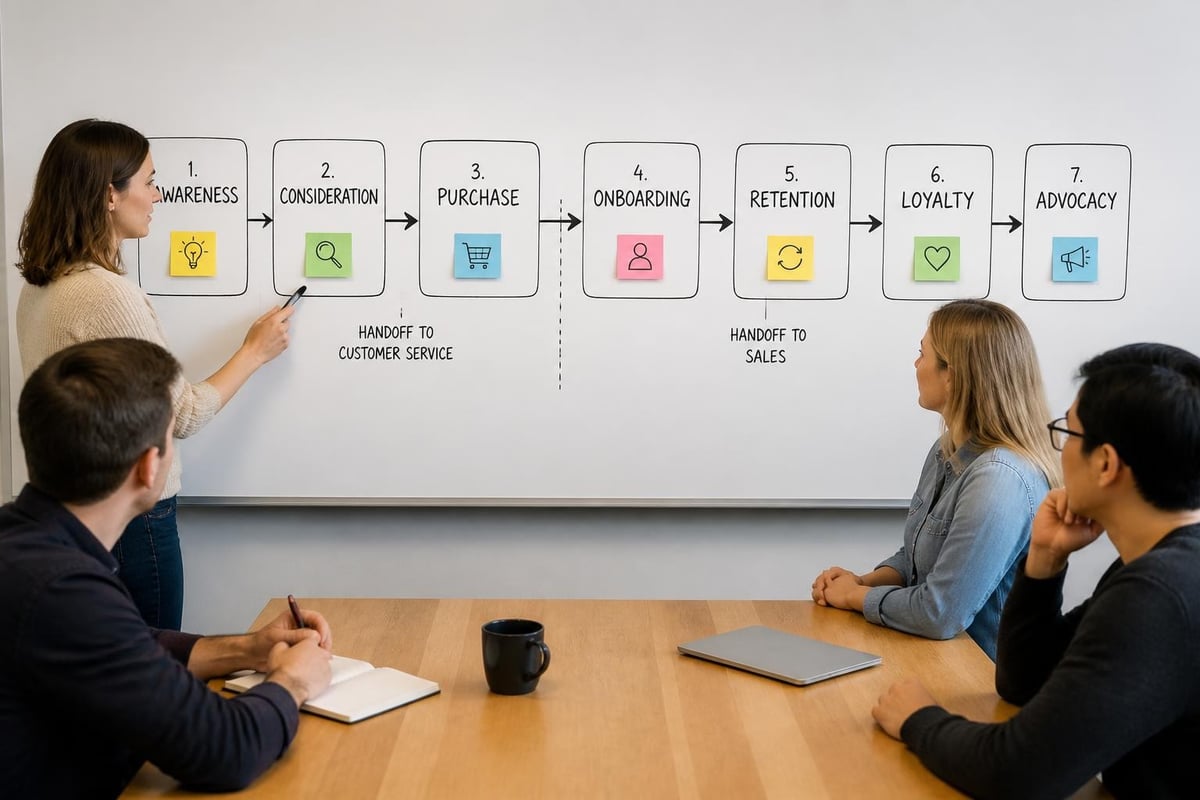
Every customer interaction represents an opportunity to strengthen relationships and demonstrate value. Mapping the complete customer journey reveals critical touchpoints where sales and customer service collaboration makes the greatest impact.
The journey typically includes these phases:
- Awareness – Prospective customers discover your solutions
- Consideration – Prospects evaluate options and compare alternatives
- Purchase – Decision-making and transaction completion
- Onboarding – Initial implementation and setup
- Adoption – Regular use and value realization
- Expansion – Additional purchases and increased engagement
- Advocacy – Referrals and positive recommendations
Strategic Touchpoint Management
Sales and customer service teams should collaborate intensively at transition points between journey stages. The handoff from sales to service during onboarding sets the tone for the entire relationship. When service teams understand what was promised during the sales process, they can ensure consistent delivery and meet expectations.
Similarly, customer service teams identifying expansion opportunities should seamlessly connect customers with sales resources. This coordination prevents customers from feeling passed around while ensuring they receive appropriate expertise at each stage.
Research on customer orientation and loyalty confirms that understanding customer needs throughout the journey significantly influences retention and repeat business. Teams focused on genuine problem-solving rather than transactional interactions build stronger, more profitable relationships.
Implementing Scalable Sales and Customer Service Solutions
Growth presents challenges for maintaining service quality and sales effectiveness. Organizations need scalable solutions that preserve personalization while handling increased volume efficiently.
Scalability Strategies
Process Standardization: Documented procedures ensure consistency across team members and locations. Standard operating procedures for common scenarios enable faster training and reduce variation in customer experiences.
Workforce Optimization: Strategic workforce management balances capacity with demand. Forecasting tools predict interaction volumes, allowing appropriate staffing levels during peak periods while controlling costs during slower times.
Global Operations: Multi-location strategies provide coverage across time zones and languages. Distributed teams extend service hours, reduce response times, and demonstrate cultural awareness that resonates with diverse customer bases.
Technology Leverage: Automation handles routine inquiries and tasks, freeing human agents to focus on complex situations requiring judgment and empathy. Self-service options empower customers preferring independent problem-solving.
Organizations can expand capacity without sacrificing quality by partnering with experienced providers. Call center outsourcing enables businesses to scale rapidly, access specialized expertise, and manage costs predictably while maintaining high service standards.
Building Long-Term Customer Relationships
Sustainable business growth depends on cultivating lasting customer relationships that extend far beyond initial transactions. Sales and customer service teams working together create consistent, valuable experiences that foster loyalty and advocacy.
Relationship Development Tactics
Successful relationship building requires intentional strategies executed consistently over time. Proactive communication keeps customers informed about relevant updates, new features, and opportunities. Rather than waiting for customers to reach out with problems, high-performing teams anticipate needs and provide solutions before issues escalate.
Personalization demonstrates that you understand and value individual customers. Sales and customer service teams accessing comprehensive customer profiles can reference past interactions, acknowledge preferences, and tailor recommendations appropriately. This attention to detail differentiates exceptional service from merely adequate support.
Regular check-ins maintain engagement during periods when customers aren't actively purchasing or seeking support. These touchpoints gather feedback, identify emerging needs, and reinforce your commitment to their success. The insights gained inform product development, service enhancements, and strategic direction.
Research examining sales team cohesion and customer satisfaction highlights how customers perceive and respond to team unity. Organizations projecting coordinated, collaborative service earn higher satisfaction scores and stronger loyalty.
Addressing Common Challenges in Sales and Customer Service Integration
Despite clear benefits, organizations often encounter obstacles when aligning sales and customer service functions. Recognizing and addressing these challenges proactively increases implementation success.
Typical Integration Obstacles
Conflicting Incentives: Sales teams compensated primarily on new customer acquisition may deprioritize smooth handoffs or customer success activities. Customer service teams measured solely on efficiency metrics might avoid time-consuming activities that benefit long-term relationships. Aligning compensation and recognition systems with collaborative goals resolves these conflicts.
Information Silos: Legacy systems, departmental boundaries, and cultural norms can restrict information flow. Breaking down these barriers requires leadership commitment, technology investment, and process redesign.
Skill Gaps: Team members accustomed to narrow functional roles may lack cross-functional competencies. Comprehensive training programs develop versatile capabilities that support integrated operations.
Resistance to Change: Established routines and comfort with existing approaches create inertia. Change management strategies including clear communication, stakeholder involvement, and visible leadership support overcome resistance.
| Challenge | Root Cause | Solution Approach |
|---|---|---|
| Conflicting Goals | Misaligned incentives | Unified success metrics |
| Information Silos | System limitations | Integrated technology platforms |
| Inconsistent Service | Training gaps | Cross-functional development |
| Change Resistance | Unclear benefits | Stakeholder engagement |
Integrating sales and customer service creates powerful competitive advantages through improved customer experiences, increased retention, and enhanced revenue growth. Organizations prioritizing collaboration between these critical functions position themselves for sustainable success in increasingly demanding markets. Focus Services helps businesses implement scalable sales and customer service solutions that deliver measurable results through global operations, advanced technology, and proven BPO expertise tailored to your specific needs.