
Workforce in Call Center: Strategies for 2026 Success
The modern business landscape demands exceptional customer service, and the workforce in call center operations stands at the frontline of this challenge. Organizations across industries face mounting pressure to deliver seamless customer experiences while managing costs, scaling capacity, and adapting to technological disruption. Building and maintaining an effective call center workforce requires strategic planning, operational excellence, and a commitment to continuous improvement that addresses both current needs and future trends.
Understanding the Modern Call Center Workforce Landscape
The workforce in call center environments has evolved dramatically over the past decade. Today's contact centers blend human expertise with advanced technologies, creating hybrid operating models that leverage the strengths of both. According to Deloitte’s 2024 Global Contact Center Survey, organizations are prioritizing workforce transformation as they navigate shifting customer expectations and technological capabilities.
Several factors distinguish high-performing call center teams from their competitors:
- Multi-channel expertise across voice, email, chat, and social media platforms
- Technical proficiency with CRM systems, knowledge bases, and AI-assisted tools
- Soft skills excellence including empathy, active listening, and problem-solving
- Adaptability to handle diverse customer scenarios and product complexity
- Cultural alignment with company values and service standards
The geographic distribution of the workforce in call center operations has also shifted significantly. Companies now leverage global talent pools to extend service hours, access specialized skills, and optimize labor costs while maintaining quality standards.

Staffing Models and Capacity Planning
Effective workforce management begins with selecting the right staffing model. Organizations must balance service level requirements against budget constraints while maintaining flexibility for volume fluctuations.
Traditional in-house teams provide maximum control and direct oversight but require significant infrastructure investment and fixed labor costs. This model works well for organizations with predictable volumes and specialized training requirements.
Outsourced workforce solutions offer scalability and cost efficiency. Partnering with providers like Focus Services enables businesses to access trained agents across multiple locations, reducing overhead while maintaining service quality through established quality assurance frameworks.
Hybrid approaches combine internal teams for core functions with external capacity for overflow, seasonal peaks, or specialized campaigns. This strategy optimizes costs while retaining strategic control over critical customer interactions.
| Staffing Model | Cost Structure | Scalability | Control Level | Best For |
|---|---|---|---|---|
| In-house | High fixed costs | Limited | Maximum | Specialized, low-volume |
| Fully outsourced | Variable costs | High | Moderate | Growth phase, cost focus |
| Hybrid | Mixed fixed/variable | Moderate-High | Balanced | Mature operations |
| Work-from-home | Lower overhead | High | Technology-dependent | Distributed customers |
Capacity planning for the workforce in call center environments demands rigorous forecasting. Analyze historical call patterns, seasonal trends, marketing campaign impacts, and product launch cycles to predict staffing needs accurately. Build buffers for unexpected volume spikes while avoiding overstaffing that erodes profitability.
Recruitment and Onboarding Excellence
Finding the right talent represents one of the most critical challenges in building an effective workforce in call center operations. The recruitment process must identify candidates who possess both technical capabilities and the personality traits that drive customer satisfaction.
Defining Ideal Candidate Profiles
Successful recruitment starts with clear role definitions. Different positions within a call center require distinct skill combinations:
Customer service representatives need empathy, patience, and strong communication skills. They handle routine inquiries and must navigate company policies while maintaining positive customer relationships.
Technical support agents require product knowledge depth and troubleshooting capabilities. These roles demand analytical thinking and the ability to translate complex concepts into accessible language.
Sales agents excel through persuasive communication, resilience, and goal orientation. Understanding customer needs while presenting solutions requires a unique combination of listening skills and assertiveness.
Screening processes should evaluate both competencies and cultural fit. Include scenario-based assessments, communication exercises, and behavioral interviews that reveal how candidates handle stress, ambiguity, and difficult customer interactions.
Structured Onboarding Programs
Once hired, new agents need comprehensive training that prepares them for real-world scenarios. Effective onboarding programs typically span 3-6 weeks and include:
- Product and service knowledge covering features, benefits, common issues, and competitive positioning
- Systems training on CRM platforms, knowledge management tools, and communication technologies
- Process education explaining workflows, escalation procedures, and quality standards
- Soft skills development focusing on communication techniques, empathy, and de-escalation strategies
- Supervised practice with shadowing, role-playing, and monitored live interactions before full independence
Research from ICMI’s State of the Contact Center 2024 reveals that organizations with structured onboarding programs experience 25-40% lower first-year turnover compared to those with informal training approaches.

Retention Strategies for Long-Term Success
Turnover in the workforce in call center operations averages 30-45% annually across the industry, creating significant costs in recruitment, training, and lost productivity. Implementing targeted retention strategies protects organizational knowledge while improving service consistency.
Career development pathways give agents clear advancement opportunities. Create progression routes from entry-level positions through senior agent roles, team leadership, quality assurance, training, and operations management. Transparently communicate requirements and timelines for each step.
Performance recognition programs celebrate achievements and reinforce desired behaviors. Balance quantitative metrics (handle time, resolution rate, sales conversion) with qualitative measures (customer satisfaction, peer feedback, quality scores). Implement both monetary rewards and public recognition to motivate diverse team members.
Work-life balance initiatives address the demanding nature of call center work. Flexible scheduling, shift-bidding systems, and remote work options help agents manage personal commitments while meeting business needs. Companies that prioritize agent wellbeing see measurable improvements in attendance, engagement, and tenure.
Compensation and Benefits Optimization
Competitive compensation remains fundamental to retention. Benchmark salaries against regional markets and industry standards, adjusting for cost of living differences across locations. Many organizations now leverage global delivery models, placing portions of their workforce in call center operations across markets like the Philippines, El Salvador, or South Africa to optimize labor costs while maintaining quality through strong management and quality assurance processes.
Beyond base pay, consider:
- Performance bonuses tied to individual and team metrics
- Commission structures for sales-focused roles
- Health and wellness benefits including mental health support
- Educational assistance for professional development
- Retirement contributions to support long-term financial security
Technology Integration and Workforce Augmentation
Artificial intelligence and automation are fundamentally reshaping the workforce in call center environments. Rather than replacing human agents, these technologies augment capabilities and allow staff to focus on complex, high-value interactions that require empathy and judgment.
According to Forrester’s research on AI transformation, organizations should prepare for significant workforce evolution as AI handles routine inquiries while human agents tackle sophisticated problem-solving.
AI-Powered Tools for Agent Support
Modern contact centers deploy various technologies to enhance agent effectiveness:
Knowledge management systems with AI-powered search deliver instant access to relevant information during customer interactions. Agents no longer waste time searching through manuals or asking supervisors for policy clarification.
Real-time coaching platforms analyze conversation sentiment, identify compliance risks, and suggest optimal responses during live calls. This technology transforms every interaction into a learning opportunity.
Chatbot escalation workflows handle initial customer contact and information gathering before routing complex issues to human agents with complete context. This reduces agent workload while improving customer experience through faster resolution.
The HBR article on generative AI success emphasizes that successful implementation requires robust knowledge management foundations. Organizations must maintain accurate, accessible information repositories before deploying AI tools that depend on that data.

Preparing Your Workforce for AI Integration
Introducing new technologies to the workforce in call center operations requires careful change management. Agents often fear that automation threatens job security, creating resistance that undermines adoption.
Address these concerns through:
- Transparent communication about technology goals and agent role evolution
- Inclusive planning involving frontline staff in tool selection and workflow design
- Comprehensive training ensuring every agent can effectively use new systems
- Demonstrable benefits showing how AI reduces frustrating tasks and empowers better service
- Ongoing support with technical assistance and feedback channels
Position AI as a tool that enhances agent capabilities rather than a replacement for human judgment. Emphasize that technology handles repetitive work while freeing agents to build relationships and solve complex problems that drive customer loyalty.
Performance Management and Quality Assurance
Measuring and improving performance remains essential for maintaining an effective workforce in call center operations. Robust quality assurance programs protect brand reputation while identifying training needs and coaching opportunities.
Balanced Scorecard Approaches
Avoid overreliance on single metrics that create unintended consequences. A representative who minimizes handle time may rush customers and damage satisfaction. An agent who achieves perfect quality scores might work too slowly to meet service level targets.
Implement balanced scorecards that include:
| Metric Category | Example Metrics | Target Purpose |
|---|---|---|
| Efficiency | Average Handle Time, Calls Per Hour | Productivity optimization |
| Quality | QA Scores, First Call Resolution | Service excellence |
| Customer Impact | CSAT, NPS, Customer Effort Score | Experience outcomes |
| Business Results | Sales Conversion, Upsell Rate, Retention | Revenue contribution |
| Compliance | Adherence, Schedule Compliance | Operational reliability |
Weight metrics according to organizational priorities and role responsibilities. Sales outsourcing teams emphasize conversion and revenue metrics, while customer care programs prioritize satisfaction and resolution.
Quality Monitoring Programs
Systematic quality assurance identifies excellence and improvement opportunities across the workforce in call center operations. Effective programs incorporate:
Random call sampling ensures representative coverage across agents, times, and interaction types. Review 3-5% of total interactions monthly, balancing statistical significance against evaluation capacity.
Calibration sessions align evaluators on scoring standards. Regular meetings where multiple supervisors assess the same interactions and discuss discrepancies prevent rater bias and ensure consistency.
Agent feedback loops transform evaluations into development opportunities. Share scored interactions with agents, discuss specific strengths and improvement areas, and create action plans for skill enhancement. Companies with strong contact center quality assurance programs demonstrate measurably better customer outcomes.
Peer review programs enable experienced agents to evaluate colleague interactions, fostering knowledge sharing and creating development pathways into quality assurance roles.
Workforce Optimization Through Scheduling and Forecasting
Matching agent availability to customer demand represents a persistent challenge for the workforce in call center operations. Sophisticated workforce management prevents both understaffing that damages service levels and overstaffing that wastes resources.
Demand Forecasting Techniques
Accurate forecasting begins with historical data analysis. Examine patterns across multiple dimensions:
- Seasonal trends reflecting annual business cycles
- Day-of-week patterns showing higher weekend or weekday volumes
- Intraday fluctuations identifying peak hours and slow periods
- Marketing campaign impacts from promotional activities
- Product launch effects as new offerings generate inquiry spikes
Apply statistical models that account for these variables while building contingency capacity for unexpected events. Weather disruptions, viral social media posts, or system outages can create sudden volume surges that overwhelm unprepared teams.
Schedule Optimization Strategies
Once demand is forecast, create schedules that balance business needs against agent preferences:
Shift bidding systems allow agents to select preferred schedules based on seniority or performance, improving satisfaction while filling required coverage. Senior agents earn priority selection as a retention incentive.
Flexible scheduling accommodates part-time agents, students, and caregivers seeking non-traditional hours. This expands talent pools and provides natural coverage during extended service windows.
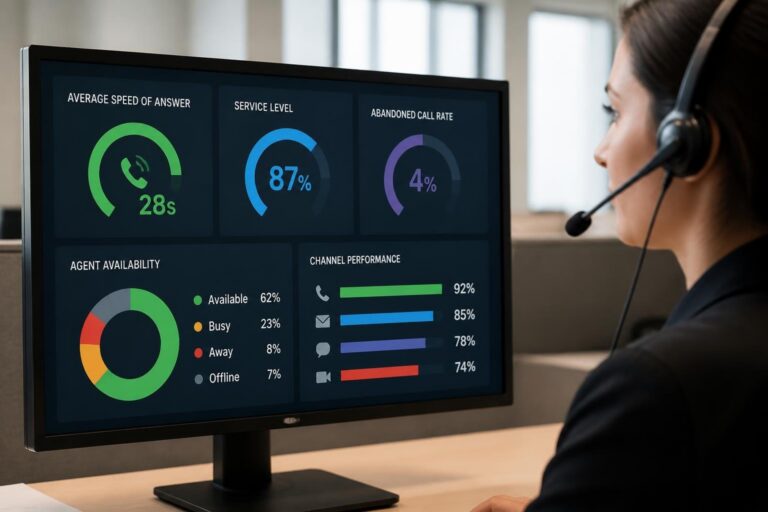
Adherence monitoring tracks whether agents work scheduled hours and manage break times appropriately. Real-time adherence dashboards help supervisors identify coverage gaps and make immediate adjustments.
Organizations with multi-location operations can optimize the workforce in call center environments by leveraging time zone differences. Business process outsourcing solutions across regions enable 24/7 coverage without excessive shift premiums or agent fatigue.
Training and Development for Continuous Improvement
Initial onboarding provides foundational knowledge, but ongoing development keeps the workforce in call center operations current with product changes, policy updates, and evolving customer expectations.
Microlearning and Just-in-Time Training
Traditional classroom training disrupts operations and struggles to maintain engagement. Modern learning approaches deliver targeted content when agents need it:
Microlearning modules present focused topics in 5-10 minute sessions covering specific procedures, product updates, or skill techniques. Agents complete modules during schedule gaps without extended absences from the queue.
Just-in-time resources embedded in agent desktops provide instant guidance during customer interactions. Pop-up tips for handling specific scenarios or processing unusual requests reduce errors and improve confidence.
Gamification elements introduce competition and achievement recognition into learning programs. Leaderboards, badges, and challenges increase engagement while reinforcing key concepts through repetitive practice.
Skills Assessment and Personalized Development
Not every agent needs identical training. Assess individual competencies to identify specific development needs:
- Baseline skills testing evaluates product knowledge, system proficiency, and soft skills
- Gap analysis compares current capabilities against role requirements and career goals
- Personalized learning paths assign relevant training modules addressing identified weaknesses
- Progress tracking monitors completion and measures competency improvement
- Recertification cycles ensure skills remain current as products and procedures evolve
This targeted approach maximizes training ROI by focusing resources where they generate the greatest impact on workforce in call center performance.
Managing Remote and Hybrid Workforce Models
The shift toward distributed work has accelerated dramatically, with many organizations now supporting fully remote or hybrid workforce in call center configurations. These models offer significant benefits but require adapted management approaches.
Technology Infrastructure for Remote Success
Remote agents need robust technical foundations:
- Secure connectivity through VPNs protecting customer data
- Cloud-based systems accessible from any location
- Communication platforms for team collaboration and supervisor support
- Monitoring tools tracking productivity and quality remotely
- Backup internet options preventing disruptions from connectivity issues
Provide standardized equipment or detailed specifications ensuring home office setups meet performance requirements. Technical support teams must assist with troubleshooting in agents' homes rather than centralized locations.
Building Culture and Engagement Remotely
Physical separation challenges the workforce in call center operations by reducing informal learning, weakening team bonds, and potentially isolating agents. Counteract these risks through intentional culture-building:
Virtual team meetings maintain connection through regular video conferences. Balance business updates with social interaction, celebrating wins and acknowledging challenges.
Digital collaboration spaces create forums for questions, knowledge sharing, and peer support. Platforms like Slack or Microsoft Teams enable the informal hallway conversations that naturally occur in physical centers.
Recognition programs adapted for remote environments ensure distributed agents receive equal visibility and appreciation. Highlight achievements in team calls and digital channels to maintain motivational impact.
Industry-Specific Workforce Considerations
Different sectors present unique challenges for the workforce in call center operations. Tailoring strategies to industry requirements optimizes outcomes and agent satisfaction.
Healthcare contact centers demand HIPAA compliance knowledge and empathy for patients navigating stressful medical situations. Training emphasizes privacy protection alongside clinical terminology and insurance processes.
Financial services operations require agents who understand complex products, regulatory requirements, and security protocols. Background checks and extended training periods protect both customers and institutional reputation.
Utilities and essential services create high-stakes environments where specialized support teams handle emergency situations, service outages, and billing concerns. Agents need crisis management skills and decision-making authority to resolve urgent customer needs.
E-commerce support faces extreme seasonal volatility during holidays and promotional events. Workforce planning must accommodate rapid scaling followed by contraction while maintaining service quality throughout volume fluctuations.
Understanding these sector-specific needs ensures the workforce in call center environments possesses the specialized knowledge, skills, and support required for success in each context.
Building an exceptional workforce in call center operations requires strategic planning, continuous investment, and commitment to both employee experience and customer outcomes. Organizations that prioritize recruitment excellence, ongoing development, technology enablement, and performance management create competitive advantages through superior service delivery. Focus Services partners with businesses across industries to build scalable, high-performing contact center teams through proven methodologies, global delivery capabilities, and AI-enabled workforce optimization that drives measurable results while controlling costs.