

AI Customer Care: A Practical Guide for Support Teams
Customer care AI is the use of machine learning, natural language processing, and automation to answer customer questions, route requests, and assist human agents across voice, chat, email, and messaging. Its purpose is to resolve routine interactions faster and free people for work that requires judgment and empathy. For high-volume programs in telecom, utilities, travel, financial services, and e-commerce, many teams now treat it as a core part of how they operate. This guide explains what it does, where it fits, how to deploy it safely, and how to measure whether it works.
What Does Customer Care AI Actually Do?
Customer care AI handles three jobs: answering customers directly, helping agents work faster, and analyzing every interaction for patterns. Each job uses different technology, and most mature programs combine all three.
- Conversational agents: Chat and voice bots that identify intent, retrieve account information, and complete simple tasks such as checking an order, resetting a password, or confirming a payment date.
- Agent assist: Real-time prompts that surface knowledge articles, suggest next steps, and draft after-call summaries while a human agent stays in control of the conversation.
- Routing and triage: Models that classify incoming contacts by topic, urgency, and sentiment so the right queue or specialist receives each one.
- Quality and analytics: Automated review of calls and transcripts that spots compliance gaps, recurring complaints, and coaching opportunities across 100% of contacts rather than a small sample.
A useful way to think about it: the first category replaces a portion of contacts, while the other three improve the work that remains. Teams that evaluate only the first category often underestimate the return.
Why Are Support Teams Adopting It Now?
Support teams are adopting AI because contact volume has outgrown what hiring alone can absorb. In HubSpot’s customer service survey, 75% of representatives said they experienced the highest ticket volume they had ever seen in 2024, and 92% of the service leaders surveyed said AI had improved their response.
Leadership intent matches that pressure. A 2025 Salesforce State of Service survey of 6,500 service professionals found that 79% of service leaders consider investment in AI agents fundamental to meeting current business demands.
Sentiment among agents is also favorable. Intercom's 2025 transformation report found that 82% of surveyed support teams felt positive about working alongside AI, while 60% said customer-service roles on their team were evolving because of the technology. That second figure matters for planning: roles are changing, not disappearing, and training budgets should reflect that.
Will Customer Service Be Replaced by AI?
Customer service will not be replaced by AI, but the mix of work will change significantly. Routine, rules-based contacts are increasingly automated, while complex, emotional, regulated, or high-value interactions stay with people.
The practical question for an operations leader is which contacts belong where. A simple screen helps:
- Automate first: Order status, balance inquiries, appointment changes, outage notifications, password resets, and basic billing questions with clear policy answers.
- Assist, do not replace: Disputes, cancellations, retention offers, technical troubleshooting with several variables, and anything involving a vulnerable customer.
- Keep human-led: Complaints with legal or regulatory exposure, bereavement or hardship situations, and sales conversations where trust drives the outcome.
Agent roles shift toward exception handling, relationship work, and AI supervision. That shift raises the skill requirement per agent, which is one reason a blend of automation and well-trained staff outperforms either alone.
Where Does AI Fit in Your Customer Care Operation?
AI fits at the points in the contact journey where volume is high, the answer is predictable, and the cost of an error is low. Mapping your contact drivers before choosing technology prevents the common mistake of buying a bot and then searching for work for it to do.
Start with a contact-driver analysis covering at least 90 days of data. Rank reasons for contact by volume and by handle time. The top five to ten drivers usually account for the majority of contacts, and the combination of high volume and short handle time marks the best automation candidates.
Industry context shapes the order of priority:
- Telecom and utilities: Outage updates, bill explanations, payment arrangements, and service activation.
- Travel: Booking changes, itinerary questions, and disruption rebooking during peak periods.
- E-commerce: Order tracking, returns initiation, and delivery exceptions, which pair well with dedicated e-commerce customer care staffing for seasonal peaks.
- Financial services: Card status, transaction lookups, and identity-verified account updates, with strict handoff rules for disputes.
For a broader view of how automation connects to staffing models, Focus Services outlines its approach to customer care automation.
What Are Examples of Customer Care AI in Practice?
The clearest examples are the everyday interactions that customers already expect to be quick. Five common patterns cover most deployments:
- Self-service chat for order and account questions, where the bot authenticates the customer and returns a status in seconds.
- Voice AI for inbound call deflection, which greets callers, captures the reason for the call, and either resolves it or transfers with the details already collected.
- Agent assist during live calls, which listens to the conversation and surfaces the relevant policy or script step.
- Automated post-contact summaries, which reduce after-call work and improve record consistency.
- Sentiment-based escalation, which flags frustrated customers mid-conversation and routes them to a senior agent.
Retailers and large platforms use similar tools, so build your plan around your own contact data rather than copying a headline example.
How Do You Choose Between Chatbots, Voice AI, and Agent Assist?
Choose the channel where your contact volume is concentrated and where customers show the greatest tolerance for automation. The table below compares the three main options on the attributes that drive the decision.
| Option | Best for | Main risk | Typical first use |
|---|---|---|---|
| Chatbot | Digital-first customers, repetitive questions | Dead-end loops without a clear exit | Order status, FAQs |
| Voice AI | Phone-heavy programs, after-hours coverage | Misrecognition on accents or noisy lines | Call greeting, authentication, simple requests |
| Agent assist | Complex or regulated interactions | Agents ignoring or over-trusting suggestions | Knowledge retrieval, summaries |
Many operations start with agent assist because it carries less customer-facing risk, then add self-service once the knowledge base proves reliable. Phone-centered businesses often reverse that order, since voice deflection can relieve queues quickly. Neither path is wrong. The right sequence follows your data.
What Are the Best Ways to Improve Customer Care With AI?
The most reliable improvements come from fixing the foundation before adding automation. These ten practices apply whether you run an in-house team or an outsourced program:
- Audit contact drivers before selecting tools.
- Clean and consolidate your knowledge base so answers are current and consistent.
- Define escalation rules in writing, including which topics always go to a person.
- Pass full conversation context to the human agent so customers never repeat themselves.
- Pilot with one or two contact types, then expand.
- Train agents on how to work with AI suggestions and when to override them.
- Review a sample of AI conversations weekly for errors and tone.
- Set clear targets for containment, resolution, and satisfaction before launch.
- Maintain a feedback loop so agents can flag wrong or outdated answers.
- Revisit the program quarterly as products, policies, and customer behavior change.
Good care also depends on fundamentals that technology cannot supply. Focus Services discusses those fundamentals in its piece on good customer care, and AI performs best when layered on top of them.

How Do You Keep Customer Care AI Safe in Regulated Industries?
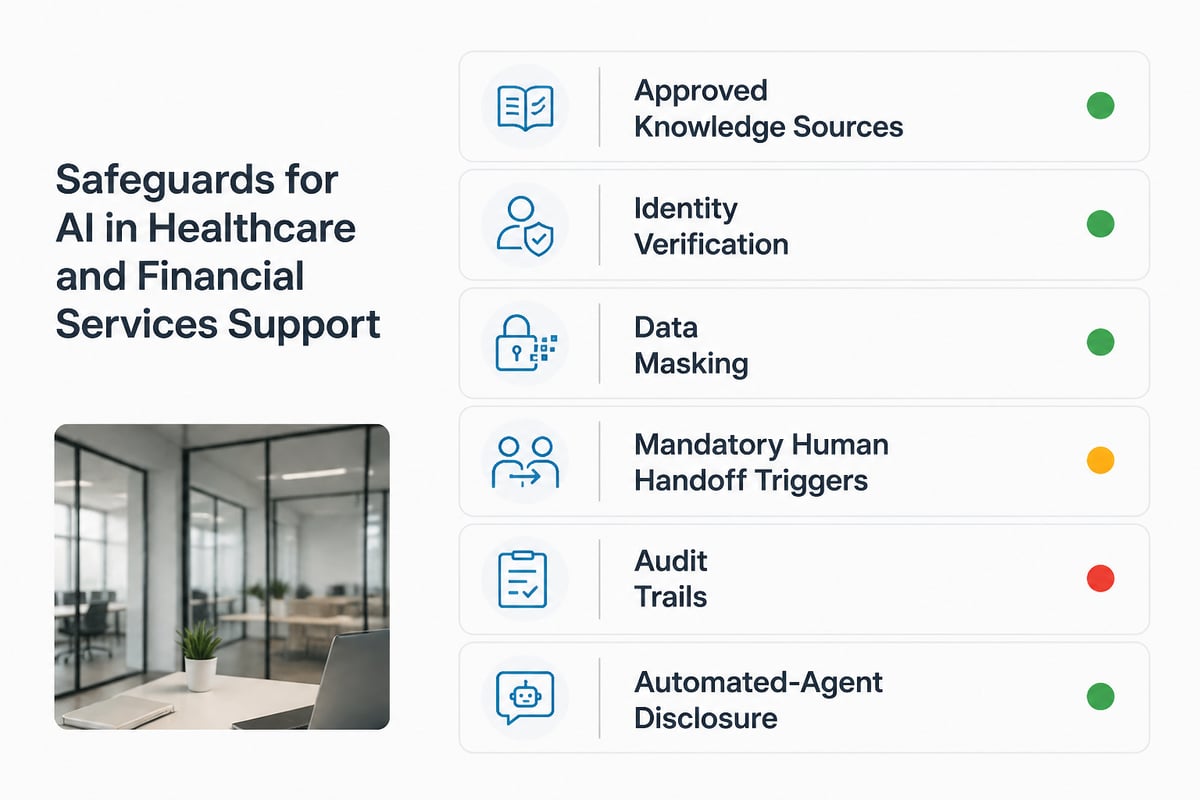
Keeping AI safe in regulated settings requires limiting what it can say, controlling the data it can see, and guaranteeing a path to a person. Healthcare and financial services organizations carry the highest exposure because a wrong answer can affect health outcomes, money, or legal rights.
Build these safeguards into the design:
- Scoped answers: Restrict the model to approved sources, and have it decline questions outside that scope instead of guessing.
- Data minimization: Pass only the fields the task requires, and mask sensitive identifiers in logs and transcripts.
- Identity verification: Authenticate before disclosing any account or patient information.
- Mandatory handoff triggers: Complaints, hardship, clinical concerns, and explicit requests for a person should route to a human immediately.
- Audit trails: Retain records of what the AI said and why, so compliance teams can review and defend decisions.
- Disclosure: Tell customers when they are speaking with an automated agent.
Healthcare programs in particular benefit from partners experienced with patient-facing work, such as those described under Focus Services' healthcare services.
How Should You Combine AI With Human Agents?
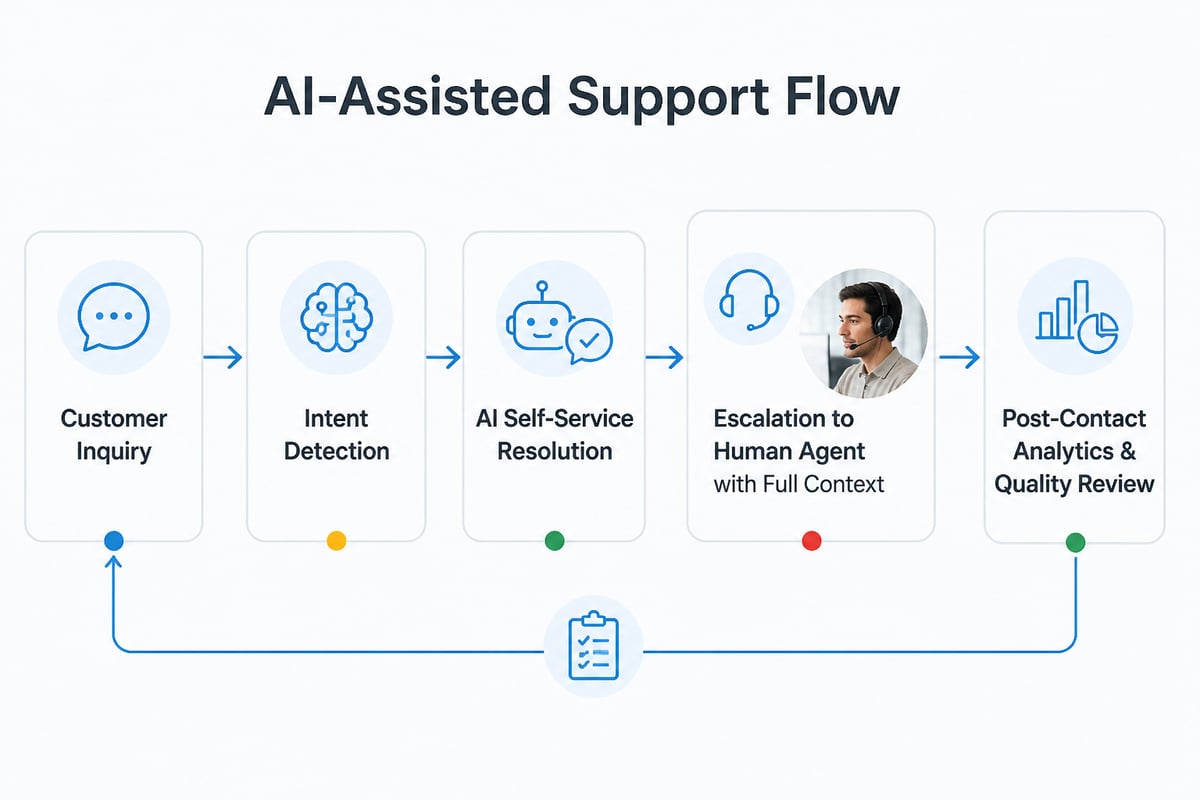
Combine them by letting AI take the predictable contacts and giving humans the context to finish the rest. The handoff is where most programs succeed or fail, because a customer who has already explained a problem to a bot will not tolerate explaining it again.
A sound handoff includes the customer's identity, the stated issue, actions already attempted, and the sentiment reading. The agent should see this before saying hello. Design the transfer so it happens without a new queue wait for urgent or emotional cases.
Staffing models need to adapt as well. When AI absorbs simple contacts, the average human contact becomes harder and longer. Plan for higher handle times on the remaining volume, stronger coaching, and agents who can handle de-escalation. Operations that need flexible capacity across time zones can pair automation with outsourced customer care teams that scale up or down as demand shifts.
For teams that want to move from planning to deployment, AI Agent Solutions from Focus Services covers AI voice and chat agents that handle routine interactions and pass complex ones to human agents, which matches the blended model described above.
What Does a Practical Rollout Look Like?
A practical rollout runs in four stages, each with a clear exit test before the next begins.
- Assess (weeks 1 to 4): Analyze contact drivers, review knowledge content, and document escalation rules. Exit test: a ranked list of automation candidates with expected volumes.
- Pilot (weeks 5 to 10): Launch on one or two contact types with a limited share of traffic. Exit test: accuracy and satisfaction at or above the human baseline for those contacts.
- Expand (weeks 11 to 20): Add contact types and channels, tune handoffs, and train agents on the new workflow. Exit test: stable containment without a rise in repeat contacts.
- Optimize (ongoing): Use conversation analytics to find new automation candidates and retire poor ones.
The week ranges are a planning illustration, not a standard, and the right pace depends on integration complexity and compliance review. What matters is that each stage ends with evidence, not a calendar date.
Which Metrics Show Whether Customer Care AI Is Working?
The metrics that matter are those that capture both efficiency and customer outcome, tracked separately for automated and human-handled contacts. Looking only at deflection can hide a poor experience.
- Containment rate: The share of automated conversations resolved without a human. Pair it with repeat-contact rate to confirm the resolution was real.
- First contact resolution: Whether the issue stayed solved, measured across both channels.
- Customer satisfaction (CSAT) by path: Compare automated, assisted, and human-only experiences.
- Average handle time and after-call work: Expect handle time on human contacts to rise slightly as the easy ones leave, while after-call work should fall.
- Escalation quality: The share of handoffs that arrive with full context and the correct routing.
- Cost per resolved contact: The blended figure, which is more honest than cost per interaction.
Industry surveys can also provide benchmarks, and it is worth reading published reports on reported outcomes from AI use. Treat such figures as context, and set targets from your own baseline.
What Mistakes Should Support Teams Avoid?
The most common mistakes are avoidable and usually organizational rather than technical.
- Launching on a weak knowledge base. The AI repeats whatever it is given, so outdated articles produce confident wrong answers.
- Hiding the human option. Customers who feel trapped abandon the channel and call back angrier.
- Treating launch as the finish line. Products, prices, and policies change, and an unmaintained bot drifts out of date.
- Ignoring the agent experience. If agents distrust the suggestions, adoption stalls and the investment is wasted.
- Measuring only cost. Savings that come with falling satisfaction or rising repeat contacts are not savings.
Adoption statistics can help you gauge where peers are heading, and published roundups of chatbot statistics collect figures on adoption and reported team priorities. Use them to frame the conversation with stakeholders, then rely on your own pilot data to make decisions.
FAQ
How much does it cost to add AI to a customer care program?
Cost depends on contact volume, channels, integration work, and whether you build, buy, or outsource. A contact-driver analysis gives the clearest basis for a business case. Focus Services publishes guidance on customer service outsourcing pricing that can help you compare models.
Can a smaller support team use AI effectively?
Yes, provided there is enough repetitive volume to automate. Agent assist and automated summaries can help teams of any size, while self-service bots pay off once routine contacts reach a meaningful share of total volume. Focus Services supports programs that scale from 5 agents to enterprise-scale programs.
Should we build in-house or work with an outsourcing partner?
Building in-house gives control but requires AI, integration, and operations skills at once. A partner can supply trained agents, workforce management, and technology together, which shortens the time to a working blended model. Evaluate partners on accountability, security practices, and their ability to staff across the hours and time zones your customers need.
Your next step is to pull 90 days of contact data and rank your top ten contact drivers by volume and handle time, since that list will show where automation can safely start. Focus Services has over 30 years of experience in the sector and serves companies across Fortune 100 clients, pairing AI-driven workforce optimization with experienced human agents from delivery centers in the United States, El Salvador, the Philippines, and South Africa. If you want to explore automated voice and chat handling, AI Agent Solutions is the place to begin, and you can Schedule a Discovery Call with Focus Services to map your contact drivers to a practical blend of AI and human support.