

Call Center Jobs Near Me: Local Openings and How to Apply
The fastest way to find call center jobs near me is to search by city on a state job board and on employer career pages, then apply to roles that match your shift availability and your experience with inbound, outbound, or technical support work. Local openings are posted continuously, and many employers screen for communication skills, typing speed, and reliability before they look at formal credentials.
This guide covers where the roles are, what they pay, how to apply, and the contact-center platforms you will use on the job. It uses the Milwaukee area as a worked example, because public labor data there shows how a large metro market behaves.
What Call Center Jobs Are Available Locally
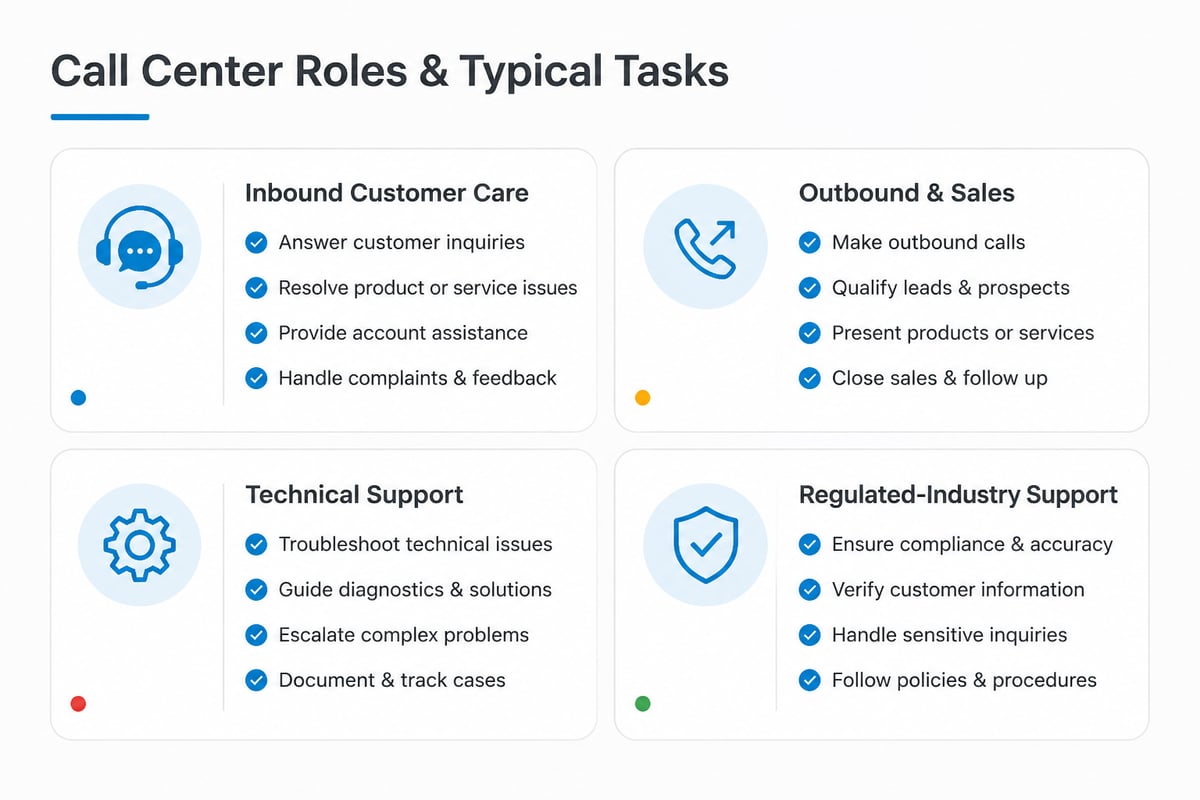
Local call center openings fall into four main categories, and knowing the difference helps you filter listings quickly.
- Inbound customer care: answering questions, resolving billing issues, and handling account changes for telecom, utility, travel, and e-commerce brands.
- Outbound and sales: placing calls, qualifying leads, and closing sales. Focus Services describes this work on its outbound call center jobs page.
- Technical and IT support: troubleshooting devices, software, and connectivity.
- Regulated-industry support: handling sensitive conversations in healthcare and financial services, where privacy training is part of onboarding.
Entry-level roles typically ask for a high school diploma, a quiet workspace or an on-site seat, and comfort with multitasking between a headset and a screen. If you want to understand the daily duties before applying, the call center job description breaks down what an agent actually does on a shift.
How Much Call Center Jobs Pay in a Large Metro
Customer service representatives in a large metro earn a mean wage near $24 per hour, though entry-level contact center roles often start lower. According to the U.S. Bureau of Labor Statistics, customer service representatives in the Milwaukee–Waukesha metro earned a mean wage of $24.03 per hour, or $49,980 annually, in May 2025.
The same release counted 14,080 customer service representative jobs in that metro in May 2025. That volume helps explain why a single metro can list many openings at once.
Pay varies with these factors:
- Industry: financial services and healthcare programs often pay more than general retail support.
- Language skills: bilingual agents are commonly in demand.
- Shift: evening, weekend, and overnight shifts may carry differentials.
- Role type: sales roles frequently add commission or bonuses on top of base pay.
Treat the Milwaukee figure as a reference point, not a promise. Wages in your own city will differ, so check your state's labor statistics before negotiating.
1. Amazon Connect
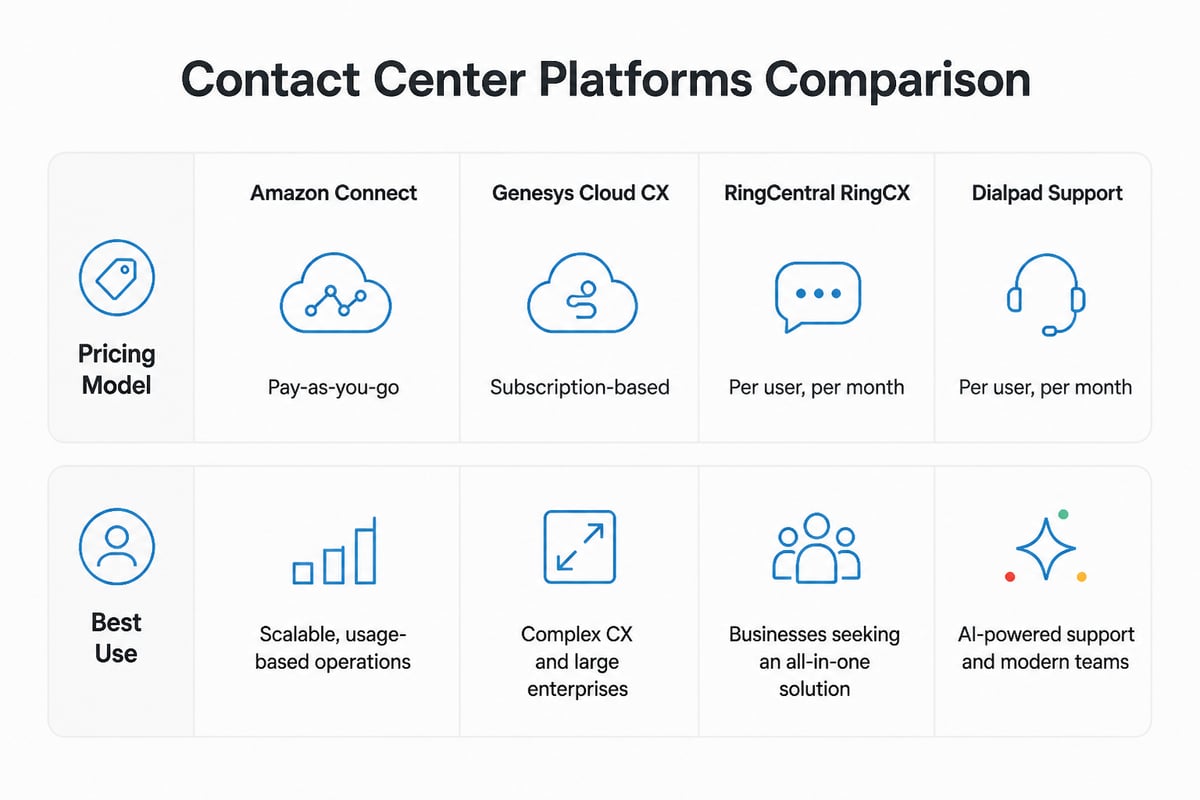
Amazon Connect is a cloud contact-center platform from Amazon Web Services that supports voice and chat, and agents at many employers log in to it each day. Pricing is usage-based at approximately $0.038 per voice minute plus telephony, with no seats or minimums. Because billing follows handled minutes, a program can add temporary agents for a busy season without buying licenses that sit idle afterward. A 10-minute call at the listed rate carries about $0.38 in voice charges before telephony fees, which gives managers an easy way to estimate cost per contact. For a job seeker, the practical takeaway is that the agent desktop is browser-based, so comfort with web applications, headset settings, and switching between call and chat tabs transfers directly to the work.
- Key specs: voice and chat channels; usage-based billing with no per-seat fees.
- Approximate price: $0.038 per voice minute plus telephony.
- Best use: teams that want to pay only for the minutes they handle rather than for licensed seats.
- Verdict: a flexible option for variable call volumes, and a common interface for agents to learn.
2. Genesys Cloud CX
Genesys Cloud CX is an omnichannel contact-center platform that suits large operations handling voice, chat, and digital channels in one agent workspace. It costs approximately $75 per user per month when billed annually. Omnichannel routing means a single agent can move from a phone call to a chat session without logging into a separate tool, and the system decides which interaction goes to which person. The platform also supports third-party voice bots, so a program can let automation answer routine requests such as balance checks and pass anything complex to a live agent. Agents who already know how queues, skills-based routing, and interaction histories work will find the layout familiar in similar enterprise environments.
- Key specs: omnichannel routing; support for third-party voice bots.
- Approximate price: $75 per user/month, billed annually.
- Best use: large omnichannel contact centers that route many interaction types to the same agents.
- Verdict: a strong fit for high-volume programs, and a useful skill to list on a resume.
3. RingCentral RingCX
RingCentral RingCX is a contact-center platform that works well for organizations already running RingCentral phones. It costs approximately $65 per user per month billed annually, or $75 billed monthly. The $10 monthly difference between the two billing terms matters for planning: a team of 20 agents pays $1,300 a month on the annual plan versus $1,500 on the monthly plan, which is a meaningful gap for a small program. RingCX also supports third-party virtual agents over SIP, so a business can connect an existing virtual assistant to handle first-line questions. Choosing a single vendor for calling and contact-center tools reduces the number of logins an agent juggles and keeps reporting in one place.
- Key specs: contact-center platform; support for third-party virtual agents over SIP.
- Approximate price: $65 per user/month annually; $75 monthly.
- Best use: teams standardized on RingCentral phone systems that want one vendor for calling and contact-center tools.
- Verdict: a practical choice when phones and contact-center software need to work together.
4. Dialpad Support
Dialpad Support is a contact-center product with built-in AI features, aimed at mid-size support teams. It costs approximately $89 per user per month when billed annually, which is the highest per-seat price among the platforms listed here. The premium buys AI transcripts and recaps, so a supervisor can scan a written summary of a call instead of listening to the full recording. Sentiment analysis flags conversations where a customer sounded frustrated, which helps coaches decide which calls to review first. Omnichannel routing and a power dialer round out the product, giving outbound agents a way to move through call lists quickly while inbound agents handle other channels.
- Key specs: omnichannel routing; power dialer; AI transcripts and recaps; sentiment analysis.
- Approximate price: $89 per user/month, billed annually.
- Best use: mid-size support teams that want AI transcription and sentiment tracking without adding separate tools.
- Verdict: a good match for teams that review calls often and value automatic summaries.
Platform Comparison
| Platform | Approx. price (Nov 2026) | Key strength | Best for |
|---|---|---|---|
| Amazon Connect | $0.038 per voice minute plus telephony | Usage-based billing, voice and chat | Variable call volumes |
| Genesys Cloud CX | $75/user/month, annual | Omnichannel routing | Large omnichannel centers |
| RingCentral RingCX | $65/user/month annual; $75 monthly | Third-party virtual agents over SIP | Teams on RingCentral phones |
| Dialpad Support | $89/user/month, annual | AI transcripts, sentiment analysis | Mid-size support teams |
Where to Search for Call Center Jobs Near Me
The most reliable places to look are your state workforce portal, employer career pages, and general job boards filtered by city and job title. Start with the state system, because it lists verified employers and offers free support.
In Wisconsin, for example, the Job Center of Wisconsin Workforce Services offers help with resume writing, job applications, interview tips, and navigating the state job-search system. The Job Center of Wisconsin help page notes that job seekers must create an account and finish registration before they can view job-posting details or use tools such as resume creation.
When you search, use specific phrases such as "customer care representative," "inbound sales agent," or "technical support specialist" alongside your city. Some search terms differ from posted titles, so try several. If you also want flexibility, review the call center jobs from home options for remote roles.
Local Call Center Jobs Near Me vs. Remote Roles
Choosing between on-site and remote work depends on your equipment, workspace, and the program's security rules. On-site seats provide the headset, workstation, and a supervisor within reach, which helps new agents learn faster. Remote roles save commuting time but usually require a reliable internet connection and a private room.
Programs that handle healthcare or financial data often favor on-site delivery or tightly controlled remote setups because of privacy requirements. Consumer-facing programs in telecom, utilities, and e-commerce more often allow remote agents. Read the posting carefully, since some "remote" roles require occasional in-person training.
How to Apply Step by Step
A strong application follows a repeatable sequence, and each step takes only a short time.
- Register on your state job portal and complete your profile.
- Build a focused resume that lists typing speed, software familiarity, and any customer-facing experience.
- Apply to several postings that match your availability, not just one.
- Prepare for a phone or video screening, where recruiters assess clarity, tone, and listening.
- Complete any assessments, which often test typing, data entry, or scenario-based judgment.
- Review the offer for pay, shift, training length, and attendance policies.
Highlight transferable skills such as retail service, hospitality, or reception work. Recruiters value a calm voice and accuracy more than a long work history.

Skills That Help You Get Hired
Employers screen for a short list of skills, and you can practice most of them before you apply.
- Clear verbal communication and active listening.
- Typing speed and accuracy while speaking.
- Problem-solving under time pressure.
- Adaptability across different systems and scripts.
- Dependability, shown through consistent attendance.
Training matters too. Reviewing how programs are structured in call center agent training gives you a sense of what the first weeks look like.
Working With a Call Center Outsourcing Provider
Many local seats are operated by outsourcing providers that run customer care and sales programs on behalf of larger brands. For a job seeker, that can mean access to programs across telecom, utilities, travel, financial services, and e-commerce under one employer.
Focus Services is one such provider, with over 30 years of experience and operations in the United States, El Salvador, the Philippines, and South Africa. Its delivery centers are aligned to U.S. business hours or to cost and timezone needs, and it serves companies across Fortune 100 clients. You can read about its call center careers and its customer care call center jobs to see how roles are described.
Frequently Asked Questions
Do I need experience to get a call center job?
Many entry-level roles do not require prior call center experience. Employers usually train new agents on products, systems, and quality standards during onboarding.
Are call center jobs near me full time?
Both full-time and part-time schedules are common. Shift availability is often the deciding factor, so list your open hours clearly on your application.
How long does hiring take?
Timelines vary by employer. Some programs move from application to offer within a couple of weeks, while others schedule hiring in classes, so check each posting for details.
Your next step is to register on your state job portal today and apply to three postings that match your availability. If you run a business that needs customer care or sales capacity rather than a seat for yourself, Focus Services can scale a dedicated program from 5 agents to enterprise size, and you can Schedule a Discovery Call to talk through your volume and coverage needs. For more on the sales side of the industry, the sales call center page outlines how those programs work.