

Programs a Call Center Can Run for Business Growth
A program call center is a contact center organized around defined programs, such as inbound customer care, outbound sales or retention campaigns, each with its own goals, staffing, scripts and metrics. The right mix of programs and technology lets mid-market and enterprise companies in telecom, utilities, travel, financial services and e-commerce grow revenue and absorb volume without losing service quality.
This list covers the platforms that power those programs and eleven outsourced options for running them at scale. Prices are approximate and should be checked against each vendor's current listing before purchase.
How a Program Call Center Is Structured
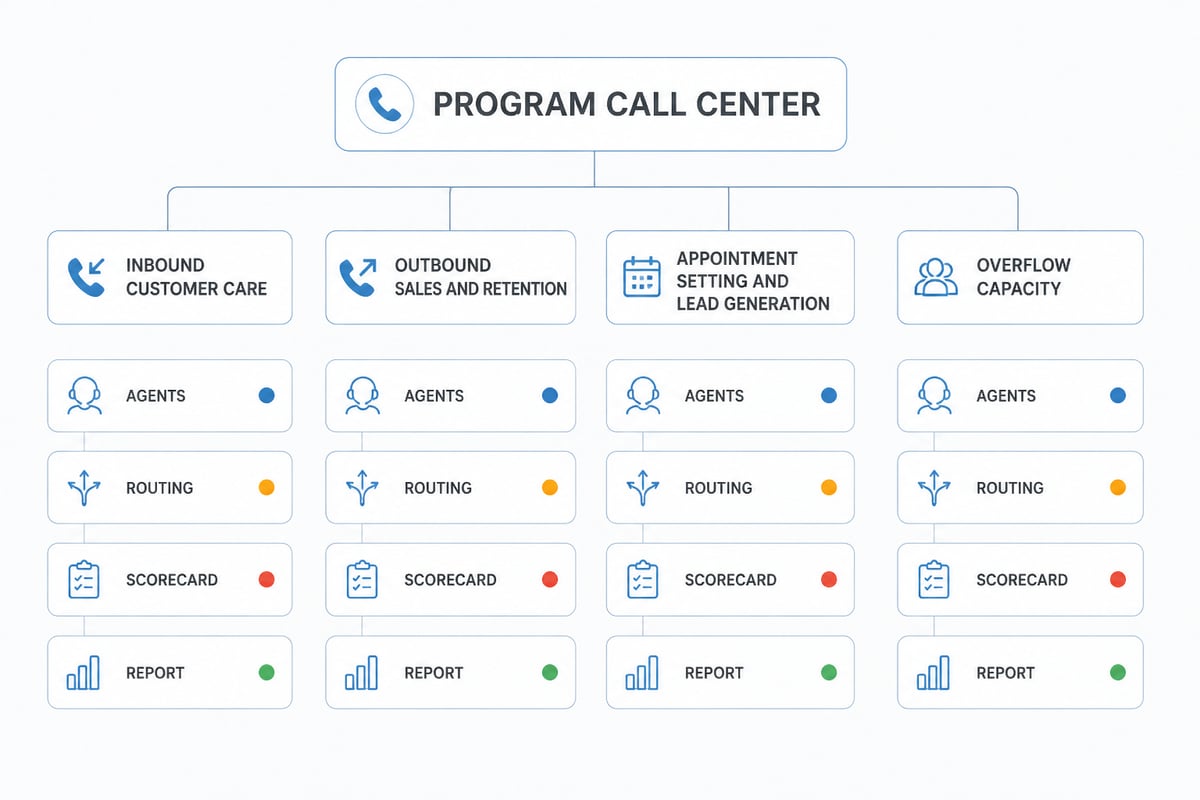
A program call center is structured by campaign or service line rather than by a single shared queue. Each program has its own agents, routing rules, quality scorecards and reporting.
The common program types are:
- Inbound customer care: billing, account changes, technical support and order status.
- Outbound sales and retention: lead follow-up, renewals, win-back and cross-sell campaigns.
- Appointment setting and lead generation: qualifying prospects before they reach a sales team.
- Seasonal or overflow programs: temporary capacity for travel peaks, utility outages or holiday e-commerce volume.
Voice has not gone away. A May 2024 Frost & Sullivan report summary says most surveyed respondents reported that voice-call volumes and average handling times had increased or stayed the same over the prior year. Programs therefore need voice capacity alongside digital channels.
How to Run a Call Center Business Around Programs
Running a call center business around programs means assigning every program an owner, a target metric and a staffing model before choosing software. The sequence below works for both in-house and outsourced operations.
- Define the business outcome per program: revenue, retention, cost per contact or resolution rate.
- Forecast volume by hour and channel, then set staffing from that forecast.
- Select the platform that matches the channel mix and dialing model.
- Build quality assurance and coaching into the weekly cycle, not an annual review.
- Review program results monthly and move seats between programs as demand shifts.
Strong workforce management is what keeps this cycle accurate, because staffing errors show up first as long waits and abandoned calls.
The 11 Options at a Glance
The table compares the nine platforms and two outsourced programs that follow. Prices are per user per month unless noted, as listed by each vendor.
| # | Option | Type | Approx. price | Best use |
|---|---|---|---|---|
| 1 | Talkdesk Digital Essentials | Platform | $85 | Multichannel digital service |
| 2 | Talkdesk Voice Essentials | Platform | $105 | Voice-first inbound |
| 3 | Zoom Contact Center Essentials | Platform | $69 annual / $85 monthly | Inbound omnichannel with feedback |
| 4 | Zoom Contact Center Premium | Platform | $99 annual / $119 monthly | Support plus outbound follow-up |
| 5 | RingCentral RingCX Standard | Platform | $65 annual | Voice plus 20+ digital channels |
| 6 | RingCentral RingCX Professional | Platform | $95 annual | AI quality monitoring and coaching |
| 7 | DialedIn Complete Platform | Platform | $25 to $69 by seat count | Outbound dialing |
| 8 | Zendesk | Platform | From $55 annual | Support workflow integration |
| 9 | LiveAgent | Platform | From $29 annual | Lower-cost omnichannel |
| 10 | Focus Services Sales Call Center Outsourcing | Outsourced program | Contact for details | Outsourced sales programs |
| 11 | Focus Services Customer Care Outsourcing | Outsourced program | Contact for details | Outsourced omnichannel care |
1. Talkdesk Digital Essentials
Talkdesk Digital Essentials is a digital engagement plan covering email, chat, SMS and social messaging. Talkdesk lists it at $85 per user per month, with Studio and routing, live dashboards, reports and API access.
- Key specs: digital channels, Studio, routing, dashboards, reports, API access.
- Approximate price: $85 per user per month.
- Suits: a service program where most contacts arrive through messaging and email rather than phone, with a mid-sized agent count.
- Verdict: a solid base for digital-first care, though it does not include voice.
2. Talkdesk Voice Essentials
Talkdesk Voice Essentials is the voice-focused tier, listed at $105 per user per month on the same Talkdesk pricing page. It includes speech recognition and voicemail transcription, along with Studio, routing, dashboards, reports and API access.
- Key specs: voice engagement, speech recognition, voicemail transcription, Studio, routing, API.
- Approximate price: $105 per user per month.
- Suits: a high-volume inbound phone program, such as billing or outage lines, where call handling is the main cost driver.
- Verdict: a strong voice foundation, priced higher than most entries here.
3. Zoom Contact Center Essentials
Zoom Contact Center Essentials is an inbound omnichannel plan covering voice, video, chat and SMS. It is priced at about $69 per user per month on annual billing, or $85 monthly.
- Key specs: inbound voice, video, chat, SMS, Flow Editor, IVR, real-time transcription, surveys and voice-of-customer tools.
- Approximate price: $69 annual, $85 monthly.
- Suits: an inbound care program that wants built-in customer feedback collection and a visual flow builder.
- Verdict: a practical inbound option; outbound dialing is listed on the Premium tier rather than this one.
4. Zoom Contact Center Premium
Zoom Contact Center Premium adds outbound capability to the Essentials feature set. It runs about $99 per user per month annually, or $119 monthly.
- Key specs: inbound and outbound omnichannel, progressive and preview dialers, email, social channels, cobrowse.
- Approximate price: $99 annual, $119 monthly.
- Suits: a blended program where agents handle support calls and also run follow-up or renewal campaigns.
- Verdict: a good fit for blended inbound and outbound work in one seat.
5. RingCentral RingCX Standard
RingCentral RingCX Standard is a core contact center plan at $65 per user per month paid annually. RingCentral lists voice and 20+ digital channels, ACD, IVR, skills-based routing and screen recording.
- Key specs: voice, 20+ digital channels, ACD, IVR, skills-based routing, agent screen recording.
- Approximate price: $65 per user per month, annual.
- Suits: a program needing broad channel coverage and routing by agent skill, such as separate queues for billing, sales and technical issues.
- Verdict: a lower-priced platform here with voice and wide digital coverage.
6. RingCentral RingCX Professional
RingCentral RingCX Professional adds quality and coaching tools to the Standard base. The RingCentral page lists it at $95 per user per month annually and describes AI-powered quality monitoring and agent assistance.
- Key specs: AI-powered quality monitoring, agent assistance, voice and digital contact center capabilities.
- Approximate price: $95 per user per month, annual.
- Suits: a growing program where quality review cannot keep pace with call volume and supervisors need automated scoring.
- Verdict: worth the step up when coaching capacity is the bottleneck.
7. DialedIn Complete Platform
DialedIn Complete Platform is an outbound-focused dialer suite with tiered per-seat pricing. DialedIn lists $69 for 5 to 49 users, $59 for 50 to 99, $39 for 100 to 199 and $25 for 200 or more.
- Key specs: predictive, power, preview and manual dialers, call recording, CRM integrations, open API, real-time reporting, US-based support.
- Approximate price: $25 to $69 per user per month by seat count.
- Suits: a high-volume outbound sales or collections program where dialing mode and seat-count discounts matter.
- Verdict: strong per-seat economics at scale for outbound work.
8. Zendesk
Zendesk is a customer service platform with voice built into its ticketing workflow. Zendesk’s comparison page lists a starting price of $55 per agent per month, billed annually.
- Key specs: IVR, intelligent call routing, call monitoring and recording, reporting, analytics, AI-powered quality assurance.
- Approximate price: from $55 per agent per month, annual.
- Suits: a care program where phone calls must connect to tickets, customer history and case management.
- Verdict: a natural choice when ticket workflow matters as much as telephony.
9. LiveAgent
LiveAgent is a lower-priced omnichannel help desk with call features. The same Zendesk comparison lists it from $29 per user per month, billed annually.
- Key specs: omnichannel support, customer profiles, IVR, call recording, reporting, analytics.
- Approximate price: from $29 per user per month, annual.
- Suits: a smaller internal program or pilot that needs omnichannel coverage on a tight budget.
- Verdict: inexpensive and capable; large enterprise programs will likely need deeper routing and workforce tools.
10. Focus Services Sales Call Center Outsourcing
Focus Services Sales Call Center Outsourcing provides inbound, outbound, lead generation and appointment setting programs run by dedicated sales teams. Software alone does not supply trained sellers, so this option fits companies that want the program staffed and managed for them.
- Key specs: inbound and outbound sales, lead generation, appointment setting, dedicated teams, dedicated leadership with operational accountability, delivery centers aligned to U.S. business hours or to cost and timezone needs.
- Approximate price: not listed here; contact Focus Services for details.
- Suits: a telecom, travel or e-commerce sales program that needs to scale from 5 agents to an enterprise-size team, backed by over 30 years of sector experience and clients across the Fortune 100.
- Verdict: a strong choice for outsourcing sales execution, not only the tools. See also its outbound call center and sales call center pages for program detail.
11. Focus Services Customer Care Outsourcing
Focus Services Customer Care Outsourcing delivers omnichannel care through dedicated teams across voice, chat, email, SMS and social media. It pairs AI-driven workforce optimization with experienced human agents.
- Key specs: voice, chat, email, SMS and social channels, dedicated teams, AI-driven workforce optimization, delivery from the United States, El Salvador, the Philippines and South Africa.
- Approximate price: not listed here; contact Focus Services for details.
- Suits: a high-volume care program in utilities, financial services or telecom that needs added capacity or round-the-clock coverage without building internal headcount. Industry pages such as utilities and telecom show how programs are tailored.
- Verdict: a good fit when the goal is capacity and cost control rather than another software license.
Is It a Contact Center or a Call Center?
A call center handles voice calls, while a contact center handles voice plus digital channels such as chat, email, SMS and social media. In practice the terms overlap, and most modern platforms above support both. The label matters less than whether each program is staffed and routed for the channels customers actually use.
What Does Technical Support Look Like in a Call Center?
Technical support in a call center is a tiered program where agents diagnose product or service problems and escalate unresolved cases to specialists. Tier one handles common fixes, tier two handles complex issues, and clear escalation rules protect resolution time. An IT support call center program usually adds knowledge base tooling and strict ticket documentation.
How to Pick the Right Mix for a Program Call Center
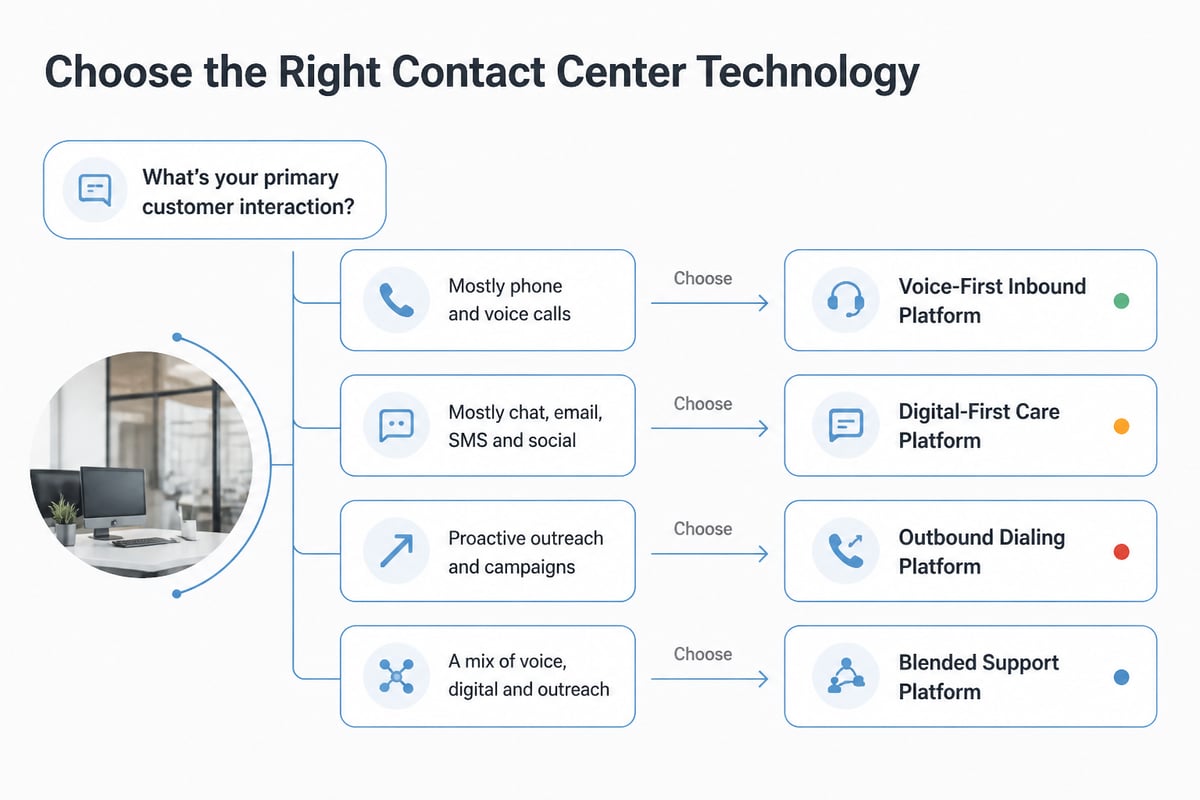
Choose by matching channel and dialing needs to the program, then decide how much of the staffing to keep in-house. Use these rules:
- Voice-heavy inbound: Talkdesk Voice Essentials or RingCentral RingCX Standard.
- Digital-heavy care: Talkdesk Digital Essentials or Zendesk.
- Outbound at scale: DialedIn, with seat tiers that fall as headcount rises.
- Blended work: Zoom Contact Center Premium.
- Quality bottlenecks: RingCentral RingCX Professional, plus quality assurance software.
- Staffing and capacity gaps: an outsourced program from Focus Services.

FAQ
How do I contact customer support at a call center program?
Most call center programs offer voice, chat, email and SMS entry points, and the right channel depends on the company running the program. Check the contact page of the business you are dealing with, since routing and hours are set by each program. For Focus Services, the contact page lists the available options.
How many seats does an outsourced program need?
The count depends on forecast volume, handling time and service level targets, not on a fixed rule. Focus Services programs can scale from small teams to enterprise size, so the volume forecast sets the seat plan.
Can AI replace agents in a call center program?
AI is best used to support agents through routing, quality scoring and workforce planning, while people handle complex or sensitive contacts. Focus Services combines AI-driven workforce optimization with experienced human agents, and its automated call centers page describes the approach.
Start by listing your three highest-volume contact types and the channel, hours and quality target each one needs, because that list decides which of these options fits. If you want a program staffed and managed rather than assembled in-house, Focus Services can pair its customer care outsourcing teams with AI-enabled workforce optimization across its delivery centers in the United States, El Salvador, the Philippines and South Africa, so Schedule a Discovery Call to map your first program with an operations lead.