

What Is a Customer Service Agent? Roles and Skills
Customer service agents are the people who answer customer questions, resolve problems, and process requests on behalf of a company, usually by phone, chat, email, text message, or social media. The U.S. Bureau of Labor Statistics describes the work as handling complaints, processing orders, and answering customer questions. For companies in telecom, utilities, travel, financial services, healthcare, and e-commerce, these agents are often a key human contact a customer has with the brand.
This article explains what the role involves, which skills separate strong agents from average ones, how call center operations are structured, and what to consider when you staff a high-volume support program.
What Does a Customer Service Agent Do?
A customer service agent is a frontline employee who resolves customer inquiries, corrects account or order issues, and represents the company in every interaction. The title overlaps with customer care representative, customer support specialist, and contact center agent, and companies use these terms almost interchangeably.
Daily duties usually fall into a few groups:
- Inbound support: answering questions about bills, orders, bookings, coverage, or product use
- Issue resolution: correcting errors, processing refunds, handling disputes, and escalating complex cases
- Account servicing: updating records, verifying identity, and processing changes such as plan upgrades or address updates
- Outbound and sales support: following up on service tickets, retaining at-risk customers, or supporting upsell offers
- Documentation: recording each interaction accurately so the next agent or a supervisor can follow the history
The phrase "customer agent" in search results usually points to this same role. It means the person acting on the company's behalf during a customer interaction, whether that person sits in a branch office, a delivery center, or a home workspace.
What Is Customer Service in a Call Center?
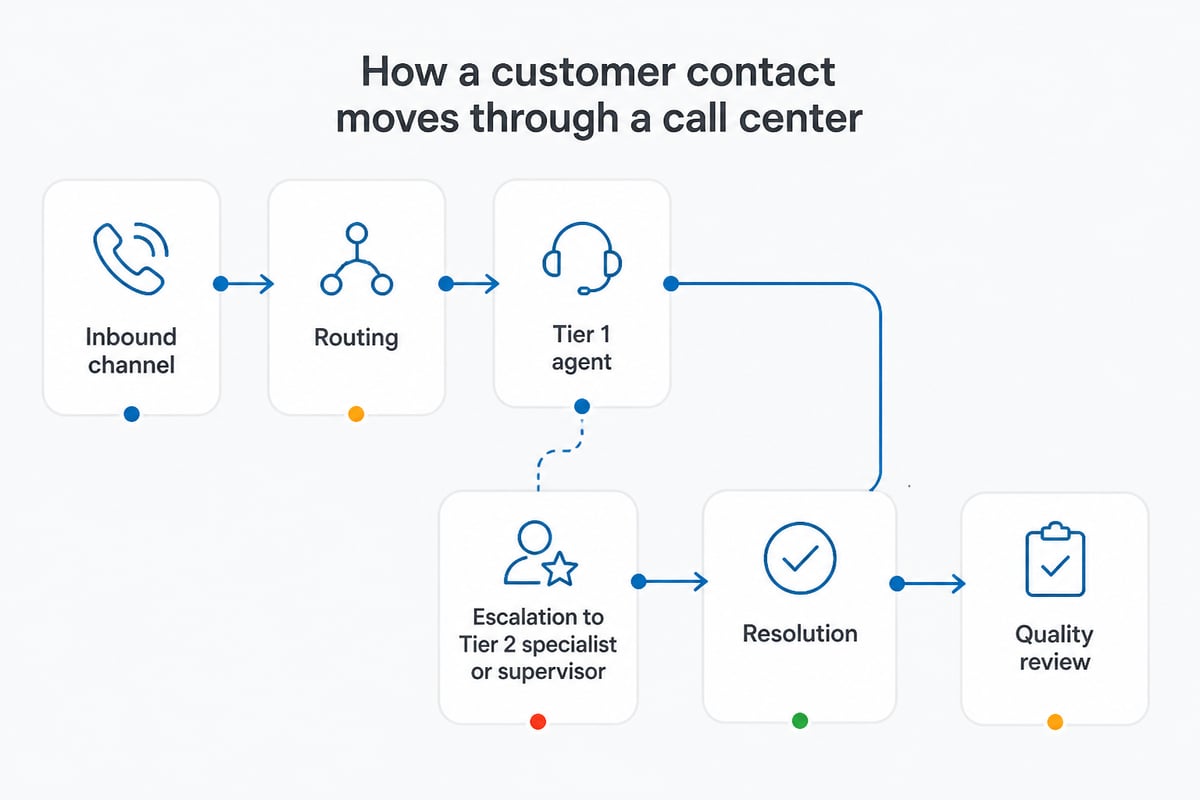
Customer service in a call center is the structured handling of high volumes of customer contacts by trained teams working within defined queues, scripts, systems, and performance targets. Instead of one employee juggling support alongside other duties, a contact center assigns agents to specific channels and issue types, then measures their output.
A typical call center setup includes:
- Routing: an automated system sends each contact to the right queue based on the customer's issue, language, or account tier.
- Tiered support: Tier 1 agents resolve common issues, while Tier 2 specialists and supervisors take escalations.
- Workforce management: planners forecast contact volume and schedule agents to match demand by hour and day.
- Quality assurance: reviewers score calls and chats against a rubric, and coaches use those scores to improve performance.
- Reporting: leaders track metrics such as first contact resolution, average handle time, and customer satisfaction.
Modern operations are omnichannel, so a customer can start in chat and continue by phone without repeating the story. Teams that run customer care contact center programs typically combine all of these elements under one management structure.
What Are the Three Most Important Skills for a Customer Service Agent?
The three most important skills for customer service agents are clear communication, empathy, and problem-solving. Technical and product knowledge can be taught in training, but these three determine whether a customer leaves an interaction satisfied.
Clear Communication
Agents must explain policies and next steps in plain language, whether speaking or writing. On the phone this means tone, pacing, and active listening. In chat and email it means concise, error-free writing that answers the actual question rather than a similar one.
Empathy
Customers often contact support when they are worried, frustrated, or confused. An agent who acknowledges the situation before moving to the solution lowers tension and shortens the conversation. In healthcare and financial services, where a call may involve a medical bill or a disputed charge, this skill carries added weight.
Problem-Solving
Agents rarely get a problem that fits a script exactly. They must diagnose the issue, search the knowledge base, decide what is within their authority, and know when to escalate. Sound judgment here directly improves first contact resolution.
Supporting Skills
Other competencies strengthen these three:
- Patience and emotional control during repeat or hostile contacts
- Typing speed and accuracy for chat-heavy roles
- Comfort moving between CRM, billing, and ticketing systems
- Time management across back-to-back contacts
- Compliance awareness, including privacy rules for protected data
Companies that invest in structured call center customer service training tend to see these skills develop faster and more consistently across large teams.
Is Customer Service Work From Home?
Customer service work can be done from home, and many employers offer remote or hybrid arrangements, but availability depends on the employer, the industry, and the data-security requirements of the program. Roles that handle general product questions or order status are the easiest to run remotely. Roles that involve protected health information or payment card data often require controlled environments with stricter security.
Remote customer service agents generally need:
- A quiet workspace with a reliable, high-speed internet connection
- A company-approved computer, headset, and secure access tools
- Self-discipline to manage schedules and stay productive without direct supervision
- Willingness to follow the same quality and compliance standards as on-site staff
Many outsourcing providers operate a mix of models. Some programs run entirely from secure delivery centers, others use at-home agents, and others combine both. For regulated programs, the delivery model is usually set during program design based on the client's security and compliance requirements.
Tools and Technology Agents Use
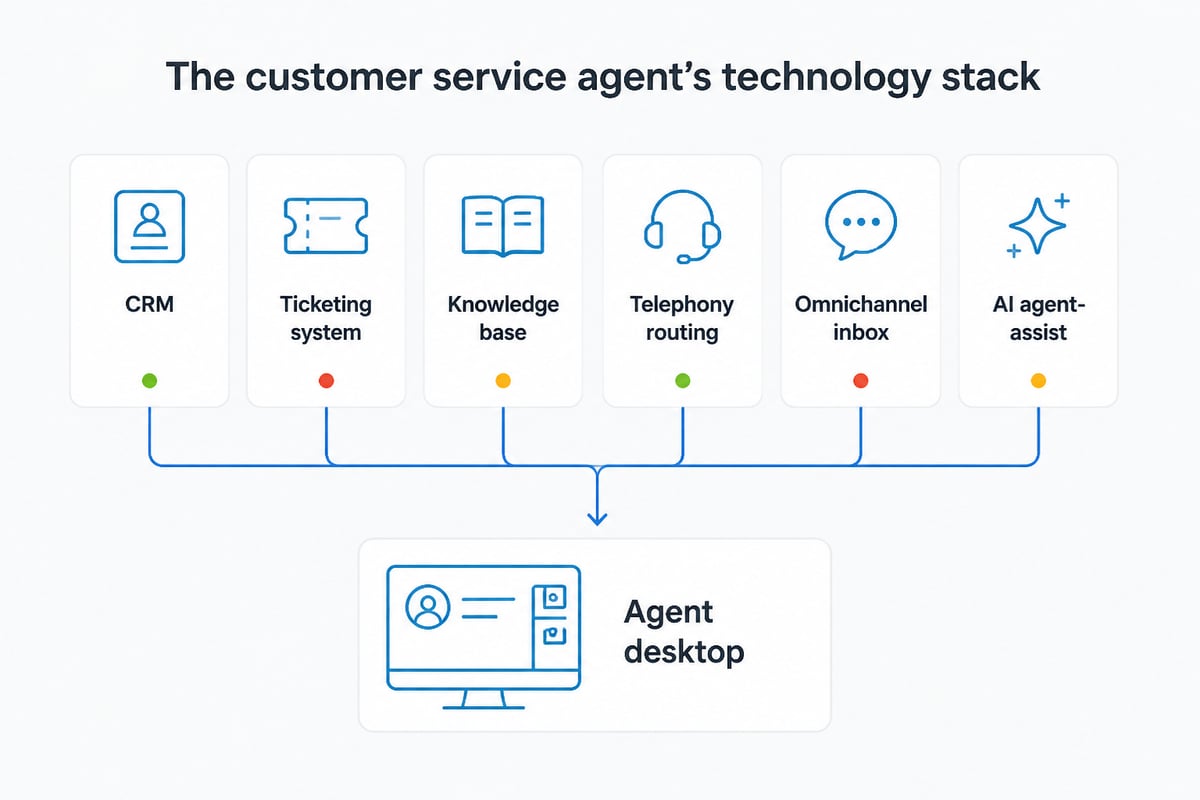
Customer service agents work inside a connected software stack that gives them customer history, guides their responses, and records every interaction. The exact tools vary by program, but most operations rely on the same core categories.
| Tool category | What it does | Example use |
|---|---|---|
| CRM platform | Stores customer profiles and interaction history | Pulling up a caller's past tickets before answering |
| Ticketing system | Tracks issues from open to resolved | Logging a billing dispute and assigning follow-up |
| Knowledge base | Holds approved answers and procedures | Finding the correct refund policy during a chat |
| Telephony and routing | Connects voice calls and distributes them to agents | Sending a Spanish-language caller to a bilingual queue |
| Omnichannel inbox | Combines chat, email, SMS, and social messages | Continuing a chat conversation by email without losing context |
| QA and analytics | Scores interactions and surfaces trends | Flagging calls for coaching based on scorecards |
AI now sits alongside these tools. Chatbots handle simple requests, and agent-assist software suggests answers or summarizes calls. Consumer attitudes toward this are conditional: many consumers are more willing to use an AI agent if they know they can escalate to a human when needed. That supports a hybrid model in which automation takes routine volume and human agents handle the cases that need judgment.
Customer Service Agents in Practice: Industry Examples
The agent's day looks different in each sector, because the contact reasons, compliance rules, and emotional context differ. These hypothetical scenarios show the range.
- Telecom: an agent troubleshoots a dropped service, verifies the account, schedules a technician visit, and offers a plan adjustment to retain the customer.
- Utilities: an agent explains a high bill, sets up a payment arrangement, and processes a start or stop service request during a move.
- Travel: an agent rebooks a traveler after a cancellation, applies fare rules, and issues a voucher, often under time pressure.
- Financial services: an agent verifies identity, investigates a disputed transaction, and follows strict scripts that satisfy regulatory requirements.
- Healthcare: an agent helps a patient understand a billing statement or schedule an appointment while protecting sensitive information.
- E-commerce: an agent tracks a delayed shipment, processes a return, and handles peak-season surges around holidays and sales events.
For online retailers in particular, dedicated e-commerce customer care teams are built to absorb these seasonal spikes in order and return inquiries.
Why Customer Service Agents Matter
Customer service agents matter because they directly influence retention, brand perception, and operating cost. Each contact is a chance to resolve a problem before it becomes a lost account, and each unresolved contact tends to produce a repeat contact that costs more.
Pressure on these teams is rising. In HubSpot's 2025 report, a large majority of surveyed customer service representatives said they handled the highest ticket volume they had ever seen in 2024. The same report found that most surveyed customer service leaders agreed customer expectations for support teams had grown year over year. Higher volume combined with higher expectations makes staffing, training, and tooling decisions more consequential than they were even a few years ago.
For mid-market and enterprise companies, the practical consequences are straightforward:
- Understaffed queues raise wait times and abandonment
- Inconsistent training produces uneven answers and compliance risk
- Poor tooling slows agents down and inflates handle time
- High turnover wastes the investment made in onboarding

How Companies Staff and Manage Agent Teams
Companies staff customer service agents through in-house teams, outsourced partners, or a blend of both, and the right mix depends on volume, complexity, and flexibility needs. In-house teams offer direct control and deep product knowledge. Outsourcing offers faster scaling, extended hours, and predictable cost, which suits programs with variable volume.
Whichever model you choose, the same management disciplines apply:
- Define the scope. Decide which channels, issue types, and languages the team will cover.
- Set measurable targets. Common ones include first contact resolution, customer satisfaction, and service level. A review of metrics for customer service helps clarify which to prioritize.
- Invest in onboarding. New agents need product training, systems practice, and supervised live contacts.
- Coach continuously. Quality assurance scoring should feed regular one-on-one coaching.
- Plan for volume swings. Workforce forecasting should anticipate seasonal peaks, outages, and campaign launches.
Organizations that outsource often look for partners who can cover U.S. business hours or take advantage of cost and timezone differences. Focus Services operates delivery centers in the United States, El Salvador, the Philippines, and South Africa, and offers scalable programs from small teams to enterprise-scale deployments, backed by decades of sector experience and dedicated leadership with operational accountability for each client. Its Customer Care Outsourcing service covers voice, chat, email, SMS, and social media through dedicated teams, which fits programs that need consistent coverage across several channels.
Career Path and Growth
A customer service agent career typically begins in an entry-level Tier 1 role and can progress into specialist, supervisory, quality, training, or workforce management positions. Strong performers often move into team lead roles after demonstrating consistent quality scores and the ability to coach peers.
Common progression steps include:
- Agent to senior agent: handling more complex or escalated contacts
- Senior agent to team lead: guiding a small group and managing daily performance
- Team lead to operations manager: overseeing a program, budget, and client relationship
- Lateral moves: shifting into QA analysis, training, knowledge management, or workforce planning
Many employers, including outsourcing providers, post openings for roles such as dispute resolution specialists and general support agents.
Related Terms
These terms appear alongside customer service agents in job listings and industry discussions:
- Customer service representative (CSR): the most common formal title for the same role
- Contact center agent: an agent who handles multiple channels, not only phone
- Customer support specialist: often used for agents with deeper product or technical knowledge
- Technical support agent: an agent focused on troubleshooting products or services
- BPO (business process outsourcing): contracting an external provider to run business functions such as customer care
- First contact resolution (FCR): the share of issues solved in a single interaction
- Average handle time (AHT): the average duration of a contact, including after-contact work
- Omnichannel support: a connected experience across all contact channels
FAQ
What does "customer agent" mean?
A customer agent is another name for a customer service agent: a person who represents a company and helps customers with questions, orders, accounts, or complaints. The term is common in contact centers and job listings, and it carries the same duties as a customer service representative.
Do customer service agents need a college degree?
Most entry-level roles require a high school diploma or equivalent rather than a college degree. Employers weigh communication ability, reliability, and comfort with computer systems heavily, and they provide product and process training after hiring.
What is the difference between a customer service agent and a customer support agent?
The titles often describe the same work, but customer support frequently implies a more technical or product-specific focus, such as troubleshooting. Customer service tends to cover broader topics such as billing, orders, and account changes. Each company defines the boundary differently.
Start by listing your top five contact reasons and the channels customers use for each, since that list shows how many agents you need and which skills they must have. From there, Focus Services can help you size and staff the program, so schedule a discovery call to talk through your volumes, channels, and coverage hours with a team that has supported Fortune 100 clients for over 30 years.