
Call Center in Outbound: Best Practices & Strategies
Modern businesses increasingly recognize the value of proactive customer engagement through outbound calling strategies. A well-managed call center in outbound operations serves as a powerful revenue driver, enabling companies to reach prospects, nurture leads, and maintain customer relationships at scale. Unlike inbound centers that respond to customer-initiated contact, outbound operations require sophisticated planning, targeted execution, and continuous optimization to deliver measurable business results. Organizations that master these fundamentals gain competitive advantages through improved sales conversion, enhanced customer retention, and accelerated market penetration across their target segments.
Understanding Outbound Call Center Operations
Contents
- 1 Understanding Outbound Call Center Operations
- 2
- 3 Strategic Planning for Outbound Success
- 4 Technology Infrastructure and Tools
- 5 Performance Metrics and KPIs
- 6 Agent Recruitment, Training, and Development
- 7 Campaign Design and Execution
- 8 Compliance and Regulatory Considerations
- 9 Quality Assurance and Monitoring
- 10 Optimizing Agent Productivity and Engagement
- 11 Technology Vendor Selection and Integration
- 12 Global Outsourcing Considerations
- 13 Advanced Strategies for 2026 and Beyond
A call center in outbound as part of your call center outsourcing solution focuses exclusively on agent-initiated communications to customers and prospects. These operations support diverse business objectives, including sales prospecting, appointment setting, market research, customer surveys, payment collection, and proactive customer service notifications.
The fundamental difference between inbound and outbound centers lies in control and predictability. Outbound teams initiate conversations on predetermined schedules, allowing precise resource allocation and campaign timing. This proactive approach enables businesses to strategically engage specific customer segments at optimal moments in the buying cycle.
Core Functions of Outbound Centers
Successful outbound operations typically encompass several key functions:
- Sales and lead generation to identify qualified prospects and convert them into customers
- Appointment setting for field sales teams or service providers
- Customer retention campaigns to reduce churn and increase lifetime value
- Market research and surveys to gather customer intelligence
- Payment reminders and collections to improve cash flow
- Product launch announcements to drive awareness and adoption
Each function requires tailored approaches, specialized training, and distinct performance metrics to optimize outcomes.

Strategic Planning for Outbound Success
Effective call center in outbound operations begin with clear strategic planning. Organizations must define specific, measurable objectives that align with broader business goals before launching campaigns.
Setting precise targets creates accountability and enables data-driven optimization. Rather than vague aspirations like “increase sales,” successful outbound programs establish concrete metrics such as “achieve 15% conversion rate on qualified leads” or “schedule 200 appointments monthly with decision-makers in the healthcare sector.”
Building Targeted Contact Lists
List quality directly impacts outbound performance. Data-driven list management separates high-performing operations from those struggling with low conversion rates.
Effective list building strategies include:
- Segmentation by demographics, behavior, and purchase history to match messaging with audience characteristics
- Regular data cleansing to remove disconnected numbers, deceased individuals, and duplicate entries
- Compliance verification to ensure all contacts meet regulatory requirements for calling
- Prioritization scoring to focus agent time on highest-value prospects
- Continuous updating as market conditions and customer circumstances evolve
Organizations should invest in quality data sources and verification tools rather than relying on outdated or purchased lists that generate frustration for both agents and contacts.
Technology Infrastructure and Tools
Modern call center in outbound operations depend on sophisticated technology platforms that amplify agent productivity and campaign effectiveness. The right infrastructure transforms raw effort into measurable results.
| Technology Component | Primary Function | Key Benefits |
|---|---|---|
| Predictive Dialer | Automated dialing with connection optimization | 200-300% increase in talk time |
| CRM Integration | Centralized customer data access | Personalized conversations, improved context |
| Call Recording | Quality assurance and compliance documentation | Training material, dispute resolution |
| Real-Time Analytics | Performance monitoring and coaching | Immediate intervention, faster optimization |
| Speech Analytics | Conversation analysis and trend identification | Coaching opportunities, compliance monitoring |
Predictive dialers represent perhaps the most impactful technology for outbound operations. These systems automatically dial multiple numbers simultaneously, connecting agents only when live contacts answer. This eliminates manual dialing time and dramatically increases productive conversations per hour.
AI and Automation Integration
Artificial intelligence is revolutionizing call center in outbound capabilities in 2026. AI-powered tools provide lead scoring predictions, conversation sentiment analysis, optimal calling time recommendations, and automated follow-up scheduling.
Smart routing algorithms match specific agents with particular customer profiles based on historical performance data. If certain representatives consistently perform better with specific demographic segments or product categories, AI systems automatically route those opportunities accordingly.
Voice analytics identify successful conversation patterns and flag compliance risks in real-time. Supervisors receive alerts when conversations deviate from approved scripts or when customers express escalating frustration, enabling immediate intervention.
Performance Metrics and KPIs
Measuring the right metrics separates successful call center in outbound operations from those struggling to demonstrate value. While countless data points exist, focusing on core performance indicators enables effective optimization.
Essential Outbound Metrics
Contact rate measures the percentage of dial attempts reaching live contacts rather than voicemail, disconnected numbers, or no-answers. Healthy contact rates typically range from 15% to 30% depending on list quality and industry.
Conversion rate tracks the percentage of contacts completing desired actions, whether purchases, appointments, or agreements. This ultimate effectiveness measure varies significantly by campaign type but should consistently improve over time.
Average handle time balances efficiency with quality. While shorter calls increase volume capacity, prematurely rushing conversations reduces conversion effectiveness. Optimal handle time depends on campaign complexity and customer segment.
Additional critical metrics include:
- Cost per acquisition to measure campaign profitability
- Revenue per successful call to assess value generation
- First-call close rate to gauge sales effectiveness
- Abandonment rate before connection to monitor dialer settings
- Compliance adherence percentage to minimize regulatory risk

Agent Recruitment, Training, and Development
The human element remains central to call center in outbound success despite technological advances. Skilled agents convert opportunities that automation alone cannot capture.
Outbound calling demands distinct personality traits and skills. Successful agents demonstrate resilience to handle rejection, persuasive communication abilities, active listening skills, and adaptability to adjust approaches based on customer responses.
Comprehensive Training Programs
Effective training extends beyond product knowledge to encompass conversation techniques, objection handling, compliance requirements, and emotional intelligence. Quality scripting practices provide frameworks while allowing personalization that builds authentic connections.
New agent onboarding should include:
- Product and service deep-dives covering features, benefits, and competitive differentiation
- Script familiarization with role-playing exercises and feedback sessions
- System training on dialers, CRM platforms, and documentation requirements
- Compliance education on calling regulations, do-not-call lists, and consent requirements
- Soft skills development including empathy, persuasion, and conflict resolution
- Shadowing experienced agents to observe successful techniques in real conversations
Ongoing development matters equally. Regular coaching sessions, call reviews, and skill workshops maintain performance levels and introduce advanced techniques as agents progress.
Campaign Design and Execution
Strategic campaign design maximizes call center in outbound effectiveness. Well-constructed campaigns align messaging, timing, and targeting to resonate with specific audiences.
Each campaign should begin with clearly defined objectives, target audience profiles, and success criteria. Campaign planners must answer fundamental questions: Who are we calling? What specific action do we want them to take? Why should they care? When is the optimal time to reach them?
Script Development Best Practices
Scripts provide consistency while guiding conversations toward desired outcomes. However, rigid scripts that sound robotic damage credibility and reduce conversion rates.
Effective scripts incorporate several elements:
- Engaging openings that capture attention within 10 seconds
- Value propositions addressing specific customer pain points
- Conversational language that sounds natural rather than corporate
- Open-ended questions that encourage dialogue and uncover needs
- Objection responses prepared for common concerns
- Clear calls-to-action that specify next steps
Scripts should serve as frameworks rather than word-for-word requirements. Agents need flexibility to adapt based on customer responses, personality, and conversation flow. The goal is guided natural conversation, not robotic recitation.
Compliance and Regulatory Considerations
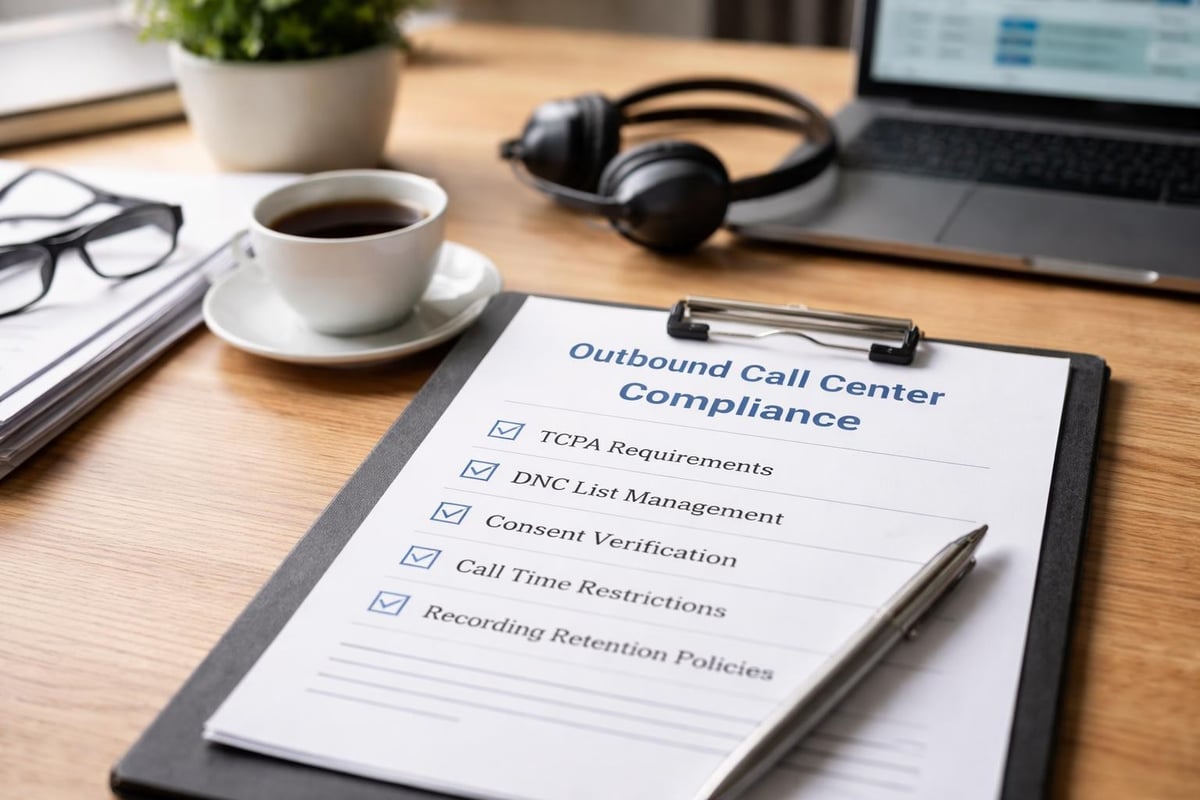
Operating a call center in outbound requires strict adherence to telecommunications regulations and consumer protection laws. Non-compliance creates significant legal and financial risks that can devastate operations.
The Telephone Consumer Protection Act (TCPA) governs outbound calling in the United States, restricting calling times to 8 AM through 9 PM local time, requiring maintenance of internal do-not-call lists, and mandating specific consent for certain call types. Violations carry penalties up to $1,500 per illegal call.
| Regulation | Key Requirements | Penalties for Violations |
|---|---|---|
| TCPA | Time restrictions, DNC compliance, consent documentation | Up to $1,500 per call |
| TSR | Disclosure requirements, payment restrictions, abandonment limits | Up to $46,517 per violation |
| FDCPA | Debt collection practices and communication standards | Actual damages plus $1,000 |
| State Laws | Varies by jurisdiction, often stricter than federal | Varies significantly |
Implementing Compliance Frameworks
Robust compliance programs incorporate technology solutions with human oversight. Establishing clear objectives includes compliance targets alongside performance goals.
Essential compliance practices include automated do-not-call scrubbing before campaigns launch, call recording with secure storage, consent documentation systems, agent training on regulatory requirements, and regular compliance audits to identify gaps.
Quality Assurance and Monitoring
Systematic quality assurance separates exceptional call center in outbound operations from mediocre performers. QA programs identify coaching opportunities, ensure compliance, and maintain service standards.
Effective monitoring combines automated systems with human evaluation. Technology flags potential compliance issues, unusual call patterns, or script deviations. Quality analysts then review flagged calls plus random samples to assess overall performance.
Building Effective QA Scorecards
Comprehensive scorecards evaluate multiple performance dimensions including greeting and introduction quality, needs discovery effectiveness, product knowledge accuracy, objection handling skill, compliance adherence, and closing technique proficiency.
Each element receives specific weighting based on organizational priorities. Compliance items typically carry higher weights given legal implications, while softer elements like rapport building matter for conversion effectiveness.
Regular calibration sessions ensure evaluators apply consistent standards. When multiple analysts score calls differently, calibration identifies interpretation gaps and aligns expectations across the team.
Optimizing Agent Productivity and Engagement
Maintaining high performance in call center in outbound environments requires continuous focus on agent productivity and engagement. Burnout and turnover undermine results regardless of technological sophistication.
Connecting with customers effectively while maintaining healthy work environments challenges many operations. Successful organizations balance productivity expectations with sustainable workloads and supportive cultures.
Recognition programs celebrating achievements boost morale and motivation. Public acknowledgment of top performers, incentive competitions, and career development opportunities retain talent and inspire excellence.
Gamification and Performance Incentives
Gamification transforms routine tasks into engaging challenges. Leaderboards, achievement badges, and team competitions inject energy into daily operations. However, incentive structures must reward quality alongside quantity to avoid counterproductive behaviors.
Effective incentive programs include:
- Tiered commission structures that increase with higher conversion rates
- Bonuses for achieving monthly quality scores above thresholds
- Team rewards for collective campaign success
- Non-monetary recognition like preferred scheduling or development opportunities
- Consistent, transparent criteria that agents trust as fair
Technology Vendor Selection and Integration
Choosing the right technology partners significantly impacts call center in outbound performance. The market offers numerous solutions with varying capabilities, integration complexities, and cost structures.
Vendor evaluation should assess functionality alignment with specific operational needs, scalability to support growth, integration capabilities with existing systems, compliance features addressing regulatory requirements, reporting and analytics depth, implementation timeline and complexity, total cost of ownership including licensing and maintenance, and vendor stability and support quality.
Requesting detailed demonstrations with realistic use cases reveals how systems perform under actual conditions. Reference checks with similar organizations provide insights into implementation challenges and ongoing support experiences.
Focus Services leverages enterprise-grade technology platforms across global operations, ensuring clients benefit from consistent, high-performance infrastructure regardless of geographic location.
Global Outsourcing Considerations
Many organizations partner with specialized providers to access call center in outbound expertise, advanced technology, and geographic diversification. Outsourcing enables rapid scaling, cost optimization, and access to multilingual capabilities.
Successful outsourcing relationships require clear communication of expectations, robust performance metrics, regular review cycles, and collaborative problem-solving. Providers should function as strategic partners rather than transactional vendors.
Evaluating Outsourcing Providers
Critical evaluation factors include industry-specific experience and expertise, technology infrastructure and capabilities, quality assurance processes and standards, compliance knowledge and certifications, geographic footprint and language capabilities, pricing transparency and contract flexibility, and cultural alignment with organizational values.
Site visits to potential provider locations offer valuable insights into operations, management practices, and workplace culture that impact service quality.
Advanced Strategies for 2026 and Beyond
Leading call center in outbound operations continuously evolve strategies to maintain competitive advantages. Several emerging trends shape the future of outbound calling.
Omnichannel integration extends outbound efforts beyond voice to include SMS, email, and social media touchpoints. Coordinated multi-channel campaigns reach prospects through preferred communication methods while maintaining consistent messaging.
Predictive analytics identify optimal calling times for individual contacts based on historical answer patterns, improving contact rates significantly. Machine learning models continuously refine predictions as data accumulates.
Conversational AI handles initial qualification calls, routing qualified prospects to human agents for relationship building and closing. This hybrid approach scales capacity while preserving the human touch where it matters most.
Personalization at Scale
Advanced data integration enables unprecedented personalization in outbound conversations. Agents access comprehensive customer histories, purchase patterns, service interactions, and preference data before calls connect.
Real-time data enrichment supplements basic contact information with social media insights, recent news about prospect companies, and behavioral signals indicating purchase readiness. This intelligence transforms generic pitches into relevant, timely conversations.
Mastering call center in outbound operations requires strategic planning, technology investment, skilled talent, and continuous optimization across multiple dimensions. Organizations that implement these best practices consistently outperform competitors in sales generation, customer retention, and market expansion. Focus Services delivers comprehensive outbound call center solutions with global teams in the United States, El Salvador, the Philippines, and South Africa, combining advanced AI-enabled technology with experienced agents to drive measurable results for clients ranging from startups to enterprise operations. Contact our team to discover how strategic outbound calling programs can accelerate your business growth.