

Call Center WFM: Optimize Workforce Management in 2026
Workforce management represents one of the most critical operational functions in modern contact centers, directly impacting service levels, cost efficiency, and customer satisfaction. As customer expectations continue to rise and contact volumes become increasingly complex across multiple channels, implementing robust call center WFM strategies has evolved from a nice-to-have capability into a business imperative. Organizations that master workforce optimization can achieve service level targets while controlling labor costs, creating a competitive advantage in an industry where margins matter and every interaction counts.
Understanding the Core Components of Call Center WFM
Call center WFM encompasses the complete lifecycle of planning, scheduling, and managing agent resources to meet customer demand. This discipline combines data analytics, forecasting algorithms, and scheduling logic to ensure the right number of agents with the right skills are available at precisely the right times.
The foundation begins with forecasting, which uses historical contact data, seasonal patterns, and business intelligence to predict future volume and average handle times. Accurate forecasts enable managers to anticipate demand weeks or months in advance, providing the lead time necessary for hiring, training, and capacity planning decisions.
Scheduling translates these forecasts into individual agent shifts, balancing business requirements against labor regulations, employee preferences, and budget constraints. Modern scheduling engines can optimize thousands of variables simultaneously, creating coverage plans that minimize overstaffing while protecting service levels.
Real-Time Management and Adherence Tracking
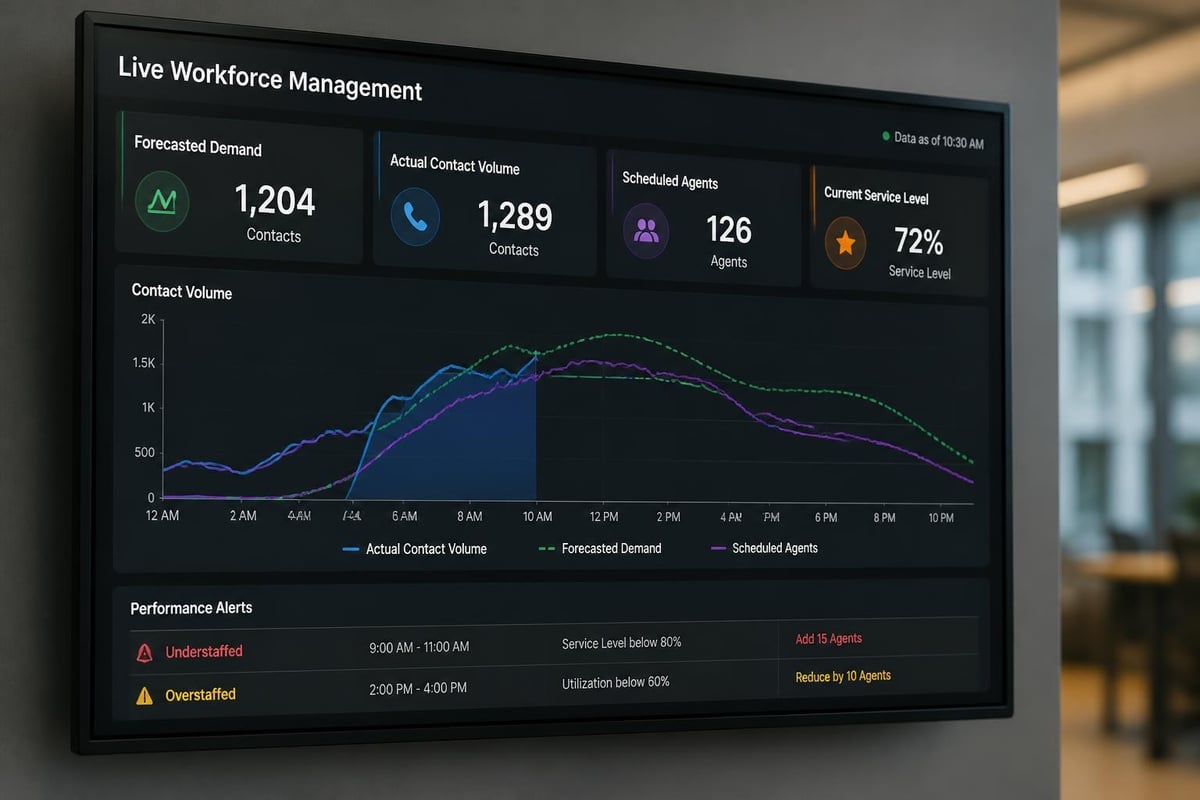
Once schedules are published and agents begin handling contacts, intraday management becomes crucial. This involves monitoring actual versus forecasted volume, tracking schedule adherence, and making tactical adjustments when reality diverges from predictions.
- Queue monitoring provides visibility into current service levels and wait times
- Adherence tracking identifies when agents deviate from planned activities
- Real-time adjustments enable supervisors to move resources between queues or channels
- Break and lunch optimization ensures coverage gaps don't coincide with volume spikes
Effective real-time management can recover service levels even when forecasts prove inaccurate, making it an essential skill for contact center operations teams.
The Business Impact of Strategic Call Center WFM
Organizations that invest in sophisticated workforce management capabilities typically realize measurable returns across multiple dimensions. According to research on modern WFM best practices, well-executed workforce strategies can reduce labor costs by 5-15% while simultaneously improving service levels.
| Performance Metric | Without Effective WFM | With Optimized WFM | Improvement Range |
|---|---|---|---|
| Service Level Achievement | 65-75% | 85-95% | +20-30% |
| Schedule Adherence | 70-80% | 88-95% | +18-25% |
| Occupancy Rate | 55-65% | 75-85% | +20-30% |
| Overtime Hours | 8-12% of total | 2-4% of total | -50-75% |
These improvements translate directly to bottom-line results. Reducing overstaffing by even a few full-time equivalents across multiple sites can save hundreds of thousands of dollars annually, while improved service levels drive higher customer satisfaction scores and retention rates.
Cost Optimization Through Precision Staffing
Labor typically represents 60-70% of total contact center operating costs, making staffing efficiency the largest opportunity for cost reduction. Call center WFM enables precision staffing by matching supply to demand at 15-minute or 30-minute interval granularity rather than using broad day-part coverage.
This granular approach identifies pockets of overstaffing during low-volume periods and ensures adequate coverage during peaks. For multi-site operations like those offered by global call center providers, follow-the-sun strategies can leverage time zone differences to optimize utilization across geographies.
Shrinkage management represents another crucial cost factor. Shrinkage includes all non-productive time such as breaks, training, meetings, and absenteeism. Organizations that accurately forecast and manage shrinkage can reduce it from industry averages of 35-40% down to 28-32%, effectively adding productive capacity without hiring.
Technology Evolution in Call Center WFM Solutions
The workforce management technology landscape has transformed dramatically over the past five years. Legacy on-premises systems that required manual data entry and produced static schedules have given way to cloud-based platforms with artificial intelligence, machine learning, and integration capabilities that were unimaginable a decade ago.
Modern WFM solutions now incorporate:
- AI-powered forecasting engines that detect patterns across multiple variables and automatically adjust for outliers
- Self-service scheduling portals where agents can bid on shifts, swap schedules, and request time off
- Mobile applications providing schedule access and real-time notifications from any device
- Gamification features that encourage schedule adherence through leaderboards and achievements
- Advanced analytics dashboards offering executive-level visibility into workforce performance
Industry analysis of the customer service technology landscape emphasizes how workforce management now integrates seamlessly with quality management, customer relationship management, and analytics platforms to create unified operational ecosystems.
Cloud Migration and Platform Integration
The shift to cloud-based call center WFM platforms accelerated dramatically through 2024-2026, driven by remote work requirements, scalability needs, and total cost of ownership considerations. Cloud solutions eliminate hardware maintenance, provide automatic updates with new features, and enable rapid scaling during seasonal peaks or business growth.
Integration capabilities distinguish leading platforms from basic scheduling tools. Modern WFM systems connect bidirectionally with:
- Automatic call distributors (ACDs) to pull real-time queue statistics and agent states
- Human resources information systems (HRIS) for employee data, skills, and certifications
- Time and attendance systems to track punches and calculate payroll
- Learning management platforms to schedule training and track completion
These integrations eliminate manual data entry, ensure single sources of truth, and enable automated workflows that would require dedicated staff in disconnected environments.

Multichannel and Omnichannel Workforce Complexity
Traditional call center WFM focused exclusively on voice interactions, where forecasting and scheduling followed relatively predictable patterns. Today's contact centers manage email, chat, social media, messaging apps, and video interactions alongside voice, each with distinct volume patterns, handle times, and skill requirements.
This channel proliferation creates significant workforce management challenges. Voice calls arrive randomly and require immediate handling, while email backlogs can be worked during lower-volume periods. Chat sessions may involve agents handling multiple conversations simultaneously, changing the occupancy calculation entirely.
Skill-Based Routing and Agent Versatility
Effective multichannel call center WFM requires matching agents who possess specific competencies to the channels and interaction types where those skills apply. Skill-based routing ensures complex technical issues reach specialized agents while routine inquiries go to generalists.
However, highly specialized agents create scheduling challenges. If only five agents can handle a particular product line or language, forecasting errors or unplanned absences create immediate service level risks. Organizations increasingly pursue universal agent strategies, training staff across multiple channels and competencies to increase scheduling flexibility.
According to NICE’s employer trends report, contact centers with cross-trained agents achieve 12-18% higher schedule efficiency than those with rigid specialization. The trade-off involves increased training costs and longer onboarding periods balanced against operational flexibility.
| Channel Type | Avg Handle Time | Concurrency | Scheduling Complexity | Volume Predictability |
|---|---|---|---|---|
| Voice Calls | 6-8 minutes | 1.0 | Moderate | High |
| 8-12 minutes | N/A (asynchronous) | Low | Moderate | |
| Live Chat | 10-15 minutes | 2-3 concurrent | High | Moderate |
| Social Media | Varies widely | 3-5 concurrent | Very High | Low |
| Video Support | 12-18 minutes | 1.0 | Moderate | Low |
Advanced Forecasting Techniques and Accuracy Improvement
Forecast accuracy drives every downstream WFM decision, making it the most critical input into workforce planning. Even sophisticated scheduling algorithms produce poor results when built on inaccurate volume predictions. Leading organizations target forecast accuracy of 95% or higher at the weekly level and 85-90% at the daily interval level.
Achieving these accuracy levels requires moving beyond simple moving averages to incorporate multiple data inputs and analytical methods. Time-series analysis identifies trends, seasonality, and cyclical patterns in historical data. Regression models correlate contact volume with external variables like marketing campaigns, product launches, or weather events.
Machine learning algorithms can automatically detect which variables correlate most strongly with volume changes and weight them appropriately. For example, an e-commerce retailer might see strong correlations between website traffic, email campaign sends, and inbound contact volume 24-48 hours later.
Managing Forecast Uncertainty and Planning Buffers
No forecast achieves perfect accuracy, making buffer strategies essential for maintaining service levels despite prediction errors. Organizations use several approaches:
- Confidence intervals that define upper and lower volume bounds based on historical variance
- Scheduled overstaffing of 3-5% during high-uncertainty periods like new product launches
- Flex-time agents who work variable hours based on actual demand
- Backlog work that can be paused when live volume exceeds forecasts
Harvard Business Review research on workforce scheduling demonstrates that planning for uncertainty often delivers better results than pursuing marginal forecast accuracy improvements. A forecast that's 88% accurate with well-designed buffers outperforms a 92% accurate forecast with no flexibility.
Optimizing Schedule Adherence and Agent Engagement
Publishing an optimized schedule represents only half the workforce management equation. Agents must follow their planned activities for forecasts and schedules to translate into actual service level achievement. Call center agents who frequently deviate from schedules create the same staffing shortfalls as inaccurate forecasts.
Industry benchmarks suggest target adherence rates of 90-95% for high-performing centers, though actual performance varies widely. Common adherence challenges include:
- Extended breaks or late returns from scheduled offline activities
- Unplanned system issues or technical problems preventing login
- Improper auxiliary code usage that misrepresents actual activities
- Early departures or late arrivals outside approved flex time
- Unscheduled meetings or supervisor requests pulling agents offline
Balancing Control and Flexibility
Rigid adherence enforcement can damage morale and increase attrition among contact center agents who value schedule flexibility. Progressive organizations adopt balanced approaches that set clear expectations while accommodating reasonable needs.
Self-service scheduling platforms allow agents to participate in shift selection, improving schedule satisfaction and adherence. When employees select their own schedules from available options, they demonstrate 15-20% higher adherence than those assigned shifts without input.
Flexible break policies that allow agents to take breaks within designated windows rather than at exact times reduce adherence violations while maintaining adequate coverage. For example, allowing breaks anytime during a 90-minute period instead of precisely at 10:30 AM accommodates agents who just entered a complex interaction.

Implementing WFM in Multi-Site and Outsourced Operations
Organizations operating contact centers across multiple locations or partnering with business process outsourcing providers face additional workforce management complexity. Each site may use different technology platforms, follow varying labor regulations, and operate under distinct cost structures.
Centralized call center WFM enables consistent methodologies and consolidated reporting across distributed operations. A single forecasting team can generate volume predictions for all sites, while scheduling teams at each location create shifts that comply with local requirements. This hybrid approach balances standardization with necessary localization.
Follow-the-sun strategies leverage global site distribution to optimize utilization and service coverage. When call volumes decrease in North American centers during evening hours, contacts can route to facilities in the Philippines or South Africa where daytime staffing costs less and agents are fresh.
The 2025 WFM market research from DMG Consulting indicates that enterprises with multi-site operations achieve 8-12% better resource utilization than single-site competitors through global optimization strategies.
Vendor Management and Performance Accountability
When outsourcing contact center operations, clear workforce management expectations must be established in service level agreements. Key contractual provisions should address:
- Minimum forecast accuracy requirements at weekly and daily intervals
- Schedule adherence targets and measurement methodologies
- Service level commitments tied to proper staffing execution
- Reporting cadence for WFM metrics and variance explanations
- Technology standards for WFM platforms and integration requirements
Leading outsourcing providers demonstrate their WFM capabilities through transparent reporting, proactive communication about volume variances, and documented continuous improvement initiatives. Organizations should evaluate vendor WFM maturity during the selection process, not just pricing and geographic presence.
Emerging Trends Shaping Call Center WFM Through 2026
The workforce management discipline continues evolving rapidly as new technologies and business models reshape contact center operations. Several trends will significantly impact WFM strategies over the next 12-24 months.
Artificial intelligence increasingly automates routine WFM tasks that previously required analyst intervention. AI engines automatically adjust forecasts based on real-time volume patterns, recommend schedule changes to optimize coverage, and identify adherence exceptions that require coaching. Research on 2026 WFM trends suggests that AI-assisted forecasting reduces analyst workload by 40-50% while improving accuracy.
Hybrid work models complicate scheduling as contact centers blend on-site, remote, and hybrid agents within single teams. WFM systems must track agent locations, ensure adequate on-site coverage for collaborative work, and maintain fairness in schedule assignments across work-from-home and in-office populations.
Gig economy integration allows contact centers to supplement core staff with on-demand agents during unexpected volume spikes or seasonal peaks. These flex workers log in through marketplace platforms when volume exceeds forecasts, providing instant capacity without long-term employment commitments. However, quality control and training consistency present ongoing challenges.
Predictive Analytics and Continuous Optimization
Advanced analytics platforms now identify optimization opportunities that humans would miss in complex operational data. Predictive models can:
- Flag forecasts likely to miss targets based on confidence intervals and recent variance patterns
- Recommend optimal shift start times based on volume curves and agent availability
- Identify scheduling patterns that correlate with higher attrition or lower adherence
- Predict which agents may call out sick based on historical absence patterns
- Suggest cross-training priorities based on skill gap analysis and volume trends
Everest Group’s research on advanced WFM capabilities demonstrates that organizations leveraging predictive analytics achieve 5-8% higher forecast accuracy and 3-5% better resource utilization than those using traditional methods.
The shift toward continuous optimization replaces periodic WFM planning cycles with ongoing algorithmic adjustments. Rather than building monthly schedules that remain static, dynamic scheduling engines make daily or even intraday modifications based on emerging patterns and real-time performance.
Measuring WFM Performance and Continuous Improvement
Effective workforce management requires consistent measurement against defined objectives and systematic improvement processes. Organizations should track both leading indicators that predict future performance and lagging indicators that measure actual results.
Key performance indicators for call center WFM include:
| KPI Category | Specific Metrics | Target Ranges | Measurement Frequency |
|---|---|---|---|
| Forecast Accuracy | Weekly volume accuracy, Daily interval accuracy | 95%+, 85-90% | Weekly |
| Schedule Efficiency | Occupancy rate, Overstaffing/understaffing % | 75-85%, <3% | Daily |
| Adherence | Schedule adherence %, Adherence exceptions | 90-95%, <5% | Real-time/Daily |
| Service Delivery | Service level %, Average speed of answer | 80/30, <60 sec | Real-time |
| Cost Management | Cost per contact, Labor as % of revenue | Varies, 60-70% | Monthly |
Regular performance reviews should analyze trends over time rather than reacting to individual data points. A single day of poor service level might reflect an unpredictable volume spike, while three consecutive weeks below target indicates a systemic forecasting or scheduling problem requiring intervention.
Building a Culture of WFM Excellence
Technology and processes enable workforce management success, but culture determines whether optimization becomes embedded in organizational DNA. High-performing contact centers cultivate WFM excellence through:
- Executive sponsorship that prioritizes workforce optimization as a strategic initiative
- Cross-functional collaboration between WFM, operations, training, and quality teams
- Agent involvement in scheduling decisions and continuous improvement efforts
- Transparent communication about performance metrics and improvement goals
- Skill development through certifications, training programs, and knowledge sharing
Workforce management benchmark insights reveal that organizational maturity matters more than technology sophistication. Centers with strong WFM cultures outperform those with advanced tools but weak execution discipline.
Organizations should assess their current WFM maturity level across people, process, and technology dimensions, then develop roadmaps addressing the most significant gaps. Attempting to implement sophisticated forecasting algorithms before establishing basic scheduling discipline typically fails, while mature programs can leverage advanced capabilities for incremental gains.
Mastering call center WFM delivers measurable improvements in service quality, cost efficiency, and operational performance across contact center operations. By implementing robust forecasting methodologies, optimizing scheduling processes, and leveraging modern technology platforms, organizations can achieve the precision staffing required for competitive advantage in today's demanding customer service environment. Focus Services combines advanced workforce management capabilities with global delivery expertise to help businesses optimize their contact center operations, reduce costs, and consistently meet service level objectives across voice and digital channels. Our AI-enabled workforce optimization and multi-site operational excellence can transform your customer service performance while delivering sustainable cost savings.