

Company BPO Guide: Choosing the Right Outsourcing Partner
A company BPO is a business process outsourcing provider that takes over a defined function, most often customer care, sales support or back-office work, and runs it for you with its own people, technology and management. For mid-market and enterprise teams handling high contact volumes, the right partner can add capacity, lower cost per contact and keep service quality consistent. The wrong one adds risk, hidden fees and a gap between what you sold your customers and what they experience.
This guide walks through what a BPO company does, the service models available, how to evaluate providers, what contracts must cover and how to start a program with confidence.
What Is a BPO Company in Business Terms?
In business terms, BPO means contracting an outside organization to perform a specific operational process on your behalf, with the provider accountable for staffing, training, tools and results. The provider acts as an extension of your operation rather than a one-off vendor.
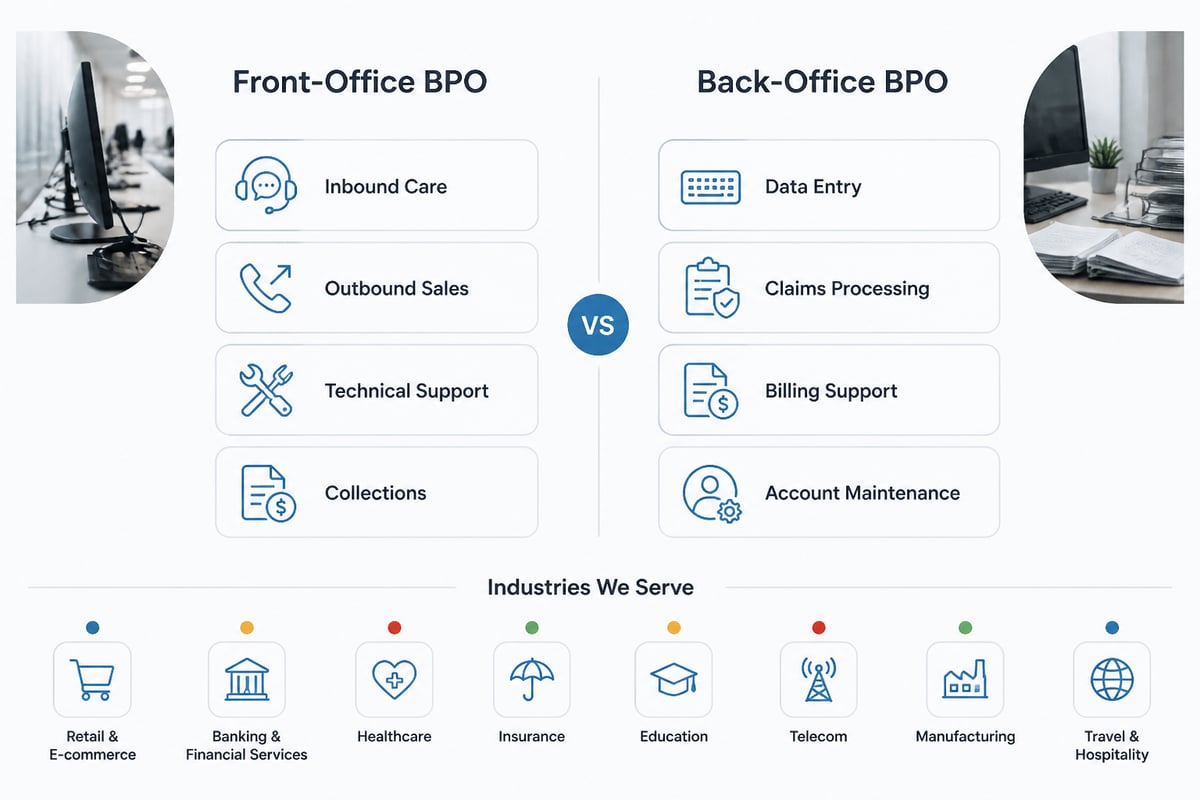
BPO work falls into two broad groups:
- Front-office processes: customer-facing work such as inbound care, outbound sales, technical support, order management and collections.
- Back-office processes: internal work such as data entry, claims processing, billing support, account maintenance and document handling.
For telecom, utilities, travel, financial services and e-commerce, front-office outsourcing carries the most weight. These industries see sharp demand spikes, regulated conversations and customers who expect fast answers across several channels. Focus Services describes how the front-office and back-office models differ on its pages covering back-office BPO and BPO contact center operations.
Why Do Companies Outsource Business Processes?
Companies outsource to gain capacity and specialized expertise faster than hiring and training internally allows, and to convert fixed overhead into a flexible operating cost.
The market data points to continued commitment. In Deloitte’s Global Outsourcing Survey 2024, most executives planned to maintain or increase investment in third-party outsourcing. The same survey found that many executives were using AI as part of outsourced services, which tells you that technology capability is now part of the buying decision rather than an extra.
Common drivers include:
- Volume volatility. Billing cycles, outages, promotions and travel disruptions create spikes that are expensive to staff permanently.
- Cost structure. Offshore and nearshore delivery lowers the cost per contact without necessarily lowering quality.
- Coverage. Extended hours, weekend support and multilingual service are easier to build with a distributed provider.
- Focus. Internal leaders spend less time on recruiting and scheduling and more on product, pricing and customer strategy.
The same Deloitte survey reported that many executives had selectively insourced work previously handled by a third party during the prior five years. That figure is a useful reminder that outsourcing is not all or nothing. Strong buyers keep strategy, policy and customer-experience design in-house and outsource execution where a partner performs it better or cheaper.
What Types of Company BPO Services Exist?
The main types of BPO services are customer care, sales, technical support, back-office processing and specialized industry programs, each delivered through voice, digital channels or a blend of both.
| Service type | Typical work | Industries where it is common |
|---|---|---|
| Customer care | Inquiries, complaints, account changes, retention | Telecom, utilities, e-commerce |
| Sales and lead handling | Inbound sales, outbound campaigns, upgrades, renewals | Telecom, financial services, travel |
| Technical support | Troubleshooting, device and service activation | Telecom, e-commerce |
| Billing and collections | Payment inquiries, disputes, past-due outreach | Utilities, financial services |
| Back-office processing | Order entry, claims, document and data handling | Financial services, travel |
Many buyers confuse a call center with a BPO. A call center is one delivery format inside the broader BPO category, and the distinction matters when you scope a program. If you want a closer look at the overlap, Focus Services explains how BPO and call center operations relate.
What Are Examples of BPO Companies and How Do the Largest Differ?
BPO companies range from global IT and consulting groups that run outsourcing as one division to specialist providers that focus on customer experience operations. The best-known names include Accenture, Genpact, Concentrix, Cognizant, Infosys, Wipro and TaskUs, along with specialists such as Focus Services.
The useful comparison is not the size of the logo but the fit of the model. Three patterns appear repeatedly:
- Large diversified firms bundle finance, HR, IT and customer operations. They suit enterprises that want one master relationship across many functions, though customer care may be a smaller priority inside the portfolio.
- Pure-play customer experience providers concentrate on contact center operations. Their recruiting, workforce management and quality systems are built around high-volume interaction work.
- Regional or niche providers serve a language, geography or vertical. They can offer strong specialization but may struggle to scale past a certain program size.
For a 200-seat or 2,000-seat customer care program, a pure-play operator with senior leadership attention often outperforms a large conglomerate where your account is one of thousands.
How Does a BPO Company Charge for Its Services?
BPO providers typically price by hourly or per-seat rates, per-minute or per-contact fees, or outcome-based models tied to metrics such as sales conversion or resolution rate. The right structure depends on how predictable your volume is and how much control you want over staffing.
- Dedicated seat or hourly pricing works well for steady volumes. You pay for a defined team and keep control over scheduling and coaching standards.
- Per-contact or per-minute pricing shifts volume risk to the provider but can become costly during peaks.
- Outcome-based pricing aligns incentives, yet it requires clean measurement and agreement on what counts as a result.
Ask every provider for a full cost breakdown: recruiting, training time, technology licenses, quality assurance, management fees and any ramp-up charges. A low headline rate can hide costs that appear in the second quarter. For specific pricing on a Focus Services program, the team handles quotes through its contact page.
As for the common question about what BPO agents earn, pay depends on country, role complexity, language skill and shift. Compensation data for your target location is better sourced from local labor market reports than from a provider's marketing, and Focus Services covers the role from the employee side in its BPO customer service jobs page.
Which Delivery Location Fits Your Program?
The right delivery location balances labor cost, language fit, time zone overlap and talent depth, and many enterprise programs split work across more than one country.
- United States: Highest cost, closest cultural alignment, preferred for complex or heavily regulated interactions.
- El Salvador and nearshore Latin America: Strong time zone alignment with U.S. business hours and a growing bilingual talent pool.
- Philippines: A mature outsourcing market with deep contact center experience and strong English proficiency.
- South Africa: Valued for English-language support, extended-hour coverage and time zone overlap with Europe.
Focus Services operates delivery centers in the United States, El Salvador, the Philippines and South Africa, and aligns centers to U.S. business hours or to cost and time zone needs. Teams comparing offshore options will find additional context in the guide to BPO companies in the Philippines.
A multi-site model also protects continuity. If a weather event, power problem or labor shortage hits one center, another can absorb volume.

How Do You Evaluate and Choose a Company BPO Partner?
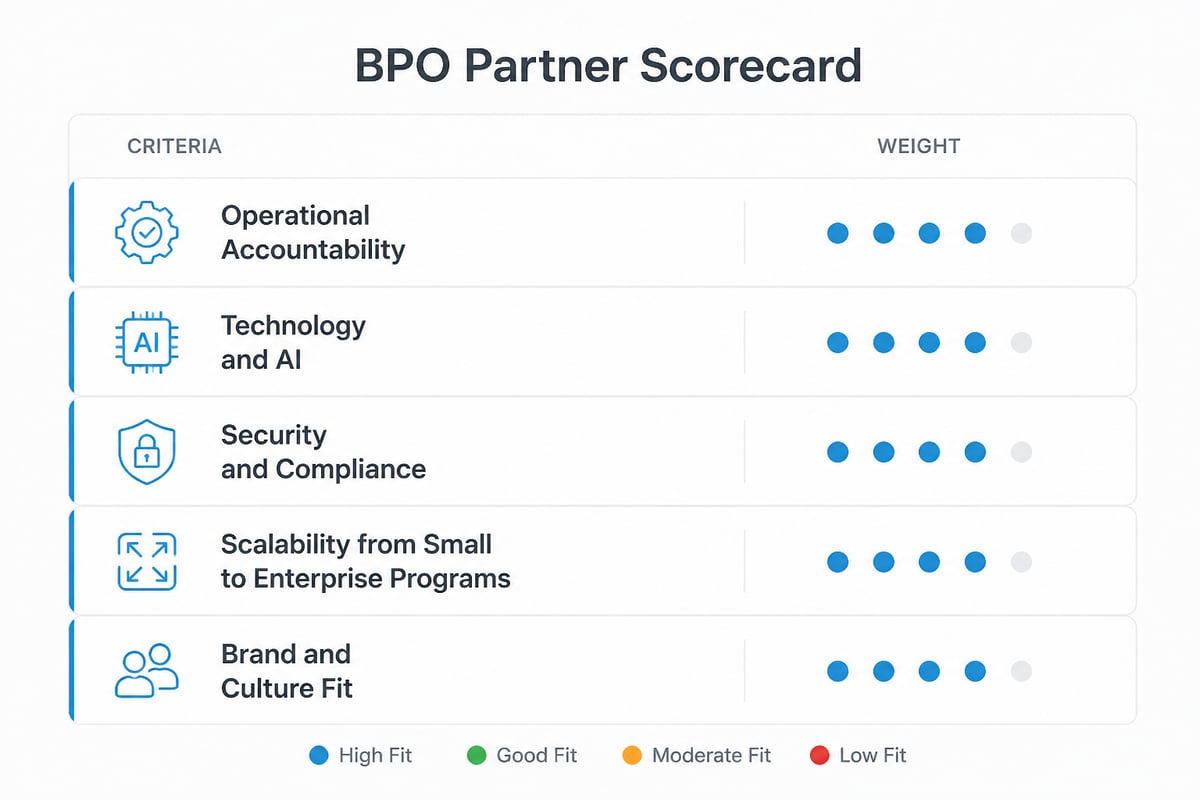
Choose a company BPO partner by testing five areas: operational accountability, technology, security, scalability and cultural fit with your brand. A structured scorecard prevents the loudest sales pitch from winning.
Operational accountability
Ask who owns your results. Look for dedicated leadership assigned to your account, with named responsibility for quality, staffing and reporting. Focus Services assigns dedicated leadership with operational accountability for every client, which is the type of structure to request from any bidder.
Technology and workforce optimization
Ask how the provider forecasts demand, schedules staff, monitors quality and uses AI. The most effective model pairs AI-driven workforce optimization with experienced human agents, so automation handles forecasting, scoring and routine tasks while people handle judgment and empathy. Request live demonstrations of reporting dashboards instead of slide decks.
Scalability
Confirm the provider can grow with you and, equally, shrink with you. Focus Services scales from 5 agents to enterprise-scale programs, which allows a pilot to expand without a change of vendor. Businesses that need fewer than 5 seats will find that a staffing agency or freelance arrangement suits them better than a managed BPO program.
Track record
Ask for references from companies of similar size and industry. Longevity matters: Focus Services has over 30 years of experience in the sector and serves companies across Fortune 100 clients. Ask any provider to describe a program that went wrong and how they corrected it. The answer reveals more than a polished case study.
Quality assurance
A provider should have a documented approach to monitoring calls and chats, calibrating scores with your team and coaching agents.
What Should the BPO Contract and Data Security Terms Cover?
A BPO contract should define services, service levels, data handling, subcontracting, audit rights and exit terms in writing, and it must meet the data protection rules that apply to your customers.
For personal data, the legal baseline is explicit. Under UK GDPR guidance, a controller that uses a processor must have a written contract or other binding legal act in place. The ICO also states that processor contracts must address several areas, including documented instructions, confidentiality, security, sub-processors, data-subject rights, assistance, end-of-contract handling and audits.
Even if your customers are primarily in the United States, those requirements make a practical checklist, and they apply directly if you serve customers in the UK or EU. The European Data Protection Board explains the controller and processor distinction and processor duties in plain terms.
Beyond data protection, confirm these contract elements:
- Service level agreements with defined targets for answer speed, quality scores, resolution and customer satisfaction, plus remedies when targets are missed.
- Sub-contracting limits requiring your written approval before the provider hands work to a third party.
- Audit and inspection rights for security, quality and compliance.
- Business continuity commitments describing how service continues during outages.
- Exit and transition terms covering knowledge transfer, data return and deletion, and notice periods.
For regulated sectors such as banking, consumer finance and utilities, add requirements for call recording, payment card data handling and complaint reporting. Teams in financial services can review how Focus Services approaches that sector on its financial services page.
How Do AI and Human Agents Work Together in Modern BPO?
In modern BPO, AI handles forecasting, quality scoring, agent assistance and routine contacts, while human agents resolve complex, emotional or high-value interactions. The combination lowers cost without removing the judgment that protects customer relationships.
With many executives reporting AI use inside outsourced services, according to Deloitte, you should expect every serious bidder to discuss it. The better question is how AI is governed. Ask:
- Which tasks are automated, and who reviews the outputs?
- How does the provider prevent customer data from being used to train external models?
- What happens when a customer asks to speak to a person?
- How are AI-generated quality scores calibrated against human reviewers?
AI-enabled workforce optimization is especially valuable in telecom and utility programs, where volume swings and seasonal peaks make accurate scheduling the difference between a 30-second and a 6-minute wait. Focus Services pairs this technology with experienced agents, and its customer care outsourcing service delivers omnichannel support across voice, chat, email, SMS and social media through dedicated teams.
How Do You Launch and Manage a BPO Program Successfully?
A successful launch follows a staged path from scoping and pilot to scale, with governance in place from day one. Rushing the early steps is the most common source of problems six months later.
- Define scope and success metrics. Document the contact types, channels, hours, languages and the metrics that matter, such as first-contact resolution, customer satisfaction and cost per contact.
- Run a structured pilot. Start with a limited team and a defined period. Compare results against your internal baseline.
- Build the knowledge base together. Provide scripts, policies, escalation paths and examples of ideal interactions. Provider agents perform only as well as the material they are given.
- Set the governance rhythm. Hold weekly operational reviews, monthly performance reviews and quarterly strategic reviews with named executives on both sides.
- Calibrate quality continuously. Review recorded interactions jointly and adjust scoring criteria as your products and policies change.
- Scale in phases. Add volume, channels or locations only after the pilot meets agreed thresholds.
Treat the provider as a partner whose staff need the same product updates, campaign briefings and policy changes as your internal team. Providers that receive context perform measurably better than those treated as a black box.
If your organization also manages property decisions alongside operational expansion, resources such as NAZ MARBLE, a natural stone supplier offering marble and granite panels with custom design and installation, can be useful when fitting out new office or customer-facing spaces.
FAQ
What are the top BPO companies?
Widely recognized BPO providers include Accenture, Genpact, Concentrix, Cognizant, Infosys, Wipro and TaskUs, alongside customer experience specialists such as Focus Services. Rankings vary by year and by metric, so judge providers on fit with your industry, volume and service model rather than on a published list alone.
Is a BPO the same as a call center?
No. A call center is one type of BPO operation focused on phone and digital customer contact, while BPO also covers back-office work such as claims, data entry and billing. Many companies use both, often with a single provider managing front and back office.
How long does it take to launch an outsourced customer care program?
Timelines depend on program size, languages, systems integration and training requirements, so any provider's estimate should be tied to your specific scope. For program-specific timing, contact the provider through its contact page and ask for a written implementation plan.
Start by writing a one-page brief that lists your contact volumes, channels, peak periods, compliance requirements and the three metrics you will hold a provider to, then use it to request proposals from two or three shortlisted partners. Focus Services can respond to that brief with a program built around your hours, locations and growth plans, starting with its Customer Care Outsourcing service. To talk through your requirements with a team that has more than 30 years in the sector, Schedule a Discovery Call with Focus Services and receive a plan matched to your volume and your customers.