

Call Center Outsourcing and the BPO Skills Gap: What Skills Matter Most
The rapid evolution of technology is reshaping call center outsourcing at every level. As businesses scale customer engagement through outsourced models, they are no longer just looking for cost efficiency. They are demanding highly skilled teams that can deliver exceptional customer experiences while working alongside advanced technology.
This shift is creating a measurable skills gap across the BPO industry. Traditional call handling is no longer sufficient. Modern call center outsourcing requires agents who combine communication expertise with digital fluency, problem-solving ability, and adaptability to AI-driven environments.
For executives evaluating outsourcing strategies, understanding which skills matter most is critical to selecting the right partner and building a future-ready customer experience operation.
Why Call Center Outsourcing Is Driving New Skill Requirements
Contents
- 1 Why Call Center Outsourcing Is Driving New Skill Requirements
- 2 Understanding the Skills Gap in the Modern Call Center
- 3 Why the Skills Gap Is Expanding
- 4 Key Skills Required in Call Center Outsourcing
- 5 How AI Solutions for Call Center Operations Are Reshaping Skills
- 6 Operational Impact of the Skills Gap
- 7 How Call Center Outsourcing Providers Close the Skills Gap
- 8 Practical Applications and Use Cases
- 9 Building a Future-Ready Call Center Outsourcing Strategy
- 10 Conclusion: Closing the Skills Gap Through Smarter Outsourcing
Call center outsourcing has moved beyond transactional support. It is now a strategic function that directly impacts revenue, retention, and brand perception.
Organizations outsource to achieve:
-
Scalable customer support without internal overhead
-
Faster response times across multiple channels
-
Access to trained talent and advanced technologies
-
Improved customer satisfaction and retention
However, these outcomes depend on the quality of the workforce. As outsourcing providers integrate automation and digital platforms, the required skill set for agents is expanding significantly.
The result is a widening gap between traditional agent capabilities and modern business expectations.
Understanding the Skills Gap in the Modern Call Center
The skills gap in a call center environment refers to the disconnect between the capabilities companies require and what the workforce currently offers.
Organizations are increasingly prioritizing AI agents to improve skills gap who can operate within technology-enabled ecosystems rather than relying solely on scripted interactions.
Modern call center environments now include:
-
AI-assisted workflows
-
Real-time analytics dashboards
-
Omnichannel communication platforms
-
CRM and knowledge base integrations
Agents must interpret data, adapt quickly, and deliver personalized experiences. Without these capabilities, performance declines even if headcount increases.
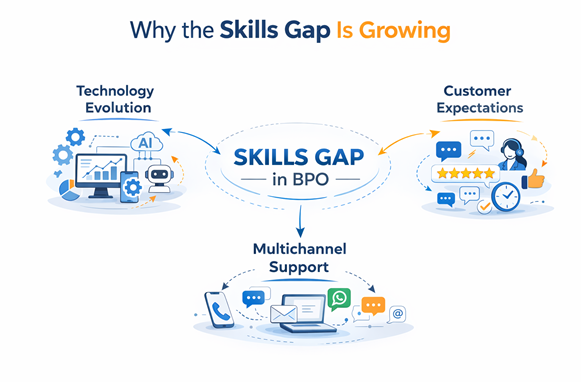
Focus Services Call Center Outsourcing Skills Gap
Why the Skills Gap Is Expanding
Rapid Adoption of AI and Automation
AI is now embedded in daily operations through tools like:
-
Intelligent routing
-
Real-time transcription
-
Automated response suggestions
-
Sentiment analysis
Agents are no longer just handling interactions. They are managing AI-assisted workflows. This requires a higher level of technical comfort and decision-making ability.
Rising Customer Expectations
Modern customers expect:
-
Immediate responses
-
Personalized interactions
-
Seamless transitions between channels
These expectations increase pressure on agents to perform at a higher level while managing more complex interactions.
Omnichannel Complexity
A modern call center operates across:
-
Voice
-
Chat
-
Email
-
Social platforms
Each channel requires different communication styles, response times, and technical workflows. Agents must switch seamlessly between them without losing quality.
Key Skills Required in Call Center Outsourcing
Advanced Communication and Customer Engagement
Communication is no longer just about clarity. It now includes:
-
Active listening
-
Emotional intelligence
-
Personalization
-
Brand alignment
In call center outsourcing, agents represent external brands. Their ability to communicate effectively directly impacts client reputation and customer loyalty.
Digital Literacy and Technology Fluency
Modern AI Solutions for call center environments require agents to:
-
Navigate CRM systems efficiently
-
Interpret real-time prompts and insights
-
Use knowledge bases effectively
-
Manage multiple digital tools simultaneously
Digital fluency is now a baseline requirement, not a differentiator.
Problem-Solving and Critical Thinking
As automation handles routine inquiries, human agents are left with more complex issues.
High-performing agents:
-
Analyze situations quickly
-
Identify root causes
-
Apply structured problem-solving frameworks
-
Deliver accurate resolutions under pressure
This is where human value increases as automation expands.
Emotional Intelligence and Empathy
Despite automation, customer experience remains fundamentally human.
Agents must:
-
Recognize emotional cues
-
De-escalate tense situations
-
Build trust quickly
-
Maintain professionalism under stress
Empathy remains one of the most defensible differentiators in a technology-driven environment.
Adaptability and Continuous Learning
Technology in outsourcing environments evolves constantly.
Top-performing teams:
-
Embrace ongoing training
-
Adapt to new tools quickly
-
Stay aligned with process updates
-
Transition into higher-value roles over time
Organizations that prioritize continuous learning outperform those that treat training as a one-time event.
How AI Solutions for Call Center Operations Are Reshaping Skills
AI is not replacing agents. It is redefining their role.
Modern AI Solutions for call center environments enhance performance by:
-
Providing real-time response recommendations
-
Automating repetitive workflows
-
Delivering instant customer context
-
Identifying sentiment and escalation risk
This allows agents to focus on:
-
Complex problem resolution
-
Relationship building
-
Revenue-generating interactions
AI-powered platforms are enabling organizations to improve both efficiency and customer satisfaction simultaneously.
Operational Impact of the Skills Gap
For executives, the skills gap is not just a talent issue. It is an operational risk.
Without the right skills:
-
Average handle time increases
-
First-call resolution declines
-
Customer satisfaction drops
-
Training costs rise
-
Employee turnover accelerates
With the right skills and structure:
-
Productivity improves
-
Customer experience becomes consistent
-
Scalability becomes predictable
-
Margin performance increases
This is why selecting the right call center outsourcing partner is critical.
How Call Center Outsourcing Providers Close the Skills Gap
Leading outsourcing providers address the skills gap through structured workforce strategies.
These include:
-
Continuous training and certification programs
-
AI-integrated workflows and coaching tools
-
Performance management systems
-
Specialized hiring and talent pipelines
A mature call center outsourcing provider does not just supply labor. It delivers a fully developed workforce aligned with modern CX requirements.
Practical Applications and Use Cases
Organizations across industries are leveraging outsourcing partners to address skill gaps:
E-commerce and Retail
-
High-volume support across chat and voice
-
AI-assisted order tracking and issue resolution
-
Personalized upsell and cross-sell interactions
Healthcare and Insurance
-
Complex customer inquiries requiring compliance awareness
-
AI-supported documentation and workflow management
-
Empathy-driven customer interactions
Financial Services
-
Fraud detection and escalation handling
-
High-stakes customer interactions requiring accuracy
-
Integration with secure digital platforms
In each case, the combination of skilled agents and AI-enabled systems drives better outcomes.
Building a Future-Ready Call Center Outsourcing Strategy
To remain competitive, organizations must rethink how they approach talent in outsourced environments.
Key priorities include:
-
Partnering with providers that invest in workforce development
-
Integrating AI into customer engagement workflows
-
Prioritizing quality over cost-only outsourcing decisions
-
Aligning CX strategy with business outcomes
The future of call center outsourcing will be defined by providers that combine talent, technology, and operational discipline.
Conclusion: Closing the Skills Gap Through Smarter Outsourcing
The skills gap in the BPO industry is real and growing. However, it is also an opportunity.
Organizations that embrace modern call center outsourcing can:
-
Access highly trained talent
-
Leverage advanced AI capabilities
-
Scale operations efficiently
-
Deliver superior customer experiences
Focus Services combines workforce expertise with AI-enabled solutions to help businesses close the skills gap and build high-performing customer engagement operations.
If you are evaluating your outsourcing strategy, now is the time to align with a partner that invests in both people and technology.
Explore how our call center outsourcing services can support your growth:



Leave a Reply
Want to join the discussion?Feel free to contribute!