

Customer Service Careers Near Me: A Local Job Guide
Customer service careers near me usually means one of three things: roles at a local call center, positions inside a company's own support department, or remote jobs tied to a nearby employer. The fastest way to find them is to search by role title and city, then compare employers on pay, schedule, and training. This guide explains the jobs available, what they pay, which skills employers screen for, and how to evaluate a local employer before you apply.
What Jobs Give You Customer Service Experience?
Any role where you resolve questions, complaints, or requests for another person builds customer service experience, and entry-level openings exist in nearly every industry. The common starting points are:
- Call center agent: Handles inbound calls for billing, account, or product questions.
- Chat and email support representative: Resolves written inquiries, often for e-commerce and software companies.
- Retail or front-desk associate: Assists customers in person and processes returns or exchanges.
- Dispute resolution specialist: Investigates billing or transaction disagreements, common in financial services.
- Technical support agent: Troubleshoots devices, connectivity, or software for telecom and utility customers.
Hospitality, healthcare scheduling, and banking branches also count. Employers hiring for these roles tend to value any record of reliable, courteous work with the public, including part-time and volunteer positions.
What Do Customer Service Roles Involve Day to Day?
A customer service representative answers questions, records each interaction, resolves complaints, and passes unresolved issues to the right department. O*NET OnLine lists these tasks among the core duties of the occupation, including handling service and billing complaints by phone or in person.
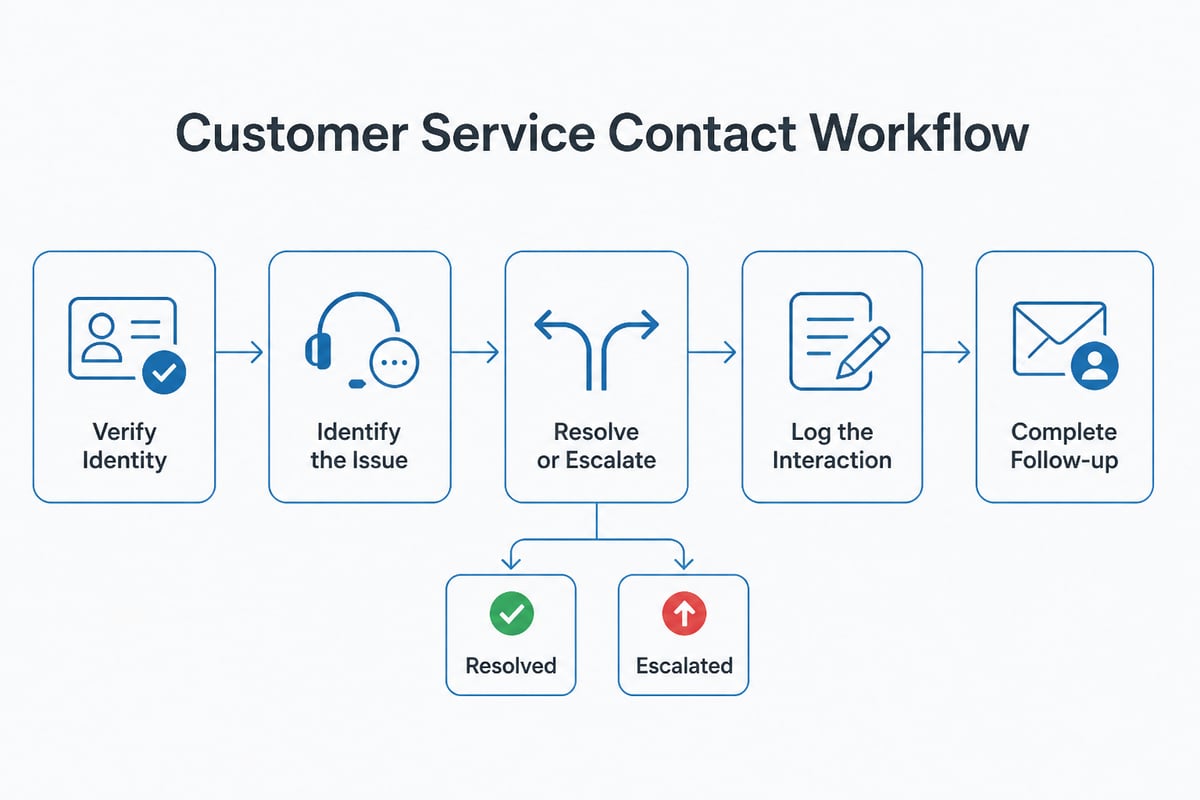
In a contact center setting, that work usually breaks down like this:
- Verify the customer's identity and account details.
- Identify the reason for the contact.
- Resolve it on the spot or document it and escalate.
- Log the outcome in the customer relationship system.
- Complete any follow-up within the required window.
Volume and complexity vary by industry. A telecom agent may handle dozens of short contacts per shift, while a healthcare or financial services agent often works fewer, longer interactions that require careful handling of sensitive information and compliance scripts.
How Much Do Customer Service Careers Pay?
Customer service representatives earned a national median of $44,770 per year, or $21.53 per hour, in 2025, according to the U.S. Bureau of Labor Statistics. That figure is a midpoint, so half of workers earn less and half earn more.
Your local rate will differ based on several factors:
- Cost of living: Metro areas typically pay more than rural markets.
- Industry: Financial services and technical support often pay above general retail service.
- Language skills: Bilingual agents frequently command a premium.
- Shift: Evening, overnight, and weekend shifts sometimes carry differentials.
- Seniority: Team leads, quality analysts, and trainers earn more than frontline agents.
For the most accurate local figure, compare several current postings in your area rather than relying on a single national number. Note whether the listed rate is a base wage or includes bonuses.
What Are the Top 5 Skills for Customer Service?
The five skills employers screen for most consistently are active listening, clear speaking, service orientation, time management, and problem solving. O*NET identifies the first four directly as relevant to the occupation, and problem solving underpins nearly every escalation.
| Skill | What it looks like on the job |
|---|---|
| Active listening | Confirming the issue before offering a fix |
| Clear communication | Explaining policies in plain language, by voice or in writing |
| Service orientation | Staying courteous when a customer is frustrated |
| Time management | Balancing handle time with resolution quality |
| Problem solving | Finding a path when the first answer does not work |
Technical comfort matters as well. Most employers expect you to navigate several screens at once, type accurately, and learn new systems quickly. Interview questions often present a difficult customer scenario, so prepare a concrete example from past work or school.
What Education and Training Do You Need?
Most entry-level customer service positions require a high school diploma or equivalent and no prior experience. The U.S. Bureau of Labor Statistics reports that workers generally receive short-term on-the-job training, which makes the field accessible to career changers and recent graduates.
That low barrier does not mean the path is flat. Employers in this field tend to keep hiring steadily, so local openings are a reliable part of the job market.
Employers in regulated industries add their own requirements. Expect a background check, and in some cases a credit check, for roles that touch payment data or health information. Paid training is common, and reputable employers cover that time at an hourly wage.
Where Do You Find Customer Service Careers Near Me?
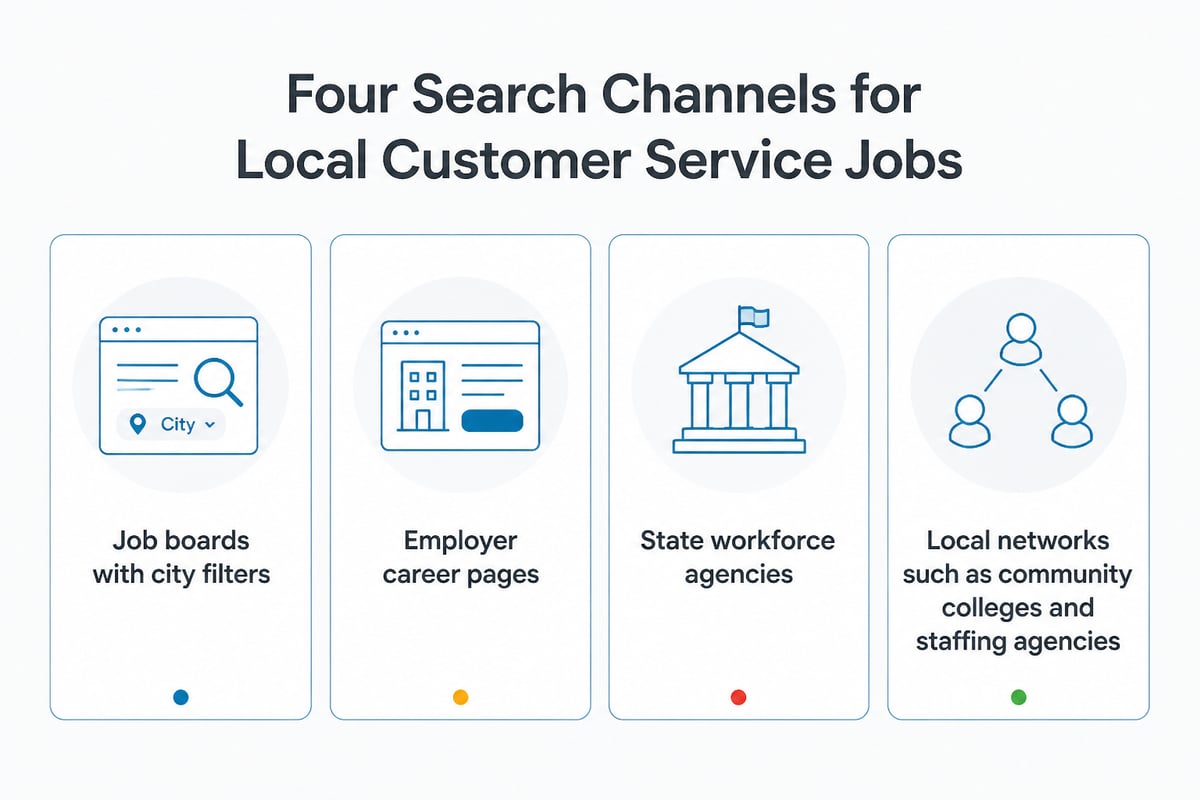
The most productive local searches combine a role title with your city and filter by posting date. Start with these channels:
- Major job boards: Search "customer service representative" plus your city, and set alerts for new listings.
- Employer career pages: Contact centers and BPO providers post openings directly, often before they reach job boards. Employers such as Focus Services list openings on their careers page, often including individual roles such as customer service agent positions.
- State workforce agencies: Public employment offices post vetted local openings and sometimes host hiring events.
- Local networks: Community colleges, staffing agencies, and neighborhood business groups often know which employers are expanding.
If you want a clearer picture of the contact center path specifically, the overview of call center careers explains how roles progress from agent to supervisor and beyond.
How Do You Evaluate a Local Employer Before Applying?
Judge an employer on training, schedule stability, and advancement, not just the advertised hourly rate. This step prevents the most common mistake in an entry-level search: accepting a role that pays well on paper but burns people out within months.
Ask these questions during screening or the interview:
- How long is paid training, and what does it cover? Structured programs signal a mature operation.
- How are schedules assigned? Ask whether shifts are fixed, bid by seniority, or change weekly.
- What do the performance metrics measure? Roles judged on quality and resolution tend to be healthier than those driven only by handle time. The explanation of customer service performance metrics is a useful reference for what fair measurement looks like.
- What is the typical path to team lead or quality roles? Look for named steps, not vague promises.
- Who supports agents on difficult calls? Accessible supervisors and clear escalation paths matter on the floor.
Pay attention to how the employer describes its clients. Agents who handle regulated work for utilities, banks, or healthcare organizations usually receive deeper compliance training, which becomes a durable résumé asset.
How Does Outsourced Customer Care Create Local Jobs?
Many of the largest pools of customer service jobs near you exist because companies outsource their support to specialized providers. A telecom, utility, travel, or e-commerce brand with high contact volume often hands part of its care operation to a business process outsourcing partner, and that partner staffs delivery centers with local hires.
This matters for your search because outsourced employers often hire in volume and run structured onboarding. They also expose you to several industries at once. An agent might support a financial services program one year and an e-commerce program the next, building a broader skill set than a single in-house role would.
Providers such as Focus Services deliver customer care outsourcing through dedicated teams that cover voice, chat, email, SMS, and social media. The company operates delivery centers in the United States, El Salvador, the Philippines, and South Africa, and some centers are aligned to U.S. business hours. For job seekers, a provider of that scale typically means more internal mobility than a small standalone department can offer, though you should confirm specifics with any employer directly.
What Are the Roles and Responsibilities of Customer Service Teams?
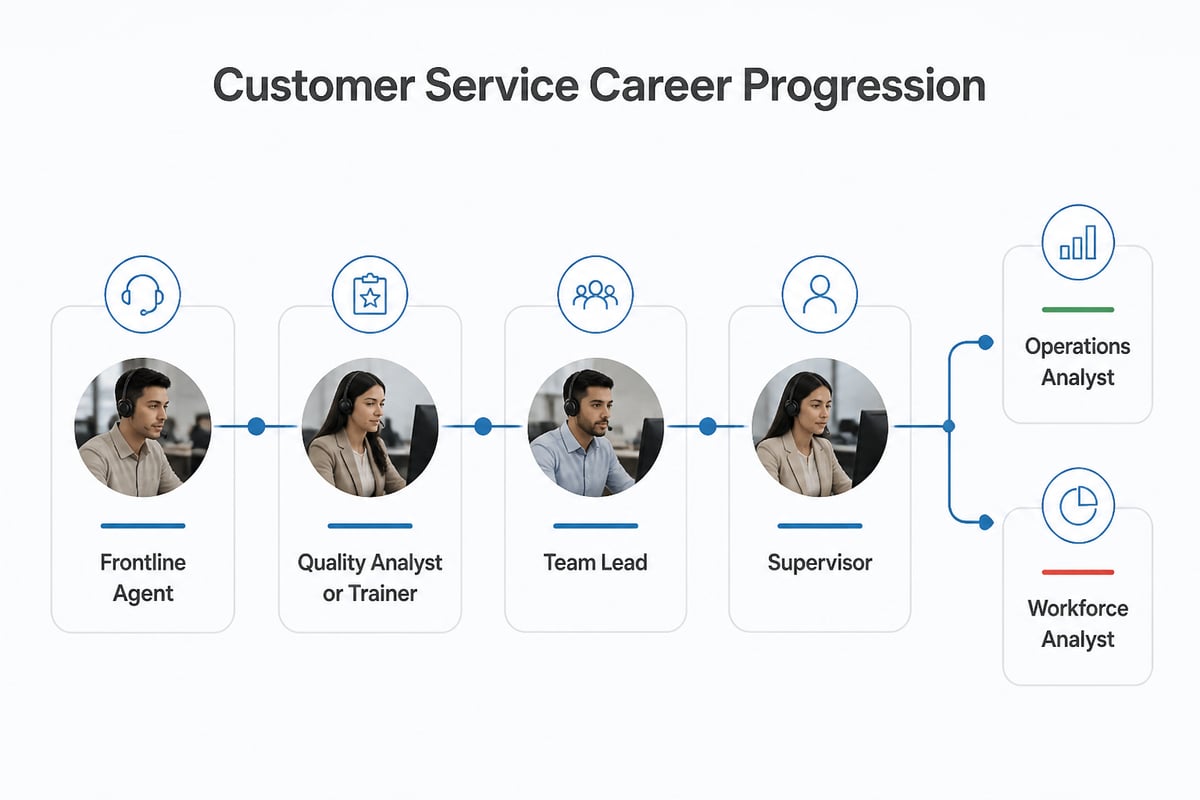
A customer service team is responsible for resolving customer needs accurately, documenting each contact, and protecting the customer relationship. Responsibilities differ by seat, and understanding the ladder helps you plan beyond your first job.
- Frontline agent: Resolves contacts, follows scripts and compliance rules, and logs outcomes.
- Quality analyst: Reviews interactions against standards and coaches agents. Read how customer service quality assurance programs work.
- Trainer: Onboards new hires and runs refresher sessions.
- Team lead or supervisor: Manages schedules, escalations, and daily performance.
- Workforce or operations analyst: Forecasts volume and staffs shifts, increasingly supported by AI-driven tools.
That last point is a useful signal about where the field is heading. AI now handles routine requests and assists agents in real time, while people handle the complex, emotional, or high-stakes contacts. Candidates who learn to work alongside these tools, and who build strong judgment on difficult cases, are positioned well for the next decade of local hiring.
How Do You Prepare an Application That Gets Interviews?
Tailor a one-page résumé to the posting, lead with measurable service results, and practice two or three short stories about resolving a problem. Hiring managers screen quickly, so make the match obvious.
- Mirror the posting's keywords for systems, channels, and industries.
- Quantify results where you can, such as customers served per day or satisfaction scores.
- List language skills and typing speed if they apply.
- Confirm you can meet the schedule and any equipment or internet requirements before applying.
Many employers use a short assessment covering typing, comprehension, and situational judgment. Treat it as a real screening step, and complete it in a quiet space.
FAQ
What is the minimum salary for customer service?
Pay varies by employer, state, and shift, and there is no single national floor beyond the legal minimum wage. Check recent local postings for hourly ranges, and compare them with the 2025 national median of $21.53 per hour reported by the Bureau of Labor Statistics.
Can you start a customer service career with no experience?
Yes. The Bureau of Labor Statistics notes that related work experience is not typically required and that training is generally short-term and on the job. Reliability, communication, and a willingness to learn systems are what most employers look for first.
Are customer service jobs available part time or remotely?
Many employers offer part-time and flexible schedules, and some roles are remote or hybrid. Availability depends on the employer, the client program, and any data security requirements, so confirm the working arrangement in the posting or during screening.
Your next step is to pull together three current local postings, compare their pay, training length, and schedule rules, and apply to the one with the clearest advancement path. If you are on the hiring side and need to expand support capacity for a high-volume or regulated customer base, the Focus Services team can walk you through scalable options, from a handful of seats to enterprise programs, and you can schedule a discovery call to talk through your staffing goals.