Voice vs. Non-Voice Support in Call Center Outsourcing: Which Is Right for Your Business?
In today’s competitive market, customer service isn’t just support — it’s a growth engine. The way you handle customer interactions directly affects retention, loyalty, and revenue.
That’s why more companies are investing in call center outsourcing to scale support without blowing up costs.
Many businesses are discovering that Call Center Outsourcing not only reduces costs but also enhances customer satisfaction.
Moreover, Call Center Outsourcing provides opportunities for businesses to innovate in customer interactions.
But there’s one key decision that shapes everything:
Should you focus on voice support or non-voice support?
The short answer: it depends on your business, your customers, and your goals.
Let’s break it down in a way that actually helps you decide, and how Focus Services can help.
What Is Voice Support in a Call Center?
Contents
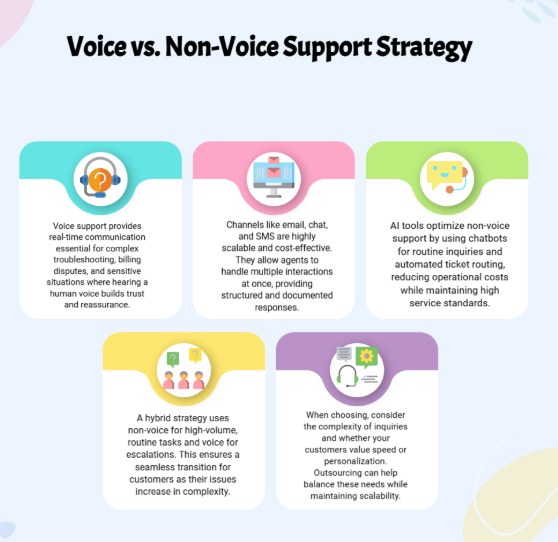
Voice support is exactly what it sounds like — real-time conversations between agents and customers over the phone.
Even with all the new digital channels, voice still plays a critical role.
It works best when:
- Issues are complex
- Emotions are high
- Customers need clarity fast
Think about situations like billing disputes or technical problems. These aren’t “send an email and wait” issues — people want answers now.
There’s also something powerful about hearing a human voice. It builds trust faster than text ever could.
The Trade-Off: Voice Comes at a Cost
Voice support is effective — but it’s not cheap.
It requires:
- Highly trained agents
- Call infrastructure
- Ongoing quality monitoring
- Workforce management
That’s where call center outsourcing becomes valuable. Instead of building everything in-house, businesses can scale voice support efficiently through experienced providers.
Utilizing call center outsourcing for your customer services and sales needs allows companies to focus on their core competencies while leaving customer interactions to experts.
Still, voice should be used strategically — not for every interaction.
What Is Non-Voice Support?
Non-voice support includes all text-based channels, such as:
- Live chat
- Social media
- SMS
- Ticketing systems
This is where modern support teams are seeing huge gains.
Why?
Agents can handle multiple conversations at once; non-voice has found new ways to improve overall efficiency.
That means:
- Faster response times
- Lower cost per interaction
- Higher overall efficiency
It also creates a written record, which helps with follow-ups, training, and quality control.
With Call Center Outsourcing, your support team can provide faster response times and improved service quality.
One of our recent clients was finding their voice call volume to be low, so we moved 1/2 of their agents to non-voice to support better efficiency, and they saved money but also found their customers preferred to talk via chat and email, essentially balancing between voice and non-voice.
Why Non-Voice Support Is Growing Fast
From a cost and scalability standpoint, non-voice is hard to beat.
Here’s what makes it attractive:
- Agents multitask instead of handling one call at a time
- Many requests can be automated
- Response quality can be more consistent
This is where AI Agent solutions for call center operations really change the game.
AI can:
- Power chatbots for common questions
- Route tickets instantly
- Suggest replies to agents
- Analyze customer sentiment in real time
The result?
Resolving customer demands instantly with lower cost.
Zendesk recently discussed this in their report on 5 trends you need to know about AI Agent Solutions.
Why Voice Support Still Matters
Despite all the efficiency gains from non-voice channels, voice support isn’t going anywhere.
Investing in Call Center Outsourcing can boost your brand’s reputation by ensuring that customer concerns are addressed promptly.
In the realm of customer service, effective Call Center Outsourcing can significantly influence customer satisfaction and retention.
In fact, it becomes more valuable in specific moments.
Voice is essential when:
- Customers are frustrated or upset
- Issues require back-and-forth clarification
- Relationships are high-value
If a customer is about to churn, a chatbot won’t save that relationship — a skilled human might.
The Hybrid Model: The Smarter Approach
Here’s the truth most businesses eventually realize:
It’s not voice vs. non-voice. It’s how you combine them.
A strong hybrid call center outsourcing strategy looks like this:
- Non-voice handles high-volume, repetitive inquiries
- AI automates simple workflows
- Voice support handles escalations and complex issues
For example:
A customer starts with live chat → the issue becomes complicated → it escalates to a voice agent.
That’s seamless support.
And it’s what customers now expect.
How to Choose What’s Right for You
If you’re deciding how to structure your support, ask yourself:
- Are your customer issues simple or complex?
- Do your customers value speed or personalization more?
- Is reducing cost a top priority?
- Can AI reduce repetitive workload?
- Would call center outsourcing improve flexibility?
Your answers will point you toward the right mix.
Final Thoughts
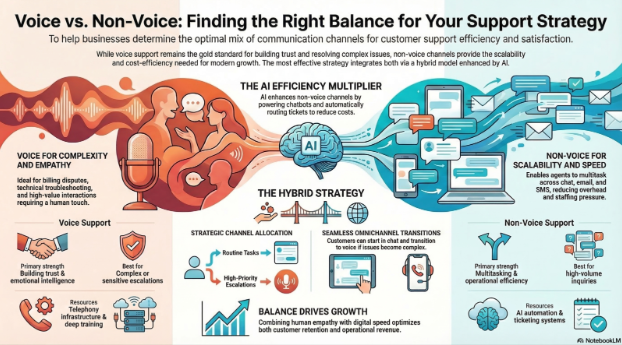
Voice and non-voice support aren’t competing — they’re complementary.
- Voice builds trust
- Non-voice drives efficiency
- AI connects the two
When combined through smart call center outsourcing, you get the best of all worlds:
The right approach to Call Center Outsourcing can lead to substantial improvements in both efficiency and customer engagement.
- Lower costs
- Better customer experiences
- Scalable operations
- The real goal isn’t choosing a channel.
It’s building a system that meets your customers where they are — and adapts as they change.
Start building a competitive advantage.
Schedule your Discover Call Today – https://www.focusservices.com/contact/